Payroll processing is one of the most time-sensitive and error-prone areas of business management. From calculating taxes to ensuring compliance with ever-changing employment laws, it can consume valuable hours every month. For U.S. companies and CPA firms, outsourcing payroll has become a practical way to control costs and reduce compliance risks.
As we move into 2025, payroll outsourcing models are evolving rapidly. Technology-driven service providers and offshore partners offer flexible, secure, and transparent payroll support at a fraction of the cost of in-house teams.
This guide explains what payroll outsourcing entails, its associated costs, the factors that drive pricing differences, and how businesses can achieve financial and operational benefits by partnering with trusted offshore experts.
Payroll outsourcing is the process of hiring an external service provider to manage your company’s payroll operation, from calculating employee salaries to handling tax filings and compliance reporting. Instead of maintaining an in-house payroll team, businesses partner with specialized firms that use secure, automated systems to handle every stage of payroll efficiently and accurately.
A typical outsourced payroll process includes:
By delegating payroll to experts, U.S. businesses gain access to advanced technology, minimize human error, and free up valuable internal resources. This approach also enhances compliance, particularly as tax regulations evolve in 2025, and ensures predictable, scalable outsourced payroll costs.
This foundation sets the stage for understanding the tangible benefits that make payroll outsourcing an increasingly strategic decision in 2025.
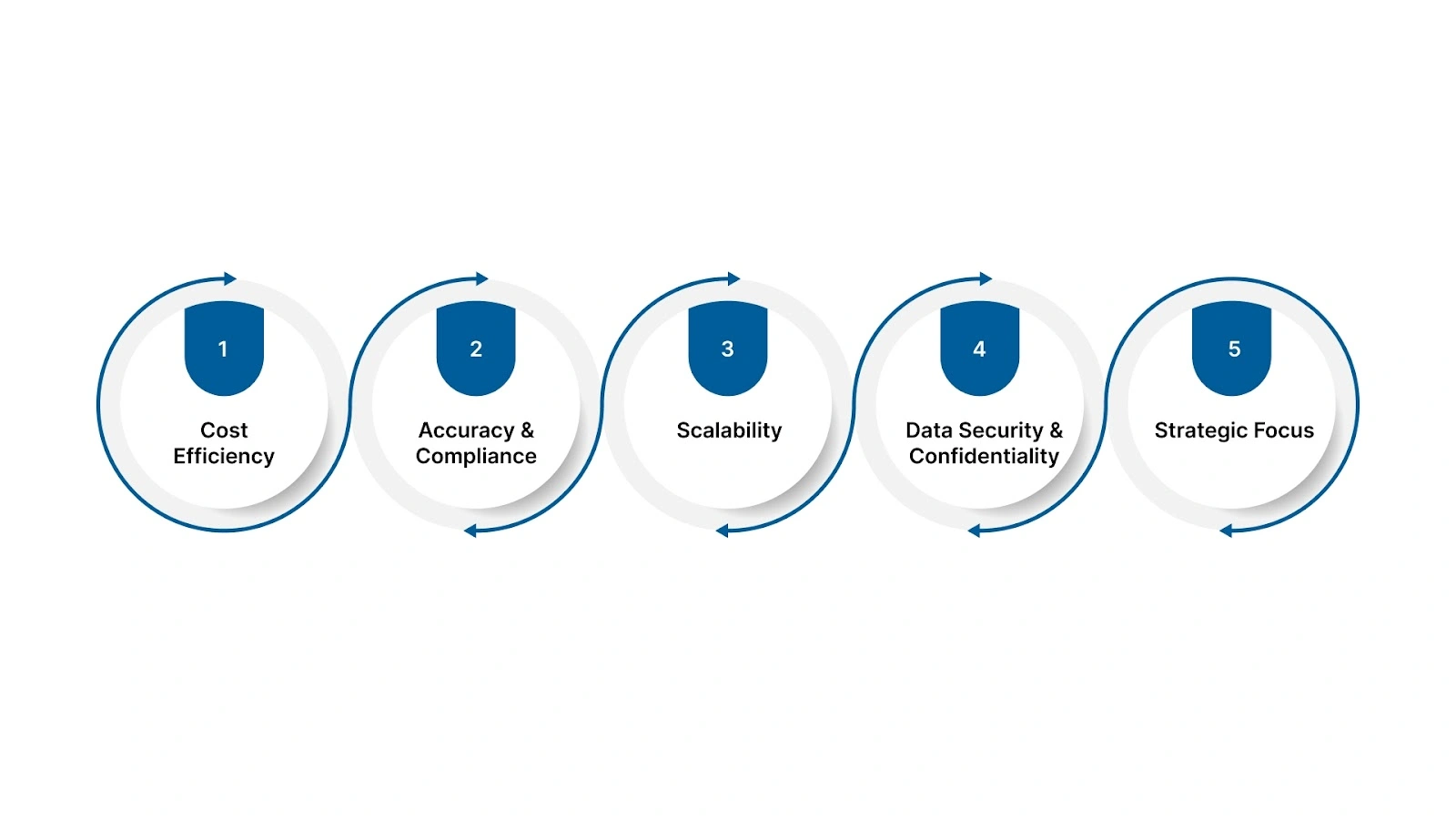
Outsourcing payroll offers more than just cost savings. It brings efficiency, compliance, and peace of mind. Here are the key benefits U.S. businesses can expect when partnering with a trusted payroll provider.
With these benefits in mind, the next logical question is: how much does payroll outsourcing actually cost in 2025 and what determines those rates?
Outsourced payroll pricing varies based on company size, employee count, service level, and location.
Also read - Accounts Payable Outsourcing Costs and Savings
Now that you know the typical pricing range, let’s explore the key factors that drive these costs and what to consider when evaluating provider proposals.
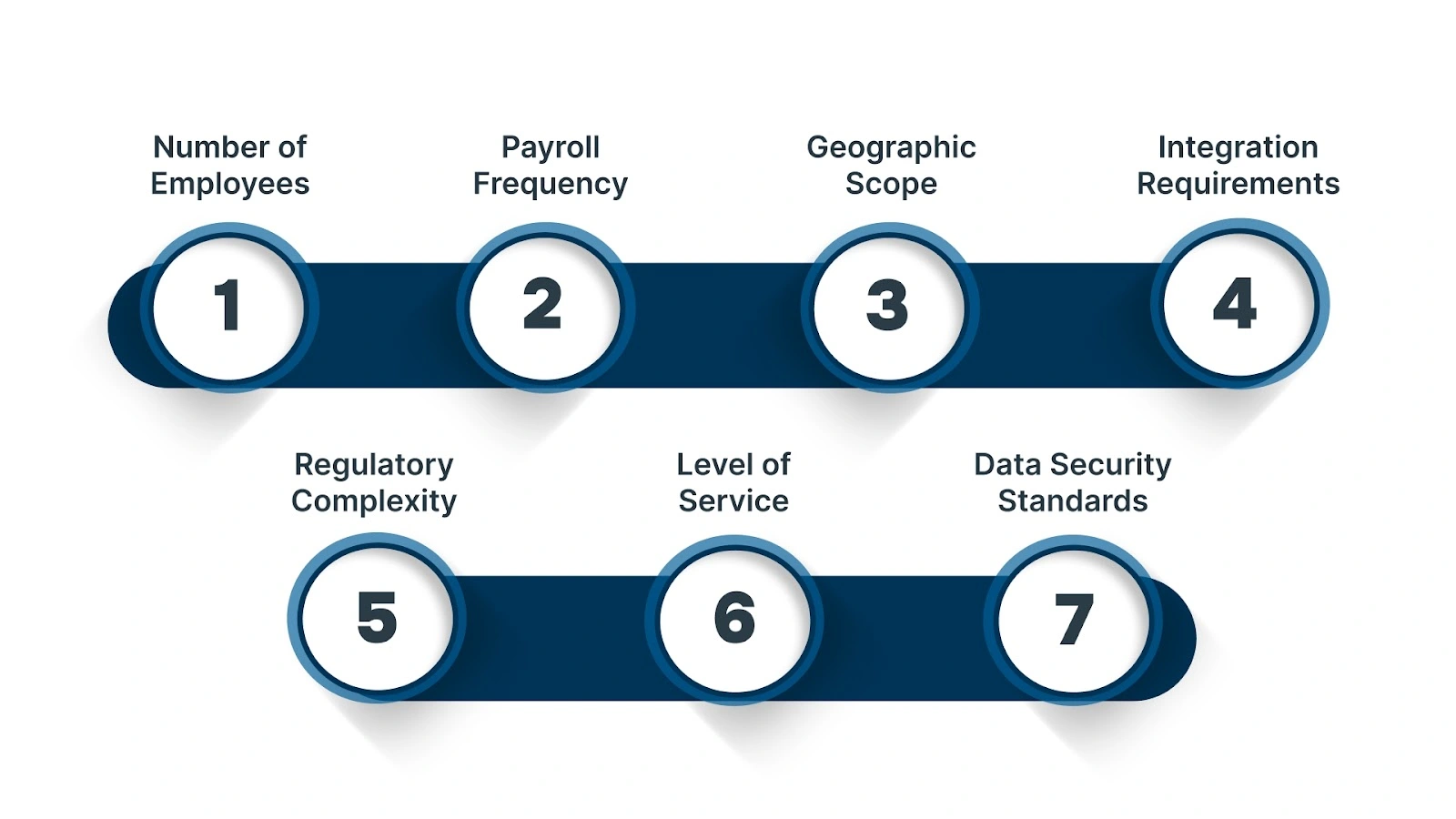
Understanding what drives payroll outsourcing costs helps businesses make informed comparisons and select the right partner for their needs. Pricing varies based on company size, operational complexity, and the level of service required. Below are the major factors that influence payroll outsourcing expenses:
Most payroll providers use a per-employee, per-month (PEPM) pricing model. The higher the employee count, the lower the cost per person, as providers can distribute administrative and software expenses across a larger base.
Weekly or biweekly payrolls require more frequent processing and reconciliations than monthly cycles, leading to higher costs. Businesses that switch to monthly pay schedules can often save on overall fees.
Companies operating across multiple states or countries face added complexity due to differing tax laws, state filings, and compliance requirements. Cross-border payrolls may also involve currency conversion, local tax registration, and dual compliance reporting.
If your payroll system needs to connect with accounting, HR, or time-tracking software, additional setup and maintenance fees may apply. While integrations improve efficiency long-term, they require upfront configuration and ongoing support.
Frequent updates from the IRS, Department of Labor, or state agencies may require software adjustments or compliance reviews. Providers who stay ahead of regulatory changes ensure accuracy but may factor this expertise into pricing.
Costs vary depending on the service scope. Basic payroll services handle salary computation and reporting, while full-service solutions cover HR support, benefits administration, and tax filing — ideal for growing or multi-entity organizations.
Top-tier providers with certifications like SOC 2 and ISO 27001 typically charge a premium for their enhanced security infrastructure. However, these certifications are critical for protecting sensitive employee and financial data, especially in outsourced or cloud-based setups.
According to Deloitte’s Global Payroll Outsourcing Survey (2024), approximately 80% of senior executives plan to expand outsourcing in 2025 to achieve cost predictability and resilience in compliance.
With these cost drivers in mind, it’s clear why India has emerged as a preferred payroll outsourcing hub offering both affordability and high compliance standards.
India has become a leading destination for payroll outsourcing due to its skilled finance professionals, strong IT infrastructure, and deep familiarity with U.S. accounting standards.
However, with many providers in the market, choosing the right partner becomes crucial for long-term success.
Also read: Key Differences Between US GAAP and IFRS Explained
A reliable outsourcing partner should combine expertise in compliance, secure systems, and transparent pricing.
Pro Tip: Consider partnering with VJM Global, which offers comprehensive payroll management, CPA review, and real-time visibility through secure cloud platforms.
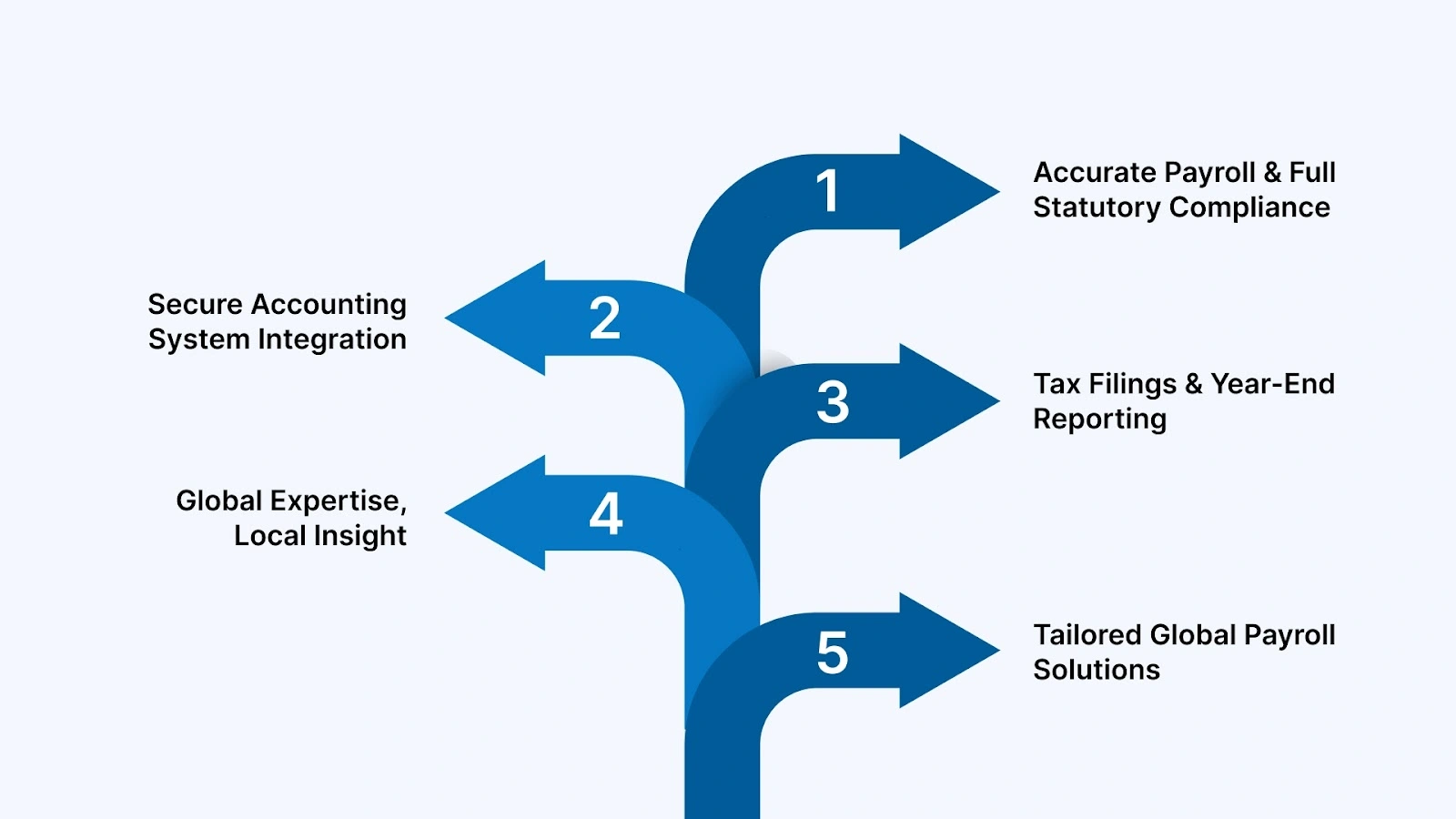
VJM Global delivers seamless payroll and compliance management, specialising in end-to-end HR and payroll solutions for US businesses expanding into India. Our integrated services ensure your teams, regardless of borders, are paid accurately, on time, and always in full compliance with local regulations.
We handle payroll calculations, tax deductions, and statutory contributions with precision. From federal and state filings in the US to GST and income tax compliance in India, our team ensures timely and error-free salary processing while keeping your business fully compliant.
To streamline operations, we integrate payroll data directly with leading accounting platforms like QuickBooks and Xero. This helps maintain synchronized, transparent financial records across your US and Indian entities.
Our experts manage all aspects of cross-border tax filings and reporting, ensuring accuracy in both jurisdictions. Whether it’s payroll taxes, social contributions, or annual summaries, we help you stay ahead of every regulatory requirement and avoid penalties.
With over 25 years of experience managing international payroll across 20+ countries, VJM Global combines global best practices with in-depth Indian regulatory knowledge. This dual expertise helps simplify expansion for US-based companies setting up in India.
We understand that every business scales differently. That’s why our payroll solutions are designed for flexibility:
Payroll outsourcing has evolved from a cost-saving tactic into a strategic business advantage. In 2025, it’s about achieving accuracy, compliance, and financial visibility without inflating administrative costs.
For U.S. businesses and CPA firms, outsourcing payroll to India can deliver measurable savings, better compliance control, and faster turnaround times. Firms like VJM Global combine Indian financial expertise with U.S. regulatory understanding, ensuring a smooth experience across time zones.
Ready to simplify payroll and save on operations in 2025?
Partner with VJM Global. Your trusted offshore chartered accountancy firm for accurate, secure, and cost-effective payroll outsourcing.
For U.S. businesses, expect to pay between $50 and $200 per employee/month, depending on the size and service level.
Salary computation, tax filing, employee records, benefits administration, and compliance reporting.
Headcount, pay frequency, integration needs, compliance level, and data security requirements.
Yes. Leading firms, such as VJM Global, utilize encrypted systems and ISO 27001-compliant infrastructure, which makes the process safe and secure.
Absolutely. It helps U.S. CPA firms scale more quickly, reduce costs, and maintain tax filing accuracy.
Offshore models offer the same accuracy and compliance standards at nearly half the operational cost.