%20(1)%20(1).webp)
If you are a U.S. business investing in innovation or a CPA firm advising clients, the R&D Tax Credit can be a powerful way to reduce tax liability. Under the regular method, it offers a 20% credit on qualified research expenses (QREs) above the base amount.
The One Big Beautiful Bill (OBBB) Act has restored immediate expensing for domestic R&D and allows retroactive claims for 2022 through 2024.
For U.S. SMEs, startups, and CPA firms, this means more than just filing IRS Form 6765. It is about identifying eligible expenses, capturing every dollar of credit available, and filing with confidence in 2025.
The R&D tax credit is a U.S. federal incentive that rewards businesses for investing in innovation and technical development.
By allowing companies to claim a percentage of their qualified research expenses (QREs) against taxes owed, it reduces financial barriers to research and supports long-term growth.
Here’s why it matters:
This credit not only fuels innovation but also strengthens a company’s financial footing. But, as new rules take effect, it’s essential to understand the legislative updates shaping how businesses can claim the R&D credit in 2025.
[Infographic: Timeline of R&D Tax Credit Legislative Changes]
The 2025 tax year brings significant changes to the R&D tax credit, combining immediate expensing rules with opportunities to amend prior returns. Here’s what U.S. businesses and CPA firms need to know:
The One Big Beautiful Bill (OBBB) Act of 2025 restored immediate expensing for domestic research and experimental (R&E) costs under IRC Section 174.
Previously, businesses were required to amortize R&D costs over five years, reducing upfront deductions. From 2025 onward, qualified R&D expenses incurred in the U.S. can be deducted in full, improving cash flow and lowering taxable income in the year they are incurred.
The OBBB Act allows businesses to deduct R&D costs for tax years 2022 through 2024 retroactively.
If your company amortized Section 174 costs during this period, you can now file amended returns to claim refunds. Corporations can use Form 1120X, while pass-through entities and individual filers can use Form 1040X.
Under Section 280C, companies claiming the R&D credit must either reduce their deductible research expenses or elect a reduced credit.
Coordinating Section 174 deductions with Section 280C requirements is critical to avoid compliance issues and ensure accurate credit calculations. CPA firms advising clients should address this early during tax provision planning.
The Protecting Americans from Tax Hikes (PATH) Act of 2015 provisions remain in place.
Qualified small businesses can continue using up to $500,000 of R&D tax credits annually to offset payroll taxes, including Social Security and Medicare contributions. This is particularly valuable for startups and early-stage companies without significant income tax liability.
These updates make 2025 a pivotal year for U.S. businesses and CPA firms to capture R&D credits, amend prior returns, and strengthen tax planning.
Understanding these changes is only part of the equation; identifying which activities meet the IRS criteria is just as critical.
Also Read: CECL Accounting Standard Implementation Insights
.webp)
The IRS uses a four-part test to define which activities meet the standard for credit eligibility. Here’s what it entails:
The activity must aim to create or improve a product, process, software, technique, or formula. Improvements can relate to performance, reliability, quality, or functionality. (IRS Section 41).
The development process must rely on principles of physical or biological sciences, computer science, or engineering (26 U.S. Code § 41; Credit for increasing research activities). Work based in social sciences, arts, or humanities does not qualify.
There must be uncertainty about capability, methodology, or design. The taxpayer must show that they sought to resolve this uncertainty during the research.
A systematic process of testing alternatives must be followed. This includes modeling, simulation, prototyping, or structured trial and error. The IRS requires evidence that a scientific method was used to resolve technical challenges.
Clear, well-supported documentation is what makes your claim stand up to IRS scrutiny. Once that is in place, the next step is figuring out which calculation method, ASC or Regular, will deliver the best outcome for your business.
Businesses claiming the R&D tax credit must choose between the Alternative Simplified Credit (ASC) and the Regular Credit Method, as outlined in IRS Form 6765 instructions.
Each method has unique rules, documentation requirements, and strategic use cases:
Once you have chosen the correct calculation method, the next step is filing. Knowing how to complete IRS Form 6765 and gather the required documentation ensures your claim is accurate and audit-ready.
Once you’ve determined eligibility and selected your calculation method, the next step is filing IRS Form 6765: Credit for Increasing Research Activities. This form is used by U.S. businesses to report qualified research expenses (QREs), calculate the credit, and make any necessary elections.
Here’s how each section of IRS Form 6765 is structured and what you need to include:
The IRS expects businesses to maintain contemporaneous records to substantiate their claim. Key documentation includes:
Proper documentation is critical not only for filing but also for withstanding potential audits.
With the OBBB Act of 2025, businesses can retroactively deduct R&D costs and claim missed credits for prior years.
Amending prior returns can generate significant refunds for companies that amortized R&D costs between 2022 and 2024 or failed to claim credits during those years.
[Infographic: How Startups Claim the Payroll Tax Credit]
For early-stage companies without significant income tax liability, the payroll tax credit election allows eligible startups to apply the R&D credit against payroll taxes. This provision is especially valuable for U.S. businesses that are still pre-revenue but investing heavily in research and development.
To qualify, a business must meet both requirements outlined by the IRS:
This election is designed for startups and small businesses focused on growth and innovation, but without taxable income to offset.
Eligible companies can apply up to $500,000 of their R&D tax credit annually against the employer portion of Social Security and Medicare payroll taxes. This amount reflects the expansion introduced under the Inflation Reduction Act of 2022, increasing the previous $250,000 cap (IRS: Inflation Reduction Act Guidance).
By applying the credit to payroll taxes, startups can reduce quarterly employment tax deposits and improve near-term cash flow while still in their growth phase.
This election is beneficial for U.S. startups reinvesting every dollar into product development, allowing them to benefit from the R&D credit immediately rather than waiting until they become profitable.
In addition to the federal R&D tax credit, over 35 U.S. states offer their own research and development incentives. These state-level credits can significantly enhance total tax savings when coordinated properly with federal claims.
According to data compiled by the National Conference of State Legislatures (NCSL), 37 states currently offer some form of R&D tax credit, grant, or incentive. Each state has its own rules, eligibility thresholds, and calculation methods.
Each state has its definition of qualified research, documentation standards, and filing forms, making coordination with federal filings essential.
To maximize the benefit of both federal and state credits, U.S. companies should:
CPA firms supporting clients across multiple states should confirm credit availability early in the year to factor it into broader tax planning. When used correctly, state R&D credits can significantly increase a company’s return on innovation investments.
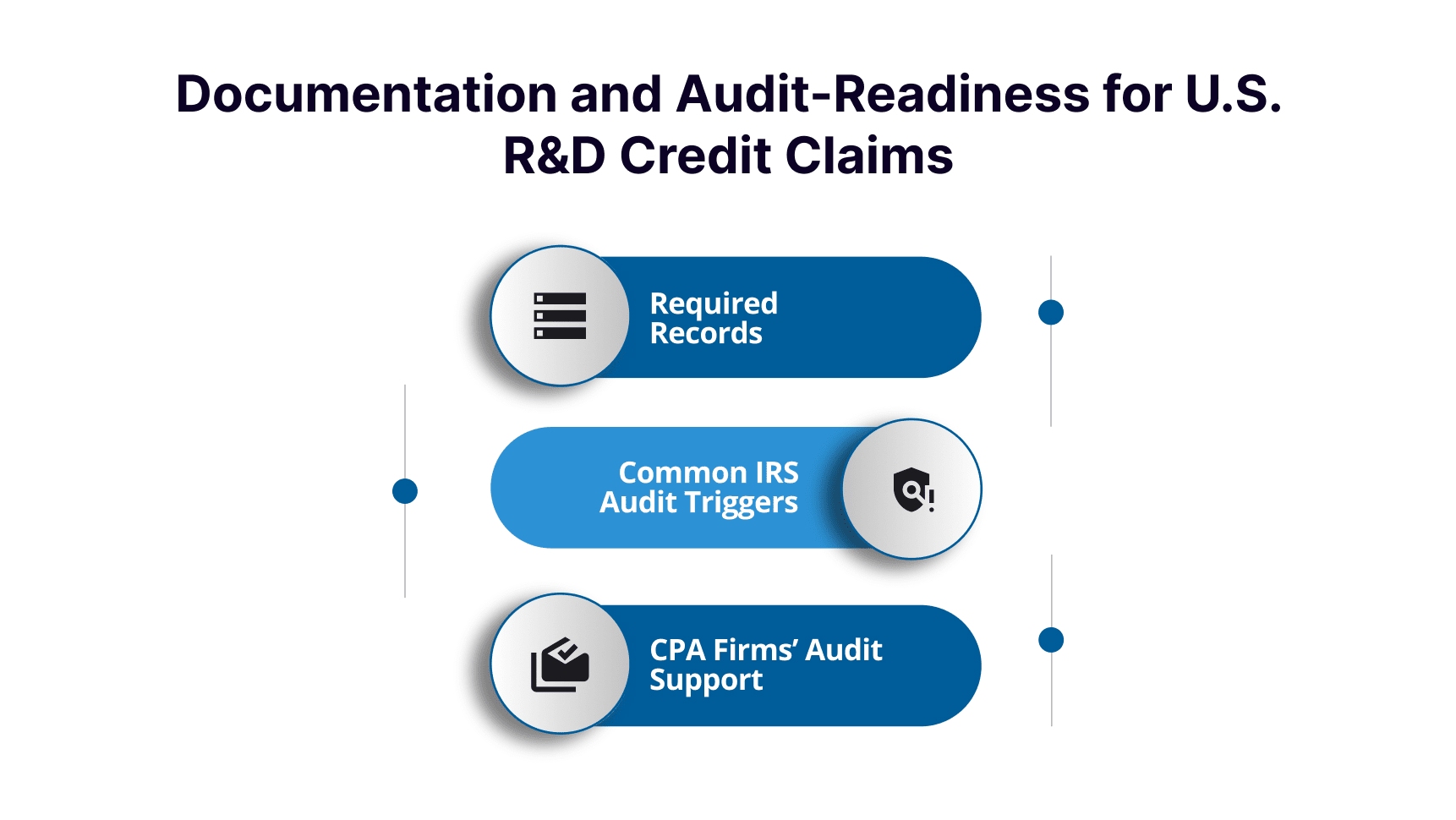
Strong documentation is essential to support R&D credit claims and reduce audit risk. The IRS expects U.S. businesses to maintain clear, contemporaneous records that demonstrate how expenses meet the criteria under 26 U.S. Code § 41.
To substantiate an R&D credit claim, companies should maintain:
Keeping records that tie directly to the four-part IRS test is critical for demonstrating qualified research activity.
The IRS closely examines R&D claims for:
Addressing them proactively reduces audit exposure.
CPA firms play a key role in preparing clients for IRS scrutiny:
For U.S. SMEs, startups, and CPA firms, audit readiness is not optional. It is a critical step to secure the credit while remaining compliant.
Also Read: Understanding Why Companies Use Accrual Accounting
[Infographic here: Integrating R&D Credits into Financial Planning]
Maximizing the R&D tax credit goes beyond filing. It should be part of a broader tax and corporate tax planning strategy.
For U.S. businesses and CPA firms, integrating these credits into long-term planning supports accurate reporting and better cash flow management.
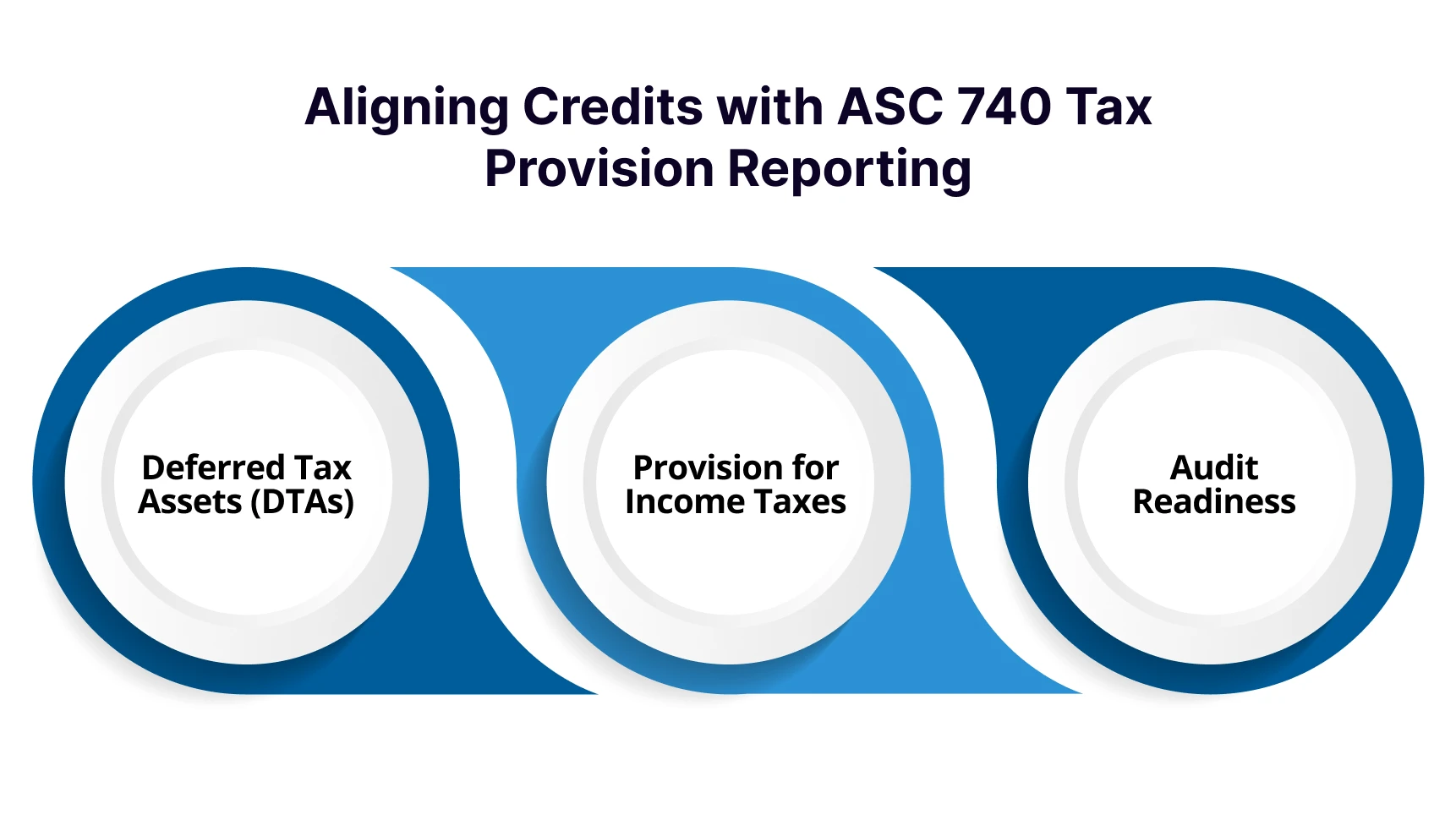
R&D credits impact current and deferred tax calculations under ASC 740. Businesses must account for these credits correctly to remain GAAP compliant.
CPA firms advising clients should review R&D credits during quarterly provision updates to ensure timely and compliant reporting.
For finance leaders managing lean teams or CPA firms balancing multiple client portfolios, outsourcing credit-related accounting tasks can provide relief. VJM Global’s offshore teams can:
With specialized knowledge in U.S. tax standards and GAAP compliance, VJM Global’s support allows U.S. businesses and CPA firms to focus on strategy while ensuring their credits are correctly reflected in financial statements.
R&D tax credit compliance can be complex, especially with changing legislation and evolving IRS requirements. VJM Global simplifies this process for U.S. businesses and CPA firms with expert tax guidance and reliable offshore support.
We handle accurate credit calculations, method elections, payroll tie-outs, project records, and IRS Form submissions for SMEs and startups. For CPA firms, we provide audit-ready documentation, reconcile R&D credits with ASC 740 provisions, and review client records to ensure defensible claims.
With our expertise, you can maximize R&D credits, reduce compliance risks, and save valuable time.
Eligible U.S. businesses, including startups and SMEs, can claim a credit of 9% to 14% of qualified research expenses, depending on whether they use the ASC or the Regular method.
Yes. If you conducted qualified activities in open tax years, typically the last three, you may file amended returns to claim unclaimed credits.
Qualified small businesses with less than $5 million in gross receipts and fewer than five years of operation can apply up to $500,000 of the credit against payroll taxes such as Social Security and Medicare using Form 6765 and Form 8974.
No. The IRS audit rate for R&D credit claims is comparable to overall audit rates. Risk depends on documentation quality rather than the credit itself.
Maintain detailed and contemporaneous records such as project logs, payroll tie-outs, design documentation, and time tracking. These support eligibility under the IRS four-part test and are essential for audits.