Eligibility turns on the taxpayer, the loan, the interest actually paid, income, filing status and the rules for the relevant tax year. A Social Security number, U.S. schooling or a Form 1098-E does not settle it. For Australian residents, there is an extra layer, because U.S. eligibility is separate from anything that happens on an Australian return.
This guide covers qualified loans, nonresident filing points, income limits, documentation and where to report the deduction. All amounts are U.S. dollars, based on 2025 forms with 2026 limits noted.
Key Takeaways
- The deduction lowers taxable income (not a credit), capped at $2,500 for 2025 and 2026.
- Form 1040-NR filers can claim it only if they meet the standard qualified-loan and paid-interest tests.
- Married filing separately, dependency status and income above the phaseout can eliminate it.
- A 1098-E shows interest paid but does not prove eligibility.
What Is the Student Loan Interest Deduction, and How Does Form 1040-NR Affect the Analysis?
What the deduction does
The deduction covers interest paid during the year on a qualified student loan, whether the payments were required or voluntary. Principal repayments never count.
It is an adjustment to income, so you don't need to itemise. That sets it apart from Schedule A deductions and education credits, which reduce tax directly.
Form 1040-NR and nonresident alien filing status
Form 1040-NR is the U.S. nonresident alien income tax return. A nonresident engaged in a U.S. trade or business generally files it, even if the income is exempt. Filing is also required for certain U.S.-source income where withholding doesn't cover the tax.
A temporarily present F, J, M or Q student with no income subject to section 871 may fall within an exception to filing. Check the current instructions for your year.
Using Form 1040-NR does not disqualify you. Publication 519 states that qualifying interest may be deducted, with Schedule 1 attached to the return.
Keep three things separate:
- U.S. federal eligibility
- Australian tax treatment
- Any treaty position or state rule
Where these overlap, get professional review.
Who May Qualify for the Student Loan Interest Deduction on Form 1040-NR?
Meet the basic taxpayer requirements
You must have paid interest on a qualified student loan during the year and been legally obligated to pay it. Three restrictions matter most:
- Dependency: you can't be claimed as a dependent on someone else's return.
- Filing status: married filing separately gets no deduction. Form 1040-NR permits neither married filing jointly nor head of household.
- Elections: a qualifying married taxpayer can elect resident treatment under section 6013(g) or (h). That means a resident return with worldwide income, not a joint 1040-NR.
Use the loan for an eligible person and qualified education
The loan must have been taken out for you, your spouse or your dependent. The student must have been enrolled at least half-time in a degree, certificate or recognized-credential program.
Qualified expenses include tuition, fees, books, supplies, equipment, room and board (within limits) and necessary costs such as transport. The school must be eligible for a U.S. Department of Education student-aid program, and certain foreign schools qualify.
Federal Student Aid's international list, for example, shows Australian National University as eligible and Australian Catholic University as deferment only. Those are different classifications, so check your school.
Loans from federal postsecondary programs meet the timing rule. For other loans, a safe harbor covers expenses for an academic period where proceeds were disbursed from 90 days before it starts to 90 days after it ends.
Check MAGI and nonresident income treatment
For a 2025 Form 1040-NR, MAGI is the line 11a AGI figure calculated without the student loan interest deduction. The foreign earned income and housing add-backs are stated for resident returns, so read the 1040-NR instructions for your year.
Section 873 generally limits nonresident deductions to those connected with effectively connected income. Publication 519 expressly allows qualifying student loan interest. Check Publication 519 and the Form 1040-NR instructions for how to allocate the deduction against your effectively connected income.

Review treaty and cross-border complications
Foreign residence or a treaty does not create eligibility. Statutory loan and income tests still apply.
Before claiming, check whether a treaty position, dual-status year, residency election or foreign-school arrangement changes your filing analysis.
Which Loans, Interest Payments, and Borrower Situations Do Not Qualify?
Loans that fail the qualified education loan rules
- Loans from a related person or through a qualified employer plan are excluded.
- Proceeds must be used solely for qualified education expenses, including amounts borrowed on a credit card.
- Private loans are not automatically disqualified; they can qualify if they meet the same tests.
- Refinancing can qualify if it only refinances your own qualified loans. A cash-out used partly for other purposes disqualifies the interest.
Related timing and fee rules also trip people up:
- Capitalized interest is deductible only as principal payments are made
- No deduction applies in a year with no loan payments
- Deferment or forbearance alone does not create a deduction
- Origination fees that are true charges for the use of money accrue over the loan’s life; processing charges do not qualify
Taxpayer is not the person legally obligated to repay
A parent generally can't deduct payments on a child's loan if the child is the legally obligated borrower. IRS guidance treats a third-party payment as a payment to the borrower, who then paid the lender.
One IRS example: a mother pays the first monthly installment after graduation as a gift, and nobody claims the borrower as a dependent. The borrower can deduct that interest if other requirements are met.
Payments that are excluded
- Principal repayments are not deductible.
- Interest paid under an employer educational-assistance program isn't deductible. Taxable employer-paid interest reported as compensation can qualify.
- Interest that was only discharged or left unpaid is not treated as paid, so it is not deductible.
- An increase in the lender balance alone is not interest you paid.
Form 1098-E is not an eligibility review
The form reports interest. It doesn't confirm your filing status, income, school or loan. The IRS warns that the full Box 1 amount may not be deductible.
Reconcile it with lender records and your own payment history, especially with multiple lenders or non-U.S. loan arrangements.
How Do Income, Filing Status, and the Deduction Amount Work?
Apply the annual deduction cap and MAGI phaseout
You deduct the lesser of $2,500 or the qualifying interest you actually paid. The cap applies to the deduction, not the interest charged. For single filers, the phaseout is the same in both years:
| Tax year | Status | Full deduction | Phaseout | No deduction |
|---|---|---|---|---|
| 2025 and 2026 | Single / qualifying surviving spouse | MAGI up to $85,000 | $85,000 to $100,000 | $100,000 or more |
| 2025 | Married filing separately | Not eligible | n/a | All income levels |
Joint thresholds are $170,000 to $200,000 for 2025 and $175,000 to $205,000 for 2026, but joint filing isn't a Form 1040-NR status.
Calculate a partial deduction
Start with the lesser of interest paid or $2,500. Within the phaseout band, reduce it by that amount multiplied by (MAGI minus the lower threshold) divided by the width. The width is $15,000 for single filers. Use the worksheet in the Schedule 1 instructions or Publication 970.
The IRS illustrates the method with a joint return: $800 interest, $185,000 MAGI, a $400 reduction and a $400 deduction.
A hypothetical single filer, for illustration only and not tax advice: $2,000 interest paid and $92,500 MAGI. The fraction is $7,500 / $15,000 = 0.500, so the reduction is $1,000 and the deduction is $1,000.

Understand the tax benefit
A deduction reduces taxable income, so its value depends on your taxable U.S. income and marginal rate. It doesn't automatically produce a refund. If you have little taxable U.S. income, the benefit may be small.
Compare the deduction with education credits
The American Opportunity and Lifetime Learning credits relate to qualifying education expenses, not interest. Both generally exclude anyone who was a nonresident for part of the year, unless a resident-treatment election is made. Check each benefit's rules separately.
How to Document and Claim the Deduction on Form 1040-NR
Gather the right records
- Form 1098-E and lender statements
- Payment histories and loan agreements
- Proof the loan funded qualified education
- Records of employer or third-party payments
Keep these records for at least three years from the date you file the return that claims the deduction.
A lender must issue Form 1098-E when you pay $600 or more of interest. That is a reporting threshold, not a minimum for deducting. If you paid less, your servicer can still give you the amount paid. Download statements from the servicer, not StudentAid.gov.
Report the deduction using current-year instructions
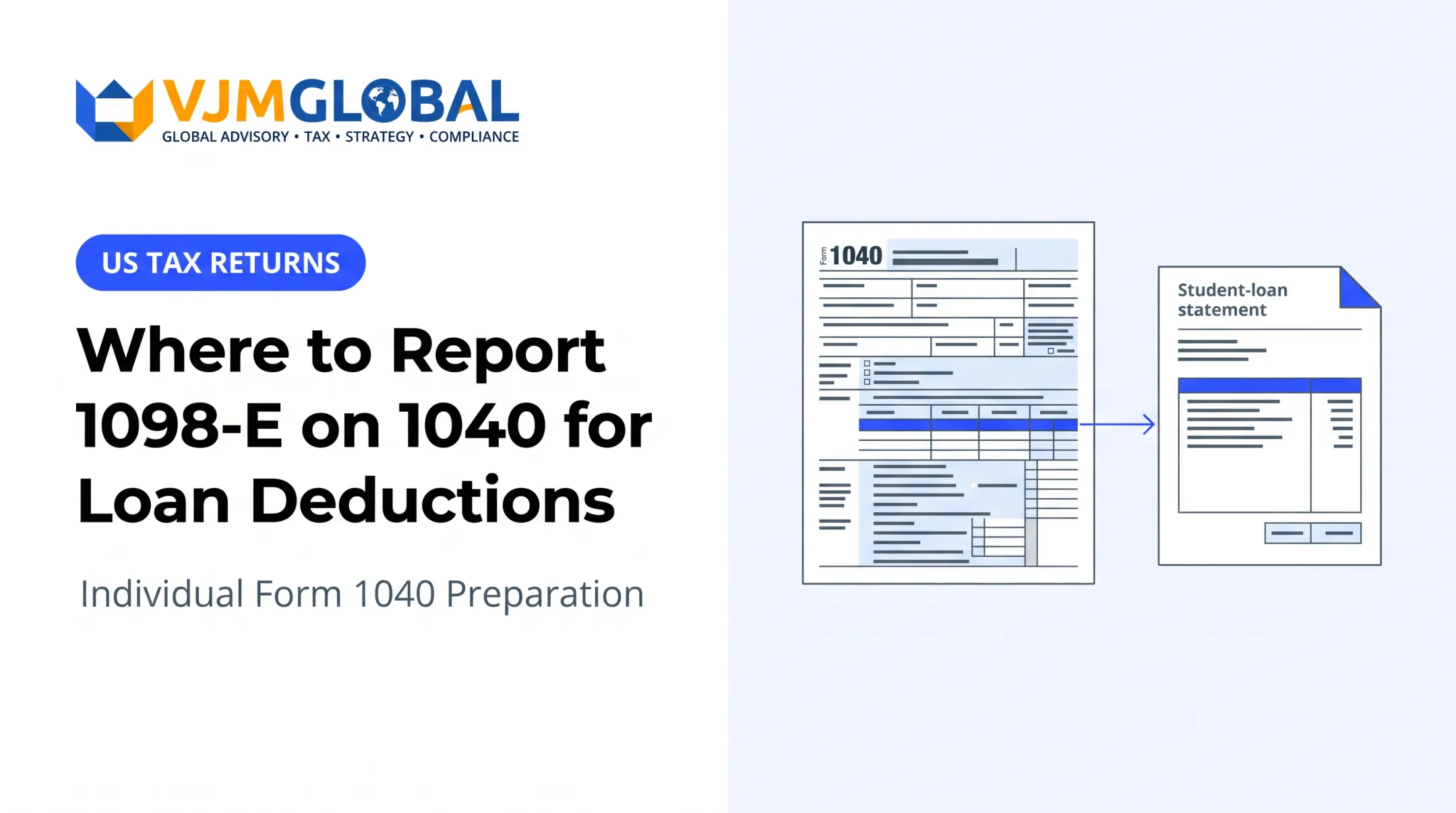
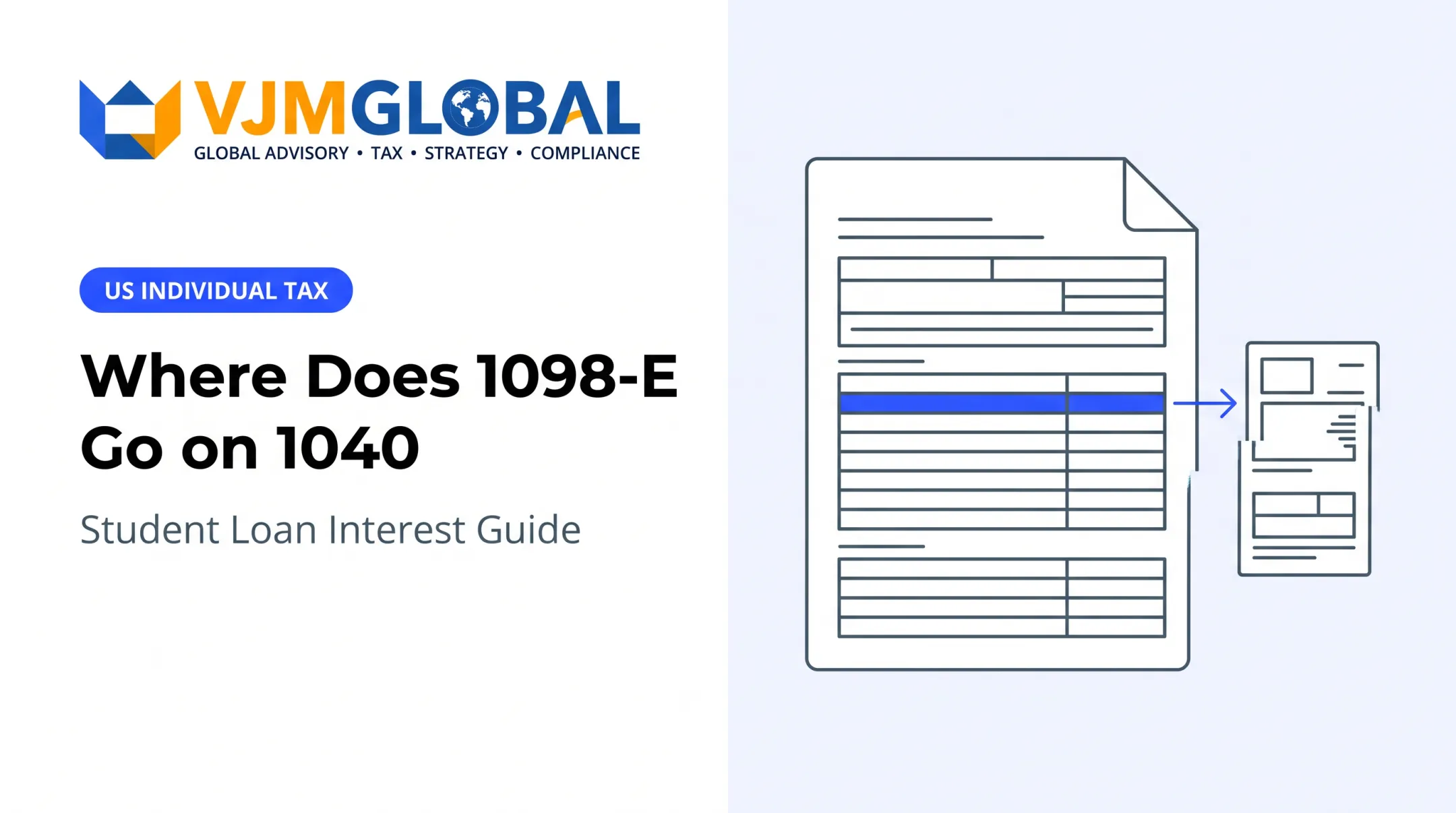
For 2025, the entry is Schedule 1 (Form 1040), Part II, line 21. It flows into Schedule 1, line 26, then to Form 1040-NR, line 10. Forms change, so confirm line numbers each year.

Calculate the allowable amount after eligibility, MAGI and phaseout checks. Don't copy Box 1 of Form 1098-E as your deduction amount.
Avoid common nonresident filing errors
- Claiming the deduction while married filing separately
- Ignoring the phaseout
- Treating all Box 1 interest as deductible
- Claiming principal or accrued interest
- Overlooking dependency status
- Assuming a private loan is automatically eligible
VJM Global's cross-border U.S. tax professionals prepare Form 1040-NR returns and can help review documentation and nonresident filing issues. Outcomes depend on your facts, and no result or IRS representation is promised.
Frequently Asked Questions
What is the maximum amount of student loan interest I can deduct?
The cap is $2,500 for both 2025 and 2026. You claim the lesser of that or qualifying interest actually paid, subject to the income phaseout.
Can I claim the student loan interest deduction on Form 1040-NR?
Yes, if you meet the loan, paid-interest, legal-obligation, dependency and MAGI requirements. It is not available if you file as married filing separately.
Does receiving Form 1098-E mean I am eligible?
No. It reports interest but doesn't confirm filing status, income, school or loan eligibility. Qualifying interest can also be deductible without the form.
Can private student loan interest qualify?
Yes, if the loan meets the qualified education loan definition and was used solely for qualified education expenses. You must also meet every other requirement.
Do I need to itemize deductions to claim student loan interest?
No. It is an adjustment on Schedule 1, independent of itemizing. For 2025 it flows to Form 1040-NR, line 10.
Can I claim the deduction if I live in Australia or attend a foreign school?
Living abroad doesn't decide eligibility. Certain foreign schools qualify, but your filing status, loan and income must still meet the rules.