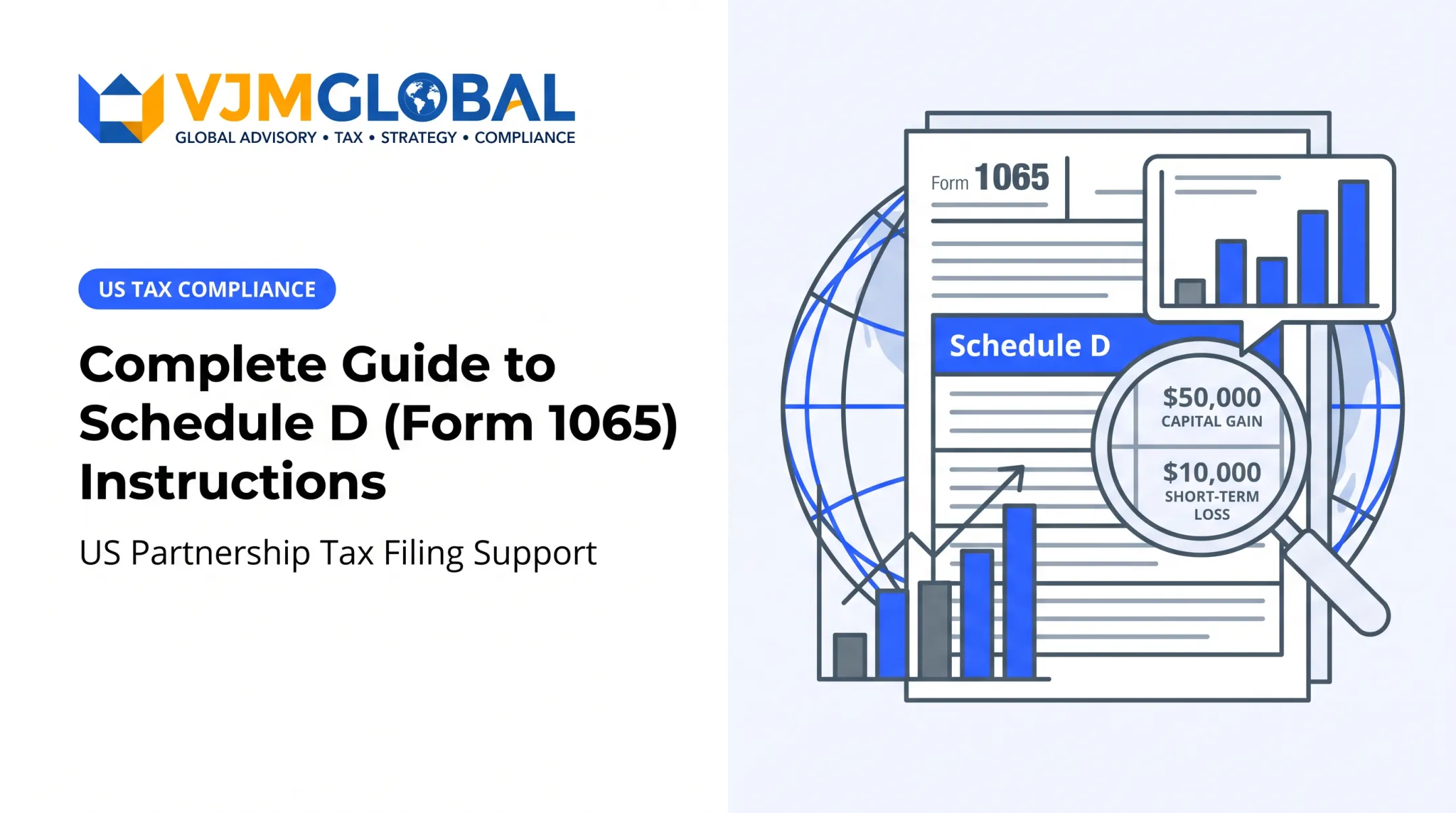
Here's the short version. Schedule D summarises your capital gains and losses. Form 8949 usually carries the transaction-level detail, and the net result flows to your federal return. This guide walks through who needs Schedule D, which records to gather, how short-term and long-term results are treated, and what Australian investors with U.S. filing obligations should check first.
Key Takeaways
- Schedule D reports gains and losses from sales or exchanges of capital assets on a 2024 U.S. federal return.
- Proceeds, adjusted basis and holding period decide whether a result is short-term or long-term.
- Form 8949 lists transactions; Schedule D totals them and feeds Form 1040, line 7.
- Australian investors must first confirm whether they file Form 1040 or Form 1040-NR.
What Is Schedule D and Who Must File It?
What Schedule D reports
Schedule D nets your capital gains and losses. It also picks up certain items from Forms 4797, 6252, 4684, 6781, 8824 and Schedule K-1. The net result goes to Form 1040, line 7 for 2024.
A capital asset is generally anything you own for personal use or investment: stocks, bonds, funds, investment property, digital assets and collectibles. Inventory and business-use property are excluded. Wages, interest and ordinary business income go elsewhere.
The maths is proceeds minus adjusted basis. Say you bought shares for $1,000 and sold them for $1,400. Your gain is $400, before adjustments such as commissions or wash-sale amounts. The figures are illustrative only.
Personal-use property is a special case: gains are reportable, but losses are nondeductible.
Who generally needs to file Schedule D
Under the 2024 Schedule D instructions, you file it when you have:
- Sales or exchanges of capital assets reported on Form 8949
- Capital gain distributions, unless the exception below applies
- Capital gains or losses passed through on a Schedule K-1
- A capital loss carryover from 2023
- Specified gains from Forms 4797, 6252, 4684, 6781 or 8824
You can skip both Schedule D and Form 8949 only if all of these are true:
- No capital losses and no qualified opportunity fund deferral
- Your only gains are Form 1099-DIV box 2a distributions
- Boxes 2b, 2c and 2d are empty
Report the distributions on Form 1040, line 7 and tick the box saying Schedule D isn't required.
What Australian filers with U.S. obligations should confirm
An Australian resident doesn't automatically file Form 1040. Classification comes first.
A resident alien meets the green-card test or the substantial presence test: 31 days in the current year and 183 weighted days across three years. Resident aliens report worldwide income. Nonresident aliens generally report U.S.-source and effectively connected income on Form 1040-NR.
Nonresident capital gains follow different rules. Many U.S.-source gains are exempt if you were present fewer than 183 days, with exceptions for effectively connected gains and U.S. real property interests. Some non-effectively-connected gains go on Schedule NEC rather than Schedule D.
Other obligations stand apart. An FBAR goes to FinCEN if aggregate foreign accounts exceed $10,000 at any point. Form 8938 is a separate IRS disclosure. One doesn't replace the other.
The U.S.-Australia treaty isn't a blanket exemption either. Its capital gains article generally lets each country tax gains under its own domestic law.
Form 8949, 1099 Forms, and Documents Needed
How Form 8949 works with Schedule D
Form 8949 records each sale: description, dates, proceeds, basis, adjustment code and resulting gain or loss. Totals then carry to Schedule D. Boxes group each transaction by holding period and how basis was reported:
- A, B, C: short-term, grouped by basis reported on a 1099-B, basis not reported, or no 1099-B
- D, E, F: the long-term equivalents
You can skip Form 8949 for qualifying 1099-B transactions where basis was reported to the IRS and no adjustments or codes apply. Enter them directly on Schedule D, line 1a (short-term) or 8a (long-term), subject to the 2024 Form 8949 instructions.
Documents to gather
- Forms 1099-B, 1099-S and 1099-DIV
- Schedule K-1 forms
- Brokerage statements, purchase confirmations and sale documents
- Digital-asset transaction histories
- Foreign exchange records
- Your 2023 Capital Loss Carryover Worksheet
Broker forms can be incomplete or wrong on basis. You're responsible for reconciling them to your own records, including trades no broker reported.
Common basis problems
- Wash sales: Loss is disallowed if you buy substantially identical securities within 30 days of the sale (code W). Per IRS Publication 550: $1,000 cost, $750 sale, $800 replacement → $250 disallowed loss and $1,050 basis.
- Inherited property: generally long-term, with basis usually at fair market value at death.
- Gifts: basis generally carries over from the donor, with a separate loss basis if value had fallen.
- Digital assets: Answer "Yes" on the 2024 Form 1040 for sales, exchanges or payments received, not wallet-to-wallet transfers. Form 1099-DA broker reporting starts with 2025 transactions.
- Foreign currency: convert to U.S. dollars using the rate prevailing when income is received or the expense paid.

How to Complete Schedule D Step by Step
Prepare and classify the transactions
- List every 2024 sale or other disposition.
- Split short-term (held one year or less) from long-term (more than one year).
- Calculate adjusted basis and reconcile proceeds to your 1099-B.
- Decide which items need Form 8949 and which go straight to Schedule D.

Watch the special cases: inherited property, gifts, corporate actions and missing acquisition dates.
Part I: short-term gains and losses
Enter short-term amounts as follows:
- Lines 1a–3: transactions from Form 8949 or direct entries
- Line 4: specified gains from Forms 6252, 4684, 6781 and 8824
- Line 5: K-1 short-term items
- Line 6: short-term loss carryover
- Line 7: net short-term result
Example: two short-term trades produce a $600 gain and a $200 loss, and you carry over a $100 short-term loss. Line 7 shows a $300 net gain.
Part II: long-term gains and losses
Enter long-term amounts as follows:
- Lines 8a–10: transactions from Form 8949 or direct entries
- Line 11: Form 4797 and specified items
- Line 12: K-1 long-term amounts
- Line 13: capital gain distributions
- Line 14: long-term loss carryover
- Line 15: net long-term result
Keep Part II separate from Part I. Example: long-term sales net a $2,000 gain and a $500 distribution is added on line 13, so line 15 is $2,500, with no mixing into the short-term $300.
Part III: summary and transfer
Line 16 combines lines 7 and 15, then flows to Form 1040, line 7. Complete the remaining lines as needed:

- Lines 18–19: 28%-rate gain and unrecaptured section 1250 gain
- Line 21: capital loss limit
- Line 22: worksheet direction
Use the Schedule D Tax Worksheet if line 18 or 19 is above zero and lines 15 and 16 are both gains. Otherwise use the Qualified Dividends and Capital Gain Tax Worksheet when directed.
Final review checklist
- Every sale captured, with correct holding period
- Basis, proceeds and adjustment codes checked against records
- 2023 carryover entered
- Form 8949 attached where required
- Schedule D totals tied to Form 1040, line 7
- Records retained
Compare the finished return with broker statements. Get professional review if you hold foreign assets, use multiple brokers or digital assets, sold real estate or business property, or lack basis records.
How Schedule D Affects Form 1040 and Capital Gains Tax
Where the result appears
Figures move from your sale records to Form 8949, then to Schedule D, and finally to Form 1040, line 7. Schedule D summarises your net capital gain or loss. It doesn't set your whole tax bill, which also depends on other income, deductions and credits.
Short-term and long-term tax treatment
Short-term gains are taxed as ordinary income. Long-term gains qualify for 0%, 15% or 20% rates based on taxable income, per Revenue Procedure 2023-34:
| Filing status | 0% through | 15% through | 20% above |
|---|---|---|---|
| Single | $47,025 | $518,900 | $518,900 |
| Married filing jointly | $94,050 | $583,750 | $583,750 |
| Married filing separately | $47,025 | $291,850 | $291,850 |
| Head of household | $63,000 | $551,350 | $551,350 |

Collectibles gain is capped at 28% and unrecaptured section 1250 gain at 25%.
The 3.8% net investment income tax applies above $200,000 (single or head of household), $250,000 (joint) or $125,000 (separate) of modified adjusted gross income. Nonresident aliens are generally exempt.
Net capital losses and carryovers
Losses offset gains first. A net loss can then offset up to $3,000 of other income ($1,500 if married filing separately). The rest carries forward and keeps its short-term or long-term character. Keep the Capital Loss Carryover Worksheet and your prior-year Schedule D.
Related forms not to overlook
- Home sales: the section 121 exclusion is up to $250,000, or $500,000 for qualifying joint filers, with 24 months of ownership and use in five years. A Form 1099-S means you report the sale even if the gain is excluded.
- Installment sales, like-kind exchanges, business property: Forms 6252, 8824 and 4797.
- IRAs: gains inside aren't taxed until distribution, and traditional IRA distributions are ordinary income.
Conclusion: A Practical 2024 Schedule D Filing Workflow
The sequence is simple:
- Identify every 2024 disposal
- Gather broker and property records
- Calculate adjusted basis
- Classify holding periods
- Complete Form 8949 where required
- Transfer totals to Schedule D
- Apply the right worksheet and reconcile with Form 1040
Australian investors should confirm whether they file Form 1040 or Form 1040-NR, then separately assess FBAR, Form 8938, currency, withholding and treaty questions.
VJM Global prepares Form 1040 and Form 1040-NR returns, and pricing depends on your structure and scope. Whatever route you take, base decisions on your own facts and the final 2024 IRS guidance.
Frequently Asked Questions
When must Schedule D be filed?
Attach it to your U.S. federal return when you have a reportable gain, loss, carryover or distribution. The 2024 return was due 15 April 2025. A timely Form 4868 extends filing to 15 October 2025, but not payment.
Do I need to file both Form 8949 and Schedule D?
Usually yes. Form 8949 lists transactions and Schedule D totals them. Qualifying 1099-B trades with basis reported and no adjustments can go directly on Schedule D.
How do I know if I need to fill out Schedule D?
You likely do if you sold capital assets, received certain capital gain distributions, have K-1 capital items or carry over a loss. Check the 2024 Schedule D instructions for exceptions.
Is it mandatory to show capital gain in ITR?
"ITR" usually means an Indian income tax return, not a U.S. form. Report a U.S. capital gain on the appropriate U.S. return and schedules, and assess any Australian obligations separately.
What can be reported directly on Schedule D?
Eligible Form 8949 summary totals, certain other-form amounts, capital gain distributions and loss carryovers. Transactions with adjustments or incomplete basis reporting generally need Form 8949 detail.