Introduction
U.S. citizens and eligible resident aliens living in Australia still must file a U.S. tax return on worldwide income. Earning it abroad doesn't change that. Many expats learn this only after a few years of missed filings.
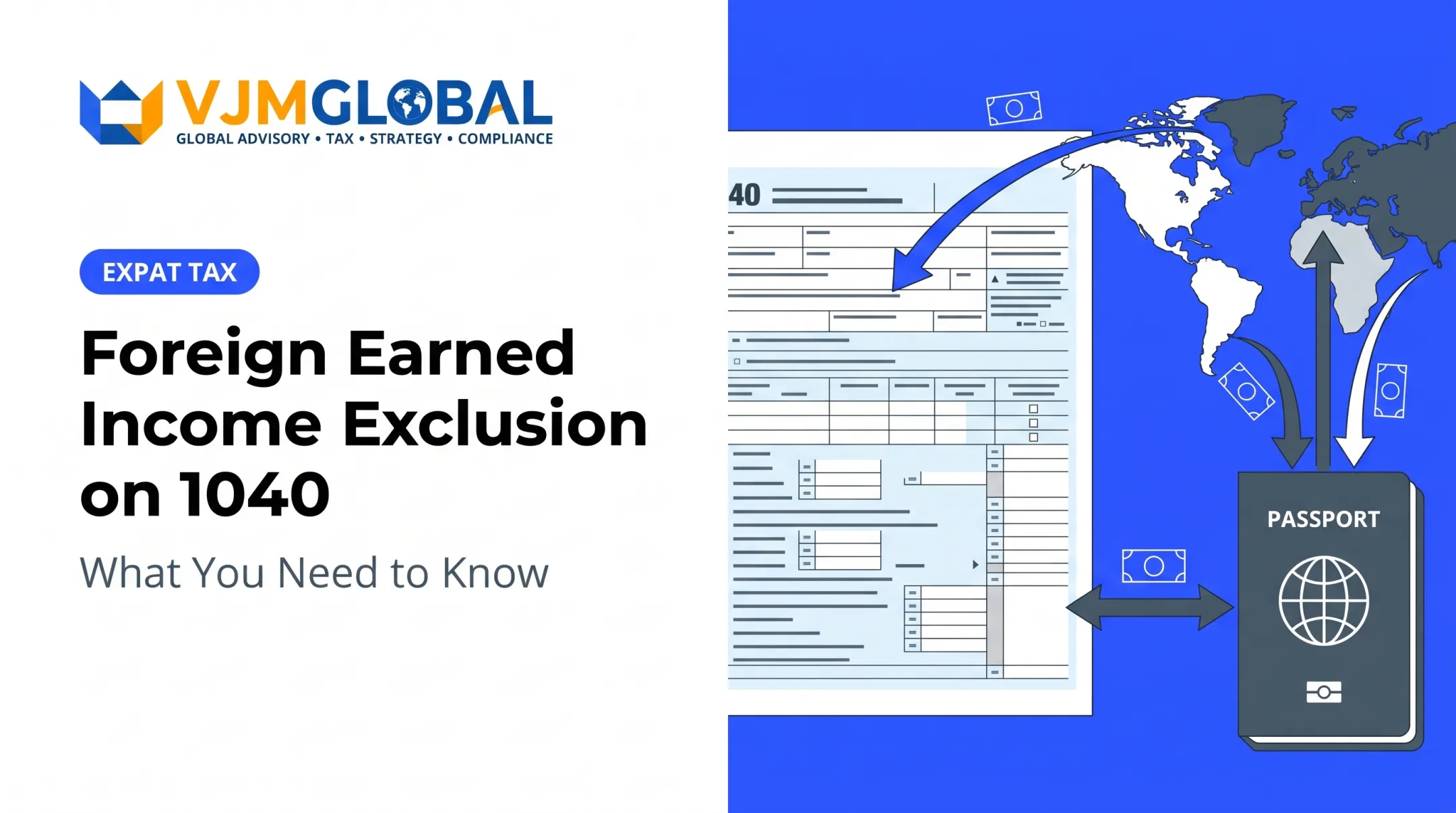
Form 2555 is how you reduce the bill. It isn't a standalone return. You attach it to Form 1040 to claim the Foreign Earned Income Exclusion (FEIE) and, where applicable, a foreign housing benefit.
One timing trap: the 2026 tax year is not the same as a return filed during calendar year 2026. The 2025 return is due in 2026, and the 2026 return is due in 2027.
This guide covers eligibility tests, 2026 limits, Australian housing figures, filing steps, deadlines and common mistakes.
Key Takeaways
- Form 2555 can cut U.S. income tax on foreign earned income, but not every U.S. filing duty.
- You need foreign earned income, a foreign tax home and one qualifying residency test.
- Only pay for services performed abroad qualifies. Investment income doesn't.
- Compare Form 2555 with Form 1116, and review FBAR, Form 8938, state tax and self-employment tax separately.
What Is Form 2555 and Who Should Consider Filing It?
The IRS describes Form 2555 as the form that calculates the Foreign Earned Income Exclusion (FEIE) and the foreign housing exclusion or deduction. It applies only to foreign earned income. The IRS form page links the 2026 version and instructions.
U.S. citizens and resident aliens can file it if they qualify under one of two tests:
- Physical Presence Test: available to both citizens and resident aliens
- Bona Fide Residence Test: resident aliens need citizenship or nationality of a country with a U.S. income tax treaty in effect (confirm in the current instructions)
Form 2555 attaches to Form 1040 or 1040-SR. It never replaces other forms you may owe, such as those for foreign accounts, foreign investments, business interests or dependents.
Form 2555 Eligibility: Tax Home, Residency Tests, and Qualifying Income
Tax home in a foreign country
Your tax home is generally your principal place of business, employment or duty, regardless of where your family lives. It must be foreign throughout the qualifying period. A foreign mailing address, a visa or an Australian home alone doesn't establish it.
A U.S. abode generally prevents a foreign tax home. Abode turns on family, economic and personal ties. Tax home is also separate from domicile and citizenship.
Physical Presence Test
You need 330 full days in one or more foreign countries within 12 consecutive months. A full day runs from midnight to midnight. Separate foreign stays can be combined, but time in international waters or the U.S. interrupts the count.
Keep a dated travel log backed by passport stamps, flight records and calendar entries. This matters most if you shuttle between Australia, the U.S. and other countries.
Bona Fide Residence Test
You must be a bona fide resident of a foreign country for an uninterrupted period that includes an entire tax year, normally January 1 to December 31. The IRS looks at housing, family, work, immigration status and intent.
Australian tax residency and U.S. bona fide residence are separate. The ATO can treat someone present fewer than 183 days as a resident under its own rules. ATO residency guidance confirms those tests differ from IRS tests and immigration residency. An Australian return or visa doesn't satisfy the U.S. test.
What counts as foreign earned income?
Wages, salary, bonuses, commissions, professional fees and self-employment income can qualify when paid for services performed outside the U.S. Income is sourced where you do the work, not where the employer sits or how you're paid.
So a U.S. employer paying you in U.S. dollars for work done in Sydney can still produce foreign earned income. An Australian employer paying in Australian dollars works the same way.
What generally does not qualify?
- Interest, dividends and capital gains
- Pensions, annuities and Social Security
- U.S. government employee pay
- Rental income (may be earned, unearned or both under IRS rules)
Mixed work locations need an allocation. In one IRS example, a mining engineer earns $88,800 over 240 workdays, 30 in the U.S. and 210 abroad. Foreign earned income is 210/240 × $88,800 = $77,700.

Digital nomads and people with employer benefits should document sourcing carefully.
How Much Can You Claim for 2026? Exclusion, Housing, and Form 1116
The maximum FEIE for 2026 is $132,900, per Rev. Proc. 2025-32. The exclusion can't exceed your qualifying foreign earned income. If you qualify for only part of the year, prorate it: maximum × qualifying days ÷ days in the tax year.
Hypothetical example: you qualify for 200 of 365 days. Your limit is $132,900 × 200/365, roughly $72,822.
Each qualifying spouse calculates an exclusion separately, so a couple could each claim their own. Housing can be calculated jointly or separately. With a joint calculation, only one spouse claims it.
Foreign housing exclusion or deduction
Eligible costs typically include:
- Reasonable rent, non-telephone utilities, and property insurance
- Nonrefundable lease fees, furniture rental, and residential parking
- Household repairs
Home purchases, mortgage principal, domestic help, and furniture purchases do not qualify.
The benefit equals qualifying expenses (up to your location's ceiling) minus the base amount:
| 2026 item | Amount |
|---|---|
| Base housing amount | $21,264 ($58.26 per day) |
| General expense ceiling | $39,870 ($109.23 per day) |
| Sydney ceiling | $65,600 |
| Melbourne ceiling | $40,600 |
| Wollongong ceiling | $46,000 |
These come from Notice 2026-25 and assume full-year qualification. The city ceiling is not the benefit itself. Employees claim an exclusion. Self-employed taxpayers claim a deduction. If you are both, you may claim both.

Form 2555 versus Form 1116
Form 2555 excludes income. Form 1116 credits Australian income tax against U.S. tax. You can't claim a credit or deduction for foreign tax on excluded income.
Model both. Australian rates often exceed U.S. rates, so the credit can win, particularly for higher earners. Other effects:
- The refundable Additional Child Tax Credit is unavailable with the FEIE.
- Excluded income isn't qualifying IRA compensation.
- Revoking the election bars it for the next five tax years without IRS approval.
How to Complete and File Form 2555 for 2026
Before completing the form
Gather:
- Prior-year and current-year Form 1040 data
- Passport and travel records
- Employment contracts and payslips
- Australian tax documents
- Visa or residency evidence
- Self-employment records
- Housing receipts
- Exchange-rate support
Form 2555 requires U.S. dollars. Use the rate on the date you received the income. The IRS has no official rate but accepts consistently used posted rates.
Evenly received income can use a yearly average. The IRS table currently ends at 2025, with no 2026 average listed.
Complete the form
Follow the current form rather than older line numbers. You'll report your foreign address, tax home, employer details, dates abroad and citizenship or residency details. Choose either the Physical Presence Test or the Bona Fide Residence Test section. Complete only one test section, not both.
Then report foreign earned income:
- Separate wages, self-employment pay, U.S.-performed services and multi-country income
- Apply proration, currency conversion, the annual cap and any housing calculation
- Calculate tax on remaining income with the Foreign Earned Income Tax Worksheet, using rates that would have applied without the exclusion

Finalise and submit
Attach Form 2555 to Form 1040. You can e-file from overseas or file on paper. Confirm current attachment rules before you file.
| Tax year | Regular due date | Overseas automatic | With Form 4868 |
|---|---|---|---|
| 2025 | April 15, 2026 | June 15, 2026 | October 15, 2026 |
| 2026 | April 15, 2027 | June 15, 2027 | October 15, 2027 |
The automatic two-month extension needs a statement explaining you live abroad. Form 2350 can extend filing to 30 days past your expected qualification date. Extensions to file don't extend payment: interest runs from the original due date.
Common Mistakes, Related Obligations, and When to Seek Help
Frequent errors:
- Miscounting qualifying days
- Treating Australian residency as automatic U.S. qualification
- Including passive income
- Skipping proration
- Using unsupported exchange rates
- Overlooking U.S.-performed work
- Keeping incomplete travel or housing records
Form 2555 doesn't replace other duties:
- FBAR: required when foreign accounts exceed $10,000 in aggregate at any time, due April 15 with an automatic extension to October 15.
- Form 8938: abroad thresholds are $200,000 at year-end or $300,000 at any time for single filers, and $400,000 and $600,000 for joint filers.
- Self-employment tax: excluded earnings still count. Under the U.S.-Australia agreement, self-employed citizens residing in Australia are exempt from U.S. Social Security contributions, with an exemption letter attached to each return.
- State and Australian tax: review these separately.
Day-count, housing, or FEIE-versus-credit questions are worth a professional review. VJM Global's team of U.S.-trained CPAs and Indian Chartered Accountants handles cross-border compliance. The firm can review Form 2555 eligibility, coordinate the form with Form 1040, compare it with Form 1116, and organise related filings for clients in Australia. Outcomes depend on your facts.
Frequently Asked Questions
What is the deadline for submitting Form 2555 in 2026?
It follows your Form 1040 deadline. The 2025 return is due April 15, 2026 (June 15 for expats, October 15 with Form 4868). The 2026 return is filed in 2027. Verify current IRS dates.
How do I get Form 2555 for 2026?
Download it from the IRS Forms and Instructions pages. You file it with Form 1040, not alone. Use the version matching your tax year.
What qualifies as foreign earned income for Form 2555 (2026)?
Wages, salary, professional fees and self-employment income for services performed abroad. Investment income, pensions, capital gains and ordinary rental income generally don't.
Who can file Form 2555 as a U.S. expat living in Australia?
You need U.S. citizenship or eligible resident-alien status, foreign earned income, a foreign tax home and qualification under the Physical Presence or Bona Fide Residence Test.
Can I use Form 2555 and Form 1116 for the same income?
Generally no. Excluded income can't also support a foreign tax credit. Different income categories may need a broader comparison.
Does Form 2555 reduce self-employment tax?
No. The exclusion affects income tax, not SE tax. Self-employed Australian residents should check the totalization agreement and Social Security position separately.