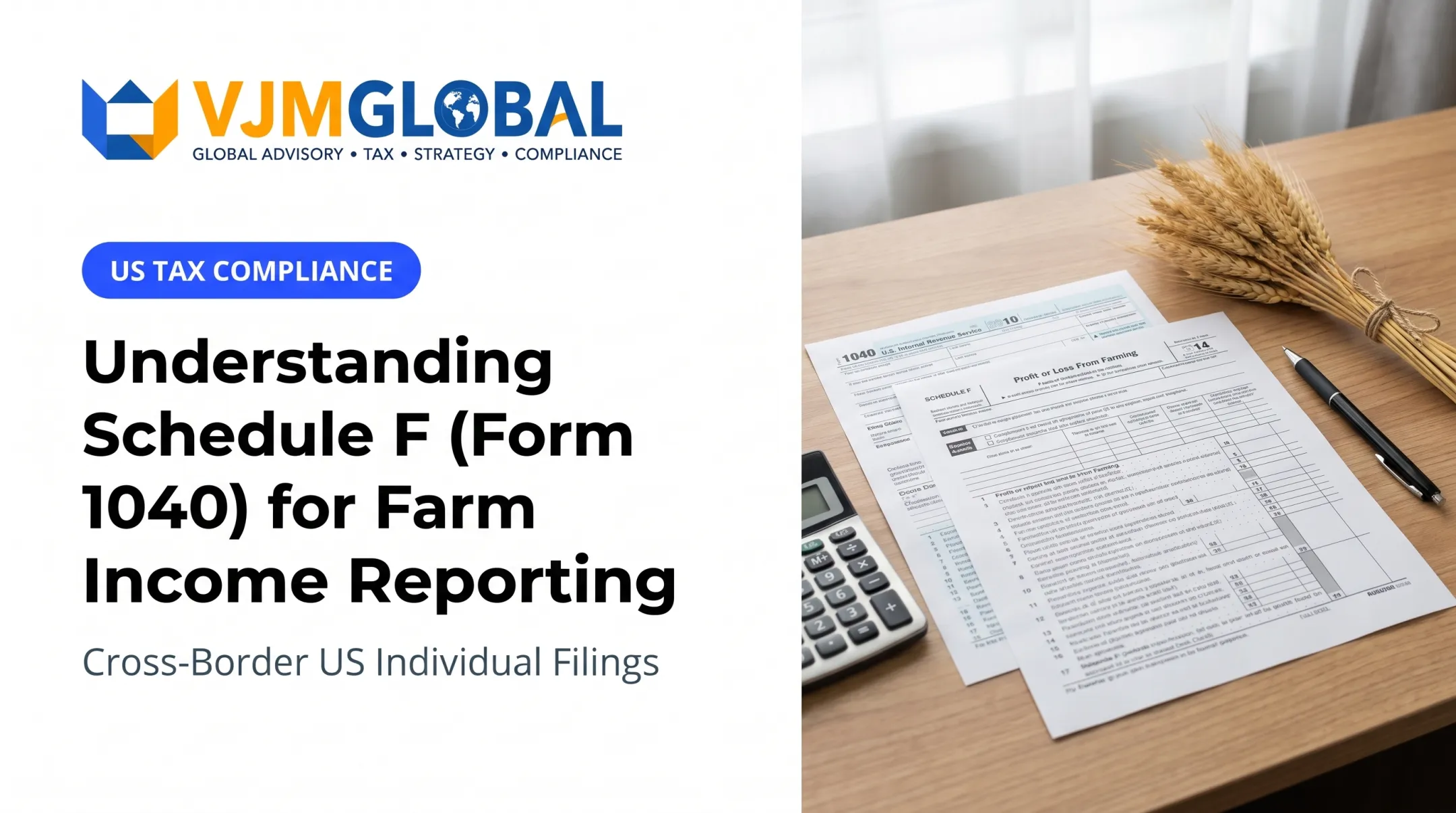
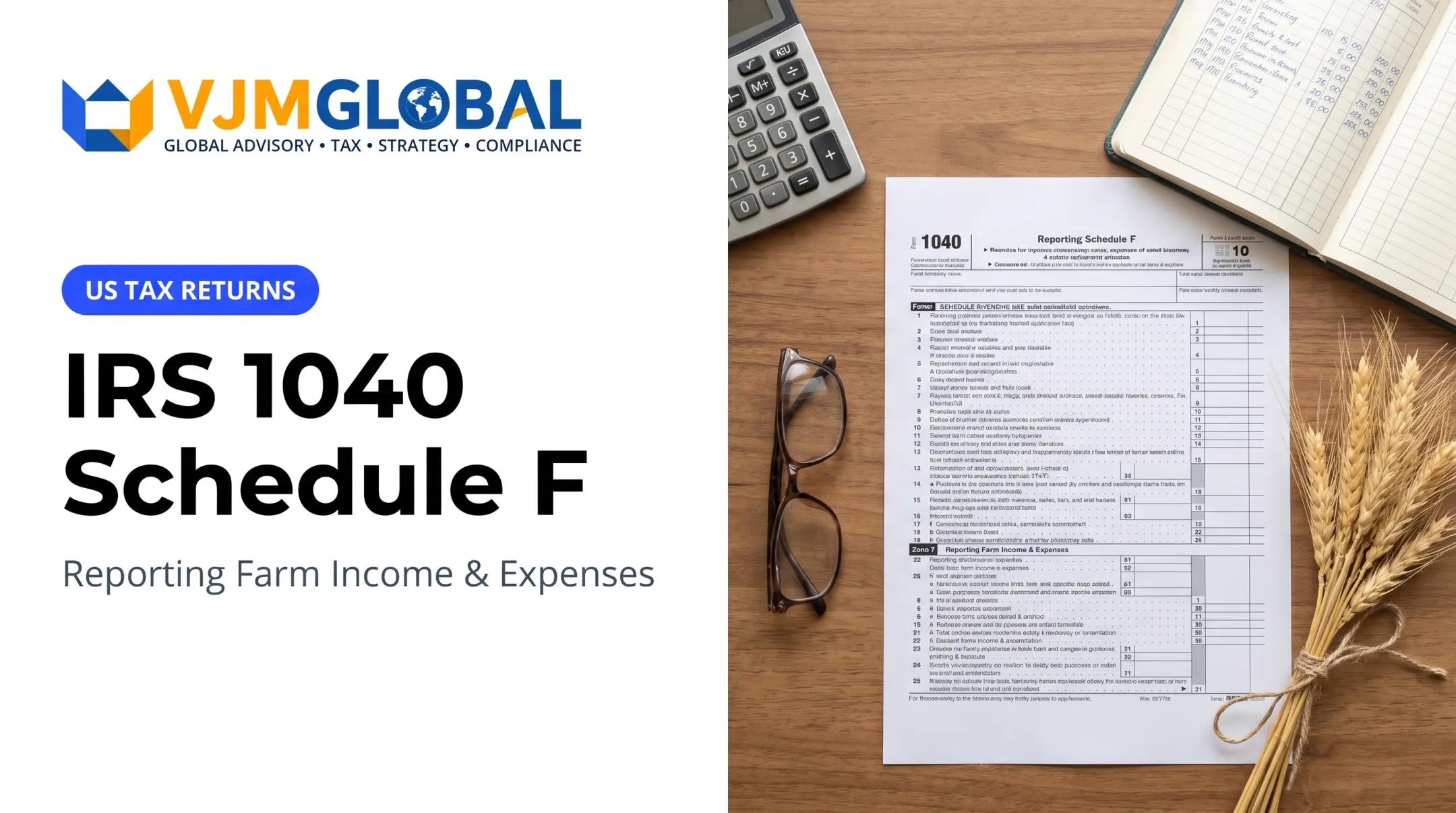
If you're reading from Australia, one point first: Schedule F is a US federal tax form attached to Form 1040. It isn't used to report farming income on an Australian tax return. This guide is for people with US filing obligations, US farm operations, or cross-border tax questions.
Below, we cover who files, what goes on the form, how profits and losses are treated, which records you need, and how to verify 2026 details before filing.
Key Takeaways
- Schedule F reports income and expenses of a qualifying farm run for profit, subject to entity and filing status.
- Farm receipts, capital assets, rental income and asset sales often belong on different forms.
- Net results may flow to Schedule 1, Schedule SE, Form 4562, Form 4797, Form 8582 or Form 6198.
- Confirm final 2026 forms, instructions, deadlines and thresholds before filing.
What Is Schedule F and Who Must File It?
What Schedule F does
Eligible individuals attach Schedule F to Form 1040. It calculates gross farm income, allowable expenses, and net farm profit or loss. That net figure carries to the federal return and may also drive self-employment tax.
Line numbers can change between years. The 2026 draft retains gross income on line 9, total expenses on line 33 and net profit or loss on line 34, but final line numbers are not confirmed yet. Always check the final form.
Who counts as a farmer
Farming means cultivating, operating or managing a farm for gain or profit, as owner or tenant. Qualifying activities include:
- Crops, livestock, dairy and poultry
- Fish, fruit and truck farms
- Ranches, orchards, groves and ornamental nurseries
The activity must be a business, not a hobby. The IRS weighs nine factors under Treas. Reg. 1.183-2:
- Businesslike conduct
- Expertise
- Time and effort
- Expected asset appreciation
- Success in similar activities
- Income or loss history
- Occasional profits
- Financial status
- Personal enjoyment
No single factor decides it.
Publication 225 also describes a presumption of profit motive: profit in 3 of 5 consecutive years (2 of 7 for horse activities). It is only a presumption, and missing it doesn't automatically make you a hobbyist.
Entity and activity boundaries
| Tax classification | Where farm results go |
|---|---|
| Sole proprietor | Schedule F with Form 1040 |
| Single-member LLC, no corporate election | Owner's Schedule F |
| Partnership | Form 1065; owners get a share via Schedule K-1 |
| S corporation | Form 1120-S |
| C corporation | Form 1120 |
Boundary cases matter too:
- A nonparticipating landlord on a crop or livestock share uses Form 4835, not Schedule F.
- Flat pasture rent goes on Schedule E.
- Sales of draft, breeding, dairy or sporting livestock and other business property go on Form 4797.
- Incidental custom hire is farm income. More-than-incidental custom work falls outside Schedule F.

The 2026 tax-year context
Preparing a return during 2026 isn't the same as filing for tax year 2026. The IRS opened its 2026 filing season on 26 January 2026 for tax year 2025 returns. Those are due 15 April 2026, or 15 October with Form 4868 (which doesn't extend the payment deadline).
For 2026 processing, e-file accepts tax years 2025, 2024 and 2023. The final Schedule F is the 2025 version; the 2026 form and instructions are drafts, not for filing.
Cross-border note: Australian primary production income is reported through the ATO's supplementary return, not Schedule F. Schedule F applies only to US farm activity. Get advice on whether Form 1040, Form 1040-NR or another US obligation applies. Nonresident aliens with a US trade or business must file Form 1040-NR, and Schedule F can attach to it.
What Income and Expenses Are Reported on Schedule F?
Farm income in Part I
Cash-method farm income includes:
- Sales of livestock, produce and resale items
- Cooperative distributions (Form 1099-PATR)
- Agricultural program payments
- Commodity Credit Corporation (CCC) loans, if elected into income, or forfeitures
- Crop insurance and disaster proceeds
- Custom hire and other farm income
Special receipts need care. Barter counts at fair market value. Cancelled debt can be income, though insolvency, bankruptcy and qualified farm debt exclusions may apply (Form 982). A CCC election generally carries to later loans.
Eligible crop insurance proceeds for physical or yield loss can be deferred to the following year under the cash method. Price or revenue-loss proceeds can't. Include Form 1099-K receipts in gross receipts too. A 1099 doesn't create taxability, and income is reportable without one.
Farm expenses in Part II
Expenses must be ordinary (customary in farming) and necessary (helpful and appropriate). Typical examples:
- Feed, seed, plants, fertiliser and lime
- Chemicals, veterinary costs and breeding fees
- Hired and contract labour
- Repairs, fuel, insurance and interest
- Utilities, rent, leases and conservation costs
Personal costs and unsupported expenses aren't deductible. Neither is the value of your own unpaid labour. Mixed-use items like household and farm utilities, or vehicles, need a reasonable allocation backed by records.
Capital assets, depreciation and asset sales
Land, buildings, machinery and long-lived livestock are generally capitalised and depreciated rather than deducted immediately. Form 4562 reports depreciation and Section 179.
| Benchmark | 2025 | 2026 |
|---|---|---|
| Section 179 maximum | $2,500,000 | $2,560,000 |
| Phase-out begins | $4,000,000 | $4,090,000 |
Bonus depreciation is 100% for eligible property acquired and placed in service after 19 January 2025. Property acquired earlier generally keeps the 40% transition rate. Section 179 also has a business-income limit.
Selling farm products differs from selling business property. Equipment, buildings and breeding or dairy livestock may go to Form 4797 or Schedule D. Livestock and crops held mainly for sale to customers stay on Schedule F.
Accrual accounting and inventory
Accrual-method farmers generally use Part III to track beginning inventory, purchases, ending inventory and cost of products sold. Income counts when earned and expenses when incurred, unlike the cash method.
Methods must be applied consistently. Changes generally need IRS consent, usually through Form 3115.
How Are Farming Profits, Losses and Accounting Methods Treated?
Choosing an accounting method
- Cash: income when received, expenses when paid.
- Accrual: income when earned, expenses when incurred, with capitalisation rules.
- Crop method: IRS-approved deferral of production costs until crop income is realised, where planting and harvest span tax years.
Not every farm or entity can use every method. Certain farming corporations, partnerships and tax shelters generally must use accrual. The gross-receipts exception for non-tax-shelter entities is $31 million (2025) and $32 million (2026). Check the instructions and Publication 225 for eligibility.
Calculating net farm profit or loss
Net farm profit or loss equals reportable farm income (adjusted for inventory where applicable) less allowable expenses.
A loss won't automatically offset every other income type. Basis, at-risk, passive activity, hobby-loss and excess business loss rules may all apply.
Tax effects of farm profit
Net profit is generally taxable income and may trigger self-employment tax through Schedule SE:
- Rate of 15.3% (12.4% Social Security plus 2.9% Medicare)
- Applied to 92.35% of net profit
- Generally applies once net earnings reach $400
- Social Security wage base of $176,100 (2025) and $184,500 (2026)

The farm optional method for 2026 allows maximum optional earnings of $7,560, up from $7,240 in 2025. Nonresident aliens are generally not subject to self-employment tax unless a social security agreement establishes US coverage.
The qualified business income deduction can be up to 20% for eligible income, but it needs its own calculation on Form 8995 or 8995-A. Schedule F profit isn't automatically the final QBI amount.
Limits on farm losses
Losses generally run through these tests in order:
- Owner basis (for pass-through owners)
- At-risk rules, Form 6198
- Passive activity rules, Form 8582
- Excess business loss, Form 461
The 2026 excess business loss threshold is $256,000 ($512,000 jointly), down from $313,000 and $626,000 for 2025. Excess becomes a net operating loss carryover. Hobby rules under section 183 stay separate.
To show profit motive:
- Keep businesslike records
- Make informed operating decisions
- Document your expertise and effort
- Show attempts to improve profitability
No set number of profitable years settles every question.
Timing, estimated tax and income averaging
Farm income often swings from year to year. Schedule J lets you average all or part of farming income over the previous three years. Crop insurance deferral is a separate timing election.
Farmers and fishers with at least two-thirds of gross income from those activities get a special estimated-tax rule. The required payment is the smaller of 66⅔% of current-year tax or 100% of prior-year tax. For 2026, pay by 15 January 2027, or file and pay everything by 1 March 2027.

Filing Schedule F: Records, Related Forms and Common Errors
Records to gather
- Sales records and settlement statements
- Bank statements, receipts and bills
- Forms 1099 and program-payment or insurance notices
- Payroll and contractor records
- Mileage logs with date, destination, purpose and business miles
- Inventory counts and depreciation schedules
- Loan-interest statements and evidence of business purpose
Estimates alone don't substantiate deductions. Record items at or near the time they happen.
Filing workflow
- Confirm the correct tax year.
- Download the matching Schedule F and instructions.
- Review Publication 225.
- Reconcile books to bank activity.
- Separate personal and business costs.
- Check whether e-filing is open for that return.
Information-return thresholds don't decide taxability. For payments from 1 January 2026, Form 1099-NEC and 1099-MISC thresholds rise from $600 to $2,000, per IRS Publication 1099. Income is still reportable below that.
Taxpayers living abroad may get an automatic two-month extension to 15 June, but it isn't blanket relief, and interest runs from the original payment date.
Common errors and professional support
- Mixing farm and non-farm activity
- Reporting asset sales on Schedule F
- Overlooking self-employment tax
- Claiming unsupported mixed-use deductions
- Using the wrong entity return
- Applying outdated figures
An IRS pilot review of 50 tax-year-2015 cases flagged personal expenses, hobby losses and mixed personal-farm mortgage interest. It's a historical example, not a current error rate.
VJM Global supports US Form 1040 preparation, US-compliant accounting and tax compliance for Australia-based taxpayers and businesses with US obligations. It doesn't provide Australian local tax advice.
Frequently Asked Questions
What is Schedule F?
It's the IRS form for reporting qualifying farm income and expenses and calculating profit or loss. It's usually filed with Form 1040.
What tax years can be e-filed in 2026?
Processing year 2026 accepts tax years 2025, 2024 and 2023 through the IRS system. Check the IRS and your software provider for current availability.
What is the tax table for 2026?
Schedule F doesn't contain the income-tax calculation. For 2026, the single 10% bracket tops out at $12,400 and the standard deduction is $16,100. Confirm against official Form 1040 instructions.
Who needs to file Schedule F?
Individuals running a qualifying farm for profit generally do. Partnerships, corporations, certain landlords and hobby activities report differently.
What expenses can farmers deduct on Schedule F?
Ordinary and necessary costs such as feed, seed, labour, repairs, fuel, rent, insurance, interest, utilities and depreciation. Personal and unsupported costs are excluded.
Does an Australian taxpayer use Schedule F?
No, it's a US federal form, not part of an ordinary Australian return. Australians with US income, a US business or a possible US filing obligation should get professional review.