Tax year 2026 relates to a return filed in 2027. At the time of writing, the 2026 Schedule A on the IRS site is marked "DRAFT - DO NOT FILE," and the instructions on the IRS hub still show 2025. Treat the numbers below as the current picture and confirm against the final forms.
This guide covers who needs the form, what it reports, how to compare it with the standard deduction, and the records to keep. All dollar amounts are US dollars, not Australian dollars.
Key Takeaways
- Use Schedule A only when itemized totals beat $16,100 (single), $32,200 (joint) or $24,150 (head of household).
- Covers medical expenses, taxes, interest, charity, casualty losses and limited other deductions.
- Schedule 1-A is a different form for additional deductions such as tips and overtime.
- Australians with U.S. filing duties should confirm their return type and residency first.
What Is the 2026 Schedule A Form and What Is It Used For?
Schedule A lists your eligible itemized deductions. The total (line 18 on the 2026 draft) moves to line 12e of Form 1040 or 1040-SR and reduces taxable income.
Itemized vs. standard deduction
You generally pick one method, not both. Take whichever gives the larger allowable deduction. The 2026 draft follows a familiar layout:
- Taxpayer information at the top
- Medical and dental expenses
- Taxes you paid
- Interest you paid, including investment interest (Form 4952 if required)
- Gifts to charity
- Casualty and theft losses
- Other itemized deductions
- Total itemized deductions
Get the PDF only from the IRS Schedule A page, not from third-party sites.
Schedules people confuse with it
Schedule 1-A, created under the 2025 legislation commonly called the One Big Beautiful Bill, covers qualified tips, overtime, car-loan interest and the enhanced senior deduction. It is not the itemized-deduction form.
Schedule C reports business profit or loss and is unrelated to itemizing.
Who Needs to File Schedule A in 2026?
Having deductible expenses does not force you to file Schedule A. You consider Schedule A when allowable itemized deductions exceed your standard deduction, or when you cannot take the standard deduction.
2026 standard deduction amounts:
| Filing status | Amount |
|---|---|
| Single | $16,100 |
| Married filing jointly | $32,200 |
| Married filing separately | $16,100 |
| Head of household | $24,150 |
Age 65 or older, or blind, adds $1,650 per person ($2,050 if unmarried and not a surviving spouse). A married person filing separately cannot take the standard deduction if their spouse itemizes.
Cross-border points for Australian readers
- Nonresident aliens use Schedule A (Form 1040-NR), not the ordinary form, and their standard deduction is generally restricted.
- Deductions allocable to income excluded under the foreign earned income exclusion are disallowed.
- You cannot claim a foreign tax credit and a deduction for the same foreign income taxes.
- The 1982 Australia-US treaty and 2001 protocol provide context, but they do not create an automatic Schedule A deduction.
What Deductions Can You Claim on Schedule A?
Medical and dental expenses
Only unreimbursed qualifying costs above 7.5% of AGI count. Expenses paid or reimbursed by insurance or others are excluded. Prescribed drugs, acupuncture and nursing services qualify; general health club dues and funerals do not.
Taxes paid
You choose state and local income taxes or general sales taxes, never both. The SALT cap for 2026 is $40,400 ($20,200 if married filing separately). It shrinks for modified AGI above $505,000 ($252,500 MFS), to a floor of $10,000 ($5,000 MFS). Foreign real property and personal property taxes are non-deductible under the 2025 instructions.

Interest paid
- Home mortgage debt incurred after 15 December 2017 is capped at $750,000 ($375,000 MFS).
- Older debt keeps the $1 million limit ($500,000 MFS).
- Proceeds must buy, build or substantially improve the home.
- Mortgage insurance premium deductions become permanent from 2026 for qualifying contracts.
- Investment interest goes through Form 4952.
Gifts to charity
From 2026, itemizers deduct gifts only above 0.5% of AGI. Cash gifts to public charities face a 60% AGI limit; noncash and "for the use of" gifts face lower limits. Records:
- Under $250: get a receipt with the charity's name, address and gift date.
- $250 to $5,000: get a written acknowledgement.
- Over $500 noncash: file Form 8283.
- Over $5,000: add a qualified appraisal, with exceptions such as publicly traded securities.
A gift straight to an Australian charity generally does not qualify, even if it is registered locally.
Non-itemizers can separately deduct up to $1,000 ($2,000 joint) of cash gifts. That is not a Schedule A item.
Casualty, theft and other deductions
Personal casualty losses are restricted to federally declared disasters, and from 2026 qualifying state-declared disasters too. Each event is reduced by $100, then the total by 10% of AGI. Qualified disaster losses use a $500 reduction and skip the 10% reduction.
Other items on the draft include gambling losses (limited to 90% of losses, up to winnings), claim-of-right repayments over $3,000 and impairment-related work expenses. Old miscellaneous deductions did not all return.
High earners also face an overall reduction of itemized deductions above $640,600 (single), $768,700 (joint) or $384,350 (MFS).
How to Decide Whether to Itemize and Complete Schedule A
Gather your records
- Medical receipts and insurance statements
- Property and income tax records
- Mortgage interest statements
- Charity acknowledgements and appraisals
- Casualty and theft documentation
The IRS says to keep records while they matter to tax administration, generally three years after filing, with longer exceptions.
Compare the two methods
Apply every limit first: the 7.5% floor, the SALT cap, the charity floor. Then total what is left and compare it with your standard deduction. If the total is lower, take the standard deduction.
Complete the form in order
- Confirm your filing status.
- Work through the lines in sequence on the final 2026 form.
- Enter only eligible amounts and apply each category's limit.
- Calculate the total and carry it to Form 1040 or 1040-SR.

Review cross-border details
Report in US dollars, using the rate when an item was received, paid or accrued. The IRS publishes yearly averages, though its Australian dollar table currently runs only through 2025. Record your method. An Australian tax payment is not automatically deductible on Schedule A.
Consider professional review
Professional help is worth considering for large deductions, multiple homes, foreign income, dual-status questions or treaty issues. VJM Global supports cross-border tax and compliance work, including US individual return preparation for Forms 1040 and 1040-NR, and has served 250+ Australian businesses.
Where to Find the Form, Filing Checklist, and Mistakes to Avoid
Download the final 2026 Schedule A and its instructions from the IRS site and check the tax year. Do not file the draft.
Pre-filing checklist:
- Confirm filing status
- Compare standard and itemized totals
- Check every limit
- Attach required forms (4952, 8283)
- Keep receipts and acknowledgements
- Attach Schedule A to the right return
Before you submit, watch for these frequent errors:
Common mistakes:
- Using the 2025 form for a 2026 return
- Confusing Schedule A with Schedule 1-A
- Including reimbursed medical costs
- Claiming both income and sales taxes
- Ignoring the mortgage debt limit
- Double-counting expenses
- Applying Australian tax assumptions to a U.S. form

Frequently Asked Questions
Where can I find Schedule A Form 1040?
On the IRS "About Schedule A" page. Confirm the tax year reads 2026 and the form is no longer marked draft.
What does Schedule A look like?
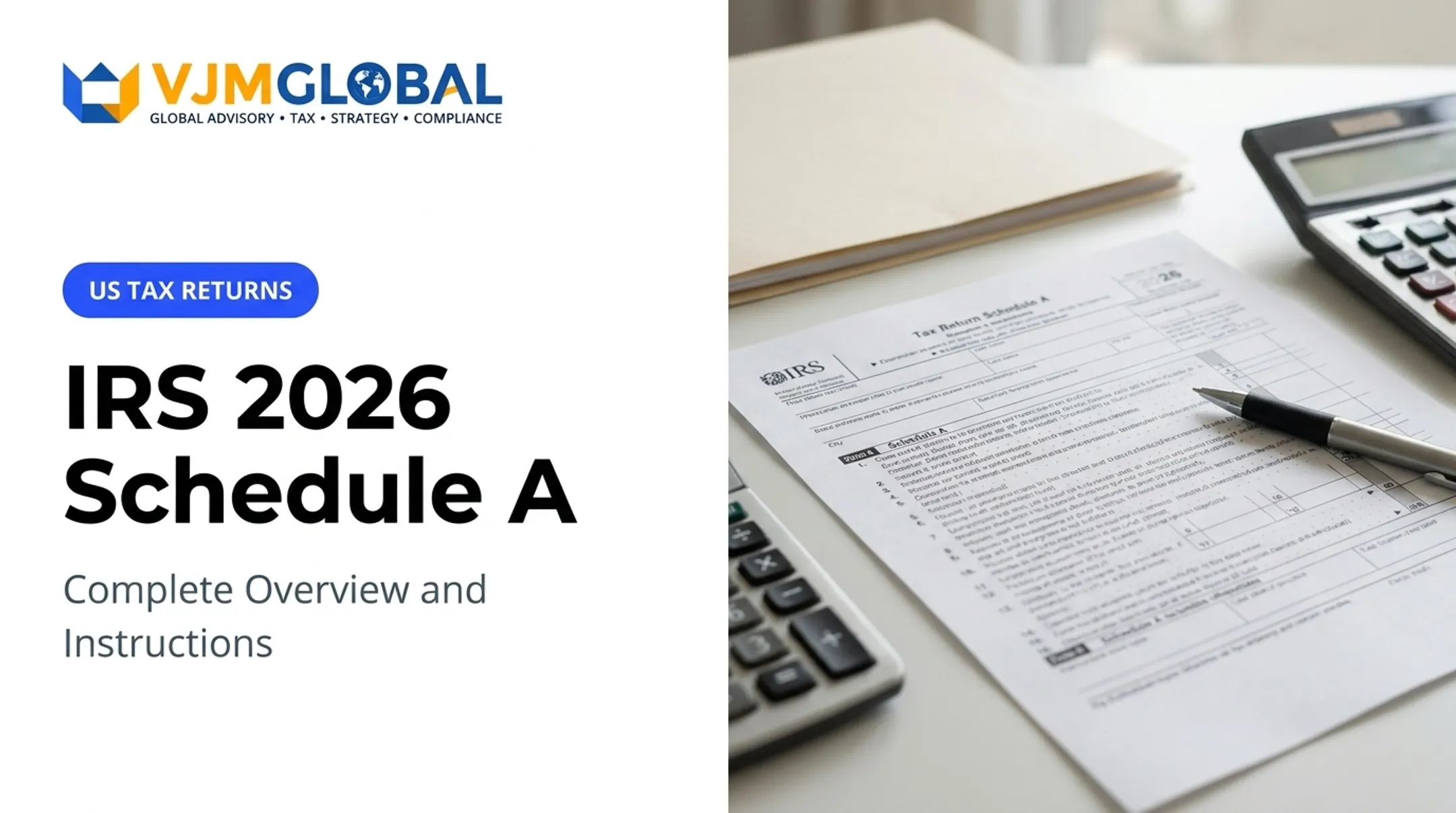
A multi-section page: taxpayer details, then medical, taxes, interest, charity, casualty and other deductions, ending with a total carried to Form 1040.
Do I need to file Schedule A if I take the standard deduction?
No. Schedule A is for itemizing. Other schedules may still apply to your return.
What deductions go on Schedule A?
Medical, taxes, interest, charity, casualty losses and other itemized items. Each has its own limits and documentation rules.
Is Schedule A the same as Schedule 1-A?
No. Schedule A reports itemized deductions. Schedule 1-A reports separate additional deductions such as tips and overtime.
When do I file the 2026 Schedule A?
With your 2026 return, due 15 April 2027 per the draft IRS calendar. Form 4868 extends filing to 15 October 2027, but not payment. U.S. citizens abroad get an automatic extension to 15 June, with interest running from April.