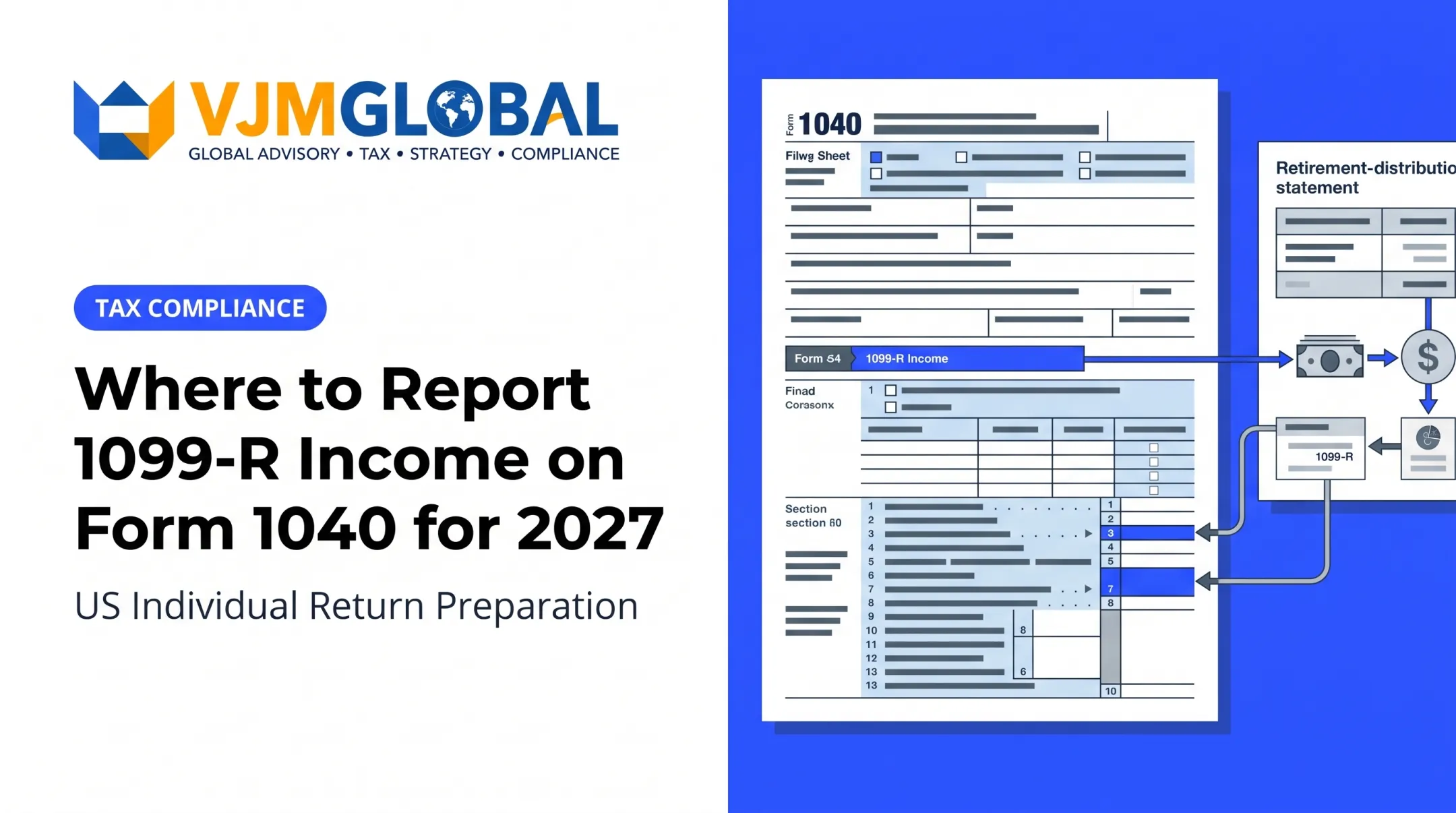
The right entry depends on where the money came from, whether the rollover was direct or indirect (completed within 60 days), and whether you rolled over all of the distribution or only part. This guide shows how to separate the gross distribution from the taxable amount, pick the correct lines, and check your entry against your paperwork. Line references follow the 2025 Form 1040 instructions, so confirm them against the instructions for your filing year.
Key Takeaways
- A rollover is generally reported on Form 1040 even when none of it is taxable.
- The gross distribution and the taxable amount are separate figures.
- IRA distributions use lines 4a to 4c; employer-plan distributions use lines 5a to 5c.
- Compare Form 1099-R with rollover confirmations, Form 5498, and withholding records before filing.
What "Amount of Rollover" Means on Form 1040
A rollover moves eligible retirement money from one plan or IRA to another qualifying account. When it is done properly, tax on the rolled-over amount is generally postponed. A rollover to a Roth IRA is the exception, because it is generally not tax-free.
Gross Distribution vs. Taxable Amount
"Rollover amount" can mean three things: the gross distribution the payer reports, the amount deposited into the new account, or the portion treated as nontaxable. They differ when money is withheld, when part of the distribution is kept, or when after-tax contributions are involved.
On Form 1099-R, box 1 shows the gross distribution before withholding, and box 2a shows the taxable amount the payer reports. Box 2a can be zero, partial, or full. A payer sometimes reports a taxable amount that ignores a rollover you completed, and you correct that on your return.
A hypothetical example with a $10,000 pre-tax distribution:
- Full rollover: all $10,000 goes into the new account, so the taxable amount is $0.
- Partial rollover: $6,000 goes in and $4,000 is kept, so $4,000 is generally taxable.
- Kept entirely: nothing is rolled over, so $10,000 is generally taxable.

These are illustrations, not universal results. Basis, age, and account type can change the outcome.
Why the Source Account Matters
The account the money left, not the account it entered, decides which lines you use. An IRA distribution goes on the IRA lines. A distribution from a 401(k), 403(b), governmental 457(b), or pension goes on the pension lines. Where the money lands does not change that.
Related Transactions That Look Similar
- Direct transfer or rollover: funds move between institutions without passing through your hands.
- Indirect 60-day rollover: you receive the money and must deposit it in time.
- Roth conversion: pre-tax money moves to a Roth IRA, and the taxable amount is generally included in income that year.
- Ordinary distribution: money is withdrawn and not rolled over, so it is taxed under normal rules.
How to Report the Rollover Amount on Form 1040
IRA-to-IRA Rollovers
Per the 2025 Form 1040 instructions, enter the gross distribution on line 4a. If you rolled over the entire amount, enter zero on line 4b and check the rollover box on line 4c. If you rolled over only part, enter the amount not rolled over on line 4b.
The instructions use the line 4c checkbox. They do not generally ask you to write "Rollover" beside the line.
Employer-Plan Rollovers
For a 401(k), 403(b), 457(b), pension, or similar plan, enter the box 1 gross distribution on line 5a. Subtract the amount rolled over and any nontaxable employee contributions, and enter the remaining taxable amount on line 5b. If nothing is taxable, enter zero on line 5b and check the rollover box on line 5c.

Direct vs. Indirect Rollovers
| Direct | Indirect | |
|---|---|---|
| Who gets the funds | The receiving plan or IRA | You |
| Withholding | None on a direct IRA transfer or employer-plan direct rollover | Generally 20% on employer-plan distributions |
| Deadline | None to track | 60 days from receipt |
| Records to keep | Rollover confirmation, 1099-R | 1099-R, receipt date, deposit proof |
With an indirect employer-plan rollover, full rollover treatment requires you to deposit the whole eligible distribution. That includes the withheld portion, which you replace from other funds. Otherwise the shortfall is taxable.
Full, Partial, and Failed Rollovers
- Full: taxable amount is zero (assuming a pre-tax account); the rollover box is checked.
- Partial: only the portion not rolled over goes on line 4b or 5b.
- Failed: if funds miss the deadline without a waiver, the undeposited amount is generally taxable for the distribution year. Depending on your age, a 10% additional tax may apply.
Entering It in Tax Software
The IRS instructions specify lines and checkboxes, not software screens, so software is only as accurate as what you tell it.
- Enter Form 1099-R exactly as printed, including boxes 1, 2a, 4, and 7.
- Answer the rollover interview questions honestly, with the actual amount rolled over.
- Review the finished Form 1040: gross amount on 4a or 5a, taxable amount on 4b or 5b, rollover box checked if applicable.
- Confirm federal withholding carried to line 25b.
Don't overwrite amounts manually to force a zero. If you can't explain a number, go back to the transaction.
How Rollover Amounts Are Taxed
A Properly Completed Traditional Rollover
A qualifying rollover from one pre-tax account to another is generally excluded from current income. That means deferral, not exemption. The money is generally taxed when the receiving account pays it out later.
Indirect Rollovers and the 60-Day Rule
The deposit must generally reach the new account by the 60th day after you receive the funds. Keep proof of both dates: the payment date on your 1099-R or statement, and the custodian's deposit confirmation.
If you miss the deadline, relief may exist:
- Automatic waiver: Available for certain institution errors when funds arrived on time and are deposited within one year
- Self-certification: Publication 590-A and Revenue Procedure 2020-46 list reasons such as institution error, serious illness, postal error, or a death in the family
- Private letter ruling: You can request one from the IRS
Self-certification is not an IRS waiver, and the IRS can still review it on examination.
Withholding and the Amount You Receive
When an eligible employer-plan distribution is paid to you, the payer generally must withhold 20%, and you can't opt out. Publication 575 gives this example: from a $10,000 distribution, $2,000 is withheld and you receive $8,000.
To roll over the full $10,000, deposit the $8,000 plus $2,000 from other money. If you roll over only $8,000, the other $2,000 is includible in income.

Either way, report the withholding from box 4 on line 25b. You still get credit for tax withheld even if you replaced the money.
Partial Rollovers
Calculate the rolled-over and retained portions from the 1099-R, deposit records, and account statements. Don't rely on the check amount alone, because withholding makes it smaller than the gross distribution.
Roth Conversions and Ineligible Distributions
Moving pre-tax money to a Roth IRA is a conversion. The taxable amount is generally included in income for the conversion year, and Form 8606 calculates it when you have after-tax basis.
Some distributions can't be rolled over at all, including:
- Required minimum distributions
- Hardship distributions
- Certain series of substantially equal periodic payments
The IRS maintains the full list, so check it for your year.
Documents, Deadlines, and Common Reporting Mistakes
Check Form 1099-R
Verify these items on every 1099-R:
- Box 1 gross distribution
- Box 2a taxable amount
- Box 4 federal withholding
- Box 14 state withholding, where applicable
- Box 7 distribution code
Common Box 7 codes include:
- Code G: direct rollover from a plan to an eligible plan or IRA
- Code H: direct rollover from a designated Roth account to a Roth IRA
- Codes 1, 2, and 7: early, early-with-exception, and normal distributions
The code alone doesn't decide your taxable amount.
Understand Form 5498
The IRA custodian files Form 5498 with the IRS and sends you a copy. Box 2 shows rollover contributions and box 3 shows Roth conversion amounts. The instructions don't direct you to attach it to Form 1040. Publication 590-A tells you to keep it.
Timing matters. Rollover and contribution information is generally due to you by May 31, which can be after you file. If it hasn't arrived, rely on the receiving custodian's confirmation, deposit date, and account statements.
Reconcile Before Filing
Match the 1099-R against:
- The receiving custodian's rollover confirmation
- The deposit date and statements
- Proof of any money you added to replace withholding
Common Filing Errors
- Using the IRA lines for a pension distribution, or the reverse
- Reporting only the check received instead of the gross distribution
- Treating a Roth conversion as tax-free
- Leaving out withholding
- Not reporting the rollover at all
Reporting mistakes can produce an IRS mismatch notice. A CP2000 compares your return with payer-reported information. It proposes changes and is not a bill.

Review it, respond by the stated date, say whether you agree, and include supporting rollover records. Ignoring it makes things worse.
Before You File: Rollover Reporting Checklist
- Confirm the source and destination accounts, direct or indirect, full or partial, traditional rollover or Roth conversion.
- Match the 1099-R to the right line pair, enter the gross and taxable amounts, and carry all withholding to line 25b.
- Keep the 1099-R, Form 5498 when received, rollover confirmations, deposit records, and plan administrator correspondence.
Consider a qualified tax professional if you missed the 60-day deadline, hold multiple account types, have cross-border facts, or received an IRS notice.
VJM Global supports U.S. individual taxpayers with Form 1040 preparation. Its tax professionals are trained in IRS rules and major tax forms.
Frequently Asked Questions
What is a rollover for tax purposes?
It is the movement of eligible retirement funds into another qualifying retirement account. It differs from a taxable withdrawal, from a direct transfer (where you never receive the money), and from a Roth conversion, which is generally taxable.
How do I show a rollover on Form 1040?
Report the gross distribution and the taxable amount on the lines set by the source account: 4a/4b for IRAs, 5a/5b for pensions and employer plans. Check the rollover box when applicable, and confirm against current IRS instructions.
How much will I be taxed on a rollover?
A properly completed traditional rollover is generally not taxed immediately. Amounts you keep, amounts missing the deadline, Roth conversions, and ineligible distributions may be taxable, and a 10% additional tax may apply before age 59½.
How many rollovers can I do in one year?
Only one IRA-to-IRA rollover is allowed in any 12-month period, counted across all your IRAs. Trustee-to-trustee transfers and Roth conversions are outside that limit, and employer-plan rollovers follow separate rules. Verify current IRS guidance.
Which amount of a rollover goes on Form 1040?
Enter the gross distribution on line 4a (IRA) or 5a (employer plan), then the taxable amount on 4b or 5b. A fully rolled-over pre-tax distribution has a taxable amount of zero.
Do I need Form 5498 to report a rollover?
No. Form 5498 confirms a rollover contribution, but it isn't attached to your return. It may arrive after filing season begins, so use your custodian's confirmation and statements in the meantime.