Most mistakes come from misreading what the table does. It doesn't show your refund, your total tax or what you owe. It isn't a tax bracket chart, and it has nothing to do with an Australian tax table. For US taxpayers living in Australia, the lookup is often just one step in a longer cross-border calculation.
This guide covers confirming the right IRS materials, calculating taxable income, finding the correct row, checking the result, and spotting when a worksheet or professional review is needed.
Key Takeaways
- Pair the table with the matching year's Form 1040 instructions, using taxable income and filing status.
- Use line 15 taxable income, not gross income, wages or AGI.
- Treat the table figure as one stage; credits, other taxes and payments decide the final outcome.
- US taxpayers in Australia often need extra foreign-income, currency, foreign-tax and account analysis.
What the 1040 Tax Table Is and What It Actually Tells You
What the tax table calculates
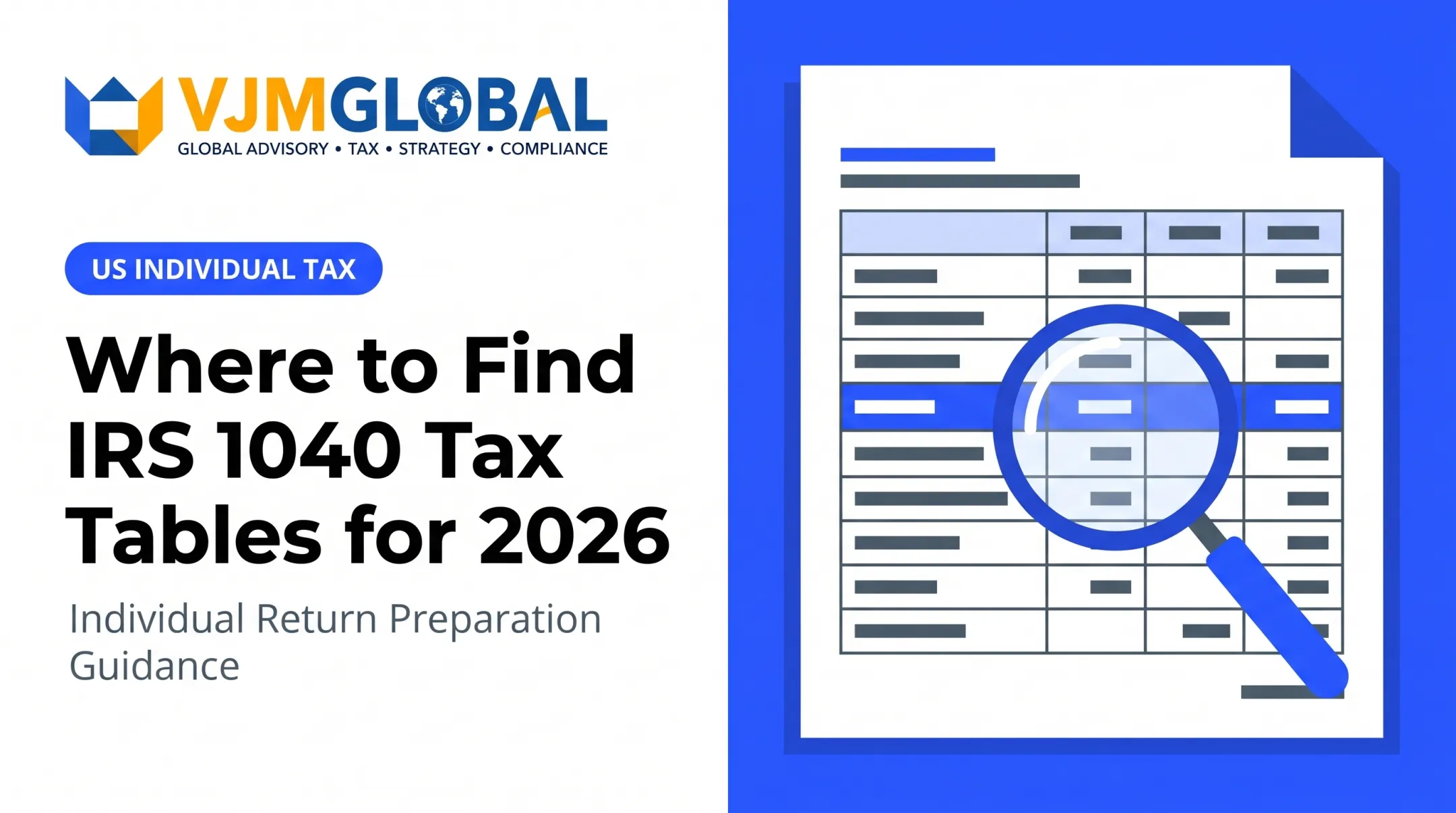
The table gives a federal income-tax amount for a taxable-income range and filing status. You enter that amount on Form 1040, line 16. That figure comes before credits, other taxes, payments and the refund calculation on the return.
The IRS's 2025 published example: a married couple filing jointly with $25,300 taxable income uses the $25,300–$25,350 row and the MFJ column. The result is $2,562.
Tax table, tax brackets and rate schedules
A table is a lookup. Brackets and rate schedules describe how income is taxed in layers. The IRS rates page notes that entering a higher bracket doesn't tax all your income at that higher rate.
For 2025, the instructions generally direct taxable income below $100,000 to the table. At $100,000 or more, you use the Tax Computation Worksheet. Exceptions exist, covered later.
Information to gather first
- Tax year and matching Form 1040 version
- Filing status
- Taxable income (line 15)
- Applicable schedules
- Any worksheet the instructions reference
US taxpayers in Australia should also confirm which return applies: Form 1040, 1040-SR, 1040-NR or an amended 1040-X. Resident-alien status generally depends on the green card or substantial presence test. A foreign mailing address alone does not determine either.
How to Use the 1040 Tax Table Step by Step
Start with the correct year and IRS source
Download the current Form 1040 and instructions from IRS.gov. The latest final instructions cover tax year 2025, which is not the same as the filing year. Check that the form, table, schedules and worksheets all match.
Don't rely on an old online table, an outdated software printout or a table from another season.
Calculate taxable income first
On the 2025 form, the flow runs like this:
- Line 9: total income
- Line 10: Schedule 1 adjustments
- Line 11a/11b: AGI (line 9 minus line 10)
- Line 12e: standard or itemised deduction
- Lines 13a/13b: qualified business income and Schedule 1-A deductions
- Line 15: taxable income (AGI minus line 14, never below zero)

Schedules can change these figures. Reconcile your table input against the final return before you use the table.
Select the correct filing-status column
Choose the column matching your actual status: single, married filing jointly, married filing separately, head of household or qualifying surviving spouse. Status also affects your deduction. Never pick one because it gives a lower number.
The 2025 basic standard deductions are:
| Filing status | Standard deduction |
|---|---|
| Single | $15,750 |
| Married filing jointly | $31,500 |
| Married filing separately | $15,750 |
| Head of household | $23,625 |
| Qualifying surviving spouse | $31,500 |
Find the row and read the amount
Locate your taxable-income range, move across to your column and record the amount exactly. Rows read "At least" and "But less than". The lower figure is included and the upper is excluded. So $25,350 falls in the next row, not the $25,300 row.
If income is at or above the table's limit, or the instructions send you to a worksheet, follow that instruction instead.
Carry the result into Form 1040
Enter the amount on line 16. From there, add Schedule 2 items (line 17), subtract credits (lines 19–21) and add other taxes such as self-employment tax (line 23).
Line 24 is total tax. Payments on line 33 then produce an overpayment (line 34) or an amount owed (line 37).

Finish with a reconciliation: compare the line 16 figure with total tax, total payments and refund or balance due. The table amount is never the final outcome.
Best Practices for Accurate Table-Based Tax Calculation
Run a pre-use checklist
- Tax year and IRS source match
- Form 1040 version is right
- Filing status is confirmed
- Taxable income ties to line 15
- Any referenced worksheet is completed
Rates, deductions, credits, table ranges and line numbers change annually, so check the instructions each year.
Keep a traceable trail
Retain income statements, deduction records, credit documentation, your prior return and supporting schedules. Under IRS Topic 305, records are generally kept for 3 years, longer in some situations. Every number should trace to a record, especially for investment, self-employment, property or foreign income.
Check status and deductions separately
A wrong filing status changes both your deduction and your table column. Compare standard and itemised deductions under current law before trusting your taxable income. The IRS's checklist of common errors also asks you to confirm the table column, deduction and credit calculations, and required schedules.
Cross-check independently
Compare your result with the Tax Computation Worksheet, a current calculator or tax software that covers your full situation. The IRS Tax Withholding Estimator is unavailable to nonresident aliens and to people without a job, pension or annuity with federal withholding.
A mismatch usually points to the wrong year, a wrong income figure, a special calculation, an omitted schedule or a software setting. It rarely means the IRS table is wrong.
Watch boundaries and unusual income
Recheck when taxable income sits near a row boundary. Also recheck if you have:
- Qualified dividends or capital gains (may need the Qualified Dividends and Capital Gain Tax Worksheet)
- Cryptocurrency (generally capital gain or loss on Form 8949; business receipts are ordinary income)
- Retirement distributions (lines 4a/4b for IRAs, 5a/5b for pensions)
- Self-employment earnings (Schedule SE generally applies at $400 or more)
Finally, review for duplicated or omitted income, incorrect basis, unsupported deductions and credits claimed before eligibility was confirmed.
How to Use the Table for Tax Planning, Without Misreading It
What actually reduces income tax
- Deductions reduce taxable income
- Credits reduce tax itself
- Refundable credits can produce a refund beyond your liability; unused nonrefundable credits don't
- Withholding and estimated payments change what you owe or get back, but they don't reduce the underlying liability
For 2025, the maximum child tax credit is $2,200 per Rev. Proc. 2025-32. These are maximums, not automatic entitlements. Eligibility limits, phaseouts and documentation rules apply to every deduction and credit.
Use the marginal rate for next-dollar decisions
Use the table to calculate current liability. When you model a bonus, extra deduction or retirement contribution, the marginal rate matters: the rate on your next layer of income. The average rate is total tax divided by total income, and it is lower than the marginal rate, so it is the wrong figure for those decisions.
For 2025, a single filer's 22% bracket runs above $48,475 up to $103,350.
Foreign-tax issues for US taxpayers in Australia
US citizens and resident aliens report worldwide income, even when living in Australia. Common relief options include the foreign earned income exclusion (maximum $130,000 for 2025, via Form 2555) or the Foreign Tax Credit (generally Form 1116).

- Claiming the exclusion requires the Foreign Earned Income Tax Worksheet, so a plain table lookup isn't enough.
- Foreign tax on excluded income can't also generate a credit.
- The exclusion doesn't remove self-employment tax.
- Currency is reported in USD, generally at the rate when income is received or expense paid.
Australian and US obligations are separate analyses. The 1040 tax table resolves neither country's full liability.
When the 1040 Tax Table Is Not Enough
Situations needing a worksheet, schedule or different form
- Qualified dividends and capital gains: dedicated worksheets
- Alternative minimum tax: Form 6251, with a 2025 single exemption of $88,100
- Self-employment tax: Schedule SE
- Foreign earned income: Form 2555 and its worksheet
- Nonresident aliens: Form 1040-NR
- Taxpayers 65 or older: optional Form 1040-SR
- Corrections: Form 1040-X
Additional checks for taxpayers in Australia
Check these items when you work through Form 1040:
- Currency conversion
- Foreign tax paid
- Australian income records
- Foreign accounts
FBAR generally applies when foreign accounts exceed $10,000 in aggregate at any time in the year. Form 8938 has separate, higher thresholds for those abroad. Both can apply, and neither replaces the other.

An Australian address doesn't determine US residency, filing status or eligibility for an exclusion or credit. Confirm current thresholds on official sources.
When professional support makes sense
Consider help if you have:
- Income from more than one country
- Self-employment or business ownership
- Investment sales
- Missing prior returns
- IRS notices
- Uncertain residency or conflicting tax documents
VJM Global offers tax compliance, accounting and advisory support, including Form 1040 and 1040-NR return preparation, when cross-border or business records complicate a table-only review. Return preparation and IRS representation differ: enrolled agents, CPAs and attorneys hold representation rights.
This article is general information. Confirm current IRS and Australian requirements and seek qualified advice for personal decisions.
Frequently Asked Questions
What is the best way to reduce your income tax?
Review eligible deductions, credits, timing decisions and foreign-tax provisions under current rules. Choosing a lower table row isn't a strategy. Confirm eligibility and keep documentation.
What income figure do you use with the 1040 tax table?
Use taxable income from line 15, not gross income or wages. Special worksheets can change the process.
Does the 1040 tax table show your refund or amount owed?
No. It gives a tax amount used within the return. Withholding, estimated payments, credits, other taxes and refundable amounts determine your refund or balance due.
How do you know which 1040 tax table to use?
Match it to the tax year, the Form 1040 instructions, your filing status and your situation. Use the current IRS source, not an old online copy.
What is the difference between the 1040 tax table and tax brackets?
The table is a lookup that supplies a single tax amount. Brackets and rate schedules show how taxable income is taxed in layers.
Can US taxpayers living in Australia use the 1040 tax table?
Eligible citizens and resident aliens can use the Form 1040 process. Foreign income, currency conversion, foreign tax, residency and account rules may require extra forms or calculations.