Introduction
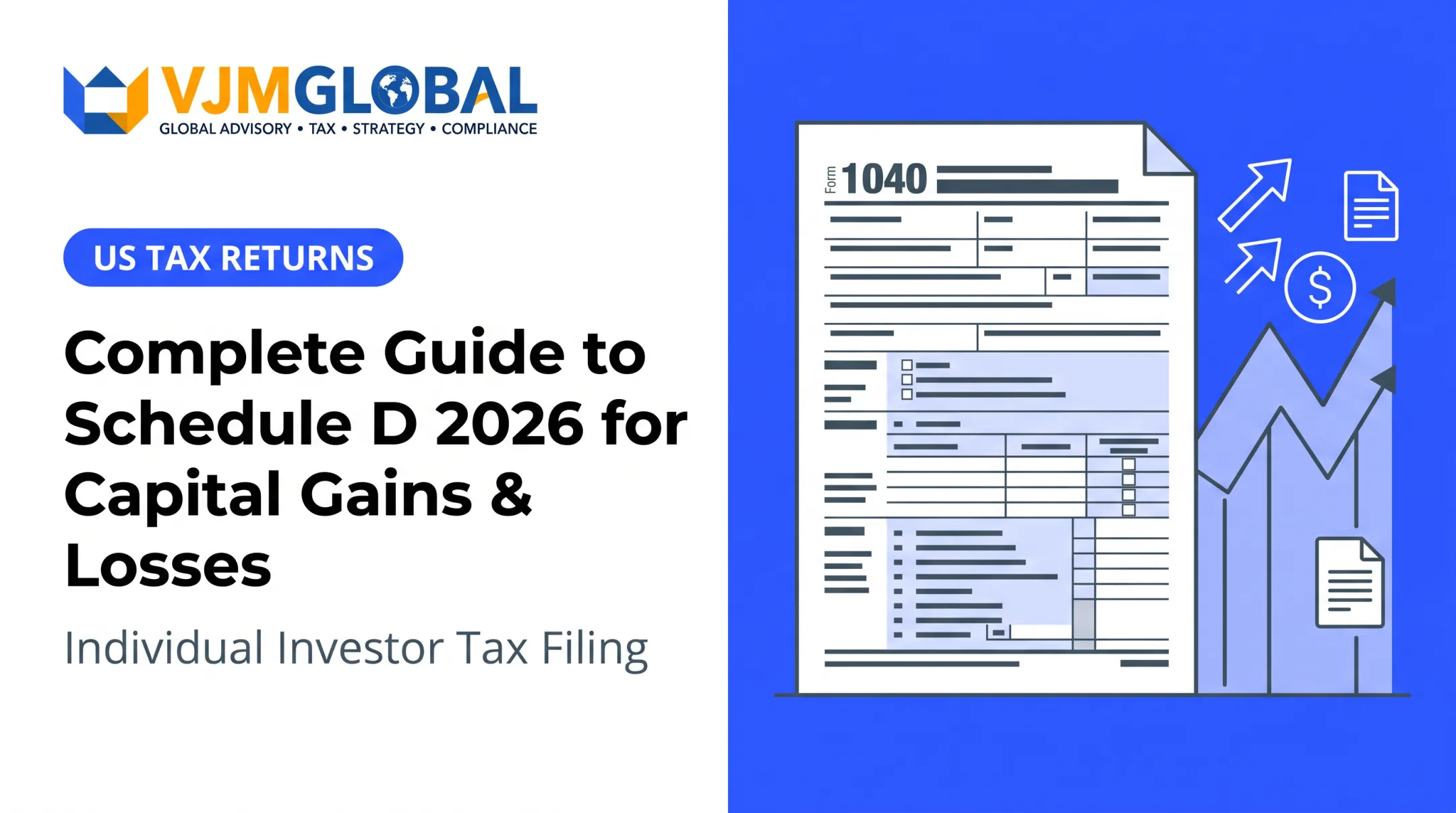
A prior-year capital loss carryover goes on Schedule D, not on Form 1040 as its own line. Schedule D nets everything, and only the final capital gain or (loss) moves to Form 1040.
That's where many filers struggle. Schedule D, Form 8949, the Capital Loss Carryover Worksheet and the Form 1040 line all play a part. People often enter the right number on the wrong form.
This guide shows which form takes which number, using the final 2025 IRS forms. Australian taxpayers with U.S. filing obligations should confirm the tax year and current IRS instructions before filing. Figures here are in U.S. dollars, as the return requires.
Key Takeaways
- Short-term carryover goes on Schedule D line 6; long-term on line 14 (2025).
- Form 8949 lists current-year sales, not carryovers.
- The Capital Loss Carryover Worksheet calculates the remaining balance.
- Only the net result from Schedule D reaches Form 1040 line 7a.
Where Is a Capital Loss Carryover Reported on Form 1040?
The carryover isn't typed onto Form 1040. It's entered on Schedule D, and the Schedule D result flows to Form 1040.
| Tax year | Short-term carryover (Schedule D) | Long-term carryover (Schedule D) | Form 1040 capital gain/(loss) |
|---|---|---|---|
| 2024 | Line 6 | Line 14 | Line 7 |
| 2025 | Line 6 | Line 14 | Line 7a |
Always check the form for your filing year, since the Form 1040 line number changed between 2024 and 2025. Only use final forms; the IRS warns that draft tax forms are not to be filed or relied on.
Why Schedule D, not Form 1040
Schedule D is where current-year transactions, prior-year carryovers and other capital items are netted. Line 16 combines the short-term and long-term results. For 2025, that result is reflected on Form 1040 line 7a, captioned "Capital gain or (loss)".
Schedule D versus Form 8949
Form 8949 lists individual sales and exchanges of capital assets, along with adjustments. Its totals feed Schedule D. A carryover isn't a sale, so it never goes on Form 8949.
The sequence at a glance
- Prior-year return and Capital Loss Carryover Worksheet
- Schedule D lines 6 and 14
- Schedule D net result (line 16)
- Form 1040 line 7a (2025)

How to Enter a Prior-Year Carryover on Schedule D
Keep short-term and long-term separate
The character of the loss stays with it. Short-term carryovers and long-term carryovers are reported separately, so don't merge them. Use the amounts shown on your prior-year Schedule D or worksheet.
Where to find the figures:
- Prior-year Schedule D and carryover worksheet
- Tax software records
- A carryover statement from your preparer
Enter the amounts
For 2025, the Schedule D instructions include a worksheet that computes the carryover from 2024. It draws on your prior-year Form 1040 line 15 and Schedule D amounts, including line 21.
- Worksheet line 8 (short-term) goes to Schedule D line 6, Part I
- Worksheet line 13 (long-term) goes to Schedule D line 14, Part II
Enter the remaining carryover, not the original loss. Part of it may already have been used against gains or the annual deduction.
Hypothetical example
These figures are invented for illustration only. Suppose you carry forward a $9,000 long-term loss and have $2,000 of long-term gains this year. The gains absorb $2,000 of the carryover, leaving a $7,000 net long-term loss.
If you can deduct $3,000 against other income, $4,000 carries forward to next year, still long-term.

For a real-world reference, IRS Publication 550 gives a case where a $7,000 loss produces a $3,000 deduction and a $4,000 carryforward.
How the Carryover Moves from Schedule D to Form 1040
Netting order
Capital losses first offset capital gains. Only a remaining net loss can then be deducted against other income. Within Schedule D:
- Short-term and long-term items are computed separately
- Long-term gains are reduced by long-term losses, including carryovers
- A net short-term loss, including unused short-term carryover, can then reduce remaining long-term gain
The annual limit
For 2025, the deduction against other income is the lesser of $3,000 or the net loss, and $1,500 if married filing separately, per IRS Topic 409. These figures are fixed by statute and not indexed for inflation.
Form 1040 line and worksheets
For 2025, the net capital gain or loss flows to line 7a. Line 7b is a checkbox used when Schedule D is not required.
When you have gains, the Schedule D Tax Worksheet or the Qualified Dividends and Capital Gain Tax Worksheet may apply. Check the Form 1040 instructions for your tax year.
Carryover versus current-year loss
A carryover comes from an earlier return. A current-year loss comes from transactions reported on this year's Form 8949 and Schedule D. Both are netted together.
What carries forward
Unused loss continues to later years until fully used, and keeps its short-term or long-term character. Record the closing balances from this year's worksheet so next year's entries stay accurate.

Records, Common Errors, and Cross-Border Considerations
Records checklist
- Prior-year Form 1040, Schedule D and carryover worksheet
- Forms 1099-B or 1099-DA, where applicable
- Form 8949 transaction records
- Brokerage statements
- Records supporting adjusted basis
Broker forms may not report complete basis. For digital assets, Form 1099-DA proceeds do not establish basis; you calculate it yourself.
Common mistakes
- Entering the full original loss instead of the remaining balance
- Putting the carryover on Form 8949
- Leaving out Schedule D
- Losing the short-term or long-term character
- Dropping the balance when changing software or preparers
- Using an outdated form
Australian taxpayers with U.S. obligations
- Currency: U.S. returns must use U.S. dollars. The IRS has no official rate; a consistent posted rate (usually the transaction-date spot rate) is generally accepted.
- Foreign brokerage records: Reconcile them with U.S. basis and dates.
- Other reporting: FBAR applies if foreign accounts exceed $10,000 in aggregate at any time in the year. Form 8938 and Form 8621 (PFICs) have separate thresholds; none of these is a Schedule D entry.
- Treaty: The U.S.-Australia treaty has rules on gains from property dispositions, and Form 1116 may require capital gain adjustments.
For complex cross-border returns, VJM Global's tax professionals prepare Form 1040 filings and track U.S. tax law changes that affect Australian filers.
Conclusion: A Practical Capital Loss Carryover Reporting Workflow
- Confirm the filing year and current forms.
- Retrieve the prior-year carryover.
- Separate short-term and long-term amounts.
- Complete the Capital Loss Carryover Worksheet.
- Enter the amounts on Schedule D lines 6 and 14 (2025).
- Review the net result on line 16.
- Transfer it to Form 1040 line 7a (2025).
If you have multiple brokerages, foreign investments, missing prior returns, amended returns or uncertain balances, professional help is worth considering. VJM Global offers U.S. Form 1040 support as one option, without promising any particular tax outcome.
Frequently Asked Questions
Where is the carryover loss on Form 1040?
It's entered on Schedule D (lines 6 and 14 for 2025). The resulting net gain or loss flows to Form 1040 line 7a. Verify line numbers for your tax year.
How much capital loss can I carry over?
The carryforward is the net loss left after offsetting gains and taking the allowable deduction. For 2025 the deduction is up to $3,000, or $1,500 if married filing separately.
Does a capital loss carry over automatically?
Software may bring it forward, but check it against your prior-year Schedule D and worksheet, especially after changing software or preparers.
Can you offset capital gains with carryover losses?
Yes. Carryover losses offset capital gains through Schedule D, with short-term and long-term amounts netted under IRS rules.
What are the rules for carry forward of losses?
Track unused losses, keep their character, and apply them in later years under IRS ordering rules. There's no fixed expiry. Check current instructions for special situations.
What is the capital loss carryover under IRS rules?
It's the part of a net capital loss exceeding the year's allowable deduction that remains for later years. The Schedule D instructions and worksheet give the authoritative calculation.