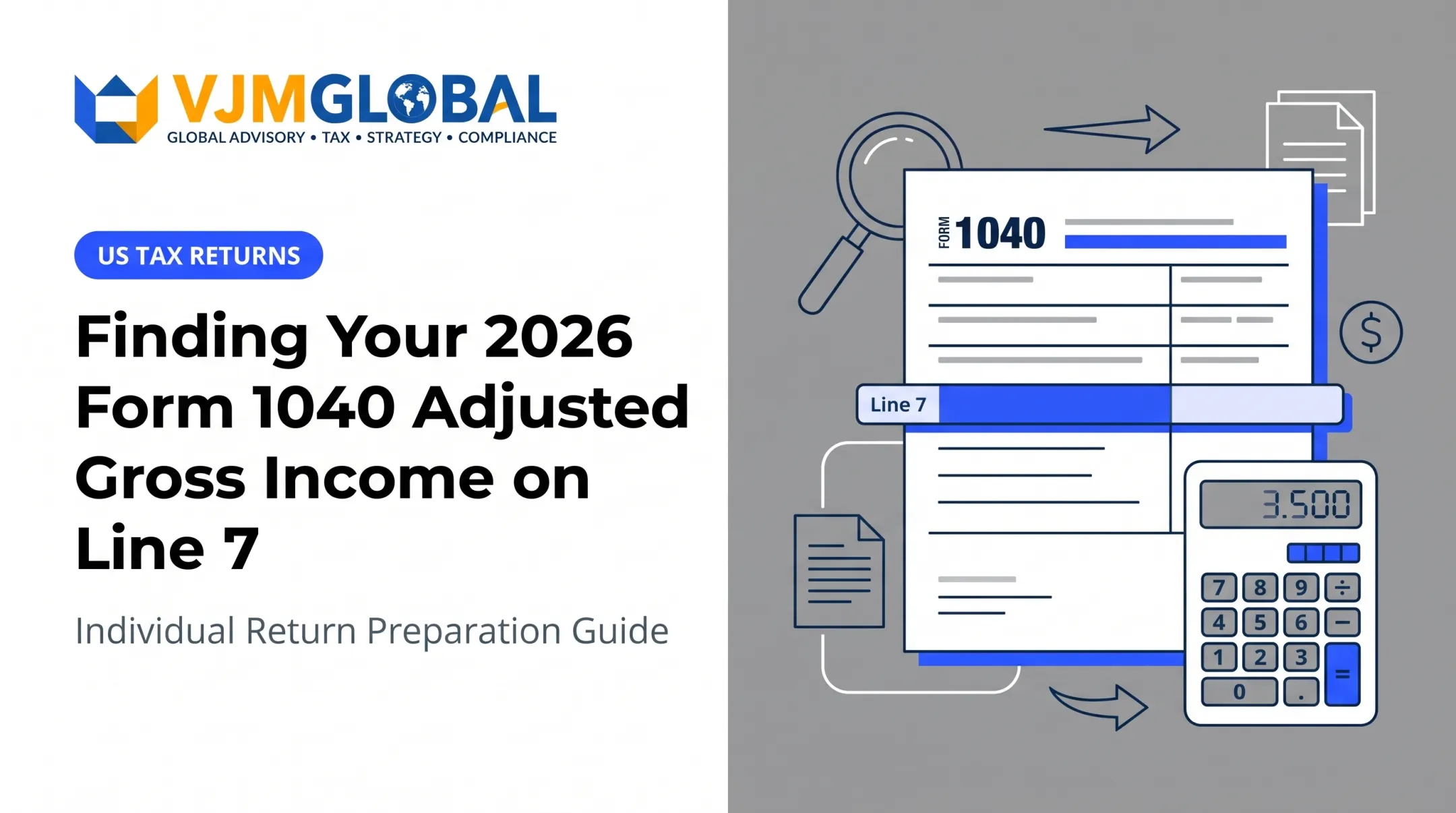
AGI is total income minus eligible adjustments to income, calculated before the standard or itemised deduction. This guide covers the common individual and self-employed adjustments, where they go on Form 1040 and Schedule 1, timing rules and records. Figures are for tax year 2025 (filed in 2026) unless stated, so check the IRS figures for your own year. Dollar amounts are US dollars, as the IRS reports them.
Key Takeaways
- Above-the-line adjustments reduce AGI whether you take the standard deduction or itemise.
- Common adjustments include HSAs, IRAs, student loan interest, educator expenses and self-employed deductions.
- AGI, MAGI and taxable income are three different numbers.
- IRA and HSA contributions generally can't be extended past April 15, 2026, even with a filing extension.
How AGI Is Calculated on Form 1040
The calculation sequence
Income moves to AGI in a fixed order on Form 1040:
- Report income from all sources and combine it into total income (2025 Form 1040, line 9).
- Subtract adjustments from Part II of 2025 Schedule 1. Line 26 totals them and carries the result to Form 1040, line 10.
- Arrive at AGI on line 11a.
Line numbers shift between years, so confirm them against your year's forms.
The standard or itemised deduction comes after AGI. You then subtract total deductions (including any qualified business income deduction) to reach taxable income, which can't go below zero.

AGI versus related terms
- Taxable income: AGI minus the standard or itemised deduction and other applicable deductions.
- MAGI: AGI plus add-backs, and the add-backs differ by benefit. Traditional IRA deductibility, Roth eligibility and student loan interest each use their own formula.
- Payroll deferrals: Pre-tax 401(k), 403(b) and SIMPLE deferrals are generally excluded from W-2 Box 1 already. They don't get deducted again on Schedule 1.
- Business expenses: Schedule C expenses reduce business profit before it reaches Schedule 1, Part I. They aren't a second Part II adjustment.
Individual Deductions and Adjustments That May Reduce AGI
Health Savings Account contributions
To contribute, you generally need qualifying high-deductible health plan (HDHP) coverage on the first day of the month, no disqualifying other coverage and no Medicare enrollment. You also can't be claimed as someone else's dependent.
| 2025 HSA benchmark | Self-only | Family |
|---|---|---|
| Contribution limit | $4,300 | $8,550 |
| HDHP minimum deductible | $1,650 | $3,300 |
Age 55 and over adds $1,000. Employer and personal contributions share one limit.
Payroll contributions (W-2 code W) are already excluded from wages. Only personal contributions are deducted, through Form 8889 and Schedule 1, line 13. Claiming both is the classic double count.
The 2025 deadline is April 15, 2026, with no extension. Excess contributions face a 6% annual excise tax. IRS Publication 969 covers the last-month rule and testing period.
Traditional IRA contributions
A traditional IRA deduction is available even if you take the standard deduction. The 2025 limit is the smaller of compensation or $7,000 ($8,000 at 50+). Being allowed to contribute doesn't mean the contribution is deductible.
If you're covered by a workplace plan, the deduction phases out by MAGI:
| 2025 situation | MAGI phaseout |
|---|---|
| Covered, single/HOH | $79,000-$89,000 |
| Covered, married filing jointly | $126,000-$146,000 |
| Not covered, spouse covered, MFJ | $236,000-$246,000 |
If neither spouse is covered, there's no phaseout. Nondeductible contributions go on Form 8606. Roth contributions never reduce AGI. See IRS Publication 590-A for the full rules.
Student loan interest
This is an adjustment, not an itemized deduction. You can deduct the smaller of $2,500 or interest paid. For 2025, the MAGI phaseout is $85,000-$100,000 for single filers and $170,000-$200,000 for joint filers. Married filing separately is ineligible.

The loan must have been taken out solely for qualified higher-education expenses. Form 1098-E supports the claim, but its $600 threshold is only a lender reporting rule, not a deduction cap. Loan principal is never deductible.
Educator expenses and other limited adjustments
Eligible K-12 teachers, instructors, counselors, principals and aides who worked at least 900 hours in a school year can deduct up to $300 of unreimbursed classroom costs for 2025. Joint filers who both qualify can deduct $600. The limit rises to $350 for 2026. Keep receipts.
Narrower adjustments include:
- Early-withdrawal savings penalty (Form 1099-INT, Box 2)
- Reservist expenses, where travel exceeds 100 miles from home
- Qualifying performing-artist expenses
- Active-duty military moves under permanent change of station orders
Alimony is not a general AGI deduction. Payments under instruments executed after 2018 aren't deductible.
Self-Employed Strategies That Can Reduce AGI
Half of self-employment tax
Schedule SE applies a 92.35% factor to net earnings, then the 15.3% combined rate (12.4% Social Security up to the $176,100 wage base, plus 2.9% Medicare). You deduct one-half of the SE tax through Schedule 1, line 15. You can't deduct the full amount.
Schedule C accuracy matters here. Overstated expenses understate profit, which understates SE tax and the deduction, and your AGI ends up wrong.
Self-employed health insurance
Premiums for medical, dental and qualifying long-term care cover for you, your spouse and dependents can qualify. Medicare premiums you pay voluntarily can also count. Limits to watch:
- The deduction can't exceed net profit from the business.
- No deduction for any month you were eligible for subsidised employer coverage, including a spouse's plan, even if you didn't enrol.
- Long-term care premiums are capped by age. The 2025 ceiling is $480 at 40 or under and $6,020 at 71+.
Use Form 7206. Keep policy statements and proof of payment.
SEP IRA, SIMPLE IRA and solo 401(k)
| 2025 plan | Main limit | Catch-up |
|---|---|---|
| SEP IRA | About 25% of compensation, capped at $70,000 | N/A |
| SIMPLE IRA | $16,500 deferral | $3,500 at 50+; $5,250 at 60-63 |
| Solo 401(k) | $23,500 deferral plus employer share, $70,000 combined cap | $7,500 at 50+; $11,250 at 60-63 |

Deadlines differ. A SEP can be set up and funded by the return due date, including extensions. A new SIMPLE generally must be established by October 1. Solo 401(k) deferral elections usually need year-end action, with a narrow first-year exception for sole proprietors.
Your own contributions as a sole proprietor or partner go on Schedule 1, line 16. For an S corporation owner, contributions are based on W-2 pay, not distributions.
An illustrative example
This is a hypothetical, not a promised saving. A single freelancer has $80,000 net Schedule C profit and no other income.
| Step | Amount |
|---|---|
| Total income | $80,000 |
| Half of SE tax (about $11,304 total) | -$5,652 |
| Personal HSA contribution (self-only, eligible) | -$4,300 |
| Student loan interest | -$1,500 |
| AGI | $68,548 |
| Standard deduction (2026 figure of $16,100, for illustration; confirm your year's amount) | -$16,100 |
| Taxable income (before any QBI deduction) | $52,448 |
Your actual benefit depends on filing status, marginal rate, phaseouts, credits and state rules.
Business structure and bookkeeping
Sole proprietors, partners and S corporation owners don't follow identical rules. A partner's insurance paid through the partnership involves guaranteed-payment reporting. A more-than-2% S corporation shareholder's premiums must be included in W-2 Box 1.
Clean books support every calculation above. An expense claimed as a business deduction can't also be an individual adjustment unless the rules say so.
How to Plan, Document and Avoid AGI-Reduction Errors
A planning timeline
- Before year-end: Estimate AGI and check phaseout ranges. Make solo 401(k) deferral elections and check SIMPLE deadlines.
- After year-end, before the filing deadline: Fund IRA and HSA contributions for the prior year by April 15, 2026.
- If you extend: Form 4868 moves filing to October 15, 2026, but not payment. IRA and HSA deadlines stay put. SEP funding can run to the extended date.

Documentation checklist
- Form 1098-E and loan statements
- HSA contribution records and Form 8889
- IRA records and Form 8606 if needed
- Insurance premium statements and payment proof
- Form 1099-INT
- Schedule C, Schedule SE and W-2 payroll data
- Educator expense receipts
The IRS generally expects you to keep records for three years, and longer in some cases.
Common mistakes
- Using last year's limit
- Confusing AGI with MAGI
- Double-counting payroll HSA contributions
- Claiming an adjustment without enough income or eligibility
- Treating Schedule A items as AGI adjustments
- Filing Form 1040 when Form 1040-NR applies
That last one matters for cross-border readers. The substantial presence test generally requires at least 31 days in the current year and 183 weighted days over three years.
Form 1040-NR adjustments aren't identical to those on Form 1040. For example, there's no spousal IRA deduction.
If you have cross-border income, multiple entities or complex coverage arrangements, a professional review is worthwhile. VJM Global prepares Form 1040 and 1040-NR returns and provides US tax compliance and international tax support, without promising any particular tax result.
Frequently Asked Questions
What deductions can reduce AGI?
Common ones are HSA contributions, deductible traditional IRA contributions, student loan interest, educator expenses, self-employed health insurance, half of SE tax and self-employed retirement contributions. Limits and eligibility vary.
How do I calculate AGI on Form 1040?
Start with total income and subtract eligible adjustments from Schedule 1, Part II. The total flows to Form 1040, and the result is AGI. Verify line numbers against your year's forms.
Are above-the-line deductions available if I take the standard deduction?
Yes. Eligible adjustments reduce AGI before either the standard or itemised deduction applies. They are separate from Schedule A deductions.
What self-employed deductions reduce AGI?
The main ones are half of SE tax, self-employed health insurance and SEP, SIMPLE or solo 401(k) contributions. Other adjustments may apply to your situation.
Is MAGI the same as AGI?
No. MAGI starts with AGI and adds back items that depend on the credit, deduction or retirement rule involved. The two figures may differ.
Can I reduce AGI after the tax year ends?
Sometimes. Eligible HSA and traditional IRA contributions for 2025 can be made until April 15, 2026. Most other deductions must be incurred or funded within the tax year.