This guide is for anyone filing a US Form 1040, including Australian residents who still have US filing obligations. Residence abroad does not remove those obligations. The rules below are US federal rules, not Australian tax treatment, and the figures come from the IRS 2025 forms. Always check the form package for your return year.
Key Takeaways
- Form 8863 calculates the credits; the results flow through Schedule 3 and Form 1040.
- AOTC and LLC differ on enrolment, duration, refundability and limits.
- Only qualifying expenses count, reduced by tax-free scholarships and assistance.
- Current IRS instructions control thresholds, ID rules and line numbers.
What Is an Education Credit on Form 1040?
A credit cuts your tax bill dollar for dollar. A deduction only lowers the income that gets taxed. That is why a $1,000 credit beats a $1,000 deduction for almost everyone.
The two credits
- American Opportunity Tax Credit (AOTC): For eligible students in the first four years of postsecondary education. Up to 40% of the credit can be refundable.
- Lifetime Learning Credit (LLC): For postsecondary courses, including graduate study and courses taken to acquire or improve job skills. It is nonrefundable.
Where the numbers go
For tax year 2025, the routing runs like this:
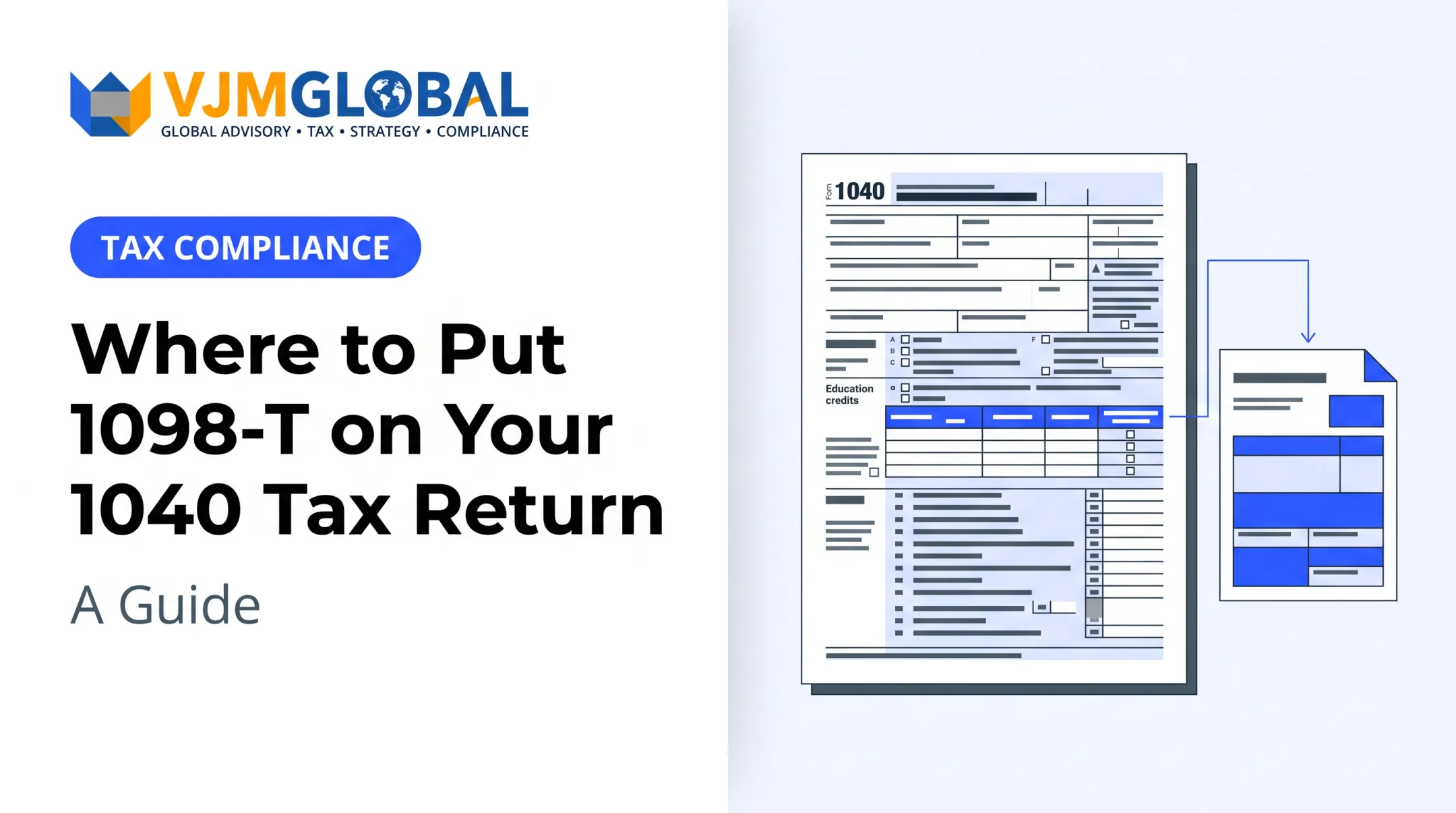
- Form 8863 Part I reports the refundable AOTC to Form 1040 line 29.
- Part II sends the nonrefundable credit (line 19) to Schedule 3, line 3.
- Schedule 3 line 8 carries to Form 1040 line 20.
Line numbers shift between years, so confirm them against your own year's forms.
Are You Eligible for an Education Credit?
Both education credits share these core requirements:
- You, your spouse or a dependent was the student.
- The school is an eligible educational institution.
- You paid qualifying expenses.
- You are not filing married filing separately.
- Your modified adjusted gross income (MAGI) is under the phase-out limit.
American Opportunity Tax Credit (AOTC) rules
For 2025, the student must:
- Not have finished the first four years of postsecondary education before 2025.
- Not have had AOTC claimed for them in more than four prior tax years, by anyone.
- Be enrolled at least half-time for one academic period in a degree, certificate or similar programme.
- Have no federal or state felony drug conviction by the end of 2025.
Lifetime Learning Credit (LLC) rules
The Lifetime Learning Credit has no half-time requirement, covers a single course, and has no four-year or lifetime year limit. Graduate and job-skill courses qualify.
Identification, dependency and residency
If another taxpayer claims the student as a dependent, you cannot claim the credit for that student. The person claiming the dependent generally takes it. Nonresident aliens are generally ineligible unless a resident-treatment or joint-return exception applies.
The 2025 instructions require the taxpayer and student to have a TIN by the return due date, including extensions. Australian filers should not assume an ITIN or foreign status satisfies this.
For tax year 2026, IRS guidance adds a valid, work-authorised SSN requirement, and an ITIN alone does not meet it. Do not apply that rule backwards to 2025.
One credit per student
You cannot claim both credits for the same student in the same year. You can claim AOTC for one child and LLC for another on the same return.
Australian institutions
A school outside the United States can qualify if it is eligible to participate in US Department of Education student-aid programmes. The Department's international list includes Monash, UNSW Sydney and Macquarie, among others. Check the status for your year and keep proof of enrolment and payment.
How Much Can You Claim and Which Expenses Qualify?
| AOTC | LLC | |
|---|---|---|
| 2025 calculation | 100% of first $2,000 plus 25% of next $2,000 | 20% of up to $10,000 |
| Maximum | $2,500 per student | $2,000 per return |
| Refundable | Up to $1,000 | No |
| MAGI phase-out (single, HOH, QSS) | $80,000-$90,000 | $80,000-$90,000 |
| MAGI phase-out (joint) | $160,000-$180,000 | $160,000-$180,000 |
These figures apply to tax year 2025 only. Check current IRS guidance for any 2026 limit changes before you file.
Refundable versus nonrefundable
A nonrefundable credit can only wipe out tax you owe. The refundable AOTC portion can produce a refund even if your tax is zero. The LLC never does.
Qualifying and nonqualifying costs
- AOTC: Tuition, required fees, and books, supplies and equipment required for the course, even if bought from a seller other than the school.
- LLC: Tuition and required fees. Books and supplies count only if paid to the institution as a condition of enrolment.
- Neither: Room and board, transport, insurance, medical costs including student health fees, and similar personal expenses. Non-credit sports or hobby courses generally fail too, except LLC job-skill courses.
Adjusting for tax-free assistance
Subtract tax-free scholarships, employer education assistance and other tax-free help from your expenses. Tax-free 529 distributions also must be coordinated, because the same dollars cannot be used twice.
Hypothetical example, not a taxpayer-specific result: A student pays $6,000 in tuition and fees and receives a $2,500 tax-free scholarship. The adjusted expense base is $3,500. AOTC would be $2,000 plus 25% of $1,500, or $2,375, before any phase-out.

How to Claim the Education Credit on Form 1040
Gather your records
- Form 1098-T from the school
- Billing statements and payment records
- Receipts for required books and equipment
- Scholarship, grant and employer assistance records
- 529 or Coverdell statements
- Taxpayer and student ID details
- Prior returns showing AOTC claims
Reconcile Form 1098-T
Box 1 shows payments the school received. It may not include every eligible cost, so it is not the credit amount. Box 5 reports scholarships and grants but is not netted against Box 1 on the form.
Box 8 flags half-time status and Box 9 graduate status. Subtracting one box from another is not the calculation.
Complete Form 8863
- Fill in Part III for each student, with institution details and qualified expenses. Each student gets a separate Part III.
- Test eligibility and compute the credit in Part I (refundable AOTC) and Part II (nonrefundable).
- Choose AOTC or LLC per student, never using the same student's expenses twice.
- Carry the results to Schedule 3 and Form 1040, and attach Form 8863 to the return.

Form 1098-T is supporting information. IRS instructions do not require routine attachment, so keep it with your records.
Final review
- Filing status and dependency
- MAGI against the phase-out
- Student and taxpayer identifiers
- Prior AOTC claims
- Tax-free assistance deducted
- No duplicate expenses
- Form 1098-T, Form 8863 and Form 1040 agree
If you missed a valid credit, you can amend with Form 1040-X.
VJM Global prepares US Form 1040 returns and handles cross-border situations, including reviewing education-credit documentation and reporting. Its tax professionals are trained in US tax law and IRS requirements. Eligibility and your final result still depend on your facts and current IRS rules.
Documents, Records, and Common Mistakes
What each record proves
- Form 1098-T: Enrolment and payments received.
- Receipts and statements: Expenses not shown in Box 1.
- Scholarship and employer records: Assistance to subtract.
- Student ID details: Identity and TIN match.
- Prior returns: AOTC claim history.
Frequent errors
- Treating Form 1098-T as the full calculation
- Claiming room and board
- Not reducing expenses for tax-free assistance
- Using the same expense for more than one benefit
- Claiming both credits for one student
- Overlooking prior AOTC claims
The scale of the problem is real. A TIGTA report estimated 3.6 million tax-year-2012 returns received $5.6 billion in potentially erroneous education credits. That is a historical estimate, not today's error rate.

If Form 1098-T is missing or wrong
- Wrong student details: Ask the school to correct them.
- Not required: Schools may skip the form for some non-credit study, nonresident aliens, or fully waived tuition. You can still claim with proof of enrolment and payments at an eligible school.
- Foreign school: A missing US form does not prove eligibility. The school must still meet the IRS test.
Retention and amending
Keep records until the limitations period expires, generally three years after filing, longer in some cases. For a missed credit, the claim deadline is the later of three years from filing or two years from paying the tax.
Frequently Asked Questions
What is the maximum amount of the American Opportunity Tax Credit?
For 2025 it is $2,500 per eligible student, with up to $1,000 refundable. Income, qualified expenses and refundability rules can reduce what you actually receive.
How can I claim the full $2,500 American Opportunity Tax Credit?
It is a maximum, not a guarantee. You need adjusted qualified expenses of at least $4,000, MAGI below the phase-out, and to meet every AOTC rule, then complete Form 8863.
How do I claim education credits on my tax return (Form 8863)?
Gather Form 1098-T and payment records, complete the relevant Form 8863 parts, and carry the result through Schedule 3 to Form 1040. Attach Form 8863 to the return.
How do I calculate education credits on Form 1040?
The calculation happens on Form 8863, not Form 1040. The amounts then flow through Schedule 3 and the return, so follow your year's instructions.
How many years can I claim the American Opportunity Tax Credit?
AOTC cannot be claimed for a student in more than four prior tax years, including claims by a parent or anyone else. Review earlier returns first.
What are the income limits for education tax credits?
For 2025, both credits phase out at $80,000-$90,000 MAGI for single, head-of-household and qualifying surviving spouse filers, and $160,000-$180,000 for joint filers. Check the current Form 8863 instructions for your year.