Much of the confusion comes from mixing up five separate questions: immigration status, federal tax residency, income-tax filing status, FICA withholding, and state residency. Each has its own rules. This guide walks through the calendar-year check, the substantial presence test, the forms you'll need, and what changes once the exclusion ends. Students from Australia and elsewhere face the same U.S. rules, and your home country's tax residency is a separate matter.
Key Takeaways
- Qualifying F-1 students generally stay nonresident aliens while their student days are excluded, usually for five calendar years.
- Residency after the exclusion depends on the substantial presence test, exceptions, treaties and the residency start date.
- Nonresident students commonly file Form 8843, plus Form 1040-NR when income or a refund claim requires it.
- FICA exemption doesn't mean income-tax exemption.
Are F-1 Students Nonresident Aliens for Tax Purposes?
What "nonresident alien" means under U.S. tax law
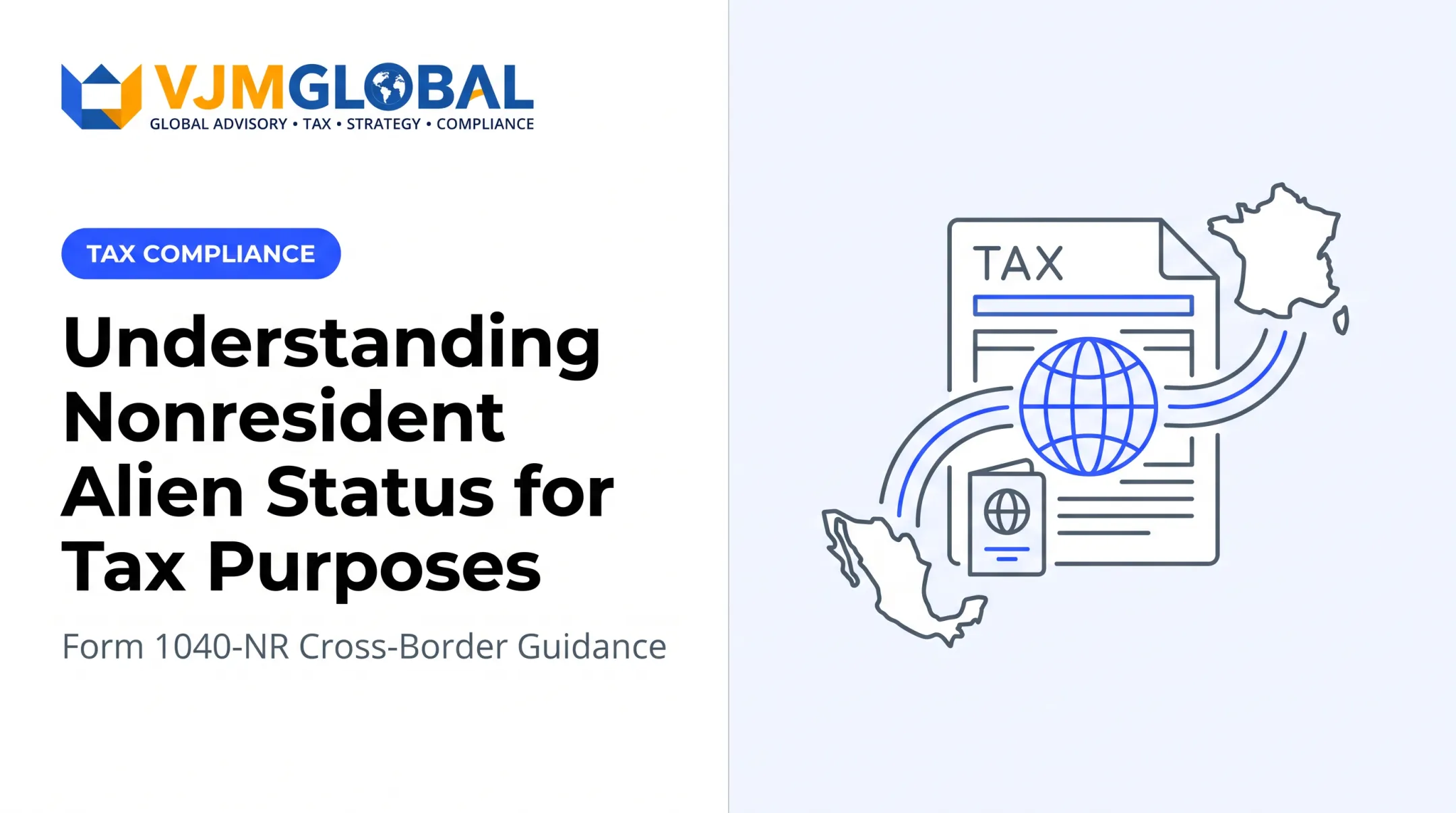
For tax purposes, a nonresident alien is someone who is neither a U.S. citizen nor a tax resident. Residency generally follows the green card test or the substantial presence test, under IRC section 7701(b). Note this is a tax definition, not an immigration one.
An F-1 student can hold lawful nonimmigrant status and be a nonresident alien for tax. Neither label automatically changes the other.
Why F-1 students are usually nonresidents at first
Qualifying F, J, M and Q students who substantially comply with their status requirements exclude their student days from the substantial presence test, generally for five calendar years. The IRS student guidance sets out the rule.
Three points trip people up:
- The count is by calendar year, not 60 months. Arriving in late December still uses up a full year.
- Partial and nonconsecutive years count.
- Prior F, J, M or Q student years, and some teacher or trainee years, reduce the exclusion you have left.
What the F-1 visa does not decide
OPT, STEM OPT and CPT don't create a separate tax-residency category. You still assess residency, work authorisation, income source and payroll tax separately.
A green card, a change of visa class, prior qualifying presence, a treaty position or a special exception can all change the result. And Form 8843 only documents why your days are excluded. It doesn't make wages or scholarships tax-free.
How to Determine Your F-1 Tax Residency
Apply the substantial presence test to countable days only
You meet the test with at least 31 countable days in the current year and 183 weighted days across three years. Weighting counts every countable day this year, one-third of last year's days and one-sixth of the year before. The IRS substantial presence page has the current wording.

Excluded student days don't count at all. "Exempt individual" means exempt from counting certain days, not exempt from U.S. income tax. Days in another visa status, and days after the exclusion ends, may count.
Build a calendar-year timeline
Do this before touching tax software:
- Find the first calendar year you were in the U.S. in qualifying student status.
- List every later qualifying year, including earlier F-1 or J-1 stays.
- Reconcile Form I-94 travel history with passport stamps, airline records and old Forms 8843.
The calendar year matters more than total days on the ground. Student A arrives in December 2022 and Student B in January 2022. Both use 2022 as the first exempt year, so both stay exempt through 2026, yet Student A gets far less actual U.S. time out of year one. This is an illustration, not individual advice.
What happens after the five-year exclusion
Once the period ends, your days begin to count. You're not automatically a resident alien, though. The IRS gives an example of a student who arrived on August 15, 2020, with exempt years 2020 to 2024. Counting began January 1, 2025, and the student met the test on July 2. Residency still started January 1 of that year.
Possible ways to stay nonresident include:
- Continued student exemption: you must show you don't intend to reside permanently in the U.S. and that you substantially comply with your status.
- Closer connection exception: fewer than 183 U.S. days in the year, a foreign tax home and closer foreign ties, generally claimed on Form 8840.
- Treaty tie-breaker: claiming other-country residence requires a timely Form 1040-NR plus Form 8833.
A transition year can be dual-status. The residency start date matters because it splits the year into nonresident and resident periods.
When to get a second opinion
Get a professional review if any of these apply:
- Prior J-1 or F-1 years
- A mid-year visa change or F-1 to H-1B move
- Long travel outside the U.S.
- A green card application or treaty benefits claim
Tax software asks for immigration details, but it can't replace a review of travel history, prior filings and residency dates.
What Changes When an F-1 Student Becomes a Resident Alien?
Income-tax scope and filing status
Residents generally report worldwide income on Form 1040. Nonresidents report U.S.-source income and income effectively connected with a U.S. business on Form 1040-NR.
Resident status can also change which deductions, credits and treaty claims you can use. Foreign income, investments and accounts may need a fresh review. Foreign-reporting duties are not identical for every resident, so confirm the current-year thresholds that apply to you.
Federal income tax versus FICA
Authorised OPT, CPT or on-campus wages stay subject to federal income tax even when the student is exempt from Social Security and Medicare tax.
Under IRS FICA guidance, the F-1 exemption applies while you're a nonresident doing authorised work consistent with your admission purpose.
Once you become a resident, that exemption ends. A separate school-employment exception may apply if you're enrolled at least half-time and the work is incidental to your studies. Ordinary jobs with outside employers don't qualify.
If an employer withheld FICA by mistake:
- Ask the employer for a refund first.
- If you don't get a full refund, file Form 843 with Form 8316 and supporting documents.
Scholarships, stipends and treaty income
Tax-free scholarship amounts for degree candidates cover tuition, required fees and required books or equipment. Room and board are taxable, and so are payments for required teaching or research service.
Treaty relief depends on your country of tax residence, income type, treaty article and time limits. Don't copy another student's position. For illustration only, the India and China treaties have student articles, and the China article exempts personal-service income up to $5,000 per year (US dollars). Both carry conditions.

Check which of these apply to your income:
- Form W-2 for wages
- Form 1042-S for taxable scholarships or treaty-exempt pay
- Form 8233 for treaty exemption on compensation
- Form W-8BEN for noncompensatory scholarships
- Form 8833 for treaty disclosures
Student-income treaty exemptions are generally waived from Form 8833 disclosure, but confirm the rule for your article and tax year.
State taxes
State rules differ from federal ones. Federal nonresident status doesn't erase state filing, local tax or refund obligations.
Common tests include:
- California: domicile, and whether your stay is temporary or transitory
- New York: domicile, or a permanent place of abode plus 184 or more days in the state
What Forms Do F-1 Students Need to File?
Form 8843
Form 8843 is required for qualifying exempt individuals, even with no income. Each person files their own. Attach it to Form 1040-NR, or mail it alone if no return is required, by the 1040-NR due date including extensions.
It supports your claim to exclude those days from the substantial presence test. It doesn't replace an income tax return when you have taxable income.
Form 1040-NR versus Form 1040
There's no universal minimum-income threshold for nonresident students. Taxable scholarships, wages and treaty-exempt income can trigger a Form 1040-NR. Solely tax-free scholarships don't.
| Situation | Likely form |
|---|---|
| Nonresident, no income | Form 8843 only |
| Nonresident with taxable U.S. income or refund claim | Form 1040-NR plus Form 8843 |
| Full-year resident alien | Form 1040, no Form 8843 |
| Dual-status year | Form 1040-NR and Form 1040 for each period |
For tax year 2025, the deadline is April 15, 2026 for people with wages subject to U.S. withholding, and June 15, 2026 for those without. Dates change each year.
Documents to gather
- Passport, visa history and Form I-20
- I-94 travel history and prior Forms 8843
- W-2 and 1042-S forms
- Scholarship records and treaty documents
- State tax statements
- Foreign-income or account records, where relevant
Then reconcile. Income statements, withholding, entry and exit dates and treaty claims should agree across the return. Treaty-exempt wages, for example, go on a different line of Form 1040-NR than ordinary wages.
Common F-1 Tax Situations and Mistakes
OPT, CPT and employment
F-1 students may work only with proper immigration authorisation, and that authorisation doesn't set tax residency. Don't confuse FICA exemption with income-tax exemption. Check your payslips for incorrect Social Security or Medicare withholding.
Common filing errors
- Filing Form 1040 instead of Form 1040-NR, or the reverse
- Treating five calendar years as five full years
- Skipping Form 8843
- Misclassifying scholarships
- Overlooking state filing
- Using another student's treaty position
Fix errors promptly. Form 1040-X covers a wrong 1040 or 1040-NR, and paper returns are marked "Amended."
Late income-tax returns generally attract 5% of unpaid tax per month, up to 25%. Reasonable cause relief is case-specific. Form 8843 has no flat student late fee, though late filing can put the exclusion at risk.

When professional support helps
Personalised help is worth it when you face:
- A sixth-year substantial presence analysis
- Prior visa history that affects the count
- An F-1 to H-1B transition or dual-status year
- Treaty income, foreign accounts or several years of missed forms
VJM Global prepares Form 1040 and Form 1040-NR returns and supports treaty-position filings such as Form 8833 for foreign nationals. The firm does not offer immigration or visa services, and no review can guarantee an outcome. It can help you check residency, income reporting and filing obligations against your own records.
Frequently Asked Questions
Are F-1 students considered nonresident aliens for U.S. tax purposes?
Generally yes, while eligible student days are excluded. Your calendar-year history, the substantial presence test, exceptions, treaties and any other visa status can change the result.
How do I know if I am a resident alien for tax purposes?
Check the green card test and the substantial presence test. Count only countable days, apply the student exclusion period, then see whether a treaty or closer-connection exception applies.
Who is considered a nonresident alien for U.S. tax purposes?
Someone who is neither a U.S. citizen nor a green card holder and who doesn't meet the substantial presence test or another residency test.
Who is exempt from Social Security tax?
An eligible nonresident F-1 student may be exempt from Social Security and Medicare tax on authorised, purpose-related work. Income tax and the school-employment exception are separate questions.
Can F-1 students work in the U.S.?
Only through authorised routes: on-campus work (generally up to 20 hours a week during sessions), CPT, OPT or STEM OPT. Authorised work remains subject to income-tax rules and, where applicable, payroll tax.
Is the F-1 visa a nonimmigrant status?
Yes. F-1 is a nonimmigrant academic-student classification. It is a separate determination from nonresident-alien tax status.