Introduction
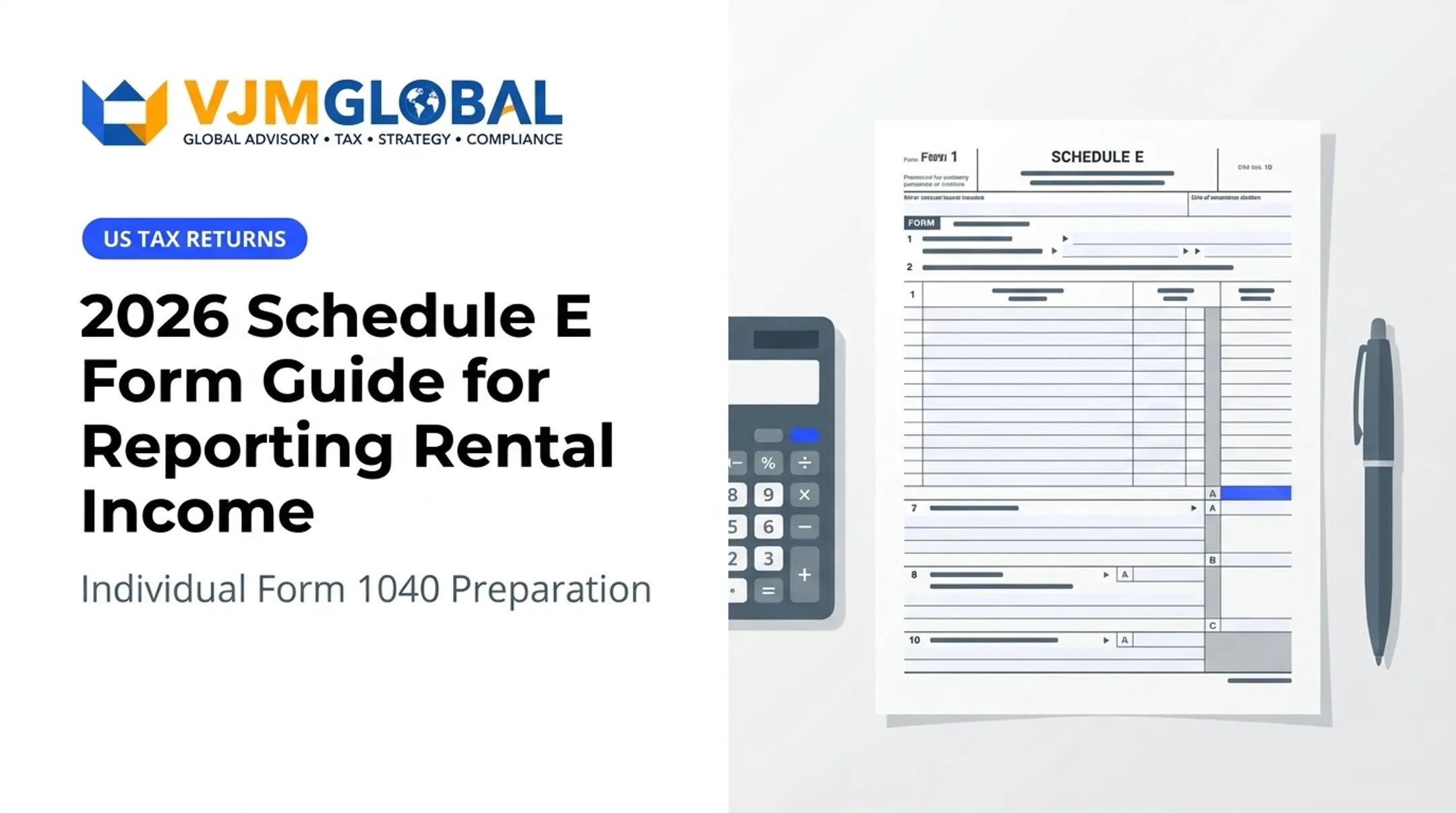
Schedule E (Form 1040), Supplemental Income and Loss, reports rental, royalty, partnership, S corporation, estate, trust, and REMIC income or loss. It attaches to your Form 1040.
For U.S. citizens and green card holders living in Australia, Schedule E often brings extra complications: foreign rent, currency conversion, and two tax systems.
Dates cause confusion. "Filing in 2026" usually means a return for tax year 2025, due April 15, 2026, with a June 15 overseas extension. The current final form is the 2025 Schedule E. The 2026 materials are still drafts marked "do not file," so confirm the revision before you file.
This guide covers rental owners, foreign-property owners, K-1 recipients, and royalty recipients. Nonresident aliens who must file Form 1040-NR need a different analysis.
Key Takeaways
- Schedule E has five parts, and you complete only those matching your income.
- Rentals use property-level expenses; K-1 amounts come from the entity.
- Losses face basis, at-risk, and passive limits before they reduce other income.
- Australian rental property brings ADS depreciation, USD conversion, and foreign tax credit questions.
What Is Schedule E, and Who Needs It?
Schedule E captures supplemental income: money that is not wages, portfolio income, or ordinary business income reported elsewhere. The IRS Schedule E page lists the covered categories.
Who may need Schedule E
- Owners of rental real estate
- Royalty recipients
- Partners and S corporation shareholders
- Beneficiaries of estates or trusts
- Holders of REMIC residual interests
U.S. citizens and resident aliens generally report worldwide income, including foreign rent.
Schedule E, Schedule C, or Form 1040-NR?
Schedule E vs. C. Ordinary rentals go on Schedule E. If you provide substantial tenant-convenience services, such as regular cleaning or linen changes, the activity generally moves to Schedule C.
Heat, light, trash collection, and common-area cleaning are not substantial services on their own. Royalties earned by self-employed writers, inventors, or artists in their business also belong on Schedule C.
Form 1040-NR. A nonresident alien is generally someone who meets neither the green card test nor the substantial presence test.
Substantial presence requires 31 days in the current year and 183 weighted days across three years (all current-year days, one-third of the prior year, one-sixth of the year before). Exceptions apply. If you fail both tests, you likely file Form 1040-NR instead.

How the Five Parts of Schedule E Work
Part I: Rental real estate and royalties
Rents go on line 3 and royalties on line 4 (2025 form). The form has three property columns, A to C. With more than three properties, use additional Schedules E, consolidate lines 23a to 26 on one copy, and answer the A/B questions only there.
Part II: Partnerships and S corporations
Use Schedule K-1 from Form 1065 or Form 1120-S and enter the amounts on line 28. Don't rebuild the entity's expenses. Partnership basis, or S corporation stock and shareholder-loan basis, limits losses before at-risk and passive rules apply.
Part III: Estates and trusts
Form 1041 Schedule K-1 supplies your figures (line 33). The fiduciary return already reflects its deductions, so don't claim them again.
Part IV: REMIC income or loss
Residual interest holders use Schedule Q (line 38). Excess inclusions get separate treatment. This part is specialised, so follow the Schedule Q statement closely.
Part V: Summary and connection to Form 1040
Line 41 combines lines 26, 32, 37, 39, and 40. That total moves to Schedule 1, line 5. Schedule 1's line 10 total then flows to Form 1040, line 8. These are 2025 references; check them against the final 2026 form when released.

Avoiding duplicate reporting
- Complete only the parts that apply.
- Use current K-1 figures.
- Don't re-enter rent, expenses, or pass-through amounts on an unrelated schedule.
What Income and Expenses Do You Report?
Rental and royalty income
Per Publication 527, the treatment of common receipts is:
- Advance rent: income when received.
- Refundable security deposits: not income at first; income if you keep them for lease violations.
- Deposits designated as final rent: advance rent.
- Lease-cancellation payments: income in the year received.
Deductible rental expense categories
The 2025 form has these lines:
| Lines 5-9 | Lines 10-14 | Lines 15-19 |
|---|---|---|
| Advertising | Legal and professional fees | Supplies |
| Auto and travel | Management fees | Taxes |
| Cleaning and maintenance | Mortgage interest paid to banks | Utilities |
| Commissions | Other interest | Depreciation or depletion |
| Insurance | Repairs | Other, listed separately |
A plumber's invoice to fix a leak is a repair. A new roof is likely an improvement.
Repairs versus improvements
Capitalize spending that produces a betterment, restoration, or adaptation to a new use. The routine-maintenance safe harbor is conditional, and failing it doesn't automatically make a cost an improvement.
Classification depends on the facts, so consult the IRS tangible property regulations.
Depreciation and basis
Establish adjusted basis and separate land (never depreciable) from the building. Track placed-in-service dates and improvements. Form 4562 is required for property first placed in service in the year.
- U.S. residential rentals use 27.5-year straight-line depreciation.
- Property used predominantly outside the U.S. usually requires ADS: 30 years for residential property placed in service from 2018, and 40 years before that.
Australian capital works deductions (2.5% over 40 years on construction cost) don't substitute for U.S. depreciation.

Foreign rental property for Australia-based filers
Report foreign rent in U.S. dollars. Generally use the rate when income is received or expenses are paid, applied consistently. The IRS yearly table shows a 2025 average of AUD 1.551 per USD; divide AUD amounts by that rate if you use it.
Foreign tax credit (Form 1116) may offset U.S. tax on rent, typically in the passive category. The credit is limited by U.S. tax on foreign-source income and isn't necessarily a refund of Australian tax.
The U.S.-Australia treaty allows taxation of real property income where the property sits and provides double-tax relief, subject to limits.
Directly owned foreign real estate isn't itself reportable on FBAR or Form 8938. Other items still can be:
- Bank accounts holding rent (FBAR above $10,000 aggregate)
- Interests in a foreign entity that owns the property
- Some superannuation interests
- Australian companies or partnerships (Forms 5471 or 8865 may apply)
Records to support each figure
Keep separate files for each property or entity:
- Leases and rent ledgers
- Bank statements and invoices
- Insurance, property tax, and loan-interest records
- Improvement costs and depreciation schedules
- Personal-use days
- Currency conversion workings
- Schedule K-1s
How Rental Losses and Other Limitations Affect Your Return
Net rental income versus cash flow
Schedule E measures taxable profit, not cash. Suppose rent is $30,000 and cash expenses are $12,000, with $10,000 in loan principal payments. You have $8,000 left in cash after principal.
Add $9,000 of non-cash depreciation and taxable income is $9,000 ($30,000 - $12,000 - $9,000). Principal isn't deductible, and a capital improvement is depreciated instead of expensed.
The order of loss limitations
Per Publication 925, restrictions apply in this order:
- Basis
- At-risk (Form 6198)
- Passive activity (Form 8582)
- Excess business loss (Form 461)
A Schedule E loss isn't automatically deductible against wages.
Passive activity loss rules
Rentals are generally passive. Taxpayers who actively participate (generally 10% or more ownership by value) can deduct up to $25,000 of rental loss against other income. The allowance drops by 50% of modified AGI over $100,000 and is zero at $150,000. Married filing separately has tighter limits:
- Living apart all year: $12,500, phasing out between $50,000 and $75,000
- Living together at any time: $0
These amounts match the 2025 final and 2026 draft Publication 925. IRS example: $120,000 MAGI and a $31,000 loss yields $15,000 deductible, with $16,000 carried forward.

Real estate professional and material participation
Active participation is a lower bar than material participation. The seven material participation tests include more than 500 hours, or more than 100 hours with no one else participating more.
A real estate professional must meet all of the following:
- Work more than 750 hours in real property trades or businesses
- Spend more than half of personal services in those activities where they materially participate
- Materially participate in the rental itself
Keep time logs. Owning property alone does not qualify you.
Suspended losses, disposition, and depreciation recapture
Suspended passive losses are generally released when you dispose of your entire interest in a fully taxable transaction to an unrelated party. On sale, unrecaptured Section 1250 gain is taxed at a maximum 25%. That cap doesn't apply to all gain. Have a professional review recapture calculations.
Short-term rentals and Schedule C
Average guest stays of 7 days or less take the activity out of "rental activity" for passive loss purposes. Self-employment tax is a separate test.
IRS memoranda have found self-employment income where substantial tenant-convenience services were provided, but not where turnover cleaning was the only service. Not every short-term rental belongs on Schedule C.
How to Prepare and File Schedule E as an Australia-Based U.S. Filer
Gather documents before completing the return
- Prior-year federal return
- Rent and expense records
- Depreciation and basis schedules
- K-1s
- Foreign property and currency records
- Personal-use days
- Passive-loss carryforwards
- Related international forms (1116, 8938, FBAR)
Complete, review, and submit the schedule
- Download the current Schedule E and instructions from IRS.gov.
- Complete only the applicable parts.
- Reconcile totals to your records.
- Attach to Form 1040 and check the Schedule 1 and Form 1040 carryovers.
- Confirm filing deadlines and extension rules for your situation.
U.S. taxpayers abroad generally face an April 15 regular due date, with an automatic two-month extension to June 15 if you live and work abroad (attach a statement). Form 4868 can extend filing to October 15, but interest still runs from April and the extension does not extend the time to pay.

Paper filers abroad mail returns without payment to the Internal Revenue Service, Austin, TX 73301-0215, USA. Returns with payment go to P.O. Box 1303, Charlotte, NC 28201-1303, USA.
If you missed filings through non-willful error, the Streamlined Foreign Offshore Procedures may help. They are not a blanket remedy.
When professional support may help
Consider professional preparation if you have multiple properties, foreign rentals, K-1s, changing residency, suspended losses, or several related forms.
VJM Global provides U.S. Form 1040 and 1040-NR preparation, plus cross-border tax, accounting, and bookkeeping support for Australian businesses and individuals. Confirm the scope for your situation.
Frequently Asked Questions
What expenses can be deducted on Schedule E (Form 1040)?
Advertising, cleaning, commissions, insurance, legal fees, management fees, interest, repairs, supplies, taxes, utilities, and depreciation. Costs must be ordinary, necessary, and allocated properly. Capital improvements are depreciated, and personal expenses are not deductible.
What types of income are reported on Schedule E (Form 1040)?
Rental real estate, royalties, partnership and S corporation income or loss, estate and trust income, and REMIC residual interests. Complete only the parts relevant to you.
Where can I find Schedule E (Form 1040)?
On IRS.gov, with the instructions and Publication 527. Download the version for your tax year, and don't file drafts.
Do I need to file Schedule E if I live in Australia and have U.S. rental income?
It depends on citizenship, residency, income source, and filing status. U.S. citizens and green card holders file Form 1040 with Schedule E; nonresident aliens may use Form 1040-NR. Factor in currency conversion, foreign tax credits, and Australian tax obligations.
How is Schedule E different from Schedule C?
Schedule E covers ordinary rentals with limited landlord services. Schedule C applies when you provide substantial services. The choice affects self-employment tax and loss treatment.
How do I report a Schedule K-1 on Schedule E?
Enter partnership and S corporation K-1 amounts in Part II and estate or trust amounts in Part III, as the instructions direct. Basis, at-risk, and passive limits may reduce what you can deduct.