Introduction
Holding an H-1B visa does not tell you which US tax return to file. Two H-1B workers in the same job can file different forms because the IRS looks at green-card status and days of presence, not the visa label.
The choice affects which income you report, which deductions and credits you can claim, your filing status, and your foreign-income disclosures. For Australians on H-1B visas, it also sits alongside Australian tax obligations.
This guide covers the decision in order: establish tax residency, review travel and income, spot special situations, and check current requirements in IRS Publication 519. Figures below relate to 2025 returns.
Key Takeaways
- Resident aliens generally file Form 1040; nonresident aliens generally file Form 1040-NR.
- Residency turns on the Green Card Test or Substantial Presence Test, not H-1B status.
- Form 1040 covers worldwide income; Form 1040-NR focuses on US-taxable income.
- First-year arrivals, treaty claims and contractor income need extra review.
What Are Forms 1040 and 1040-NR for H-1B Tax Filing?
Form 1040 is the standard US individual income tax return. US citizens and resident aliens use it, so an H-1B holder who meets the residency tests files it.
Form 1040-NR is the US Nonresident Alien Income Tax Return. It applies to H-1B holders who don't meet those tests but have a US filing obligation, such as US trade or business income or tax not fully covered by withholding.
Core differences between Form 1040 and Form 1040-NR
| Item | Form 1040 (resident) | Form 1040-NR (nonresident) |
|---|---|---|
| Income reported | Worldwide | US-taxable income |
| Standard deduction | Available | Generally not available |
| Filing status | All statuses | Single, married filing separately, or qualifying surviving spouse |
| Education credits | Available if eligible | Not available |
| Dependents | Available if eligible | Generally not available |
A resident filer must report worldwide income, including Australian salary, investment, rental or business income. A nonresident reports US-source and effectively connected income.
Form choice is not a planning preference. Filing the form with more deductions or credits without meeting the residency tests can mean underreported income, wrong claims, penalties and amended returns.
Situations that complicate form choice for H-1B workers
These situations commonly trigger a closer look at the residency tests:
- A first US tax year
- A move from OPT to H-1B
- Time spent outside the US
- A spouse with a different tax status
- Foreign accounts
- Income on Forms W-2 or 1099
What to Consider When Choosing Between Form 1040 and Form 1040-NR
Work in order: settle tax status first, then income, deductions, special circumstances and extra reporting. Check the current IRS instructions for thresholds and deadlines each year.
Residency status under the Green Card Test and Substantial Presence Test
An H-1B holder is not automatically a resident or nonresident. Two tests decide:
- Green Card Test: you are a resident if you were a lawful permanent resident at any time during the calendar year.
- Substantial Presence Test (2025): at least 31 days in the US in 2025 and at least 183 weighted days across 2025, 2024 and 2023. Count all 2025 days, one-third of 2024 days and one-sixth of 2023 days.

Publication 519 lists exempt categories whose days may be excluded, such as certain students, teachers and trainees. H-1B is not on that list. Another status you held may still need separate analysis.
Build a travel log from passport stamps, boarding passes and I-94 records. Immigration residence and tax residence are different concepts.
A closer connection exception may apply if you were in the US fewer than 183 days, kept a tax home in a foreign country and had closer ties there. It requires Form 8840.
Worldwide income, US-source income, and foreign tax paid
Resident filers report worldwide income and may claim a credit for foreign taxes paid, using Form 1116. Nonresidents generally report income subject to US tax, with Schedule NEC covering income not effectively connected with a US business.
Residents with foreign accounts should also check:
- FBAR: required when aggregate foreign accounts exceed $10,000 at any time in the year, per FinCEN.
- Form 8938: for single filers living in the US, more than $50,000 at year end or $75,000 at any time. It is filed separately from the FBAR.
Australian note: your US return does not decide Australian tax residency, reporting or treaty treatment. The ATO applies its own residency rules, and Australian tax residents generally declare foreign income. If you hold Australian income, assets or continuing ties, get coordinated advice in both countries.

Deductions, credits, and filing status
Resident filers generally get the standard or itemised deduction, a wider set of credits, and all filing statuses, subject to eligibility. Nonresidents face limits:
- No standard deduction, apart from a narrow India treaty exception for students and apprentices
- No education credits
- Dependent claims limited to specific cases, such as residents of Canada or Mexico or US nationals
- No married filing jointly or head of household without an election
One election matters for couples. Under Section 6013(g), a nonresident spouse of a US citizen or resident can be treated as a resident for the full year, with a joint return. Whether it saves tax depends on your numbers.
First-year arrivals, status changes, and dual-status returns
If you arrive or leave mid-year, or become a resident partway through, you may have a dual-status year. The primary return depends on your status on the last day of the year:
- Resident on December 31: file Form 1040 and attach a Form 1040-NR statement for the nonresident period.
- Nonresident on December 31 after ending US residence: file Form 1040-NR and attach a Form 1040 statement for the resident period.

For 2025, dual-status returns can't be e-filed, and dual-status filers can't claim the standard deduction.
A first-year choice may let you be treated as a resident from an earlier date. It requires meeting the following year's Substantial Presence Test, a 31-consecutive-day presence period and a 75% presence period.
You can't file under the election until the following-year test is met. Confirm the details in Publication 519.
Treaties, closer connection claims, and contractor income
A treaty position works only when its legal and procedural conditions are met. Forms to research:
- Form 8833: treaty-based return position disclosure
- Form W-8BEN: given to your payer, not the IRS
- Form 8840: closer connection exception
The US-Australia treaty has a short-stay employment exemption, but it demands every condition, including no more than 183 days and a nonresident employer. Its saving clause also preserves each country's right to tax its own residents. Don't assume eligibility.
Form 1099 is an information form issued by a payer. It doesn't replace Form 1040 or 1040-NR. Contractor income may also attract self-employment tax for residents, which nonresidents generally avoid.
Check whether independent work is permitted under your H-1B authorisation. USCIS handles that through petition procedures, and an immigration adviser should answer it.
Filing records, deadlines, and correcting mistakes
Gather:
- Passport, visa, I-94 and I-797 documents
- Travel history for 2023 to 2025
- Forms W-2, 1099 and 1042-S
- Foreign income, tax and account records
- Spouse and dependent details
- State documents and prior-year returns
Key 2025 deadlines:
- Form 1040: April 15, 2026
- Form 1040-NR with wages subject to withholding: April 15, 2026
- Form 1040-NR without such wages: June 15, 2026

Form 4868 gives a six-month extension to file, but it doesn't extend time to pay. Paid preparers generally must e-file Form 1040-NR, with exceptions such as dual-status returns. Check state deadlines separately.
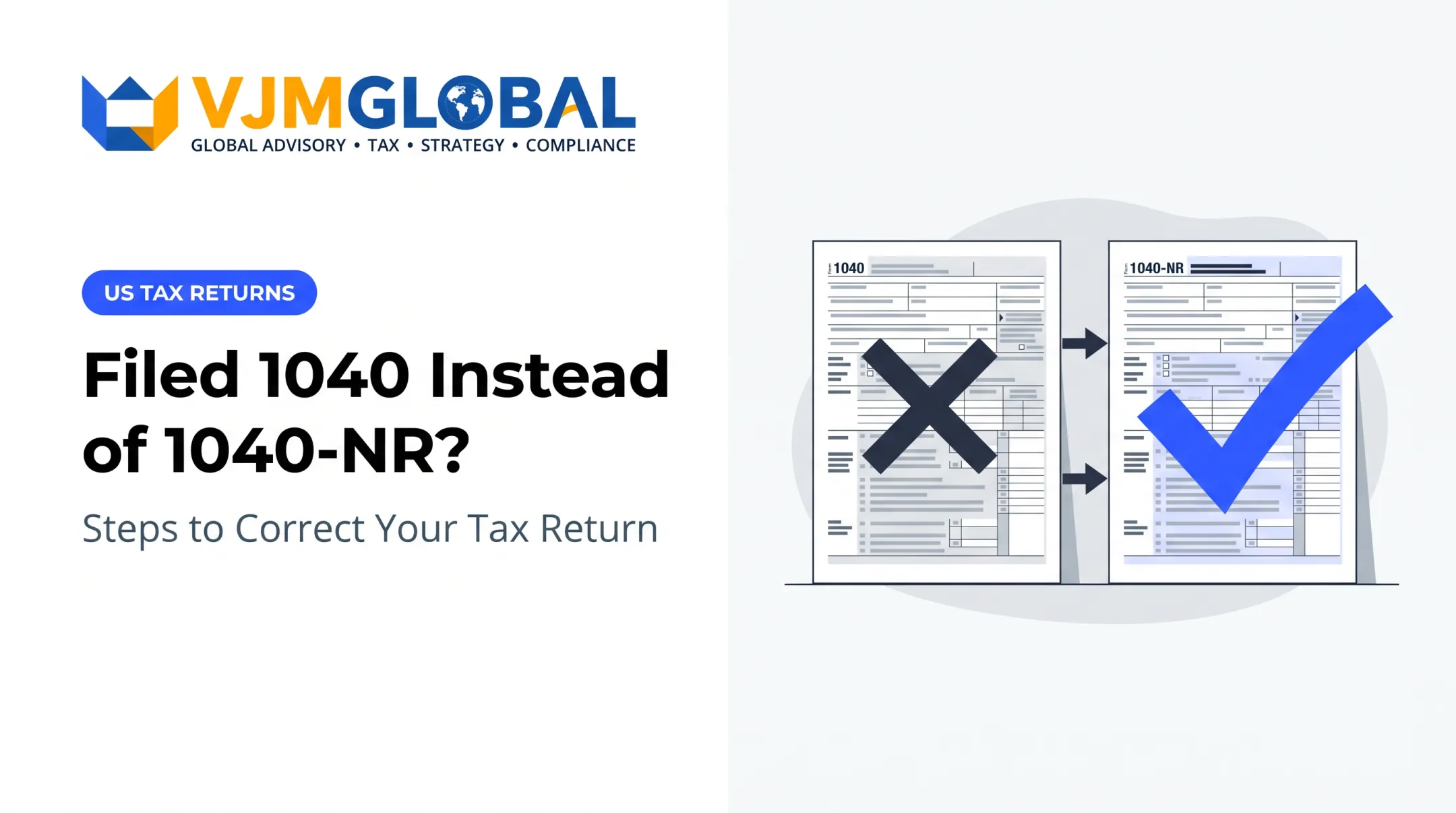
If you filed the wrong form, use Form 1040-X. The usual limit is three years from filing or two years from payment, whichever is later.
How VJM Global Can Help
VJM Global is a firm of Chartered Accountants providing cross-border accounting and international tax services. We prepare US individual returns on Form 1040 and Form 1040-NR, including treaty claims on Form 8833 and support for withholding and FATCA compliance.
Key credentials include:
- 30+ years in tax, audit and advisory work
- A team of 100+ professionals, including CPAs and Chartered Accountants
- Clients across the USA, UK and Australia
- ISO 27001 certification for information security
In practice, the team can review your residency documentation, income sources and foreign tax records, and determine which filing requirements apply. We do not provide immigration or visa services, so questions about your H-1B status or work authorisation belong with a qualified immigration adviser.
Conclusion
Choose Form 1040 or Form 1040-NR only after determining tax residency under the IRS rules. The visa itself settles nothing.
The right answer depends on:
- Days of presence in the US
- Worldwide versus US-source income
- Filing status and treaty positions
- Dual-status or contractor facts
Keep travel and income records, recheck your status each tax year, and confirm current IRS guidance. Get professional help when foreign income or complex facts are involved.
Frequently Asked Questions
Who is considered a nonresident alien for tax purposes?
A person who meets neither the Green Card Test nor the Substantial Presence Test is generally a nonresident alien. Exceptions, elections and treaty rules can change this.
Can an H-1B holder receive Form 1099?
A Form 1099 is issued by a payer to report payments. It doesn't replace your income tax return. Contractor work may also raise separate H-1B work-authorisation issues.
Which tax form should an H-1B holder file, 1040 or 1040-NR?
Resident aliens generally file Form 1040 and nonresident aliens generally file Form 1040-NR. First-year and dual-status cases need individual review.
Does an H-1B holder report worldwide income on Form 1040?
Yes, a resident-alien filer generally reports worldwide income. Exclusions, foreign tax credits, treaty provisions and foreign account reporting rules may apply.
Can an H-1B holder have a dual-status tax year?
Yes. A change in tax residency during the year can create dual-status treatment. It requires the correct primary return and a statement for the other period.
What happens if an H-1B holder files the wrong form?
Income may be misreported and deductions or credits wrongly claimed, leading to penalties and delays. Failure-to-file is 5% of unpaid tax per month, up to 25%. An amended return after professional review may be needed.