This guide covers US tax year 2023 for independent contractors, freelancers, sole proprietors and single-member LLC owners reporting self-employment income.
Australia scope note: living in Australia, or having a US client, does not automatically create a Form 1040 obligation. First work out whether you are a US citizen, green card holder, US tax resident or nonresident alien.
Key Takeaways
- Most eligible US contractors report business income on Schedule C, attached to Form 1040.
- Report all business income, even when a client issues no 1099.
- Schedule SE calculates self-employment tax, which is separate from income tax.
- Check rates, thresholds and line numbers against the official IRS 2023 forms.
Form 1040 vs Form 1099: Which Form Does an Independent Contractor Use?
What Form 1040 does
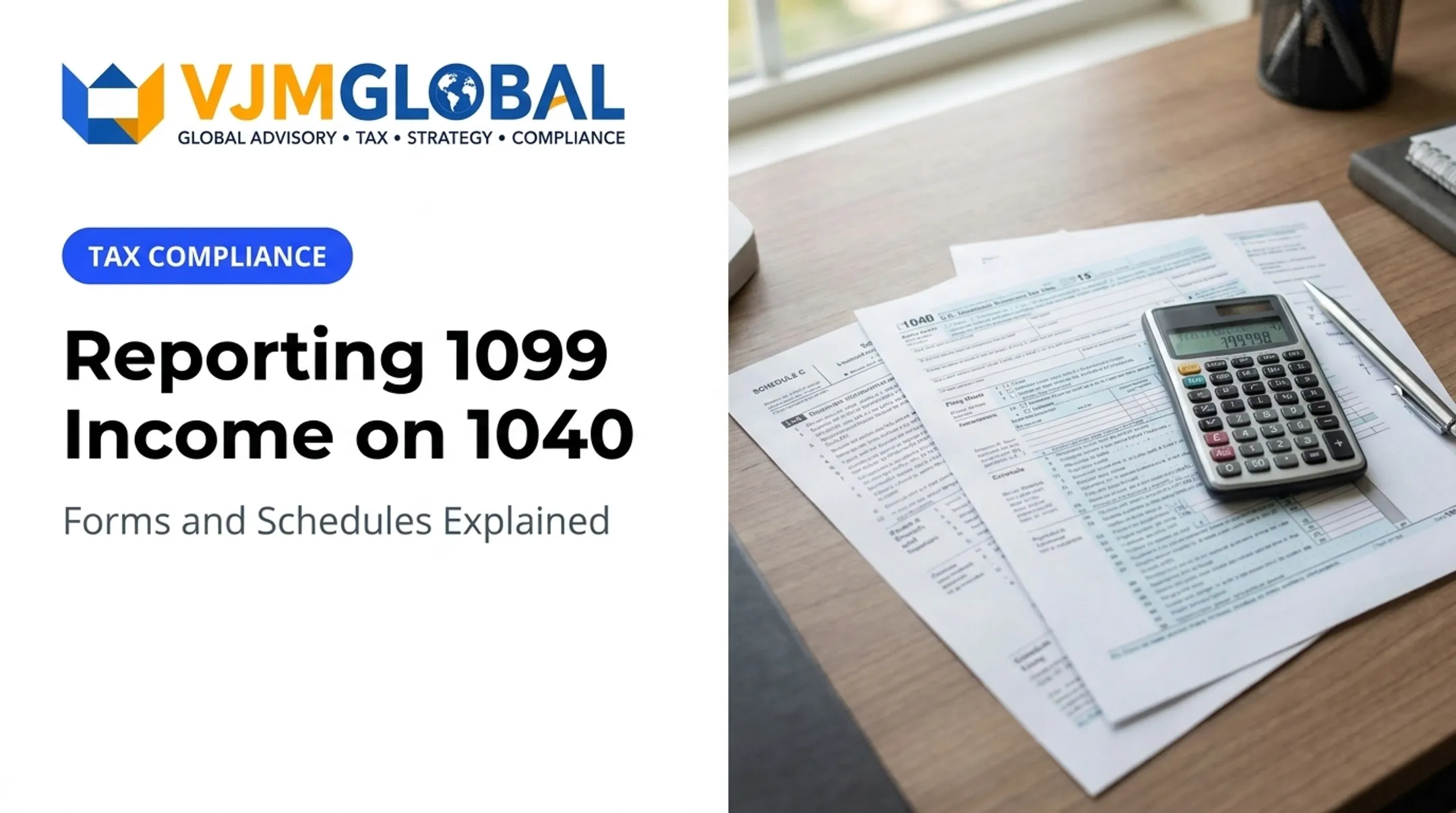
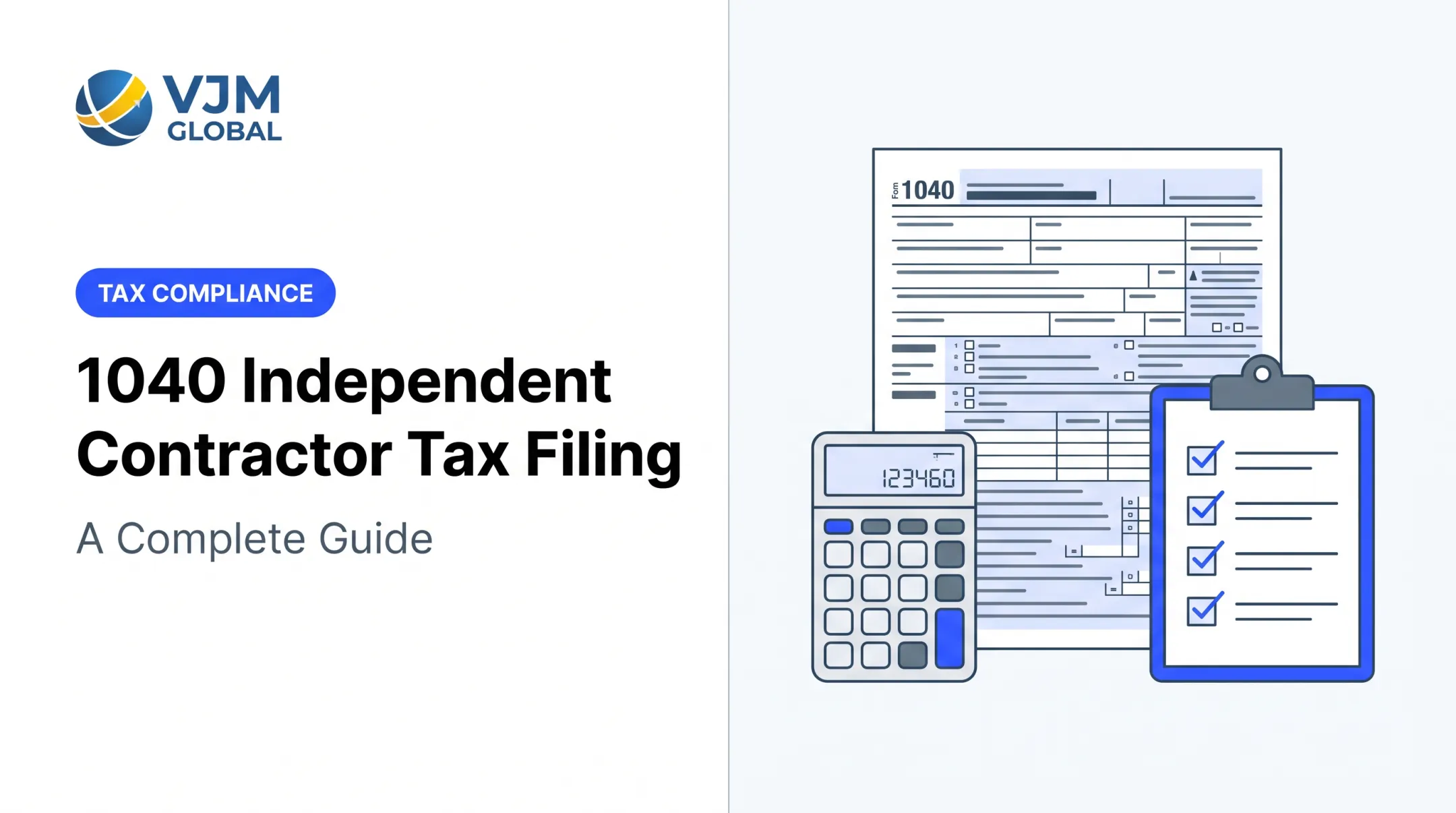
Form 1040 combines your income, deductions, credits and tax payments into one balance due or refund. Schedules and other forms feed into it. A 1099 never replaces it.
What Form 1099 does
A business payer generally reports $600 or more of nonemployee compensation on Form 1099-NEC, according to the IRS 1099 instructions. Other variants cover different income:
- 1099-K: card and third-party network payments
- 1099-MISC: rents, royalties, prizes
- 1099-INT and 1099-DIV: interest and dividends
The payer's duty is to issue the form, and your duty is to report income whether or not you receive one. A contractor gives the client a Form W-9 (US persons) rather than sending it to the IRS. Foreign persons use a W-8 form instead.
Who may need a different return
US citizens and resident aliens generally report worldwide taxable income on Form 1040. A nonresident alien engaged in a US trade or business, or with US-source income not fully taxed at source, may need Form 1040-NR instead.
Residency follows the green card test or the substantial presence test: 31 days in 2023 and 183 weighted days (all 2023 days, one-third of 2022 days, one-sixth of 2021 days). Exceptions and treaty rules apply.
Entity type matters too. A single-member domestic LLC is generally reported on Schedule C unless it elects corporate treatment. Partnerships and S corporations report separately.
Which Forms and Schedules Feed Into Form 1040?
The core filing package
- Form 1040: the return itself
- Schedule C: business profit or loss
- Schedule SE: self-employment tax
- Schedule 1: additional income and adjustments
- Schedule 2: additional taxes
- Form 1040-ES: estimated tax payments, not the annual return
Use the 2023 versions only. Line numbers shift between years.
From client payments to gross income
Reconcile invoices, bank deposits, payment platform records, cash, and every Form 1099. Barter counts too, at fair market value when received. A missing or wrong 1099 does not remove the obligation.
For 2023, third-party platforms issued Form 1099-K only when payments exceeded $20,000 and 200 transactions, after the IRS delayed the lower threshold. Income below that threshold is still reportable.
Schedule C: business profit or loss
Gross receipts go on line 1. Subtract ordinary and necessary expenses to reach net profit on line 31. Keep business and personal money separate and retain support for each expense category.
Schedule SE: self-employment tax
Line 31 profit flows to Schedule SE. Key 2023 figures:
- Filing trigger: $400 net self-employment earnings
- Earnings factor: 92.35% of profit
- Rate: 15.3% (12.4% Social Security plus 2.9% Medicare)
- Social Security ceiling: $160,200
- Deductible half: line 13, carried to Schedule 1 line 15

Foreign clients and payment platforms
Australia-based contractors should log every payment, US and non-US, in US dollars. Use the transaction-date rate, or an annual average for income received evenly through the year. The IRS has no official rate, so pick an appropriate one and apply it consistently. Then reconcile platform statements against the income you actually received.
How to Complete Form 1040 for Independent Contractor Income in 2023
Step 1: Confirm filing status and gather records
Collect:
- Prior-year return and ID numbers
- All 1099s, invoices and bank or platform statements
- Expense records
- Estimated payments made
- Other household income details
Filing status, dependants and credits affect the return even when contracting is your main income. The 2023 standard deduction is $13,850 single, $27,700 joint and $20,800 head of household.
Step 2: Complete Schedule C first
Identify the business activity, report gross receipts, categorise expenses and calculate net profit. Do not enter only the 1099 total if you had other income or several forms.
Step 3: Transfer business income to Form 1040
Schedule C profit goes to Schedule 1 line 3. Schedule 1 line 10 feeds Form 1040 line 8, and adjustments on line 26 feed line 10. This drives adjusted gross income (line 11).
Step 4: Add self-employment tax, deductions and credits
Schedule SE line 12 goes to Schedule 2 line 4. Schedule 2 line 21 feeds Form 1040 line 23. The deductible half reduces AGI.

Keep the categories distinct:
- Business deductions reduce Schedule C profit
- Adjustments reduce AGI
- Standard or itemised deductions reduce taxable income
- Credits reduce tax directly
Step 5: Review, sign and file
Reconcile income, deductions, estimated payments and bank details. The general deadline was April 15, 2024. Form 4868 gives six more months to file, not to pay.
Keep a full copy of the return, schedules, source documents and payment confirmations. Records are normally kept three years, or six if you omitted more than 25% of gross income.
Independent Contractor Deductions, Self-Employment Tax, and Estimated Payments
Common Schedule C deductions
Expenses must be ordinary (common and accepted) and necessary (helpful and appropriate). Business-use portions of these expenses commonly qualify:
- Software, supplies, internet and phone
- Professional fees, insurance and advertising
- Subcontractors and travel
- Meals (generally 50%)
- Vehicle: 65.5 cents per mile standard rate for 2023
- Home office: simplified $5 per sq ft, up to 300 sq ft, or actual expenses
- Equipment: Section 179 up to $1,160,000, or depreciation
Records that support deductions
- Dated receipts and invoices
- Mileage logs with destination and purpose
- Bank and platform statements
- Notes on business-use percentages
Allocate mixed expenses honestly. Unsupported estimates cause trouble in a review.
Self-employment tax is separate
You may owe both income tax and self-employment tax on the same profit. Additional Medicare tax of 0.9% applies above $200,000 for single filers ($250,000 joint), reported on Form 8959.
Estimated quarterly payments
Form 1040-ES applies if you expect to owe at least $1,000 after withholding and credits. The 2023 due dates:
- April 18, 2023
- June 15, 2023
- September 15, 2023
- January 16, 2024
Safe harbour: pay the smaller of 90% of 2023 tax or 100% of 2022 tax (110% if 2022 AGI exceeded $150,000). Form 2210 handles underpayment. Pay through Direct Pay or EFTPS.

Additional deductions and planning items
- QBI deduction: up to 20%, subject to limits, claimed on Form 1040 line 13
- Self-employed health insurance: Schedule 1 line 17, unavailable for months with employer-subsidised coverage
- SEP IRA: lesser of $66,000 or 20% of net earnings
- Solo 401(k): $22,500 deferral, $66,000 combined limit, plus $7,500 catch-up at 50+
Eligibility depends on filing status, income, business type and coverage.
Australia-Based and Cross-Border Considerations
Determine whether a US return is required
A US client, US payment processor or US-dollar payment alone does not require Form 1040. Citizens and green card holders generally must file on worldwide income. A nonresident alien performing services outside the US generally has foreign-source income, but check Form 1040-NR rules.
Coordinate US and Australian obligations
An eligible US taxpayer in Australia files separately with the ATO. Australia's income year runs 1 July to 30 June, and the ATO requires assessable foreign income even when foreign tax was withheld. A foreign income tax offset may apply.
On the US side, consider:
- Filing date: qualifying taxpayers abroad get an automatic extension to June 17, 2024, though interest runs from April 15
- Form 2555: foreign earned income exclusion up to $120,000, which does not remove self-employment tax
- Form 1116: foreign tax credit, with no credit on excluded income
- Totalisation: self-employed US citizens residing in Australia can obtain an exemption letter from the SSA, attached annually
- FBAR: aggregate foreign accounts over $10,000, filed separately with FinCEN
- Form 8938: abroad thresholds start at $200,000 year-end or $300,000 anytime (single)
One filing never cancels the others.
When professional support helps
Seek review if you have:
- Mixed US and Australian income or multiple currencies
- Late returns or foreign financial accounts
- Entity changes or large deductions
- Doubt over Form 1040 versus 1040-NR
VJM Global is a chartered accountancy firm that supports Australian businesses with US reporting needs, including Form 1040 and 1040-NR preparation. Individual taxpayers should still confirm their position with a qualified US tax professional.
Frequently Asked Questions
Do I file a 1040 as an independent contractor?
Eligible US taxpayers generally report contractor income on Form 1040 with the required schedules. Nonresident aliens or those using another business structure may file differently.
What IRS form do I give to an independent contractor?
A payer typically collects Form W-9 and issues Form 1099-NEC when 2023 rules require it, generally at $600 or more.
What income is reported on a 1099?
It depends on the variant. 1099-NEC reports nonemployee compensation, while others cover interest, dividends, rents or payment-platform transactions.
What does a 1099 form look like?
It shows payer and recipient details, taxpayer ID, the payment amount and form-specific boxes. Reconcile it against your own records.
How do I report independent contractor income on Form 1040 for 2023?
Report receipts and eligible expenses on Schedule C, carry the profit to Form 1040 via Schedule 1, and use Schedule SE when self-employment tax applies.
Do I need Schedule C and Schedule SE with Form 1040?
Sole proprietors and qualifying single-member LLCs commonly use Schedule C. Schedule SE is generally required at $400 or more of net self-employment earnings; check exceptions for your entity.