Many filers struggle with the same points: whether a rental belongs on Schedule E or Schedule C, how to treat repairs versus improvements, and why a loss on paper may not be deductible. Australian residents with US rental property or US pass-through income face the same US rules, so this guide uses the US framework throughout and US dollars for IRS amounts.
Below, you'll see who files, how to complete Part I, which expenses count, how loss limits work, and what to check before filing.
Key Takeaways
- Schedule E reports rental, royalty, pass-through, estate, trust, and REMIC items; complete only the parts that apply.
- Calculate rental income and expenses property by property before carrying totals to the summary.
- Repairs, improvements, interest, principal, and depreciation each get different treatment.
- Confirm line numbers, deadlines, and loss rules against the official 2025 IRS forms.
What Is Schedule E and Who Uses It?
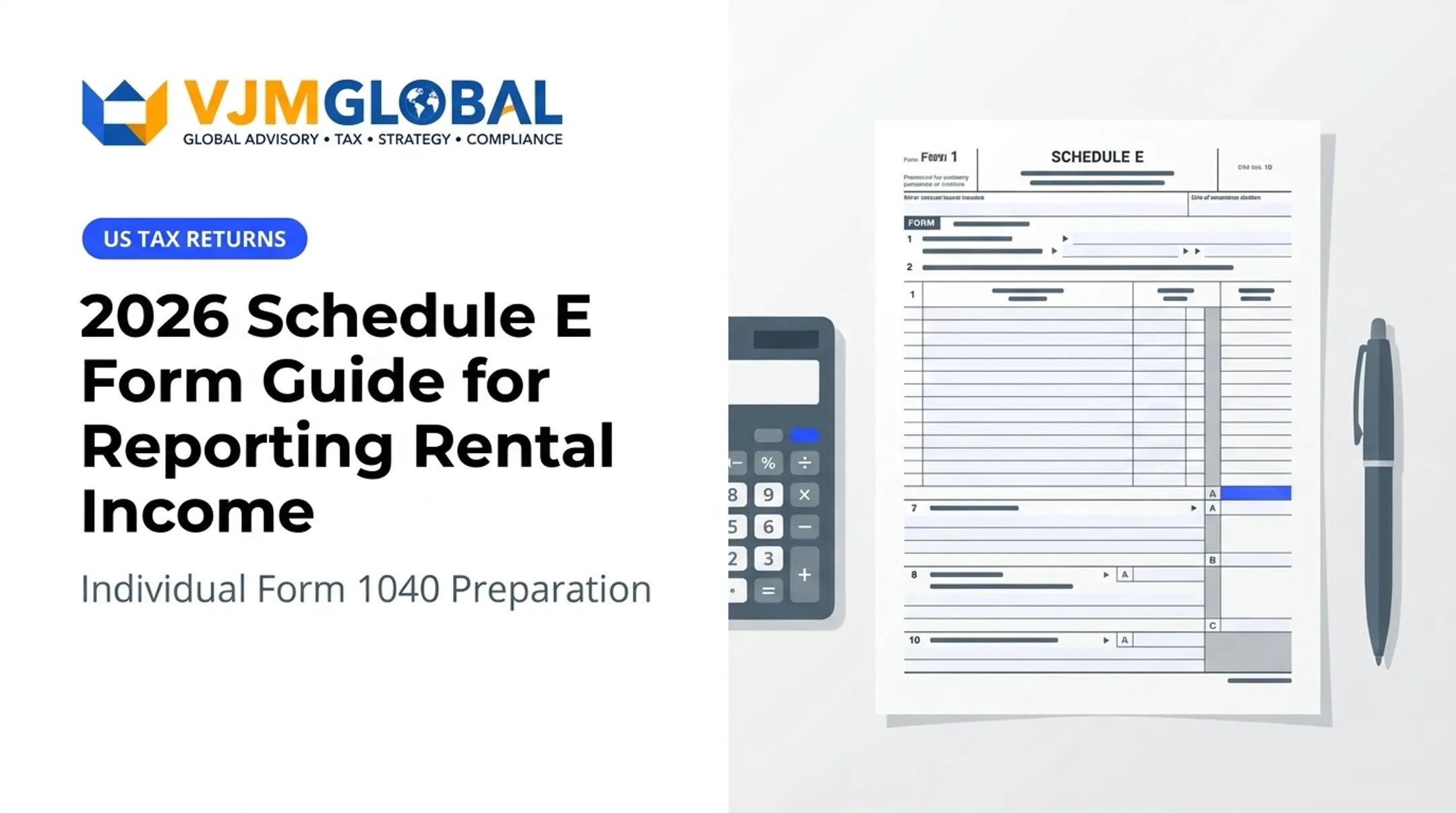
Schedule E (Form 1040), titled Supplemental Income and Loss, reports income that doesn't come from wages, interest, or dividends. Individuals with rentals, royalties, partnership or S corporation items, estate or trust items, or REMIC residual interests use it.
Who generally files Schedule E?
- Individual owners of rental real estate
- Recipients of royalties
- Partners and S corporation shareholders
- Beneficiaries of estates and trusts
- Holders of REMIC residual interests
You may need Schedule E even when the activity produces a loss. Whether you can deduct that loss is a separate question, covered later.
What income does not normally belong on Schedule E?
Wages and ordinary sole-proprietor business income go elsewhere. Rental income moves to Schedule C when you provide substantial services for tenants' convenience. Per the 2025 Schedule E instructions, heat, light, trash collection, and cleaning of public areas are not significant services. Regular cleaning, changing linen, or maid service are significant services.
Self-employed writers, artists, and inventors also report their business royalties on Schedule C, not Part I.
How Schedule E connects to Form 1040
Schedule E line 41 flows to Schedule 1 line 5. Schedule 1 line 10 then feeds Form 1040 line 8. If Parts II to IV don't apply, line 26 goes straight to Schedule 1 line 5. Confirm placement on the final 2025 forms.
Schedule E doesn't set your tax bill on its own. Filing status, other deductions, credits, and loss limits all matter.
The five parts of Schedule E
| Part | Covers |
|---|---|
| I | Rental real estate and royalties |
| II | Partnerships and S corporations |
| III | Estates and trusts |
| IV | REMICs (residual holder) |
| V | Summary |
Most individuals use only one or two parts.
How to Complete Part I for Rental Real Estate
Before you start, gather:
- 2025 Schedule E
- Rent ledgers and bank statements
- Receipts and mortgage interest statements
- Depreciation schedules and prior-year returns
- Any information returns
Property information and rental-use details
Record the address, property type, fair rental days, and personal-use days. Part I has three property columns, A to C. Attach additional Schedules E if you own more, completing the A/B section and lines 23a to 26 on only one.
Count fair rental days only when the property was actually rented at a fair price, not days it was merely available. Personal-use days include owner use, below-market use, and generally family use.
For a dwelling used as a home, personal use must exceed the greater of 14 days or 10% of days rented at fair rent. If you rent a home fewer than 15 days, you exclude the income but cannot deduct rental expenses.

Ownership structure matters too. Spouses filing jointly may qualify as a qualified joint venture only if they are the only members and both materially participate. Mere co-ownership does not qualify.
Reporting rental income
Report gross rent before expenses, property by property. Items to review, per IRS Publication 527:
- Advance rent counts when received, whatever period it covers
- Lease-cancellation payments are rent when received
- Tenant-paid owner expenses are rent (and may be deductible)
- Property or services received instead of cash count at fair market value
- Refundable security deposits are excluded, unless you keep them for lease violations
- A last-month-rent deposit is advance rent
Calculating the property result
Subtract operating expenses and depreciation from gross rent to get net income or loss.
Hypothetical example: Rent collected is $24,000. Operating expenses (insurance, taxes, repairs, interest) total $13,000, and depreciation is $5,500.
Preliminary net rental income: $24,000 − $13,000 − $5,500 = $5,500. These figures are illustrative only, not IRS rates or thresholds.
Keep property-level records. You'll need them for future depreciation and sale calculations.
Schedule E Expenses and Rental Income Calculations
The main rental expense categories
The 2025 form lists these expense lines:
- Line 5: advertising
- Line 6: auto and travel (rental mileage is 70 cents per mile for 2025)
- Line 7: cleaning and maintenance
- Line 8: commissions
- Line 9: insurance
- Line 10: legal and other professional fees
- Line 11: management fees
- Lines 12 and 13: mortgage and other interest
- Line 14: repairs
- Line 15: supplies
- Line 16: taxes
- Line 17: utilities
- Line 18: depreciation or depletion
- Line 19: other (listed)
Each expense must relate to the rental, be documented, and appear on the correct line.
Repairs versus improvements
Deduct repairs and maintenance unless capitalization is required. Capitalize betterments, restorations, and adaptations to a new use. Capitalized costs are recovered through depreciation.
The IRS's tangible property guidance describes safe harbors, including de minimis, small taxpayer, and routine maintenance. Dollar limits come from standing IRS guidance rather than a 2025-specific table, so confirm the current thresholds before you file. Elected de minimis deductions go on line 19.
Mortgage interest, principal, and other interest
Principal is never a current rental expense. Deductible mortgage interest goes on line 12 if paid to a bank or financial institution. Use line 13 if the lender is not a financial institution or you did not receive Form 1098.
Depreciation and capitalized costs
Residential rental buildings use straight-line depreciation over 27.5 years with the mid-month convention. Land isn't depreciable, so allocate a combined purchase price between land and building.
Form 4562 is required for property placed in service in 2025 and for listed property such as cars. 100% special depreciation was restored for qualified property acquired after January 19, 2025.
Depreciation reduces your basis, and you reduce basis by depreciation allowed or allowable, even if you never claimed it. Missing prior-year records create problems when you sell the property.

Records that support deductions
Keep records that support every deduction, including:
- Invoices and receipts
- Mileage logs
- Mortgage and insurance statements
- Tax bills and management reports
- Tenant payment records
Track repairs and improvements separately. Bookkeeping software helps with year-end reconciliation, but it does not decide tax treatment.
Other Schedule E Parts, Related Forms, and Loss Rules
Schedule E versus Schedule C
Ask four questions:
- What type of property is it?
- What services do you provide to occupants?
- How involved are you personally?
- Is the activity run as a trade or business?
Ordinary rentals generally stay on Schedule E, even when they are a business. Substantial tenant-convenience services push the activity to Schedule C. Borderline cases deserve professional review.
Partnerships, S corporations, and Form 8825
A partnership or S corporation reports its rentals at the entity level, often on Form 8825. Owners receive a Schedule K-1 and report their share in Part II, even if they didn't receive the cash. Retain the K-1 rather than attaching it. A personally owned rental goes in Part I instead.
Passive activity and at-risk limitations
Losses face limits in this order: adjusted basis, at-risk, then passive activity. Form 6198 may apply for at-risk limits, and Form 8582 for passive losses. Disallowed passive losses carry forward.
Rentals are generally passive, even with material participation. Active participants may deduct up to $25,000 against nonpassive income. That allowance phases out between $100,000 and $150,000 of MAGI. If you are married filing separately and lived apart all year, the cap is $12,500. Verify these figures on the 2025 Form 8582 instructions before relying on them.
Special situations
- Short-term rentals: not a rental activity for passive rules if average use is 7 days or less, or 30 days or less with significant personal services
- Vacation homes: personal-use tests limit deductions
- Royalties: Part I covers mineral, copyright, and patent royalties
- Estates and trusts: Part III, from Schedule K-1 (Form 1041)
- REMICs: Part IV, using Schedule Q (Form 1066)
2025 Filing Checklist, Common Mistakes, and Professional Support
Preparation checklist
- Correct 2025 form and instructions
- Property and ownership details
- Gross income records for each property
- Categorised expenses
- Depreciation information
- K-1s and prior-year suspended losses
- Reconciliation to bank statements, management reports, and Forms 1098
Common mistakes
- Omitting advance rent or tenant-paid expenses
- Counting vacant days as rental days
- Deducting mortgage principal
- Treating improvements as repairs
- Missing depreciation
- Mixing personal and rental costs
- Choosing Schedule C or E by property type alone
Most calendar-year returns are due April 15, 2026. A timely Form 4868 generally extends filing to October 15, 2026, but not payment time. IRS Free File Fillable Forms supports Schedule E for 2025, with limitations.

When professional assistance may be appropriate
Consider help when you have:
- Multiple properties
- Partnership or S corporation ownership
- Cross-border situations
- Large passive losses
- Mixed-use property
- Incomplete prior-year records
- Uncertainty about repairs and depreciation
VJM Global supports US tax reporting, bookkeeping, and accounting for complex records, with certified CPAs and Chartered Accountants who have US compliance expertise. Confirm the provider's scope and get advice based on your own facts.
Final takeaway
Accurate filing comes down to four habits: choose the right income category, keep property-level records, apply the correct expense and loss rules, and check the official 2025 instructions before submitting Form 1040.
Frequently Asked Questions
What is Schedule E on Form 1040?
It's the schedule for supplemental income or loss: rental, royalty, pass-through, estate, trust, and REMIC items. Results flow to Form 1040 through Schedule 1.
How do I calculate rental income on Schedule E?
Report gross rent, subtract allowable expenses and depreciation, and find each property's result. Then follow the 2025 form's instructions for carrying it forward.
What is the difference between Schedule C and Schedule E?
Schedule E generally covers rentals and other supplemental income. Schedule C covers an active trade or business, and substantial tenant services can move a rental there.
Can I e-file my Form 1040?
Often, yes, if your software or preparer supports the forms you need. Confirm eligibility for your full return with the IRS or an approved provider.
Who needs to file Schedule E?
Rental owners, royalty recipients, partners, S corporation shareholders, estate or trust beneficiaries, and REMIC residual holders.
What expenses can I deduct on Schedule E?
Common ones include advertising, management, insurance, qualifying interest, repairs, utilities, taxes, supplies, and depreciation. Each must relate to the rental, be documented, and follow current IRS rules.