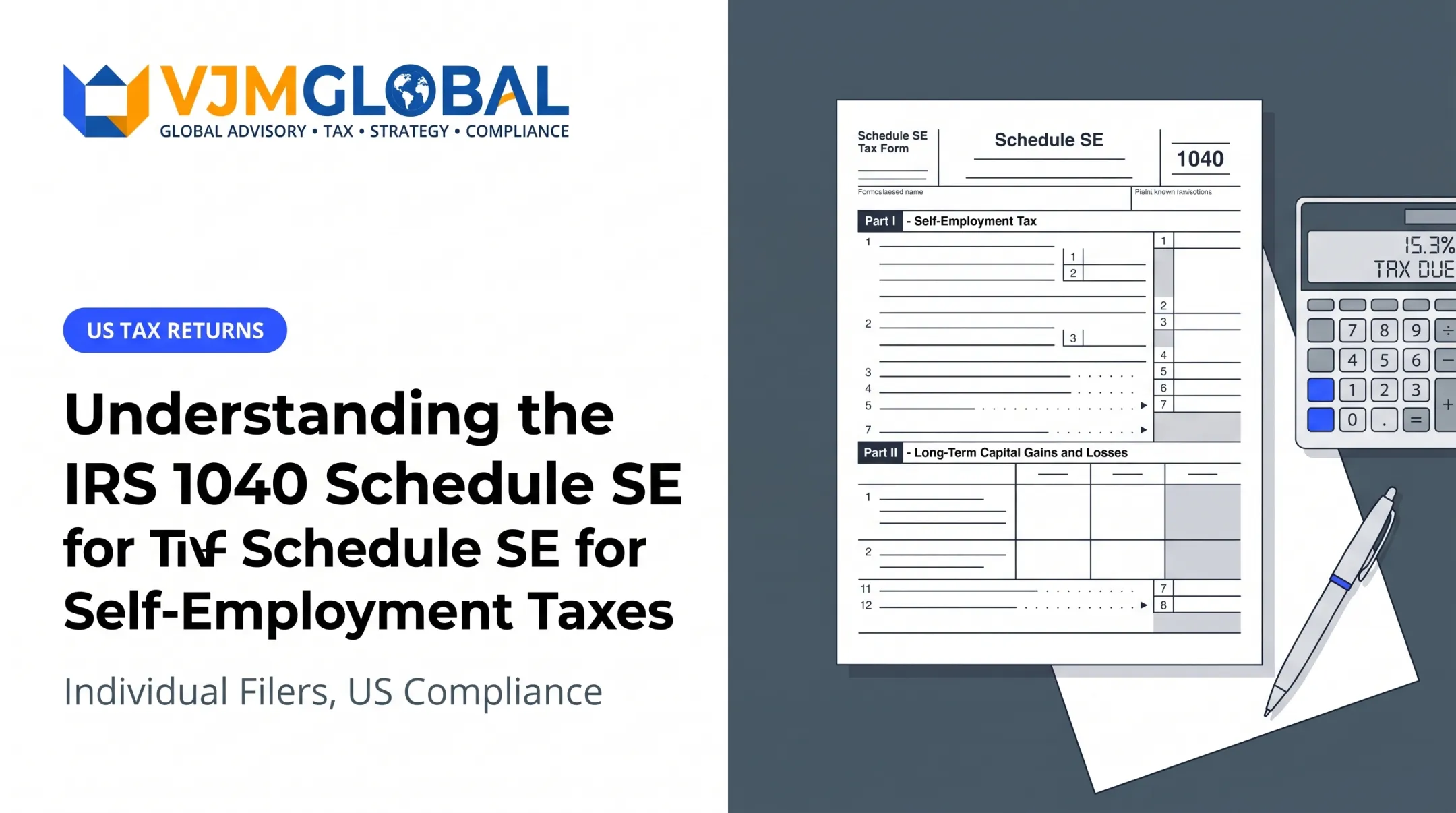
The confusion starts early. Schedule SE doesn't begin with gross receipts. It begins with net earnings, and the answer shifts with your business structure, other income, W-2 wages and the tax year. Australian-based freelancers and business owners with US clients often run into this form for the first time.
This guide covers whether Schedule SE applies, what to gather, how to complete each calculation, where the results go, and which errors to avoid. Figures below are for the 2026 form, quoted in US dollars. Always confirm against the IRS instructions for your own tax year.
Key Takeaways
- Schedule SE uses net earnings, not gross payments or a single Form 1099 total.
- Reconcile Schedule C, F, K-1, SE, 1 and 2; each does a different job.
- Current-year IRS instructions control every threshold, rate and line number.
- W-2 wages, multiple businesses, partnership income, church income and nonresident status can change the result.
How to Complete IRS Schedule SE (Form 1040)
Step 1: Confirm Schedule SE applies and gather the current form
Download the Schedule SE and instructions for your tax year. Don't work from last year's PDF, a software screenshot, or the old "short form" and "long form" labels.
Generally, you file when net earnings from self-employment are $400 or more, according to the 2026 instructions. Church employee income of $108.28 or more is a separate trigger.
A Form 1099 doesn't decide this. The IRS says gig income must be reported even when no information return arrives, per its gig worker guidance. The net-earnings test is what counts.
Identify how you earn income: sole proprietorship, single-member LLC, partnership, farm, church employment, or side business. Then gather:
- Schedule C or Schedule F
- Schedule K-1 information for partnerships
- Forms 1099 and W-2 wage details
- Bookkeeping reports and expense records
- Your prior-year return
Step 2: Determine net earnings
Start with profit or loss from the right source. For 2026, farm profit comes from Schedule F, line 34, and farm partnership K-1, box 14, code A. Nonfarm profit comes from Schedule C, line 31, and partnership K-1, box 14, code A.
To get from gross receipts to net profit, subtract ordinary and necessary business expenses. Neither gross receipts nor 1099 totals are the final Schedule SE amount.
If you run several businesses, combine them on one Schedule SE. A loss in one reduces profit in another.
Optional methods exist for low earners, so check them if your profit is small:
- Farm: gross farm income of $11,340 or less, or net farm profit under $8,186.
- Nonfarm: net profit under $8,186 and under 72.189% of gross nonfarm income, with at least $400 net earnings in two of the prior three years.
- Combined optional-method earnings can't exceed $7,560, and the nonfarm method can be used only five times.
Illustrative calculation (placeholders only):
- Gross receipts: [A]
- Less ordinary and necessary expenses: [B]
- Net profit (Schedule C): [A] minus [B] = [C]
- Net earnings for Schedule SE: [C] × 0.9235 = [D]

Work from your own figures. The IRS publishes the lines and the 92.35% factor, not a sample taxpayer.
Step 3: Complete the tax calculation
Follow the Schedule SE line order. For positive net earnings, the form applies the 0.9235 factor before the tax rates.
The basic rates are:
- 12.4% Social Security
- 2.9% Medicare
- 15.3% combined
For 2026, the Social Security portion applies only up to $184,500 of combined wages and net self-employment earnings.
W-2 wages matter here. Line 8a takes Social Security wages from W-2 boxes 3 and 7. If those wages already reach the wage base, the form skips the Social Security calculation and moves to Medicare. Having a W-2 job doesn't remove your Schedule SE duty for a side business. It can reduce the Social Security part.

Additional Medicare Tax of 0.9% may apply above these thresholds, using Form 8959:
| Filing status | 2026 threshold |
|---|---|
| Single, head of household, qualifying surviving spouse | $200,000 |
| Married filing jointly | $250,000 |
| Married filing separately | $125,000 |
Wages subject to this tax reduce the threshold left for your self-employment income, but not below zero.
Special cases apply only if you qualify:
- Partnerships: general partners generally include their distributive share. Limited partners generally include only guaranteed payments for services actually rendered.
- Church employees: enter zero on line 4c and continue through the church-employee lines.
- Optional methods: see Step 2.
Step 4: Transfer the results and review
For 2026, the Schedule SE itself directs the following:
- Line 12 (self-employment tax) goes to Schedule 2, line 4.
- Line 13 (one-half of SE tax) goes to Schedule 1, line 15.

The half deduction lowers your income tax. It doesn't reduce the self-employment tax itself. Attach Schedule SE to Form 1040, or Form 1040-NR if you're a nonresident.
Verify line numbers each year, because layouts change. Before filing, check for:
- Omitted or duplicated income
- Unsupported expenses
- W-2 or K-1 figures that don't match your records
- Estimated-tax needs
Estimated payments are generally required if you expect to owe at least $1,000 after withholding and credits. The 2026 instalment dates are April 15, June 15 and September 15, 2026, plus January 15, 2027.
When to Complete Schedule SE and What You Need
Not every kind of income belongs on Schedule SE. The decision depends on your net self-employment earnings and special circumstances.
When you generally need it
- Freelancers, independent contractors and gig workers
- Sole proprietors and single-member LLC owners
- Anyone with self-employment income on top of W-2 wages
Situations needing extra review
- Income under the threshold or business losses: Compare net earnings against the $400 test.
- S corporation owners: Shareholder-employees need reasonable wages; IRS guidance does not treat distributions as Schedule SE income.
- Rental income: Generally reported on Schedule E and not part of SE earnings, unless you are a real estate dealer.
- Nonresident aliens: Generally not liable for US SE tax unless a totalization agreement applies. Those who are liable file Schedule SE with Form 1040-NR.

Records and readiness checks
Collect the documents from Step 1, plus mileage or asset records where relevant. Then confirm four things:
- You're using the correct tax-year form.
- You understand your entity classification.
- Your income and expenses are documented.
- You know whether Form 1040, Form 1040-NR, Form 1040-ES or other schedules are also needed.
Key Parameters, Common Mistakes, and Troubleshooting
Schedule SE results move when your income classification, deductible expenses, W-2 wages, tax year or taxpayer status changes. Get those inputs right first.
Net earnings from self-employment
Net profit controls the calculation. Incomplete expense records overstate your tax. Padded or unsupported expenses understate it, and invite problems later.
Tie the amount carried from Schedule C, F or K-1 back to your books. If they disagree, fix the source before touching Schedule SE.
Business structure and income source
- Sole proprietors, single-member LLCs, partners: generally on Schedule SE.
- S corporation shareholder-employees: wages are reported through payroll, not Schedule SE.
- Church employees and clergy: special rules, and an exemption through Form 4361 is possible on religious grounds only.
- Rental and investment income: usually Schedule E or other reporting.
Tax year and special elections
Verify rates, thresholds, line numbers, optional methods, Additional Medicare Tax, church exemptions and totalization agreements from official IRS sources. Never copy figures from a prior-year form.
Common mistakes
- Leaving out cash, digital-platform or 1099 income
- Counting the same receipts twice
- Using gross instead of net figures
- Misclassifying LLC or S corporation income
For 2026, 1099-K reporting generally starts above $20,000 and 200 transactions, and 1099-NEC at $2,000. These thresholds don't replace the net-earnings test.
Pre-filing checklist:
- All self-employment activities included
- W-2 wages entered
- K-1 amounts matched
- Current-year form version
- Supporting records on file
Troubleshooting unexpected results
- Schedule SE doesn't match Schedule C or F: check for a loss, adjustment, second business or optional method, then compare line by line.
- Tax is higher than expected: confirm you used net rather than gross earnings, included all expenses, combined activities correctly and entered W-2 wages.
- Software asks for Schedule SE or shows a blank: recheck income type, threshold, entity classification and any special rule.
- Form 1040 doesn't reconcile: verify the Schedule 1 and Schedule 2 transfers, the half-SE-tax deduction and current line references.

Alternatives to Completing Schedule SE Yourself
The right level of help depends on how simple your income is, how good your records are, how many businesses you run and what an error would cost.
Tax software
Best when income is straightforward and records are tidy. Software automates the maths and transfers, but it can't fix a misclassified input or a special rule you don't know applies.
IRS forms and instructions
Best for simple situations where you want the source rules directly. It's authoritative, but you do the calculations, the yearly research and the cross-schedule reconciliation by hand.
Professional tax preparation
Consider a professional when you face any of the following:
- Multiple businesses
- Partnership or S corporation income
- Nonresident or cross-border issues
- Amended returns
- Big income swings or estimated-payment uncertainty
It costs more but adds a review of classification, calculations and transfers. A paid preparer must sign your return, though you remain responsible for its accuracy.
VJM Global offers Form 1040 and Form 1040-NR preparation through US-compliant professionals, quoted by entity structure and scope. It's an option for complex or cross-border situations.
Conclusion
An accurate Schedule SE depends on three things: the correct tax-year form, verified net self-employment earnings, and following the amounts through Schedules 1 and 2 to Form 1040.
Most errors come from incomplete records, wrong income classification, outdated instructions, or ignoring W-2 wages and multiple activities. If you have partnership, church, farm, nonresident or cross-border facts, check current IRS guidance or get qualified help.
Frequently Asked Questions
What does Schedule SE calculate?
It calculates self-employment tax (Social Security and Medicare) on qualifying net earnings. This is separate from regular federal income tax.
Are Schedule C and SE the same?
No. Schedule C generally reports business profit or loss. Schedule SE takes qualifying earnings and calculates the self-employment tax.
Who is exempt from SE tax?
It depends on income type and status. Examples include earners below the $400 threshold, most nonresident aliens (unless a totalization agreement applies) and eligible religious workers with an approved Form 4361. Check current IRS rules for your case.
What income is reported on Schedule 1?
Schedule 1 carries additional income and adjustments, including the deduction for one-half of SE tax (line 15 for 2026). The Form 1040 instructions for your tax year control exact reporting.
Where is income listed on Form 1040?
Income often starts on a schedule or form, such as Schedule C or a W-2, before flowing to a Form 1040 line. The right line depends on the income type and tax year.
What is included in earned income for tax purposes?
Generally wages from employee work and net self-employment earnings. The definition varies by purpose: the EITC definition doesn't change the Schedule SE calculation.