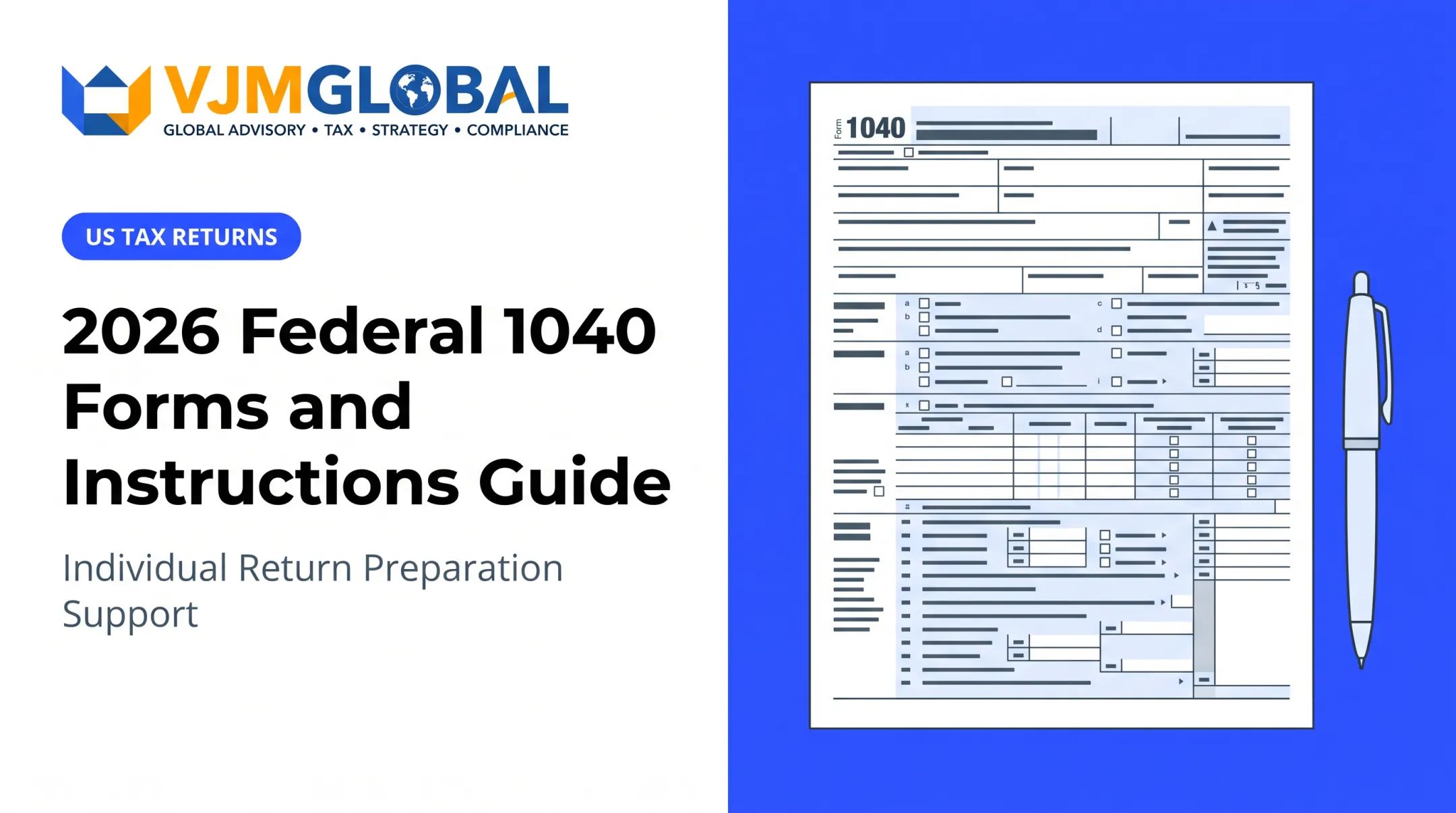
This guide walks through the 2026 Form 1040 using Marcus Roberts as a hypothetical taxpayer. No facts about Marcus's citizenship, income or family have been supplied, so every figure here is a labelled placeholder, not a real return. "2026 Form 1040" means the 2026 tax year, filed in 2027.
One caution up front: the 2026 form located so far is a draft. Check the final IRS form and instructions before you file.
Key Takeaways
- Confirm whether Marcus files Form 1040, 1040-SR, 1040-NR or another return before entering anything.
- Gather income, deduction, payment and identity records first, plus foreign records if relevant.
- Use the 2026 IRS instructions for line numbers, not an earlier year's.
- Have a qualified US tax professional review residency, treaty, business and foreign-reporting issues.
What the 2026 Form 1040 Is and Whether Marcus Roberts Should Use It
Identify the correct return
Form 1040 is the annual individual income tax return, generally used by US citizens and resident aliens, including those with foreign income. Other returns cover different situations:
- Form 1040-SR: an optional alternative for taxpayers aged 65 or older, using the same instructions and schedules.
- Form 1040-NR: for nonresident aliens with US trade or business activity, or US-source income not fully covered by withholding.
- Form 1040-X: corrects a return already filed.
Australian residence alone does not decide which form Marcus should file.
The tax year and filing year also differ. The 2026 return covers income earned in 2026 and is filed in 2027. The IRS draft is marked created 19 August 2026, but no final revision date exists yet.
Map the major sections
The form moves in a fixed order:
- Identification, filing status and dependants
- Income
- Adjustments and adjusted gross income (AGI)
- Deductions and taxable income
- Tax and credits
- Payments
- Refund or balance due
- Signature

Schedules attach only when Marcus has the relevant item, not simply because he lives overseas:
- Schedule 1: additional income and adjustments
- Schedule 2: additional taxes such as AMT and self-employment tax
- Schedule 3: extra credits, including the foreign tax credit
- Schedules A, B, C, D, E and SE: itemised deductions, interest and dividends, business profit, capital gains, rental income and self-employment tax
Treat the example as hypothetical
Any wages, dividends, withholding or bank details for Marcus below are placeholders. Never copy them into a real return.
What to Gather Before Completing Marcus Roberts's Return
Good preparation prevents most errors. Start with the basics:
- Legal names, SSNs or ITINs, and address
- Filing status, spouse and dependant details
- Prior-year AGI and any IRS PIN
- Bank routing and account details
- Any IRS correspondence about the filing
Then collect income and payment records, as applicable:
- W-2 and W-2G forms
- 1099-INT, DIV, NEC, MISC, K, G and R forms, plus SSA-1099
- Brokerage statements and capital-gain records
- Rental and sole-trader income and expense records
- Estimated-tax payment confirmations
For deductions and credits, gather:
- Form 1098 (mortgage interest) and Form 1098-T (tuition)
- Childcare, charitable, health and retirement records
- Form 1095-A if Form 8962 applies for health coverage
Foreign records
If Marcus has Australian ties, add foreign income records, foreign tax paid or accrued (in both Australian dollars and US dollars), ownership details of foreign accounts, and records of any US-source income.
Report everything in US dollars. The usual rule converts income at the rate when it was received and expenses at the rate when paid or accrued.
The IRS has no single official exchange rate and generally accepts a consistently used, posted rate. Document your source and conversion dates, including if you use a yearly average the IRS has not published for 2026.

How to Complete the 2026 Form 1040 Step by Step
Enter taxpayer information and select filing status
Copy Marcus's name, taxpayer identification number and address exactly as they appear on official records. Then choose a filing status. Head of household has extra requirements and does not simply mean unmarried, so test eligibility before ticking the box.
Report income accurately
Move each source document onto the right line:
- W-2 wages go to the wages line
- Interest and dividends flow through Schedule B where required
- Business profit comes from Schedule C and Schedule SE
- Capital gains come from Schedule D
- Rental income comes from Schedule E
Don't omit, duplicate or misplace income. Self-employment tax generally applies once net self-employment earnings reach $400.
Calculate AGI and deductions
Schedule 1 adjustments feed into AGI. Check eligibility and documentation for each one. Schedule 1-A may cover items such as qualified tips, overtime, vehicle-loan interest and an enhanced senior deduction, subject to eligibility.
Then compare the standard deduction with itemised deductions on Schedule A. The 2026 basic standard deductions, published in Revenue Procedure 2025-32, are:
| Filing status | 2026 standard deduction |
|---|---|
| Single / married filing separately | $16,100 |
| Married filing jointly | $32,200 |
| Head of household | $24,150 |
Age and blindness add-ons are separate. Where eligible, qualified business income deductions use Form 8995 or 8995-A.
Apply tax, credits and other taxes
Brackets apply to taxable income in bands, not as a flat rate. For 2026, a single filer's 10% band runs to $12,400 and the 12% band to $50,400. Capital gains may use different rates, and Form 6251 determines AMT where applicable.
Credits may need their own forms, such as Schedule 8812 for child credits or Form 8962 for the premium tax credit. Confirm eligibility before claiming any.
Enter payments, refund details and signatures
Reconcile withholding, estimated payments, refundable credits and any prior-year overpayment applied forward against source documents. Compare total payments with total tax to find the refund or balance due.
Direct deposit must go to an account in the taxpayer's name at a US financial institution. Form 8888 supports split deposits.
Both spouses generally sign a joint return. A paid preparer must sign, include a PTIN and give the taxpayer a copy.
Additional Guidance for an Australian Taxpayer or US Nonresident
Determine US tax residency first
Living in Australia does not decide between Form 1040 and Form 1040-NR. US citizens and resident aliens are generally taxed on worldwide income. Residency turns on:
- US citizenship
- Green-card status
- The substantial presence test: at least 31 days in the current year and 183 weighted days (current year, plus one-third of the prior year, plus one-sixth of the year before)
- Any treaty tie-breaker position
Australian tax residency, as defined by the Australian Taxation Office, is a separate question from US classification. Establish the US status before reporting any income.
Review US-source income and treaty points
US employment, investments or business activity can create a filing obligation even for a nonresident. The US-Australia treaty can affect the result, but treatment is never automatic.
The saving clause generally preserves US taxation of citizens and residents. Article 4 sets a residence tie-breaker in this order: permanent home, habitual abode, then closer personal and economic relations.
Superannuation needs fact-specific advice, because the treaty does not create a blanket US exemption. Form 8833 may be needed to disclose a treaty-based position. Where there is a business, permanent establishment, investment gains or multiple countries, get professional review.
Handle currency and foreign tax paid
Convert Australian-dollar amounts into US dollars using a consistent method, and record the rate source and the transaction date or period.
Two relief mechanisms often get confused:
- Foreign tax credit (Form 1116): limited to US tax on foreign-source income; unused credits may carry back 1 year and forward 10
- Simplified Form 1116 election: may apply if creditable foreign taxes are no more than $300 ($600 jointly) and all other conditions hold
- Foreign earned income exclusion (Form 2555): needs a foreign tax home plus bona fide residence or 330 full days abroad in 12 consecutive months
- 2026 FEIE maximum: $132,900; pensions do not count

Neither follows automatically from Australian residence.
Keep foreign information reporting separate
Filing Form 1040 does not satisfy every foreign reporting duty. Check these separately:
- FBAR (FinCEN Form 114): required when aggregate foreign accounts exceed $10,000 at any time in the year; file electronically with FinCEN by 15 April (automatic extension to 15 October)
- Form 8938 (unmarried, living abroad): assets over $200,000 at year-end or $300,000 at any time
- Form 8938 (joint filers): thresholds of $400,000 and $600,000; follows the tax return's extensions

VJM Global offers international tax and accounting support, including Form 1040 and 1040-NR preparation for US individual taxpayers and non-resident aliens with US-source income. Confirm the scope of service and ask a suitably qualified US tax professional for advice on your own filing.
Review, File, and Keep Records
Final reconciliation checklist
- Compare every figure with its source document
- Confirm all schedules are attached
- Check names and taxpayer identification numbers
- Recheck the arithmetic
- Confirm signatures and e-file authorisations
Filing, payment and deadlines
The IRS accepts e-file and paper returns. Free File offers guided preparation and fillable forms, with eligibility limits. The ordinary deadline for 2026 returns is 15 April 2027.
Other key dates (confirm against the final Form 4868; 2027 dates still appear in draft):
- Living abroad: automatic extension to 15 June 2027 (interest still runs from 15 April)
- Form 4868: extends filing to 15 October 2027, but not payment
- Certain nonresidents without wages subject to US withholding: also 15 June 2027
Late penalties compound quickly:
- Failure to file: generally 5% of unpaid tax per month, capped at 25%
- Failure to pay: generally 0.5% per month, capped at 25%
Keep records and fix errors
Retain these records:
- Signed return and source documents
- Calculations and exchange-rate evidence
- Payment confirmations and correspondence
Retention periods:
- 3 years in general
- 6 years if omitted income exceeds 25% of reported gross income
- Indefinitely if no return was filed
The IRS may fix simple clerical errors. Substantive changes need Form 1040-X, generally within 3 years of filing or 2 years of payment, whichever is later.
Frequently Asked Questions
How do I read and understand the 2026 Form 1040?
It runs from identification and filing status through income, AGI, deductions, tax, credits, payments, refund or balance, and signature. The 2026 layout is currently a draft, so confirm line numbers in the final IRS instructions.
Who should file a 2026 Form 1040?
It depends on citizenship, residency, income, filing status and US connections. Some people need Form 1040-NR instead. Check the final IRS instructions for 2026 filing thresholds rather than reusing 2025 figures.
What documents do I need to complete the 2026 Form 1040?
Identity details, W-2 and 1099 forms, deduction and credit records, withholding and estimated-payment evidence, and prior-year AGI. Add foreign income and tax records where relevant.
Can an Australian resident file Form 1040 instead of Form 1040-NR?
Australian residence alone does not answer it. Assess US citizenship, green-card status, the substantial presence test, treaty position and income connections.
When is the 2026 Form 1040 due?
Ordinarily 15 April 2027. Qualifying taxpayers abroad and certain nonresidents have until 15 June 2027, and Form 4868 extends filing to 15 October 2027. Payment is still due in April.
What should I do if I make a mistake on Form 1040?
Minor clerical errors may be corrected by the IRS. Substantive changes to income, deductions, credits or filing status need Form 1040-X, so compare the error with the current amendment instructions.