For couples living in Australia, the stakes are higher. U.S. rules interact with Australian wages, investments, superannuation, foreign tax paid and financial-account reporting. A choice that looks cheaper this year can create reporting burdens for years.
This guide walks through the decision: confirm residency, compare the three filing paths, gather records, and check international reporting before you file.
Key Takeaways
- MFS generally keeps the NRA spouse's worldwide income off your U.S. return.
- MFJ needs a §6013(g) election, an SSN or ITIN, and reporting of both spouses' worldwide income.
- HOH is never automatic; several tests must all be met.
- The lowest tax bill today may not be the best choice once foreign assets and future years are considered.
What Is a Nonresident Alien Spouse and Why Does Filing Status Matter?
What "nonresident alien" means for U.S. tax purposes
Under IRS Publication 519, an alien is generally a nonresident unless the green card test or the substantial presence test makes them a resident. Visa exceptions, treaty tie-breakers, dual-status years and earlier elections can change the result.
Why the classification changes the return
Citizenship, immigration status, where you physically live, and U.S. tax residency are four separate things. An Australian citizen living in Sydney is usually an NRA, but a green card holder living in Sydney is not.
Marital status is generally fixed on the last day of the tax year. Living apart, or in different countries, does not by itself let you file as Single.
Available filing paths
| Path | What it means |
|---|---|
| MFS (Married Filing Separately) | Usual route when no joint election is made |
| MFJ (Married Filing Jointly) | Available only after a valid §6013(g) election |
| HOH (Head of Household) | Narrow alternative with extra conditions |
Your NRA spouse cannot be your HOH qualifying person. They may also need their own Form 1040-NR if they have U.S.-source income, such as income from a U.S. trade or business. Marriage alone does not create that obligation.
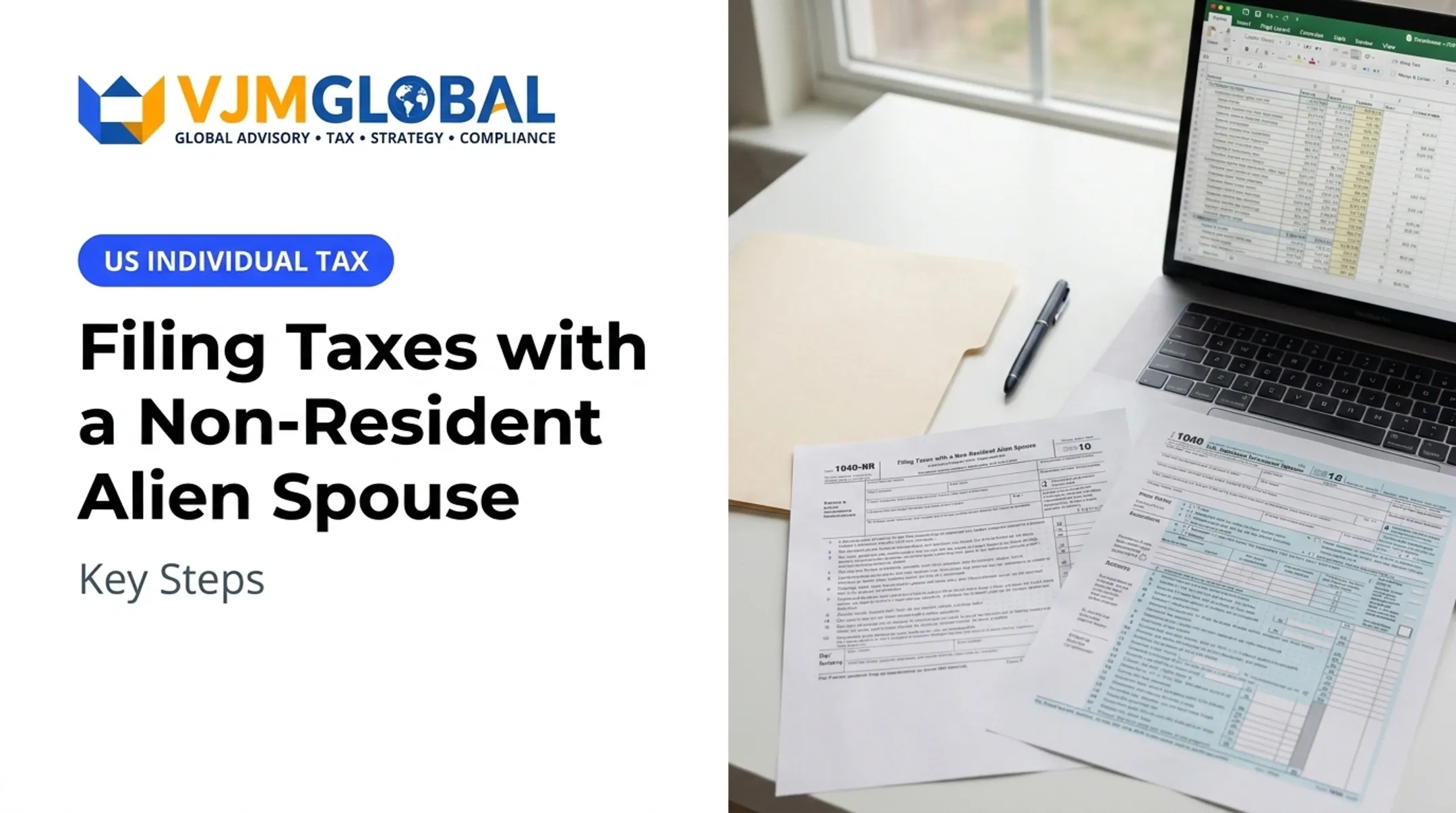
How to File Taxes with a Nonresident Alien Spouse: Key Steps
Step 1: Confirm your spouse's U.S. tax residency
Test the green card rule first. Then the substantial presence test: at least 31 days in the current year and 183 weighted days (current year, plus one-third of the prior year, plus one-sixth of the year before).

Also check:
- Exempt-day categories
- The closer-connection exception
- Treaty tie-breakers
- Dual-status periods
- Any earlier §6013(g) election
Separately, work out whether your spouse earned U.S.-source income that requires Form 1040-NR.
Step 2: Choose the filing path before preparing the return
Compare MFS, MFJ and HOH using real numbers. The 2026 basic standard deductions are $16,100 for MFS, $32,200 for MFJ and $24,150 for HOH. A bigger MFJ deduction is tempting, but it is only one line.
Weigh these against it:
- Both spouses' Australian and other foreign income
- Dependants and credits
- Foreign tax paid
- Investment complexity
- Your plans for the next several years
An MFJ election pulls your spouse's worldwide income into the U.S. system, which is a heavy price for a modest deduction gain.

Step 3: Gather income, identification and account records
Collect:
- Marriage records and both spouses' names and addresses
- SSN or ITIN details
- Wages, business, rental and investment income
- Pension and superannuation statements
- Foreign tax paid and exchange-rate documentation
- Account balances at year-end and the peak during the year
Different Australian assets can have different U.S. treatment. A share portfolio, a managed fund and a superannuation account should not be treated alike.
Step 4: Complete the election or ITIN application
For MFJ, attach a signed §6013(g) statement to the first joint return. Both spouses sign it and list names, addresses and identification numbers. The statement must declare year-end statuses and the election of resident treatment for the whole year. Your spouse also needs an SSN or ITIN.
For MFS, the 2025 Form 1040 instructions allow "NRA" in the spouse's identification field if your spouse has neither number and is not required to have one.
Form W-7 normally goes in with the return, with original documents or copies certified by the issuing agency. A passport generally proves identity and foreign status for an adult. A Certifying Acceptance Agent can authenticate most documents and return originals immediately.
Step 5: File and review international reporting
You file Form 1040. Your spouse files Form 1040-NR only if they have a filing obligation of their own.
Deadlines for Australian-based filers:
- The 2026 return is due 15 April 2027.
- Eligible overseas filers get an automatic extension to 15 June 2027.
- Interest still runs from April on any tax owed.

Then review these international reporting items:
- FBAR
- Form 8938
- Form 8621 for PFICs
- Foreign pension and trust reporting
- Treaty disclosure on Form 8833
- State obligations
Key Factors That Affect the Filing Decision
Income, assets and source country
Australian employment income, self-employment, rental property, investments and superannuation all shift the MFS versus MFJ comparison. Passive foreign investment company (PFIC) exposure can add heavy reporting. Run a side-by-side estimate that includes foreign tax credits, exclusions, deductions and compliance costs.
Identification and documentation
An SSN and an ITIN are not the same. An ITIN is for tax administration only, not employment or immigration status. Anyone eligible for an SSN must not apply for an ITIN.
Timing matters. The IRS estimates about 7 weeks for W-7 processing, or 9 to 11 weeks at peak or for overseas applicants. A return using a newly assigned ITIN cannot be e-filed in the calendar year it is assigned.
Foreign accounts and information returns
FBAR and Form 8938 are separate regimes with different thresholds and definitions.
- FBAR: required when aggregate foreign accounts exceed $10,000 at any time in the year
- §6013(g) and FBAR: the election alone does not make your spouse a U.S. person for FBAR
- Form 8938: an elected NRA spouse is a specified individual; abroad thresholds are $200,000 year-end or $300,000 any time (Single/MFS), and $400,000 or $600,000 (MFJ)

Confirm current thresholds before filing.
Treaty and foreign-tax relief
The U.S.-Australia treaty includes residency tie-breakers and a saving clause that preserves U.S. taxation of citizens and residents. Foreign tax credits (Form 1116) can offset double taxation, and the 2026 Foreign Earned Income Exclusion tops out at $132,900 per qualifying person.
None of this removes U.S. filing or reporting duties. The IRS has not established a blanket U.S. exemption for Australian superannuation, so treat each case on its own facts.
Timing, future years and consequences
A §6013(g) election continues in later years until it is terminated. Later MFS filing does not end it. It ends only through:
- Revocation
- Death
- Qualifying legal separation or divorce
- Inadequate records After termination, neither spouse can elect again, even with a new partner.
Joint filing also means joint and several liability: each of you can owe the whole tax, interest and penalties. Innocent spouse relief exists, but it is conditional.

Common Issues and When Joint Filing May Not Be Appropriate
Common misconceptions
- A noncitizen is not automatically an NRA.
- Living in Australia does not permit Single filing.
- Marriage does not automatically create U.S. residency.
- An NRA spouse cannot be your HOH qualifying person.
- Living in different U.S. states does not change federal filing-status categories, though state law can affect marriage determinations.
Reporting and process mistakes
- Omitting the NRA spouse's U.S.-source income
- Failing to report worldwide income after an MFJ election
- Using the wrong tax year's figures or exchange rates
- Sending an incomplete W-7 package
- Treating FBAR and Form 8938 as interchangeable
Penalties add up. Form 8938 failures can cost $10,000 initially, with up to $50,000 more after notice.
When MFJ may not be appropriate
MFS or eligible HOH is often safer when your spouse has:
- Substantial foreign income
- Complex investments or PFIC exposure
- Foreign pensions, superannuation or businesses
- Treaty-sensitive income
- Incomplete records
HOH is available only when every test is met:
- You did not elect to treat your NRA spouse as a U.S. resident
- Another qualifying person lived with you for more than half the year
- You paid more than half the cost of keeping up the home
Because an election can last for years, get a fact-specific cross-border review before committing. VJM Global's U.S.-compliant CPAs and Chartered Accountants prepare Forms 1040 and 1040-NR and can help you model both options.
Conclusion
The sequence is simple:
- Confirm your spouse's tax residency
- Compare MFS with MFJ and any eligible HOH route
- Gather both spouses' records and sort out identification
- Review U.S., Australian, treaty and information-reporting obligations
For personalised cross-border support, contact VJM Global at [email protected]. The right status depends on your facts and current IRS guidance.
Frequently Asked Questions
How do I file my taxes if I am married to a nonresident alien?
Confirm your spouse's U.S. tax residency first. Then generally file MFS, consider MFJ only with the §6013(g) election, or check whether you meet every HOH condition.
How do I file taxes if my spouse does not have an SSN or ITIN?
On a separate return, you may enter "NRA" if your spouse has no SSN or ITIN and isn't required to have one. For a joint return, your spouse generally needs an ITIN through Form W-7.
Can my husband and I file jointly if we live in different states?
Living in different states does not by itself block federal MFJ. You still need the resident election, and state residency and state returns must be reviewed separately.
How do I answer the question "Are you a nonresident alien?"
The answer depends on U.S. tax residency, not citizenship or location. Apply the green card test, substantial presence test, exceptions, treaty rules and any valid election.