Owners commonly struggle with the same questions. What counts as income? Which costs are personal? What happens when no 1099 arrives from a tenant or property manager? The IRS has long seen problems here: a TIGTA audit review found at least 53% of sampled returns for tax year 2001 misreported rental activity. That is old data, but the pain points haven't changed.
This guide follows the filing workflow: where income appears, how expenses reduce profit, when Schedule C applies, and which records to gather. Figures are in US dollars and reflect 2025 IRS forms.
Key Takeaways
- Schedule E, Part I reports rental real estate income, expenses and the net profit or loss.
- Reportable income goes beyond monthly rent, so reconcile leases, deposits and manager statements.
- Repairs, improvements, personal costs and mortgage principal each need separate treatment.
- A missing Form 1099 does not remove your reporting obligation.
What Schedule E Is and Where Rental Income Goes
Schedule E reports supplemental income and loss. Part I covers rental real estate. Royalties, partnership and S corporation income (Part II), estates and trusts (Part III) and REMIC residual interests (Part IV) sit elsewhere on the form. Part V is a summary. Don't mix them with property rentals.
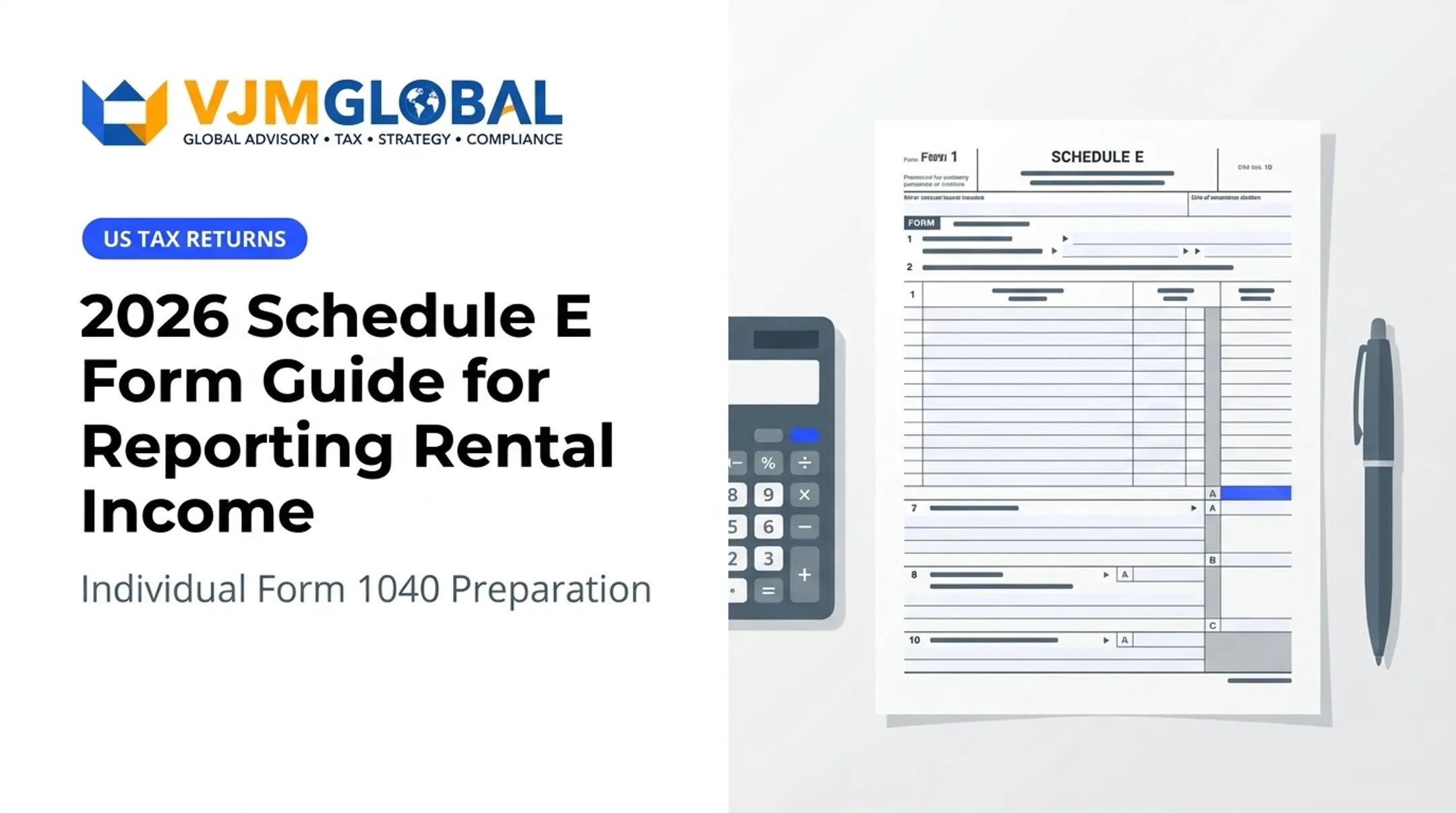
Where rental property information appears
For each property (the form has columns A to C), Part I asks for:
- Address and property type (codes 1 to 8, such as 1 for single family, 3 for vacation or short-term rental)
- Fair rental days and personal use days
- Rents received (line 3)
- Expenses on lines 5 to 19, totalled on line 20
- Net income or loss on line 21
How the amount reaches Form 1040
With only Part I completed, the total on Schedule E line 26 goes to Schedule 1 line 5. If page 2 is used, line 41 goes to Schedule 1 line 5. Schedule 1 line 10 then flows to Form 1040 line 8. Line numbers can change, so check the form for your tax year.

Who generally uses Schedule E
Traditional landlords who collect rent without providing substantial tenant services report on Schedule E. Supplying heat, light, trash collection and common-area cleaning normally still qualifies.
Schedule E reports taxable profit, not cash deposited. Losses can also be limited by basis, at-risk and passive activity rules, covered later.
How to Report Rental Income on Schedule E Part I
Gather property and ownership details
Before entering figures, collect:
- Property address and type
- Your ownership percentage and co-owner details
- Days rented at fair rental price
- Days of personal use
Co-owners report their own share. In an IRS example, a 50% owner who pays $968 in repairs deducts $484, and the balance is reimbursable by the co-owner.
Know which receipts are reportable
Rent is more than the monthly payment. Under IRS rules:
- Advance rent: taxable when received, whatever your accounting method.
- Security deposits: exclude refundable deposits you plan to return. Include amounts kept for damage or lease violations in the year you keep them. A deposit meant as final-month rent is advance rent.
- Lease cancellation payments: treated as rent in the year received.
- Tenant-paid expenses: include them in rent, then deduct them if they otherwise qualify.
- Services instead of rent: include fair market value. If a tenant paints for two months' rent, report the forgone rent and deduct the qualifying painting cost.
Confirm late fees and other incidental charges with current IRS guidance or your adviser, since rental-specific treatment is not clearly defined.
Reconcile your income records
Compare leases, rent ledgers, bank statements, payment-app records, manager statements and any 1099s. The goal is a gross figure that is neither understated nor double counted.
Report properties separately
Track income and expenses per property first. With more than three properties, use additional Schedules E. Complete the totals lines (23a to 26) on only one.
Allocate mixed-use activity
Personal use counts when you, your family or others use the property rent-free or at below-market rates. Under IRC 280A, it is treated as your residence if personal use exceeds the greater of 14 days or 10% of fair rental days.
- Under 15 rental days and used as a residence: rental income is excluded and rental deductions are not allowed.
- Vacation homes: expenses are generally allocated by fair rental days over total days used. Days the property sits vacant but available don't count as rental days.
- Shared costs: use a reasonable method, such as square footage.
- Partial-year conversions: no rental depreciation or insurance deduction for the personal period.

Calculate the net result
This is a hypothetical illustration only, not a personal tax calculation.
| Item | Amount |
|---|---|
| Rents received | $24,000 |
| Mortgage interest | $(7,500) |
| Property taxes | $(3,000) |
| Insurance | $(1,200) |
| Repairs | $(1,800) |
| Depreciation | $(5,000) |
| Net rental income | $5,500 |
If expenses exceeded rent, the loss would not automatically be deductible. Basis, at-risk and passive activity rules apply first.
Deductible Rental Expenses and Common Classification Issues
Expenses must be ordinary and necessary: tied to managing, conserving or maintaining the rental, and backed by records. Costs generally become deductible once the property is available for rent.
Common Schedule E categories
| Line(s) | Category | Example |
|---|---|---|
| 5 | Advertising | Listing fees |
| 6 | Auto and travel | Trips to inspect or repair |
| 7 | Cleaning and maintenance | Gardening, turnover cleaning |
| 8 | Commissions | Leasing agent fees |
| 9 | Insurance | Landlord policy |
| 10 | Legal and professional | Tax preparation, eviction counsel |
| 11 | Management fees | Property manager |
| 12 to 13 | Mortgage and other interest | Bank loan interest |
| 14 to 16 | Repairs, supplies, taxes | Fixing a leak, light bulbs, property tax |
| 17 to 18 | Utilities, depreciation | Water, building depreciation |
| 19 | Other | Listed separately |
Mortgage interest versus principal
Interest is deductible. Principal repayments are not a current expense. Match the interest figure to your lender's year-end statement.
Repairs versus improvements
A repair keeps property in ordinary operating condition. An improvement is a betterment, a restoration, or an adaptation to a new use, and must be capitalised and depreciated. Fixing a defect, adding capacity or replacing a major component generally falls into the second group.
Two safe harbours can simplify the call:
- De minimis rule: Expense items up to $2,500 per item or invoice without an applicable financial statement (the old $500 limit ended for tax years from 2016). Requires an annual election.
- Small taxpayer safe harbour: Available for buildings with unadjusted basis of $1 million or less.
Have a professional review renovations, replacements and large restorations.
Depreciation
Residential rental property is depreciated over 27.5 years, straight line, using the mid-month convention. Land is not depreciable. Form 4562 is required for property first placed in service in the tax year.
Depreciation reduces taxable income without any cash leaving your account. Basis is reduced by depreciation allowed or allowable, whichever is greater, even if you never claimed it. On sale, gain linked to depreciation (unrecaptured section 1250 gain) can be taxed at up to 25%.

Mixed-use and shared expenses
Deduct only the rental share of utilities, insurance, interest and repairs. Paying a personal cost from a rental bank account doesn't make it deductible. Keep receipts, invoices and paid bills, since they also support basis and depreciation until the limitations period for the sale year closes.
Schedule E vs. Schedule C and Other Related Forms
Schedule E or Schedule C?
The deciding factor is the services you provide to occupants. The Schedule E instructions point to Schedule C when you provide significant services, such as regular cleaning, linens or concierge-type help.
A 2021 IRS Chief Counsel memo (CCA 202151005, nonprecedential) shows the contrast. Where the average stay was seven days and the owner supplied daily maid service, linens and amenities, the income counted as self-employment earnings. Where the owner only cleaned between guests, it did not.
This matters because Schedule C income can bring self-employment tax. Short stays alone don't force Schedule C, and ordinary rents are generally excluded from SE earnings.

How Forms 1099 relate to rental income
You might receive:
- 1099-MISC (box 1): from business payers for rent of $600 or more for 2025 ($2,000 threshold for 2026 payments)
- 1099-K: from payment platforms when payments exceed $20,000 and 200 transactions; payment-card 1099-Ks have no minimum
Earlier lower 1099-K phase-in thresholds no longer apply. The IRS 1099-K FAQs confirm that taxable income is reportable even without a 1099-K. Compare any form against your own records before copying it.
Schedule K and Schedule K-1
Schedule K summarises all owners' shares at the partnership or S corporation level. Schedule K-1 shows each owner's share of income, deductions and credits. Partners use it to report their allocable share.
That share goes in Schedule E Part II, even if no cash was distributed. Don't add it to Part I rents for the same property, or you will count it twice.
Special Rules, Filing Records, and Common Mistakes
Rules that limit rental losses
Losses clear three hurdles in order: basis, at-risk (Form 6198), then passive activity (Form 8582). The IRS Publication 925 explains each.
- $25,000 allowance: available for active participation with at least 10% ownership. It phases out by 50% of income above $100,000 modified AGI and reaches zero at $150,000.
- Real estate professionals: more than 750 hours and more than half of working time in real property businesses, plus material participation in the rental.
- Suspended losses: carry forward and are generally released on a fully taxable disposition of the entire activity to an unrelated party.

Ownership and unusual situations
- Single-member LLC: disregarded unless it elects corporate treatment, so rentals generally stay on Schedule E.
- Co-owned property: not a partnership merely because it is rented, unless tenant services are provided.
- Vacant property held for rent: expenses and depreciation continue, but you can't deduct lost rent.
- Foreign property: US citizens and resident aliens report worldwide income. Foreign taxes may qualify for a credit (Form 1116).
- Foreign-use residential property: generally depreciated over 30 years under ADS.
- FBAR / Form 8938: foreign real estate itself isn't reported, but related foreign accounts or entities may be.
Review entity and ownership documents before deciding where income belongs.
Filing checklist
Income and third-party documents
- Leases and rent ledgers
- Bank and payment-app statements
- Property manager reports
- Forms 1099 received
Expenses, basis, and personal use
- Receipts and invoices
- Mortgage interest statements
- Property tax and insurance records
- Depreciation schedules
- Travel logs
- Personal-use day records
Common mistakes
- Reporting only deposits received
- Leaving out non-rent receipts
- Deducting mortgage principal
- Treating improvements as repairs
- Combining several properties
- Claiming personal expenses
- Not reconciling third-party forms
VJM Global supports US individual taxpayers with Form 1040 and 1040-NR preparation and provides tax compliance and accounting services, which can help with organised rental records or more complex filings. Your circumstances will differ, so get individual guidance before you file.
Frequently Asked Questions
Where does rental income go on a 1040?
It starts on Schedule E, Part I. The total flows to Schedule 1 line 5, then through Schedule 1 line 10 to Form 1040 line 8.
Should I report rental income on Schedule C or E?
Ordinary rentals generally use Schedule E. Substantial services to occupants can require Schedule C. Review your facts with a tax professional.
Do I have to report rental income to the IRS?
Yes. Taxable rental income generally must be reported whether or not you received a Form 1099.
Do I get a 1099 for rental income?
It depends on the payer, manager or platform. Business payers use 1099-MISC at $600 for 2025 and $2,000 for 2026. Report all income either way.
What is Schedule K income?
Schedule K summarises a partnership or S corporation's items. Your K-1 shows your share, which you report on Schedule E, Part II.