Introduction
Short answer: for U.S. federal purposes, an S corporation's pass-through profit generally isn't subject to self-employment tax. But wages paid to an owner-employee are subject to payroll taxes.
That doesn't mean S corporation owners escape tax. Many Australian owners with U.S. interests struggle to separate self-employment tax from federal income tax, state taxes and payroll taxes. Pass-through profit still lands on the owner's individual return either way.
This guide is written for Australian business owners and freelancers with U.S. business interests. It covers salary versus distributions, reasonable compensation, compliance costs and the cross-border checks you need before electing S status.
Key Takeaways
- S corporation distributions generally avoid self-employment tax, but owner wages go through payroll.
- Pay yourself a reasonable salary; you can't relabel earned pay as a distribution.
- Weigh potential savings against payroll, filings, state taxes and fees.
- A U.S. S election doesn't replace Australian tax advice or settle Australian treatment.
What Self-Employment Tax Means, and Where S Corporations Fit
Self-employment tax covers Social Security and Medicare for people working for themselves. The IRS self-employment guidance sets it at 15.3% (12.4% + 2.9%). It applies to net earnings, normally 92.35% of business profit. The 2026 Social Security wage base is $184,500, while Medicare has no cap.
How structures compare
- Sole proprietors and single-member LLCs (disregarded) file Schedule C and Schedule SE, and pay self-employment tax on net earnings.
- Partnerships report on Form 1065 and K-1; the partner's share generally feeds Schedule SE.
- S corporations file Form 1120-S and issue K-1s. A shareholder's income share is not self-employment income, but officer wages are FICA wages.
Not income-tax-free
Avoiding self-employment tax on distributions doesn't make them tax-free. S corporation income passes through and is taxed on shareholders' individual returns whether or not it is distributed.
Payroll taxes also differ in mechanics. The company must handle both employer and employee shares on shareholder wages: 6.2% Social Security and 1.45% Medicare each, plus a possible 0.9% additional Medicare withholding above $200,000 in wages.
Other taxes can apply too, such as the 3.8% net investment income tax on certain passive income, and state-level S corporation taxes. Verify the rules for the relevant tax year.

How the Salary-and-Distribution Strategy Works
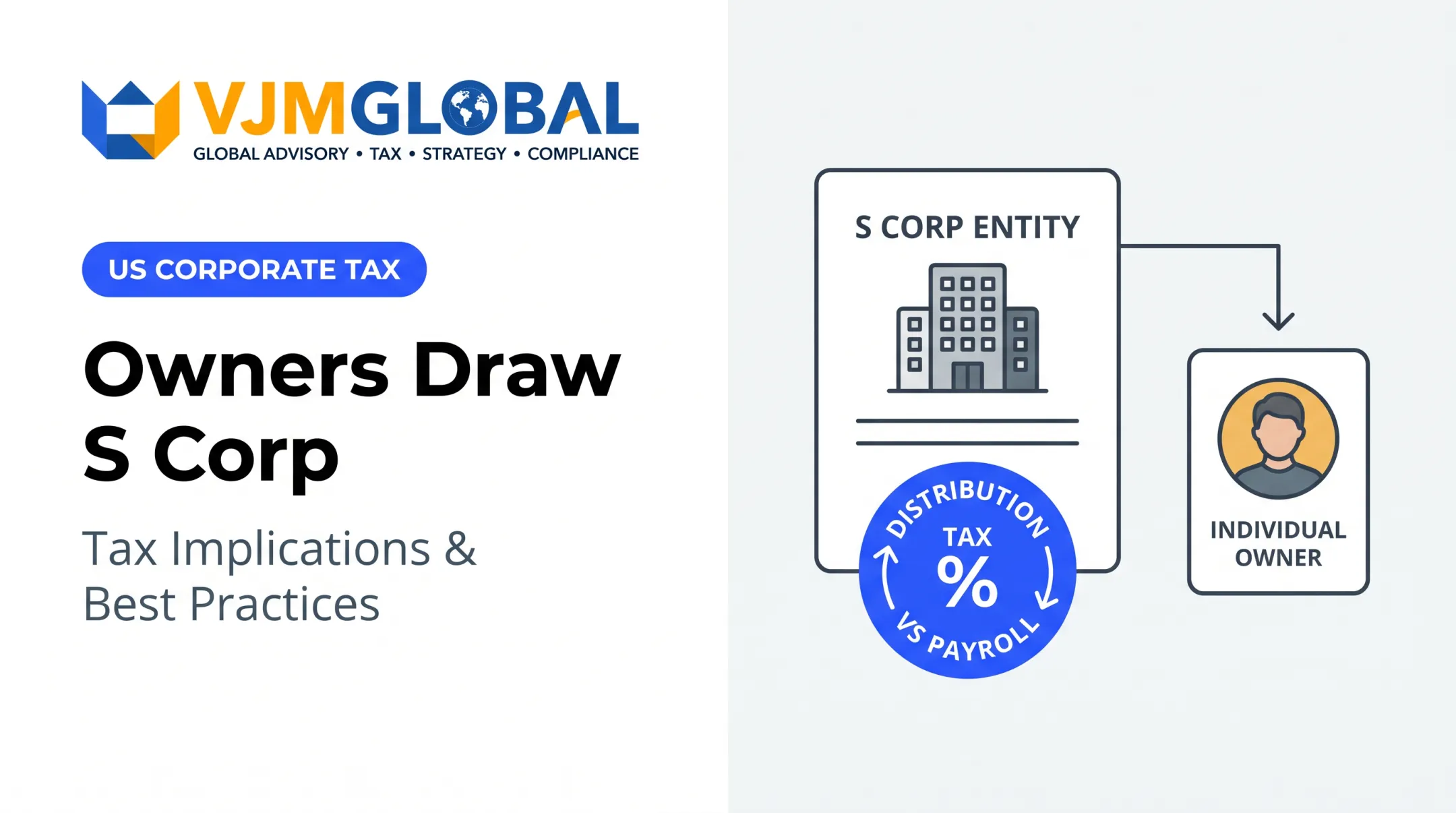
The model has two parts: a reasonable salary for services, then distributions of remaining profit according to ownership and available cash.
Payroll obligations on salary
- Withhold income tax and the employee's FICA share
- Pay the employer's FICA share
- Report wages on Form W-2
- File Forms 941 (or 944) and 940, and deposit taxes electronically
- Keep payroll records
Distributions
- Non-dividend distributions are tax-free up to the shareholder's stock basis
- Any excess over basis is capital gain
- Debt basis doesn't shelter distributions
- Track basis on Form 7203
- Need adequate cash, accurate books and consistency with governing documents
A hypothetical comparison
Illustrative only, using round numbers. Say a business earns US$150,000 before owner pay.
- Sole-trader style: self-employment tax applies to roughly 92.35% of profit, about $138,500, at 15.3%, roughly $21,200.
- S corporation: suppose a supportable salary of $80,000. FICA totals about $12,240 (both shares). Self-employment tax doesn't apply to the other $70,000.
- Gap before costs: around $9,000 (before payroll fees, Form 1120-S preparation, state taxes and lost retirement contributions).

The result depends on reasonable pay, profit, state rules and your wider tax position. The employer half of FICA is also deductible by the company, which this simplified example ignores.
Expenses, reimbursements and loans
- Accountable-plan reimbursements (business connection, substantiation, return of excess) aren't wages. Nonaccountable payments are.
- Loans from you directly to the company can create debt basis. Guarantees alone don't.
- Undocumented personal withdrawals invite recharacterisation as wages.
Reasonable Compensation, IRS Scrutiny and Consequences
Reasonable compensation reflects the value of services you actually perform, not an artificially low figure chosen to cut payroll tax. The IRS compensation guidance lists factors including training and experience, duties, time and effort, comparable pay, other employees' pay and dividend history.
Evidence to keep
- Written duties and hours worked
- Comparable pay data for your role, industry and region
- Company revenue and the use of other staff or contractors
- A dated record of how you set the salary
Common risk signals
- An active owner paid no wages
- A nominal wage despite heavy activity
- Distributions far above salary without support
- Revenue tied mainly to the individual rather than the company
What courts have said
In David E. Watson, P.C. v. United States (8th Cir., 2012), the court upheld $91,044 as reasonable annual pay against a $24,000 salary. In Radtke (7th Cir., 1990), a full-time working shareholder took $0 salary and about $18,225 in dividends; the payments were treated as wages. These outcomes turned on their facts, not a universal formula.
A TIGTA 2021 report flagged 266,095 one-shareholder returns with profit over $100,000 and no officer pay. That is historical data, not current prevalence.
Consequences of a challenge
Possible results include recharacterisation of distributions as wages, extra payroll taxes, amended filings, interest, penalties and professional fees. No outcome is guaranteed either way.

Compliance checklist
- Document your salary decision in writing
- Run regular payroll
- Keep separate bank accounts
- Reconcile books monthly
- Document every distribution
- Review salary annually
Is an S Corporation Right for You? Election, Costs and Compliance
When it may be worth evaluating
- You earn consistent profits
- You perform substantial services for the business
- Your profit exceeds a supportable salary plus expenses
- Your tax savings likely exceed the added costs
When it may not suit
- You expect start-up losses or thin profits
- Your cash flow is irregular
- You dislike payroll and corporate formalities
- Your ownership or financing plans clash with S corporation rules
Alternatives
- Sole proprietor, LLC or partnership: avoids payroll but keeps self-employment tax
- Australian sole trader: not the same as a U.S. S corporation (individual tax arrangement versus a U.S. tax election)
Eligibility and filings
- U.S. domestic corporation, at most 100 shareholders, one class of stock
- Shareholders must be eligible individuals, certain trusts or estates; partnerships, corporations and nonresident aliens are excluded
- Form 2553, generally within 2 months and 15 days of the tax year start
- Form 1120-S, generally due the 15th day of the third month after year end, with K-1s to shareholders
- Payroll filings, state filings and records
Break-even check
Compare the tax saving against:
- Accounting and payroll service fees
- State taxes: California charges 1.5% (minimum generally $800), Illinois 1.5% replacement tax, and Texas, New York and others have their own rules
- Registered-agent and corporate costs
- Retirement effects: distributions aren't earned income for plan contributions, so a lower salary means lower contributions

What Australian Business Owners Should Check Before Choosing a U.S. S Corporation
An S corporation is a U.S. tax classification, not an Australian company type. Favourable U.S. treatment doesn't remove Australian reporting or tax.
Questions needing professional review
- Eligibility: nonresident aliens can't directly own S shares. Australian residence doesn't itself decide U.S. tax residence, which turns on a green card or the substantial presence test.
- Australian reporting: residents generally declare foreign income, and controlled foreign company rules may apply.
- Classification: how an S corporation K-1 allocation is characterised in Australia is not clearly settled under ATO guidance. Don't assume flow-through treatment.
- Foreign tax offset: the offset is non-refundable and not automatic for every allocation.
- Treaty and social security: the 1982 treaty (amended 2001) and the U.S.-Australia Social Security Agreement may affect outcomes; self-employed U.S. citizens resident in Australia request a U.S. exemption letter.
Don't assume an S election carries over to an Australian company, subsidiary, trust or sole-trader arrangement. Get advice before forming or electing.
VJM Global supports Australian and international businesses with accounting, tax compliance and U.S.-compliant professional assistance. That includes bookkeeping, payroll and cross-border compliance, which suits owners who need these coordinated.
This article is general information, not personalised U.S. or Australian tax, legal or financial advice. Verify rules and deadlines for the applicable tax year.
Frequently Asked Questions
What expenses are deductible for the self-employed?
Expenses generally must be ordinary, necessary, business-related and documented. Personal costs aren't deductible. In an S corporation, expenses are generally handled at company level.
Is it better to be a company or a sole trader?
Companies offer liability separation but add administration and compliance costs; sole traders are simpler. An Australian sole trader isn't comparable to a U.S. S election, so profit, risk and residency drive the choice.
Do I need to pay tax if I am a freelancer?
Generally yes: you report business income and may owe income and employment-related taxes. Treatment depends on residency, entity type and which country's rules apply.
Are S corporations subject to self-employment tax?
Pass-through income and properly treated distributions generally aren't subject to self-employment tax. Shareholder wages are subject to payroll taxes, and the income remains subject to income tax.
How do S corp owners pay themselves?
Through a reasonable payroll salary, plus distributions when supported by profit, records, ownership and cash.