"2026" causes confusion. The 2026 filing season covers tax year 2025 returns, due April 15, 2026. Tax year 2026 returns are filed in 2027 and are due April 15, 2027. This guide covers both, and flags which is which.
For U.S. citizens and residents living in Australia, the stakes include automatic extensions, foreign income rules and separate reporting forms. Below: what Schedule 2 covers, who needs it, how to complete it, key dates, and common errors.
Key Takeaways
- Schedule 2 applies only when a listed additional tax or repayment applies.
- Its section totals carry to designated Form 1040 lines.
- Schedule SE, Form 6251, 5329, 8959, 8960 or 8962 usually come first.
- Deadlines differ by tax year, and an extension to file is not an extension to pay.
What Is IRS Schedule 2 and What Does It Cover?
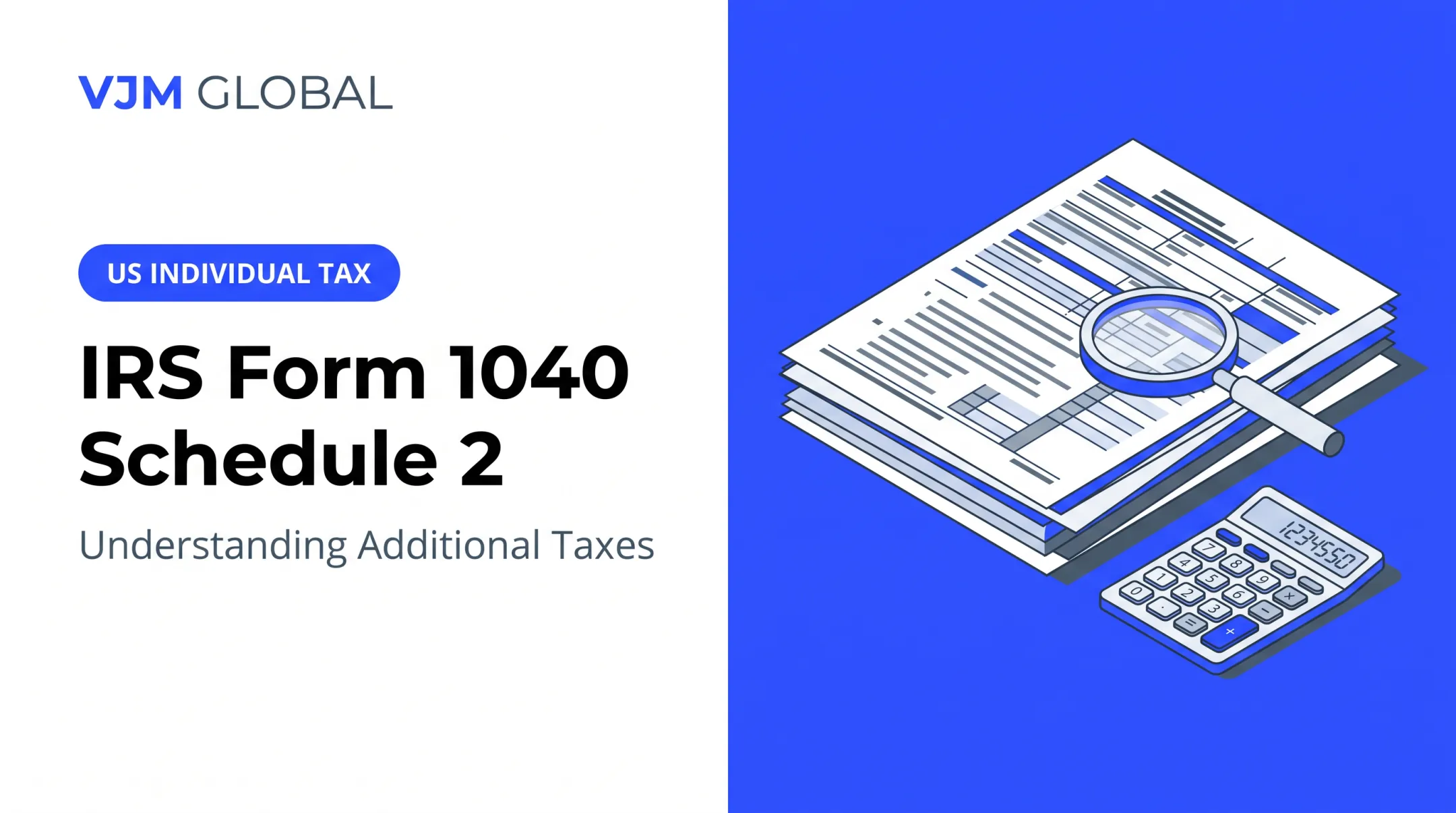
The IRS instructions say to use Schedule 2 for additional taxes that cannot be entered directly on the main return. It is not an annual attachment for every filer.
How it differs from Schedules 1 and 3
- Schedule 1 reports additional income and adjustments to income.
- Schedule 2 reports additional taxes.
- Schedule 3 reports certain nonrefundable credits and other payments.
Structure of the form
The finalised form for the 2026 filing season is the tax year 2025 version. Part I is titled "Tax" and its line 3 flows to Form 1040 line 17. Part II, "Other Taxes," ends at line 21, which flows to Form 1040 or 1040-SR line 23 (Form 1040-NR line 23b).
The IRS tax year 2026 draft renames Part II "Additional Taxes" and is marked "DRAFT - DO NOT FILE." Don't rely on draft line labels.
Common items on the 2025 form
Part I
- Excess advance Premium Tax Credit repayment (Form 8962)
- Clean-vehicle credit repayments (lines 1b and 1c)
- Alternative Minimum Tax (Form 6251)
Part II
- Self-employment tax (Schedule SE)
- Additional tax on IRAs and other tax-favored accounts (Form 5329, line 8)
- Household employment tax (Schedule H)
- Additional Medicare Tax (Form 8959)
- Net Investment Income Tax (Form 8960)
PFICs: for individuals, specified PFIC interest from Form 8621 goes on line 17p
Schedule 2 mostly reports amounts calculated elsewhere. It is a collection point, not a worksheet. Complete the supporting form first, then carry the number across.

Who Needs to File Schedule 2?
Use a simple rule: if your return shows an additional tax, repayment or recapture listed on the form, you need it. High income or living abroad doesn't automatically trigger it.
Common triggers
| Item | Rule |
|---|---|
| Self-employment tax | Net earnings of $400 or more generally trigger it |
| Additional Medicare Tax | 0.9% above $250,000 (joint), $125,000 (separate) or $200,000 (other) |
| Net Investment Income Tax | 3.8% on the lesser of net investment income or MAGI over the same thresholds |
| AMT (2025) | Exemption of $88,100 single, $137,000 joint |
| Early retirement distributions | Generally 10% additional tax before age 59½, subject to exceptions |
Other triggers include excess advance Premium Tax Credit, excess IRA contributions (a 6% excise tax) and household employment. Check current thresholds in the IRS instructions each year.
Self-employment
Freelancers, contractors and sole proprietors typically track business income, complete Schedule C, then Schedule SE. SE tax flows to Schedule 2, and part of it becomes a deduction on Schedule 1.
Taxpayers filing from Australia
Living in Australia changes the supporting analysis, not the basic test.
- Foreign Earned Income Exclusion: the maximum is $130,000 for 2025 and $132,900 for 2026. Under IRS guidance, self-employed people must still pay SE tax on net profit even when they claim the exclusion.
- Totalization agreement: Per the SSA, self-employed U.S. citizens in Australia are exempt from U.S. Social Security on that income and should request an SSA letter of exemption (Australia issues none). Confirm the position first; it is not a blanket exemption from all Schedule SE tax.
- Foreign tax credit: Form 1116 limits the credit to the smaller of foreign tax paid or U.S. tax on foreign-source income.
- Superannuation: Treaty treatment of private Australian superannuation is unclear. Get professional advice before choosing a reporting position.

Separate forms, separate obligations
Schedule 2 doesn't replace other reporting. Depending on the facts, you may also need Form 2555, Form 1116, Form 8621, an FBAR or Form 8938.
- FBAR: required when aggregate foreign account value exceeds $10,000 at any time
- Form 8938: for filers abroad, generally $200,000 at year-end or $300,000 at any time (unmarried), or $400,000 and $600,000 for joint filers
- Form 8938 doesn't replace the FBAR
How to Complete and Submit Schedule 2
Before you start
Collect these items before you begin:
- Current Schedule 2 and its instructions
- Form 1040 instructions for the same tax year
- Income records, withholding details and every supporting form
Confirm the form version matches your tax year.
Australian-based filers should report in U.S. dollars. Use the spot rate on the date you receive income or pay an expense, or an IRS yearly average rate. Choose a method that fits each transaction type and apply it consistently.
Completing the schedule
- Calculate the underlying amount on the supporting form (Schedule SE, Form 6251, 5329, 8959, 8960, 8962 or Schedule H).
- Enter each result on the matching Schedule 2 line.
- Add each part to reach its total.
- Carry the totals to the Form 1040 lines identified in the current instructions. Don't copy line numbers from a prior-year form.

Final review
Attach Schedule 2 to your full Form 1040-series return, whether you e-file or mail it. Include supporting forms when the instructions require them. Before you send anything, confirm the Schedule 2 total matches the Form 1040 entry.
2026 Filing Dates and Filing Process
Which return are you filing?
| Return | Original due date |
|---|---|
| Tax year 2025 (2026 filing season) | April 15, 2026 |
| Tax year 2026 (filed in 2027) | April 15, 2027 |
Extra time for taxpayers abroad
Eligible calendar-year filers living outside the United States generally receive an automatic two-month extension to June 15. Attach a statement explaining the qualifying situation. Filing Form 4868 by that date extends the deadline to October 15.
Paying is separate
An extension to file is not an extension to pay. Interest runs on tax unpaid after April 15. The Q4 2026 IRS rate is 7% per year, compounded daily, and the failure-to-pay penalty is generally 0.5% per month, up to 25%.

Schedule 2 items such as SE tax, NIIT, and Additional Medicare Tax feed total tax, so they affect estimated-tax safe harbors. You generally avoid the underpayment penalty if any of these apply:
- You owe under $1,000
- You paid at least 90% of current-year tax
- You paid 100% of prior-year tax (110% for higher earners)
E-file or paper
E-filing is available to taxpayers abroad and catches many common errors. Paper filers abroad mail returns without payment to the Department of the Treasury, Internal Revenue Service, Austin, TX 73301-0215, USA. When enclosing payment, use P.O. Box 1303, Charlotte, NC 28201-1303, USA. Keep a full copy of the return and source documents.
Common Mistakes, Tax Impact, and When to Get Help
Frequent errors
- Using an older Schedule 2
- Confusing Schedule 2 with Schedule 1 or 3
- Entering an amount without its supporting form
- Omitting a required foreign form
- Failing to reconcile the schedule total with Form 1040
The IRS also warns against filing before all tax documents arrive and choosing the wrong filing status. GAO reported paper returns took about one month to process in the 2026 season, roughly twice the prior year.

Effect on your refund
Schedule 2 is not a penalty. Its entries add to total tax, which can shrink a refund or create a balance due if withholding and payments fall short. Not every entry is a separate calculation; many simply carry amounts from other forms.
When to get professional help
Cross-border and self-employment facts are where Schedule 2 mistakes most often appear. Get help when you face:
- Self-employment income
- Foreign investments, pensions or PFICs
- Foreign tax credits or the Foreign Earned Income Exclusion
- Totalization-agreement questions
- Uncertainty about tax year or deadlines
VJM Global offers U.S. individual return preparation (Form 1040 and 1040-NR) and cross-border accounting support, with a team that includes CPAs and U.S.-compliant professionals. Contact the firm if you need organised records or a review of U.S. reporting. U.S. return preparation does not include Australian tax advice, and engagement does not imply automatic IRS representation.
Frequently Asked Questions
What is Schedule 2 for?
It reports additional taxes, repayments, penalties or recaptured benefits carried to a Form 1040-series return. Check the current IRS form for the exact categories.
What is the filing date for 2026?
For the 2026 filing season (tax year 2025), it was 15 April 2026. Tax year 2026 returns are due 15 April 2027. Filers abroad generally get until 15 June with a statement.
Do I need Schedule 2 if I only have W-2 income?
Often not. But AMT, credit repayments, retirement-account taxes or other listed items can still require it.
Does self-employment income require Schedule 2?
Usually. SE tax is calculated on Schedule SE and carried to Schedule 2. Living in Australia, and the US-Australia totalization agreement, may change how SE tax applies.
Does Schedule 2 affect my tax refund?
Yes. It can increase total tax, which reduces a refund or creates a balance due when payments don't cover it.
Can I file Schedule 2 separately from Form 1040?
No. It is filed with the complete Form 1040-series return, with supporting forms included as required.