It is not part of an Australian tax return. Before anything else, work out whether you must file a U.S. federal return at all. This guide covers what Schedule A deductions are, which expenses qualify, how itemizing compares with the standard deduction, and how to handle Australian expenses.
Key Takeaways
- Schedule A applies only if you itemize instead of taking the standard deduction.
- Expenses must fit a category, meet IRS rules, and be documented.
- Australian tax treatment does not decide U.S. deductibility.
- Convert Australian dollars to USD with a consistent, documented method.
- Foreign income taxes force a choice: deduct or claim the Foreign Tax Credit.
What Are Schedule A Deductions?
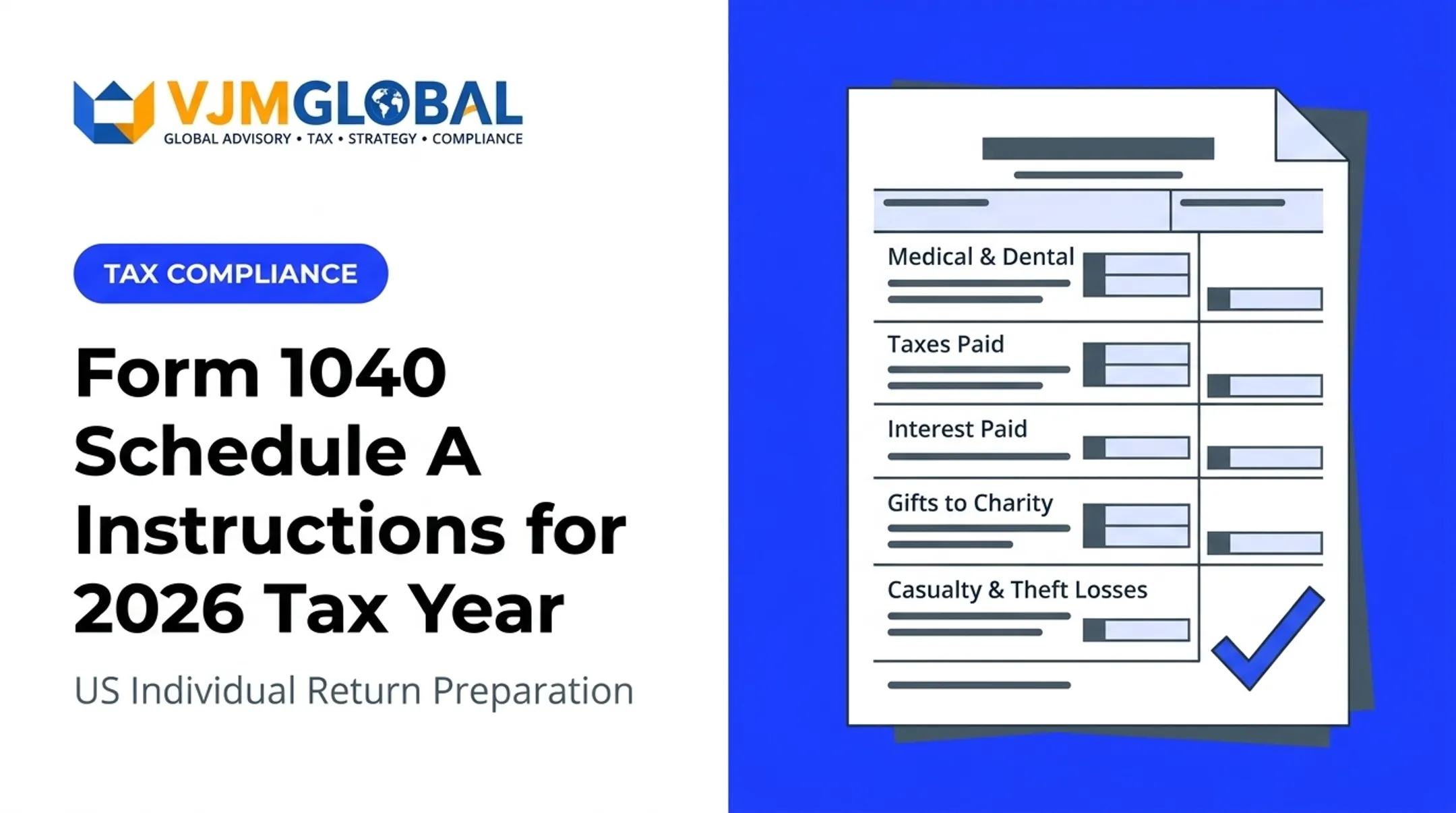
Schedule A attaches to Form 1040 or 1040-SR. It totals your itemized deductions, and IRS instructions describe it as covering medical and dental expenses, taxes, interest, contributions, and other deductions. On the 2026 draft form, the total moves to line 12e of Form 1040.
A deduction reduces income before tax is calculated. A credit reduces the tax bill dollar-for-dollar.
The workflow is simple:
- Identify eligible expenses.
- Apply each category's thresholds and limits.
- Total the allowable amount.
- Compare it with the standard deduction for your filing status.

You don't need expenses in every category. Report only what applies.
Schedule A versus Schedule 1-A
The names are similar, but the forms are different. Schedule 1-A ("Additional Deductions") was created by P.L. 119-21 and covers:
- Qualified tips (up to $25,000)
- Qualified overtime (up to $12,500, or $25,000 joint)
- Qualified passenger vehicle loan interest (up to $10,000)
- The enhanced senior deduction (up to $6,000 per eligible person)
The IRS says you can claim these whether you itemize or take the standard deduction. The senior deduction is temporary, covering 2025 to 2028.
Why it matters for Australian-based filers
Expenses paid in Australia must be converted to U.S. dollars. You also need to check whether the expense is recognised under U.S. rules at all.
An expense that is deductible under Australian rules is not automatically deductible on your U.S. return. The two systems operate independently.
Which Expenses Can You Claim on Schedule A?
Medical and dental expenses
For 2025, only unreimbursed medical and dental costs above 7.5% of AGI count, per IRS Publication 502. Qualifying items include medical care, certain long-term-care costs, and medical lodging (generally capped at $50 per person per night).
Points for Australian-based filers:
- Subtract anything reimbursed by insurance or other sources.
- Premiums paid by an employer or with pre-tax money are not deductible; after-tax premiums may qualify.
- Travel for purely personal reasons or general health, and diet or weight-loss costs, are excluded.
- Publication 502 doesn't specifically address Australian Medicare levy, private health cover, or treatment received abroad. Get professional advice before claiming these.
State and local taxes
The SALT category lets you choose state and local income taxes or general sales taxes, not both. Qualifying real and personal property taxes are included, all subject to a cap.
| Limit | 2025 | 2026 |
|---|---|---|
| SALT cap | $40,000 | $40,400 |
| MFS cap | $20,000 | $20,200 |
| Phaseout begins (MAGI) | $500,000 | $505,000 |
The cap phases down above the threshold, with a floor of $10,000 ($5,000 MFS) in 2025.
Australian income tax is not a state or local tax. Foreign income taxes are reported separately as other taxes, or handled through the Foreign Tax Credit. Foreign real property taxes are also not deductible for individuals under IRC §164, and the 2025 Act removed the sunset on that exclusion.

Mortgage interest
Interest on acquisition debt, meaning a loan used to buy, build, or substantially improve a qualified main or second home, may be deductible. Limits under Publication 936:
- $750,000 ($375,000 MFS) for debt taken after Dec. 15, 2017
- $1 million ($500,000 MFS) for earlier debt
- Home-equity interest is generally not deductible unless the funds improved the home securing the loan
Interest reported on Form 1098 goes on line 8a; other qualifying interest goes on line 8b. The mortgage insurance premium deduction has expired.
Publication 936 doesn't say expressly whether an Australian home qualifies, so don't assume either way. Rental or business interest belongs on other schedules, not here.
Charitable contributions
Gifts generally must go to U.S.-qualified organisations. Publication 526 says foreign charities are generally not deductible, with exceptions only for certain Canadian, Mexican, and Israeli organisations. It lists no Australian exception.
A U.S. charity can fund a foreign programme if it approves the programme as advancing its own purpose and keeps control. A simple earmarked pass-through doesn't count.
Documentation rules:
- Gifts of $250 or more need a written acknowledgement.
- Noncash gifts over $500 generally need Form 8283.
- Noncash property over $5,000 generally needs a qualified appraisal.
- Keep proof of payment.
From 2026, itemizers can deduct charitable gifts only above 0.5% of AGI, while non-itemizers can deduct up to $1,000 ($2,000 joint) in cash gifts.
Casualty, theft, and excluded expenses
For 2025, personal casualty and theft losses generally must come from a federally declared disaster. They are reduced by $100 per casualty, and the total must exceed 10% of AGI (Form 4684). From 2026, certain state-declared disasters also qualify.
Generally not deductible on Schedule A:
- Ordinary living costs and commuting
- Political contributions
- Expenses deducted elsewhere
- Unreimbursed employee expenses, since miscellaneous itemized deductions stay disallowed from 2026 (except educator expenses)
Check before claiming foreign property taxes or anything affected by recent law changes.
Should You Itemize or Take the Standard Deduction?
Compare your allowable itemized total with the standard deduction and take whichever gives the better result.
| Filing status | TY2025 (filed 2026) | TY2026 (filed 2027) |
|---|---|---|
| Single | $15,750 | $16,100 |
| Married filing separately | $15,750 | $16,100 |
| Married filing jointly | $31,500 | $32,200 |
| Head of household | $23,625 | $24,150 |
| Qualifying surviving spouse | $31,500 | $32,200 |
Source: IRS Revenue Procedure 2025-32 and IRS credits and deductions guidance.
Age 65+ or blind adds $2,000 (unmarried) or $1,600 (married) per person for 2025, and $2,050 or $1,650 for 2026. The separate senior deduction on Schedule 1-A is in addition.
A practical decision process
- Estimate each Schedule A category.
- Remove amounts blocked by thresholds or limits.
- Total what's left.
- Compare it with your standard deduction.

A large expense doesn't produce an equal tax saving. The benefit depends on your marginal rate. Run both calculations before filing, especially if you're close to the line or your filing status has changed.
Filing status and special rules
- If you're married filing separately and one spouse itemizes, the other must itemize too.
- Itemizing on a US federal return may or may not affect a US state return. Australian tax law has no equivalent federal-versus-state itemizing choice.
- Claim the Foreign Tax Credit for all qualifying foreign taxes or deduct all of them for the year; you can't split them (Publication 514). The credit generally uses Form 1116.
How to Complete Schedule A and Support Your Claims
Gather and classify records
Collect:
- Medical invoices and insurance statements
- Mortgage interest statements
- Tax receipts
- Donation acknowledgements and valuation records
- Disaster-loss documents
- Proof of payment
Separate personal, rental, business, and reimbursed expenses before entering anything.
Convert Australian expenses and keep an audit trail
U.S. returns are stated in U.S. dollars. IRS guidance generally uses the spot rate when an item is paid, and yearly average rates aren't a blanket substitute. Pick a reasonable method, apply it consistently, and document it.
Keep original Australian receipts, bank statements, exchange-rate records, translations where needed, and your conversion calculations. Keep records for 3 years, and 6 years if more than 25% of gross income was omitted.

Filers living abroad may get an automatic extension to June 15, though interest on unpaid tax still runs from the regular due date.
Avoid errors and know when to get help
Common mistakes:
- Using outdated limits
- Deducting foreign property taxes
- Claiming foreign income tax as both deduction and credit
- Ignoring AGI thresholds
- Skipping substantiation
Get professional review if your return involves Australian income taxes, foreign real estate or mortgages, FEIE, the Foreign Tax Credit, or large charitable gifts. VJM Global provides tax compliance and advisory support through U.S.-compliant professionals for taxpayers and businesses with cross-border reporting needs. No adviser can promise a specific tax result.
Frequently Asked Questions
What is the standard tax deduction for 2026?
For tax year 2026 (returns filed in 2027): $16,100 single or married filing separately, $32,200 married filing jointly or qualifying surviving spouse, and $24,150 head of household. Age or blindness adds $2,050 (unmarried) or $1,650 per person, per IRS Revenue Procedure 2025-32.
What is Schedule A used for?
Schedule A attaches to Form 1040 to calculate itemized deductions. The total replaces the standard deduction when it's larger.
Who should use Schedule A instead of the standard deduction?
Taxpayers whose allowable itemized deductions, after all limits, exceed their standard deduction. Compare both before filing.
What deductions can be claimed on Schedule A?
Main categories are medical and dental expenses, qualifying taxes, mortgage interest, charitable contributions, and eligible casualty or theft losses, all subject to current IRS rules.
Can I deduct expenses paid in Australia on Schedule A?
Some may qualify under U.S. rules, but Australian tax treatment doesn't control. Convert to USD, and take extra care with foreign taxes, property, mortgages, and charities.
Do I need receipts for Schedule A deductions?
Yes. Keep receipts, statements, acknowledgements, proof of payment, and calculations for each category, generally for at least 3 years.