This guide is for sole proprietors, freelancers, independent contractors, gig workers and single-member LLC owners with a US federal filing obligation. Mistakes here affect your income tax, your self-employment tax and your deductions. They can also draw IRS correspondence. A TIGTA's 2019 review of gig-economy payers found about 25% of reviewed Form 1099-K recipients did not report that income on Schedule C or line 21.
What "for 2026" means. A 2025 tax-year return is filed during calendar year 2026 (due April 15, 2026). A 2026 tax-year return is generally filed in 2027. Always use the form and instructions for the tax year you are filing. Line numbers below follow the 2025 form.
Key Takeaways
- Schedule C reports business income, expenses and net profit or loss, then carries the result to Form 1040.
- Gather income records, expense proof, mileage logs, home-office figures and inventory counts first.
- Work in order: business details, income, expenses, inventory, vehicle, other expenses, final result.
- Check current IRS line numbers, rates and deadlines before filing, because they change.
What Is Schedule C (Form 1040), Who Files It, and Why?
What Schedule C reports
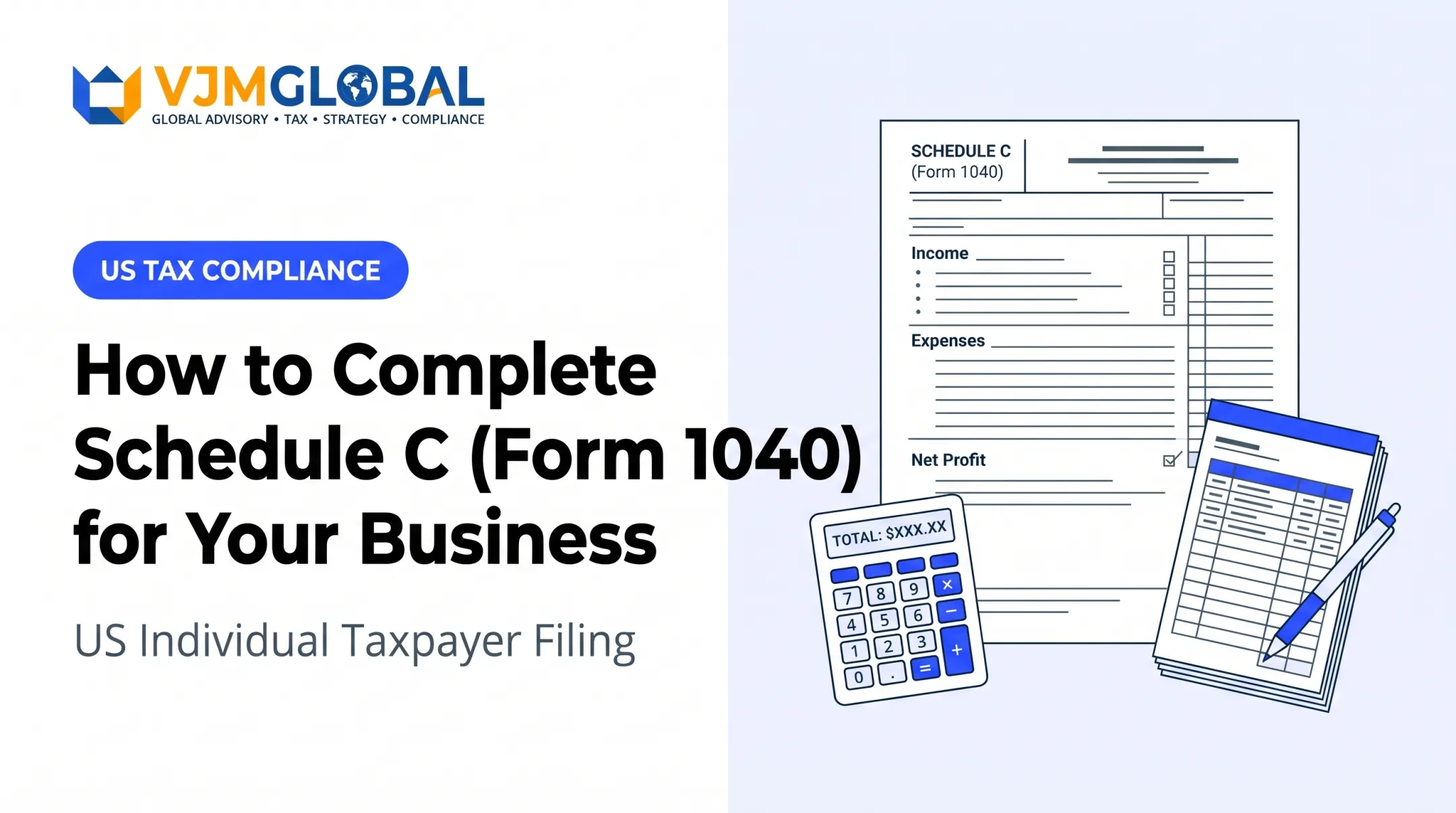
The form calculates gross business income, deductible expenses and net profit or loss. An activity counts as a business when its primary purpose is income or profit and it runs with continuity and regularity.
Expenses must be ordinary and necessary. Ordinary means common and accepted in your field. Necessary means helpful and appropriate for the business.
The final figure generally flows to Form 1040 through Schedule 1, and also to Schedule SE, which calculates self-employment tax.
Who generally files it
- Sole proprietors and freelancers
- Independent contractors and gig workers
- Single-member US LLCs that have not elected corporate tax treatment
Schedule SE is generally required when net self-employment earnings reach $400. Check the current threshold and exceptions in the IRS guidance.
Other income belongs elsewhere:
- Partnerships: Form 1065 and Schedule K-1s
- C corporations: Form 1120
- Rentals and royalties: Schedule E
- Farming: Schedule F
- Employee wages: Form W-2
When Schedule C may not be the right form
Receiving a 1099 does not decide the form. The nature of the income and your business structure do. A 1099 alone does not establish worker status either.
Nonresident taxpayers, foreign-owned businesses and anyone with cross-border facts should get professional advice first. A nonresident alien engaged in a US trade or business may attach Schedule C to Form 1040-NR. A foreign-owned US disregarded entity can also face separate Form 5472 reporting.
Before You Fill Out Schedule C
Gather your records
Income records:
- Forms 1099-NEC and 1099-K
- Invoices and payment processor statements
- Cash and cheque receipts
- Business bank statements
Report income whether or not a payer sent a 1099. Cash, property and services all count.
Expense records:
- Receipts, invoices, and bank and card statements
- Contractor payment records
- Mileage logs
- Home-office measurements
- Asset purchase records
- Beginning and ending inventory counts, if you sell goods
Confirm the form and dates
Download the current form and the Schedule C instructions from the IRS. An early 2026 draft exists, marked "DRAFT - DO NOT FILE", and draft content can change. Never file on a draft.
For a 2025 return, the deadline was April 15, 2026. An extension moves the filing date to October 15, 2026, but it does not extend the time to pay. State or local filing obligations are separate from the federal return.
Understand the form's flow
The form has a header and five parts:
- Header: business information
- Part I: income
- Part II: expenses
- Part III: cost of goods sold
- Part IV: vehicle information
- Part V: other expenses
Part III feeds line 4 in Part I. Part V totals on line 48 and moves to line 27b. The final profit or loss lands on line 31.

How to Fill Out Schedule C Step by Step
Step 1: Complete the business information
Enter your name and SSN, business name and EIN (if you have one), address, and your principal business or profession.
Then answer the questions on accounting method, material participation, whether you started or acquired the business this year, and whether you were required to file 1099s.
- Pick the principal business code from the current instructions, not an old article or a stale software screen.
- Cash method: income is generally counted when received, expenses when paid.
- Accrual method: income is counted when earned, expenses when incurred.
- Unsure of your method, or thinking of changing it? Ask a tax professional first.
Step 2: Report income in Part I
- Line 1: gross receipts or sales from every business source, including amounts without a 1099
- Line 2: returns and allowances
- Line 4: cost of goods sold from Part III, if it applies
- Line 6: other business income
- Line 7: gross income
Don't build line 1 from bank deposits alone. Payment processors often deposit net amounts after fees and refunds, while a Form 1099-K shows the gross. Reconcile the two, and report the fees as expenses rather than netting them silently.
Step 3: Report deductible expenses in Part II
Expenses must be ordinary, necessary, business-related and backed by records. Leave out personal costs and the personal share of mixed-use items.
Common Part II categories include:
- Advertising, commissions and fees, contract labour
- Car and truck costs, depreciation, insurance, interest
- Legal and professional fees, office expenses, rent, repairs
- Supplies, taxes and licences, travel, meals, utilities and wages
Meals are generally limited to 50%. The home-office deduction goes only on line 30.
Some items trip people up:
- Platform and payment fees usually go under commissions and fees
- Self-employed health insurance is figured on Form 7206 and claimed on Schedule 1, not Schedule C
- Owner SEP, SIMPLE and qualified-plan contributions are Schedule 1 adjustments
- Product materials and shipping may belong in cost of goods sold rather than supplies
Step 4: Complete Part III if you sell goods
Part III generally applies to businesses that make, buy for resale or otherwise sell physical goods. Most service businesses leave it blank.
Cost of goods sold equals beginning inventory plus purchases, direct labour, materials and other direct costs, minus ending inventory.
- Keep inventory costs out of ordinary supplies
- Use consistent valuation and keep count records
- Some small businesses can skip formal inventory if their method clearly reflects income; for 2026 the gross-receipts threshold is $32 million. Confirm eligibility in the current instructions

Step 5: Total expenses, home office and net result
Total your expenses, subtract from gross income for a tentative profit or loss, then subtract any home-office deduction on line 30.
Home-office methods:
| Method | Simplified | Regular |
|---|---|---|
| Calculation | $5 per sq ft, up to 300 sq ft | Actual expenses, allocated by area |
| Form | None | Form 8829 |
| Use test | Regular and exclusive business use | Regular and exclusive business use, with limited exceptions |
A loss is not automatically deductible. Apply limits in this order:
- At-risk rules (Form 6198)
- Passive activity rules (Form 8582)
- Excess business loss (Form 461)
The 2025 excess business loss threshold was $313,000 ($626,000 for joint filers). Check the final 2026 Form 461 instructions for the new figure.
Step 6: Vehicle information and other expenses
Complete Part IV when you claim car or truck expenses on line 9 and don't have to file Form 4562. You choose between:
- Standard mileage: a per-mile rate that generally replaces actual operating costs for that vehicle and year
- Actual expenses: fuel, repairs, insurance and so on, multiplied by your business-use percentage
The IRS mileage rates are 70 cents per business mile for 2025. For 2026 they are 72.5 cents from 1 January to 30 June and 76 cents from 1 July to 31 December.

Keep a log with dates, destinations, business purposes, business miles and total miles. Actual-expense claims also need receipts.
Part V lists expenses that fit no other line. Total them on line 48 and carry the figure to line 27b. Verify line numbers against the current form.
What Happens After Schedule C: Filing, Review, and Common Issues
How Schedule C connects to Form 1040
For 2025, line 31 profit flows to Schedule 1, line 3, and to Schedule SE, line 2.
Self-employment tax basics:
- Rate: 15.3% (12.4% Social Security plus 2.9% Medicare)
- Social Security wage base: $176,100 for 2025 and $184,500 for 2026
- Half of SE tax is deductible when calculating adjusted gross income

Profit is not a fixed tax bill. What you owe depends on filing status, other income, deductions, credits and state rules. Income tax brackets for 2025 single filers run from 10% to 37%.
Self-employed people usually need to make estimated payments on Form 1040-ES if they expect to owe at least $1,000 after withholding and credits.
How to submit it
You don't send Schedule C alone. File it with Form 1040 through tax software, an authorised preparer or on paper.
- Run the e-file checks before transmitting.
- Sign, or give electronic authorisation (a preparer may use Form 8879).
- Keep a full copy.
- Confirm that Schedule SE, Form 4562, Form 8829 and any other required attachments are included.
Keep records generally for 3 years, longer in some cases, such as 6 years for substantial omitted income.
Final review checklist
- Gross receipts tie to invoices, processors, bank records, cash and 1099s.
- No item is reported or deducted twice.
- Every expense has support and personal portions are removed.
- Inventory figures match the books.
- Vehicle records are complete.
- Required forms and any contractor 1099s are handled.
Common mistakes
- Missing income because no 1099 arrived
- Reporting net deposits instead of gross receipts
- Deducting personal expenses
- Putting inventory costs in supplies
- Double-counting platform fees
- Using an outdated form
- Mixing accounting methods
- Claiming mileage without a log
- Copying thresholds from a prior-year example
When self-filing may not be appropriate
Get a professional review if you have:
- Multiple businesses or significant inventory
- Substantial losses
- Employees or contractors
- Entity classification questions
- Foreign ownership, nonresident status or multiple states
- An amended return or doubts about deductions
VJM Global supports eligible business owners with bookkeeping, tax compliance preparation and Schedule C review through its CPAs and US-compliant team. No preparer can promise a particular tax result.
This article is general education. It doesn't replace advice from a qualified tax professional who knows your facts.
Conclusion
An accurate Schedule C rests on a short checklist:
- Identify the right taxpayer and business activity
- Gather complete income and expense records
- Enter amounts in the correct parts of the form
- Work out inventory or vehicle deductions where they apply
- Carry the net profit or loss to Form 1040
Use the IRS form and instructions for your tax year. When entity structure, cross-border issues, inventory, losses or deduction rules make the return complex, work with a tax professional. VJM Global prepares Form 1040 and 1040-NR returns, including Schedule C, for individual taxpayers who need that support.
Frequently Asked Questions
Who needs to file Schedule C (Form 1040)?
Sole proprietors, eligible single-member LLC owners, freelancers, contractors and other self-employed people. Check the current IRS filing threshold and exceptions for your situation.
When do I file Schedule C (Form 1040)?
With your Form 1040, by the individual return deadline. A 2025 tax-year return is filed in 2026, due April 15, 2026, or October 15, 2026 with an extension (payment is still due in April).
Is Schedule C the same as Form 1040?
No. Schedule C is an attachment reporting business profit or loss. Form 1040 is your full individual income tax return.
How much tax do you pay on Schedule C income?
There is no single rate. Profit may attract ordinary income tax plus 15.3% self-employment tax, depending on your wider circumstances.
Can I file Schedule C if I also have W-2 income?
Generally yes. Wages stay on Form W-2 reporting, while separate self-employment profit goes on Schedule C, as long as the activity is genuinely self-employment.
What happens after I file Schedule C?
Net profit or loss carries to your return and may affect Schedule SE and your tax payments. Keep your records and watch for any IRS correspondence.