Introduction
Schedule C deductions do more than lower your ordinary income tax. Eligible business expenses reduce your net business profit, and that profit is also the starting point for self-employment tax.
Schedule C is a U.S. federal tax form. This guide is written for Australian residents and business owners who run a U.S. sole proprietorship or single-member LLC. Australian tax and reporting duties may still apply separately.
We cover who files Schedule C, how profit flows into self-employment tax, which deductions belong on the form, which are claimed elsewhere, and what records back it all up. Figures are in U.S. dollars (US$) because the IRS calculates everything in that currency.
Key Takeaways
- Schedule C reports receipts, allowable expenses and net profit, not the raw total on a 1099.
- Net profit drives both income tax and self-employment tax through Schedule SE.
- Health insurance, retirement contributions and half of SE tax are claimed on Schedule 1, not Schedule C.
- Mileage logs, business-purpose notes and 1099 reconciliation prevent costly errors.
What Schedule C Reports and Who Files It
Who should generally file Schedule C?
Sole proprietors, freelancers, independent contractors, gig workers and owners of single-member LLCs file Schedule C. A domestic single-member LLC is generally disregarded for federal income tax unless it elects corporate treatment.
Partnerships report through Form 1065 and Schedule K-1. S corporations and C corporations use their own returns. File a separate Schedule C for each separate business.
Schedule SE is generally required once net earnings from self-employment reach $400.
A note for Australians: the U.S.–Australia totalization agreement coordinates Social Security coverage, but it is not a blanket exemption. Under the SSA's summary, self-employed U.S. citizens living in Australia are exempt from U.S. Social Security on that income, while self-employed U.S. residents remain covered.
A nonresident alien may also need Form 1040-NR. Confirm your status before assuming SE tax does or does not apply.
What income belongs on Schedule C?
Report gross receipts from all sources:
- Services and product sales
- Cash, checks, card processors and payment platforms
- Barter, at fair market value when received
- Amounts on Forms 1099, plus income with no form at all
No 1099 does not mean no reporting. The 1099-NEC threshold is $600 for 2025 and rises to $2,000 for payments made in 2026, but that only governs what payers must issue.
Reconcile your total to bank deposits, invoices and processor statements. Never count one payment twice; a 1099-K amount often overlaps with invoices.
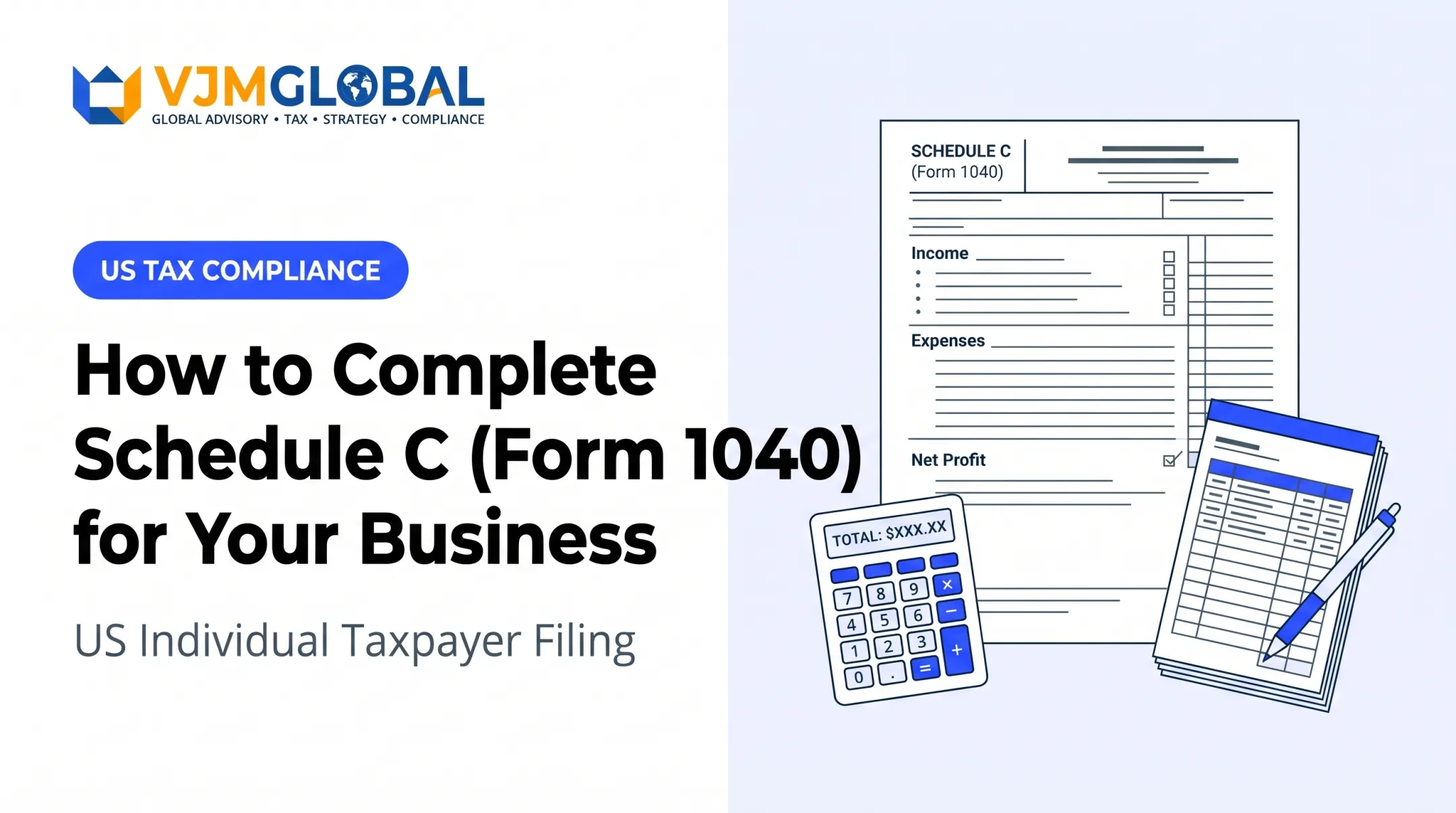
How the main parts of Schedule C work
- Part I: income
- Part II: operating expenses
- Part III: cost of goods sold, for product businesses
- Part IV: vehicle information
- Part V: other expenses
Most service businesses skip Part III. Sellers of physical goods need opening inventory, purchases, production costs and closing inventory.
Net profit is gross receipts, less returns and cost of goods sold, less allowable expenses. This lands on line 31 of the 2025 form. Track materially different businesses separately.
What makes an expense deductible?
The IRS standard is "ordinary and necessary": common and accepted in your field, and helpful and appropriate for the business. Mixed-use costs must be split.
If you use a phone or vehicle personally as well, deduct only the business share. Personal spending is never a deduction.
How Schedule C Profit Creates Self-Employment Tax
Self-employment tax versus income tax
SE tax covers Social Security and Medicare, while income tax is calculated separately. A W-2 employee has an employer who withholds and matches payroll tax. A sole proprietor pays both halves personally.
The calculation from Schedule C to Schedule SE
The IRS self-employment tax page sets the rate at 15.3%: 12.4% Social Security plus 2.9% Medicare. Schedule SE applies a 92.35% factor to net profit first. The Social Security portion stops at the wage base: $176,100 for 2025 and $184,500 for 2026. An extra 0.9% Medicare tax applies above $200,000 for single filers.

Illustration (2025, single, hypothetical):
| Item | Amount |
|---|---|
| Gross receipts | $120,000 |
| Schedule C expenses | $40,000 |
| Net profit | $80,000 |
| SE earnings (× 92.35%) | $73,880 |
| SE tax (× 15.3%) | about $11,304 |
| Half of SE tax (Schedule 1 deduction) | about $5,652 |
Income tax is then worked out separately on the return, after the standard deduction and other adjustments.
How the tax reaches Form 1040
On the 2025 forms, Schedule C line 31 flows to Schedule 1 line 3 and Schedule SE line 2. Schedule SE line 12 goes to Schedule 2 line 4. Line 13 (half of SE tax) goes to Schedule 1 line 15.
Line numbers change between years, so check the current forms.
How deductions change the SE tax base
An operating expense on Schedule C lowers net profit, so it can reduce both income tax and SE tax. Items claimed elsewhere cut taxable income but leave Schedule C profit, and so SE tax, unchanged. That includes half of SE tax, health insurance, retirement contributions and the qualified business income (QBI) deduction.

The broader impact of net profit
Profit also affects:
- Estimated tax payments
- How much you can put into retirement plans
- Eligibility for certain deductions and credits
- Your Social Security earnings record
A higher profit may prompt a look at an S corporation, but that is not an automatic saving. Reasonable compensation, payroll costs, administration, state rules and professional advice all matter.
Schedule C Deductions and Their Tax Impact
Common operating deductions
Typical categories include:
Advertising and software
Office expenses and supplies
Professional fees and contract labour
Insurance (other than health), rent, and bank or payment fees
Education tied to your current business
Travel and meals
Meals: generally 50% deductible
Gifts: limited to $25 per recipient per year
Travel and education: must have a clear business purpose
Mixed-use items: deduct only the business share
Home office
You need regular and exclusive business use. A desk in a living room that doubles as a lounge fails.
- Simplified method: $5 per square foot, up to 300 square feet, with no depreciation or recapture.
- Actual method: a business-use percentage of home costs, claimed on Form 8829. Depreciation applies and can affect gain when you sell.
Vehicle and mileage
Standard mileage rates are 70 cents per mile for 2025. For 2026, the rate is 72.5 cents through 30 June and 76 cents from 1 July. The alternative is actual expenses: fuel, repairs, insurance and depreciation times business-use percentage.
Keep dates, destinations, purpose and total miles. Commuting is not deductible, and mileage rebuilt from memory is hard to defend. Choose the standard rate in the first year an owned vehicle is used for business.
Equipment, depreciation and inventory
Computers, machinery and furniture usually need depreciation or Section 179 rather than going into supplies.
Section 179 allows up to $2,500,000 for 2025 and $2,560,000 for 2026. Bonus depreciation is now permanent at 100% for qualified property acquired after 19 January 2025. A $2,500 per-item safe harbour can cover smaller purchases if you elect it.

Inventory purchases are not an immediate expense; they flow through cost of goods sold. If business use of Section 179 property drops to 50% or less, recapture can follow.
Deductions not usually entered on Schedule C
- Half of SE tax: Schedule 1, line 15
- SEP, SIMPLE and qualified plans: line 16
- Self-employed health insurance: line 17
- QBI deduction: Form 8995 or 8995-A, up to 20% of qualified business income
Never deduct a cost twice. Limits depend on income, structure and filing status.
In short: a business deduction reduces profit, an adjustment reduces adjusted gross income, and a credit reduces tax owed directly.
Recordkeeping, Filing Workflow and Tax Planning
Building records that support deductions
- Keep business and personal bank accounts separate
- Reconcile invoices to deposits
- Retain receipts and note the business purpose
- Maintain mileage logs and home-office and inventory workings
IRS Publication 583 accepts electronic records that are complete, accurate and accessible. Keep records generally 3 years, or 6 if you omit more than 25% of gross income. Publication 463 requires contemporaneous support for travel and vehicle claims, and does not allow estimates.
Filing and payment workflow
- Gather income records and reconcile gross receipts
- Categorise expenses
- Calculate cost of goods sold, if relevant
- Complete Schedule C, then Schedule SE
- Review Schedules 1 and 2 and estimate the balance due

Estimated tax is usually due when you expect to owe $1,000 or more and withholding falls short of the smaller of 90% of 2026 tax or 100% of 2025 tax (110% if prior-year AGI exceeded $150,000).
2026 due dates are April 15, June 15, September 15 and January 15, 2027. Nonresident aliens use Form 1040-ES (NR). Check state obligations as well.
How VJM Global can help
VJM Global provides accounting outsourcing, financial reporting and tax compliance for international and Australian businesses, with U.S.-compliant professionals who prepare Form 1040 and 1040-NR returns. If you need help organising records or coordinating U.S. Schedule C obligations, we can work alongside your existing arrangements. Schedule C does not replace your Australian filing requirements.
Frequently Asked Questions
How much tax deduction for self-employed?
There is no single amount. It depends on your actual ordinary and necessary expenses, eligible adjustments, business use, filing status and current-year rules.
What income is reported on Schedule C?
Gross business receipts from clients and customers, including cash, payment-platform income, barter and amounts on information returns, adjusted for returns and cost of goods sold.
What is the difference between Schedule 1 and Schedule C?
Schedule C calculates profit or loss from a sole proprietorship or single-member LLC. Schedule 1 reports additional income and adjustments, and receives the Schedule C profit.
What falls under self-employed?
Sole proprietors, freelancers, independent contractors, gig workers and single-member LLC owners. Corporations and partnerships generally use different business tax forms.
What deduction can I claim without receipts?
There is no blanket deduction for missing receipts. Use reliable alternatives such as invoices, bank statements, mileage logs and contemporaneous notes, within IRS substantiation rules.