Introduction
Freelancers, contractors, gig workers, and small business owners in Michigan carry a tax bill that no employer splits with them. Two layers matter most: federal self-employment tax, which funds Social Security and Medicare, and Michigan individual income tax, which the state administers separately.
Many self-employed people get tripped up by the same mistakes. They budget for income tax and forget the 15.3% self-employment tax, or they divide gross receipts by four to set quarterly payments.
This guide covers who owes the tax, how to calculate it, which deductions apply, how estimated payments work, which forms to file, and where LLCs fit in. It also flags which 2027 figures are confirmed and which you still need to check.
Key Takeaways
- Self-employment tax is based on net profit, not gross revenue, so expense tracking changes your bill.
- Federal self-employment tax, federal income tax, and Michigan income tax are three separate calculations.
- Confirm 2027 deadlines and Michigan figures with the IRS and Michigan Department of Treasury before filing.
- Entity type, filing status, other income, and withholding can shift the final amount.
What Is Self-Employment Tax in Michigan for 2027?
Self-employment (SE) tax is how people who work for themselves pay into Social Security and Medicare. Employees split these contributions with an employer. You pay both halves.
According to IRS Topic 554, the rate is 15.3%: 12.4% for Social Security and 2.9% for Medicare. It applies to net earnings from self-employment of $400 or more, and net earnings are generally 92.35% of net profit.
How It Differs From Income Tax
Your return can show three calculations at once:
- Federal SE tax, based on net business earnings
- Federal income tax, based on taxable income after deductions
- Michigan income tax, based on Michigan taxable income
Michigan does not levy a separate self-employment tax. It taxes your income.
Who Owes It
- Sole proprietors and independent contractors
- Freelancers and gig workers
- Partners, including members of multi-member LLCs taxed as partnerships
- Single-member LLC owners, since these are generally disregarded for federal income tax
2027 Figures to Know
- Social Security wage base: $192,300 for 2027 (up from $184,500 in 2026), set by the Social Security Administration. Only earnings up to that amount face the 12.4% rate.
- Medicare: The 2.9% has no earnings cap.
- Additional Medicare Tax: Extra 0.9% above $200,000 (single), $250,000 (joint), or $125,000 (married filing separately). These thresholds are not inflation-indexed.
Reconcile Every Income Source
Report business income whether or not anyone sends you a form. That includes 1099-NEC amounts, cash, checks, card payments, and payment-app deposits.
A Form 1099-K shows gross payments and may not match taxable income, so reconcile it against your own invoices and bank records.
How to Calculate Your 2027 Self-Employment Tax
The Five Steps
- Add up total business income from all self-employment sources.
- Subtract ordinary and necessary business expenses to arrive at net profit.
- Multiply net profit by 92.35% to get net earnings subject to SE tax.
- Apply 15.3% to those earnings (12.4% Social Security only up to the wage base, plus 2.9% Medicare).
- Deduct half of the SE tax when you calculate federal income tax.

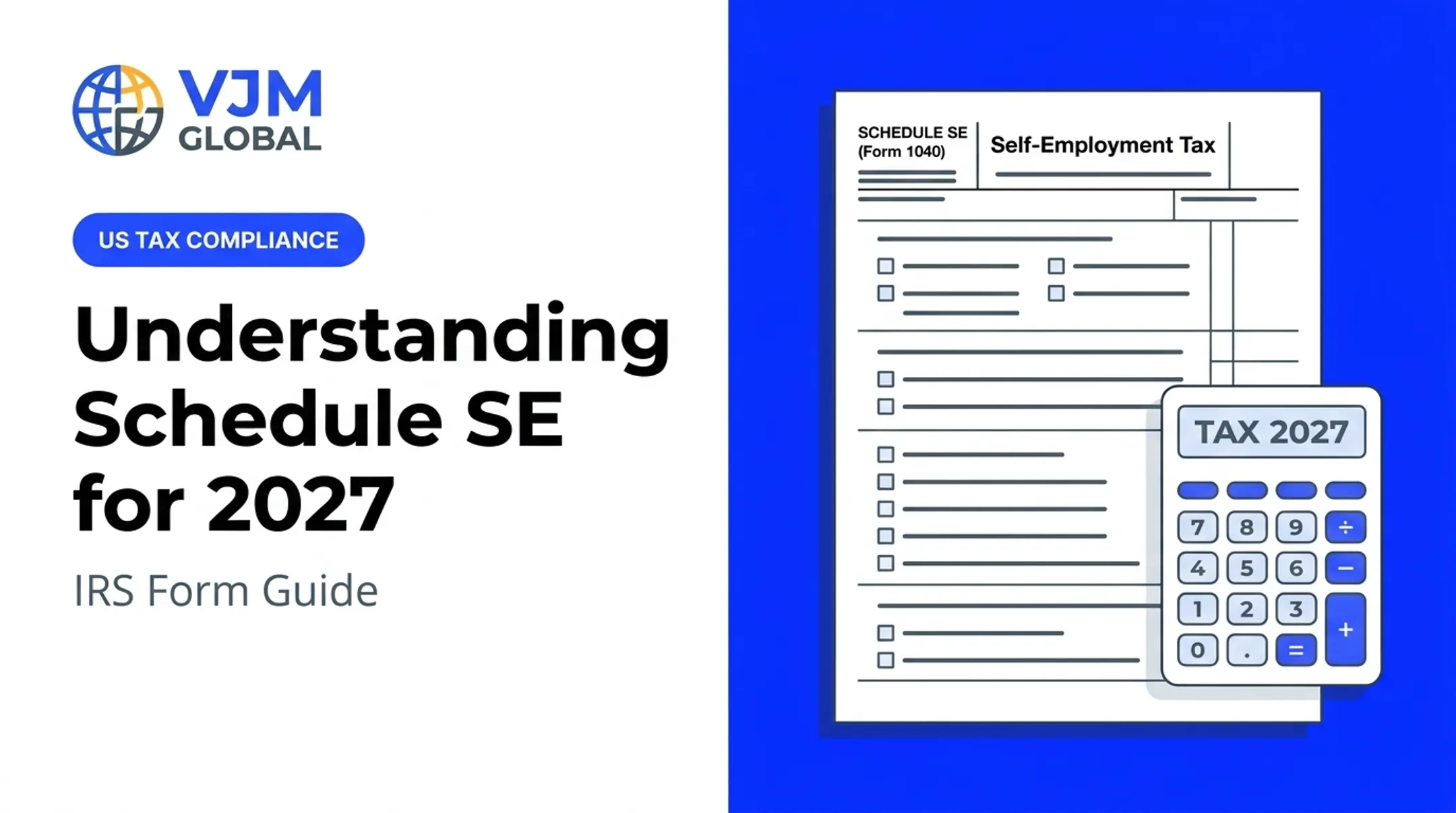
Schedule C records income and expenses for a sole proprietor or single-member LLC. Schedule SE calculates the tax, and you generally file it when net earnings reach $400.
Illustrative Example
This is a hypothetical example, not advice for your situation. Say a Michigan freelance designer has $80,000 in net profit.
| Step | Amount |
|---|---|
| Net profit | $80,000 |
| Net earnings (x 0.9235) | $73,880 |
| SE tax (x 15.3%) | about $11,304 |
| Half-SE deduction | about $5,652 |
The earnings fall below the $192,300 base, so the full 15.3% applies. The $5,652 deduction lowers federal taxable income. It does not reduce the SE tax itself, and it belongs on Schedule 1.
What Changes Your Balance Due
Other items affect what you owe in total without changing the SE calculation:
- W-2 wages from a separate job, which also use up part of the Social Security wage base
- Spouse, investment, or retirement income
- Federal withholding and prior estimated payments
- Credits
Records to Gather
- 1099s, payment-platform reports, invoices, and bank deposits
- Expense receipts and mileage logs
- Retirement contribution and health insurance records
- Last year's return
What Other Taxes and Deductions Affect Michigan Self-Employed Individuals?
Michigan Income Tax
Michigan taxes individual income at a flat rate. Michigan Treasury confirmed 4.25% for tax year 2026. Check Treasury for the 2027 rate before you plan around it, and don't assume it stays put.
The personal exemption was $5,800 on the 2025 MI-1040, and Michigan's 2026 withholding guide lists $5,900. Look up the 2027 amount when Treasury publishes it.
A few Michigan points matter for the self-employed:
- Residents pay Michigan tax on income earned while living in the state.
- Nonresidents and part-year residents use Schedule NR.
- Detroit adds a city tax on unincorporated business profits: 2.4% for residents and 1.2% for nonresidents.
- Public Act 24 of 2025 keeps Michigan on pre-OBBBA rules for certain bonus depreciation and Section 179 calculations, which can change individual business income.
Federal Deductions That Reduce Net Profit
When properly documented, these can lower Schedule C profit:
- Supplies, software, equipment, and professional fees
- Business insurance and advertising
- Business mileage: 72.5 cents/mile for January to June 2026 and 76 cents from July 1, 2026. No 2027 rate is published yet.
- Home office: the simplified method allows $5 per square foot up to 300 square feet, for space used regularly and exclusively for business
Deductions that reduce Schedule C profit also reduce your SE tax. Other items work differently:
- Half-SE deduction, self-employed health insurance (Form 7206), and retirement contributions adjust income on Schedule 1 and lower income tax, not SE tax
- The qualified business income deduction, generally up to 20% of QBI, is calculated separately
An expense must be ordinary (common in your field), necessary (helpful and appropriate), and business-related. Mixed-use costs, like a phone or car, only count for the business share. Unsupported deductions are the ones that fail in an audit.

The $100,000 Question
Michigan's flat rate gives a simple piece of arithmetic: $100,000 of Michigan taxable income at 4.25% is $4,250 before credits. That is only the state piece.
Nobody can give you a single answer for "$100,000" without knowing:
- Whether it's gross revenue or net profit
- Filing status and other income
- Deductions, credits, and withholding
- Residency and business structure
For federal context, the 2027 standard deduction is $16,600 for single filers and $33,200 for married filing jointly. The first 2027 bracket (10%) tops out at $12,800 for single filers and $25,600 for joint filers.
How to Pay and File 2027 Taxes
Federal Estimated Payments
Taxes aren't withheld from self-employment income, so you pay as you go using Form 1040-ES. Payments are generally required when you expect to owe $1,000 or more after withholding and credits.
The safe harbor is the smaller of 90% of this year's tax or 100% of last year's. Use 110% of last year's tax if your prior-year AGI exceeded $150,000 ($75,000 if married filing separately).
Confirm the 2027 due dates on IRS.gov. Traditional installments fall in mid-April, mid-June, mid-September, and mid-January.

How to Estimate a Quarter
Don't divide gross receipts by four. Instead:
- Project annual net profit.
- Calculate SE tax and federal income tax.
- Add Michigan income tax.
- Subtract withholding, credits, and payments already made.
- Divide by the number of remaining installments.
Revisit the projection whenever income jumps or drops.
Michigan Estimates
Michigan generally requires estimates if you expect to owe more than $500 with your MI-1040. Use the MI-1040ES, and pay through Michigan's individual income tax ePayments. Confirm the 2027 schedule on Treasury's site.
Forms You'll Likely Use
- Federal: Form 1040, Schedule C, Schedule SE, Schedule 1, Form 1040-ES, and Form 2210 for penalties. Add Form 7206 for the health insurance deduction and Form 8995 or 8995-A for QBI.
- Michigan: MI-1040, MI-1040ES, Schedule 1, and Schedule NR or MI-1040H where residency or apportionment applies.
VJM Global prepares Form 1040 returns for US individual taxpayers, including those with business income.
Payment Methods and Records
IRS Direct Pay is free and draws from a bank account. EFTPS is another option. Keep confirmation numbers, bank records, and copies of every submitted form. Hold supporting records for at least 3 years, and 6 if more than 25% of gross income was left off a return.
Underpayment Risk
Uneven income, skipped installments, and bad projections can bring a penalty and a large April bill. The IRS underpayment rate was 7% for October to December 2026, and it resets quarterly. Form 2210 figures the penalty by installment period.
Your 2027 Self-Employment Tax Checklist and Next Steps
Practical Checklist
- Open a separate business bank account and card
- Reconcile income monthly
- Log expenses and save receipts
- Keep a mileage record as you drive
- Review your entity classification each year
- Project quarterly tax and set aside a fixed percentage of each payment
- Update projections after any big income change
When to Get Professional Help
Bring in a tax professional if you:
- Run an LLC or are considering an S corporation election (Form 2553, generally due 2 months and 15 days after the effective date)
- Have employees, or earn in multiple states
- Have foreign ownership or income
- Made significant equipment purchases
- Combine W-2 and self-employment income
Entity choices matter. A single-member LLC is disregarded by default, and a multi-member LLC is a partnership. Form 8832 lets an eligible LLC elect corporate treatment.
Michigan's flow-through entity tax election is open to partnerships and S corporations but not to sole proprietors or disregarded single-member LLCs.
VJM Global provides accounting, tax compliance, and individual return preparation for USA-based businesses and multinational clients. If your situation has more moving parts than a spreadsheet handles, it's worth a conversation.
This guide is educational, not a personalized tax calculation. Confirm 2027 rules with the IRS, the Michigan Department of Treasury, or a qualified tax professional before filing.
Frequently Asked Questions
How much is $100,000 taxed in Michigan?
It depends on whether $100,000 is gross revenue, net profit, or taxable income. At Michigan's 2026 flat rate of 4.25%, $100,000 of taxable income is $4,250 in state tax. Federal income tax and SE tax are calculated separately.
What taxes does an LLC pay in Michigan?
It depends on federal classification and activity. Possible taxes include federal income and self-employment tax, Michigan income tax, employer payroll taxes, and sales or use tax (generally 6%). LLCs also pay a $25 annual statement fee to the state.
What is the income tax exemption in Michigan for 2026?
Michigan's 2026 withholding guide lists a $5,900 personal exemption, up from $5,800 on the 2025 MI-1040. Exemptions are separate from federal deductions and SE tax. Verify the final amount in Michigan's 2026 return instructions.
Do self-employed people in Michigan have to pay federal self-employment tax?
Yes, if net earnings from self-employment reach $400. The obligation follows federal rules, not Michigan residency. Business type and other income affect the details.
What forms do Michigan freelancers use to file their taxes?
Most use Form 1040 with Schedule C and Schedule SE, plus the Michigan MI-1040. Estimates use Form 1040-ES and MI-1040ES. Employees, elections, or multi-state income can add other forms.