Introduction
Form 1040-NR is the IRS income tax return for nonresident aliens with U.S. income. Sprintax is a third-party platform that prepares the return and, for eligible filers, e-files it. Many Australians on student, working holiday or exchange visas hit the same wall: the software prepares the return, but e-file isn't offered.
"Officially in 2027" needs a careful reading. Most returns filed in 2027 cover tax year 2026, since IRS tax year 2026 guidance generally applies to returns filed in 2027.
Confirm final TY2026 instructions, 2027 deadlines and Sprintax's 2027 rules with the IRS and Sprintax before you file. This guide uses TY2025 rules as labelled benchmarks, so check each point against those sources.
Key Takeaways
- Confirm you're a nonresident for tax purposes before choosing Form 1040-NR.
- Preparing a return in Sprintax doesn't guarantee e-file eligibility.
- "Accepted" by the IRS means accepted for processing, not refund approved.
- Sprintax's federal e-file doesn't cover state returns.
- Complex cases need a nonresident tax professional.
How to E-File Your Form 1040-NR Using Sprintax in 2027
Step 1: Confirm the correct tax year and filing status
Select the tax year first. Income earned in calendar 2026 is reported on a return filed in 2027. A return for an earlier year filed during 2027 is a late or prior-year filing, with different e-file rules.
Then test your residency. You are generally a U.S. resident for tax purposes if you meet the Green Card Test or the Substantial Presence Test. The latter needs at least 31 days in the current year and 183 weighted days across three years.
Students on F, J, M or Q visas and some J/Q teachers and trainees may exclude days as "exempt individuals". That concerns day-counting only, not tax exemption.
Also check what else you owe:
- Form 8843 explains excluded days. It is not a tax return and does not replace Form 1040-NR when you have taxable U.S.-source income. Attach it to the return when both are required.
- State returns depend on where you lived and worked. Sprintax prepares them on request but doesn't e-file them with its federal service.
Step 2: Gather documents and create the Sprintax return
Sprintax lists these identity and travel items:
- Passport and visa details
- DS-2019 (J visa) or I-20 (F visa)
- Current and past U.S. entry and exit dates
- SSN or ITIN, where you have one
Income documents include Forms W-2, 1042-S and 1099, plus any scholarship or fellowship records. Enter details exactly as they appear on the originals. Use a secure device and don't email tax documents through unsecured channels.
ITIN eligibility is unclear. Sprintax's main page generally excludes ITIN holders, and its help page excludes an ITIN not issued in 2025. Confirm 2027 eligibility with Sprintax before you pay.
Step 3: Complete the nonresident tax interview
Answer every question on immigration status, U.S. days, income, withholding and treaty positions. Don't guess and don't skip sections. Sprintax uses your answers to pick forms and run the calculations.
Watch for warnings before you reach e-file. Sprintax's published limits explicitly exclude these from e-filing:
- Capital gains
- Self-employment and 1099-NEC income
- Taxpayers without an eligible ITIN or SSN
Dual-status returns aren't supported for preparation at all. Amendments may be prepared, but e-file support for them is unclear. If a warning appears, treat it as a signal to switch to paper or get advice.

Step 4: Review the generated Form 1040-NR and related forms
Compare the return against each source document. Check:
- Names, SSN or ITIN, and employer EINs
- Income amounts and federal withholding
- Treaty claims and addresses
- Bank details
Nonresidents can't use resident-only benefits. Under TY2025 rules there is no Married filing jointly or Head of household status, and no education credits or earned income credit. Nonresidents generally can't claim the standard deduction either, with narrow treaty exceptions such as the India treaty for certain students.
Check refund banking carefully. IRS overseas guidance requires a U.S. account or a foreign bank with a correspondent account at a Federal Reserve Bank. An ordinary Australian account may not qualify.
Paper refund cheques have also largely ended after 30 September 2025, with exceptions, so don't assume one. Refunds of tax withheld on Form 1042-S can take up to six months.
Step 5: Submit, monitor, and retain proof of e-filing
The TY2025 workflow runs: finish the questionnaire and payment, choose "Proceed with E-File", sign electronically, verify your identity, then submit.
Know the three outcomes. Per IRS Publication 4164, transmission alone is insufficient and "Accepted" means accepted for processing, not that a refund is approved. Sprintax shows Pending, Accepted or Rejected, and its guide suggests roughly 3-5 days for the e-file result.
Save:
- The confirmation number
- The acceptance or rejection message
- Your payment receipt
- A full copy of the submitted return
Sprintax's help says you get one e-file attempt. If rejected, you must paper-file.
If you paper-file under TY2025 instructions, mail to Department of the Treasury, Internal Revenue Service, Austin, TX 73301-0215, USA with no payment. With payment, use Internal Revenue Service, P.O. Box 1303, Charlotte, NC 28201-1303, USA. Confirm both addresses against the 2027 instructions.

When Should You E-File Form 1040-NR, and What Do You Need First?
E-filing suits a straightforward nonresident return where you want guided preparation, electronic submission and a status record. Who must file depends on IRS rules: nonresidents with U.S. trade or business income, or U.S. income not fully covered by withholding. Don't rely on visa type alone.
E-file may be unavailable if you have:
- Capital gains or self-employment income
- A dual-status year
- An amended return
- A missing or ineligible identifier
Per the IRS processing guidance, the e-file system accepted TY2025, 2024 and 2023 Forms 1040-NR in 2026. No 2027 window should be assumed.
System needs:
- Reliable internet and a current browser
- Secure email access
- A way to upload or accurately transcribe documents
Preparation needs:
- Income forms and withholding records
- Immigration and travel history
- Treaty documentation
- Bank details and deduction records
Key Checks That Affect a Successful Form 1040-NR E-File
Residency status and presence history
Visa category, days present and exempt-individual rules determine whether you're a nonresident. A wrong answer produces the wrong return type and may force an amendment later.
Income type and document compatibility
Wages, scholarships, dividends and rental income may require different schedules. Missing EINs or mismatched 1042-S identifiers are common causes of rejection.
Treaty claims, deductions, and withholding
Treaty eligibility depends on your country, income type and facts, not where you live now. Australians should check the U.S.-Australia treaty closely:
- Article 15 (wages): every short-stay condition must be met, including no more than 183 days and a non-U.S. employer.
- Article 20 (students): payments for maintenance and education must come from outside the U.S. It isn't a blanket exemption for U.S. scholarships or wages.
- Dividends: the ordinary treaty rate is 15%. The 5% rate covers a separate qualifying category, not ordinary portfolio holdings.
Form 8833 isn't needed for every treaty claim. The IRS lists exceptions, including certain student and scholarship benefits.
Identity, payment, and security information
Your legal name, SSN or ITIN, address and bank details must match across the return and source documents. Mismatches trigger rejections, refund delays or verification requests. Use a secure connection throughout.
Common Mistakes, Troubleshooting, and Alternatives
Common mistakes when e-filing Form 1040-NR
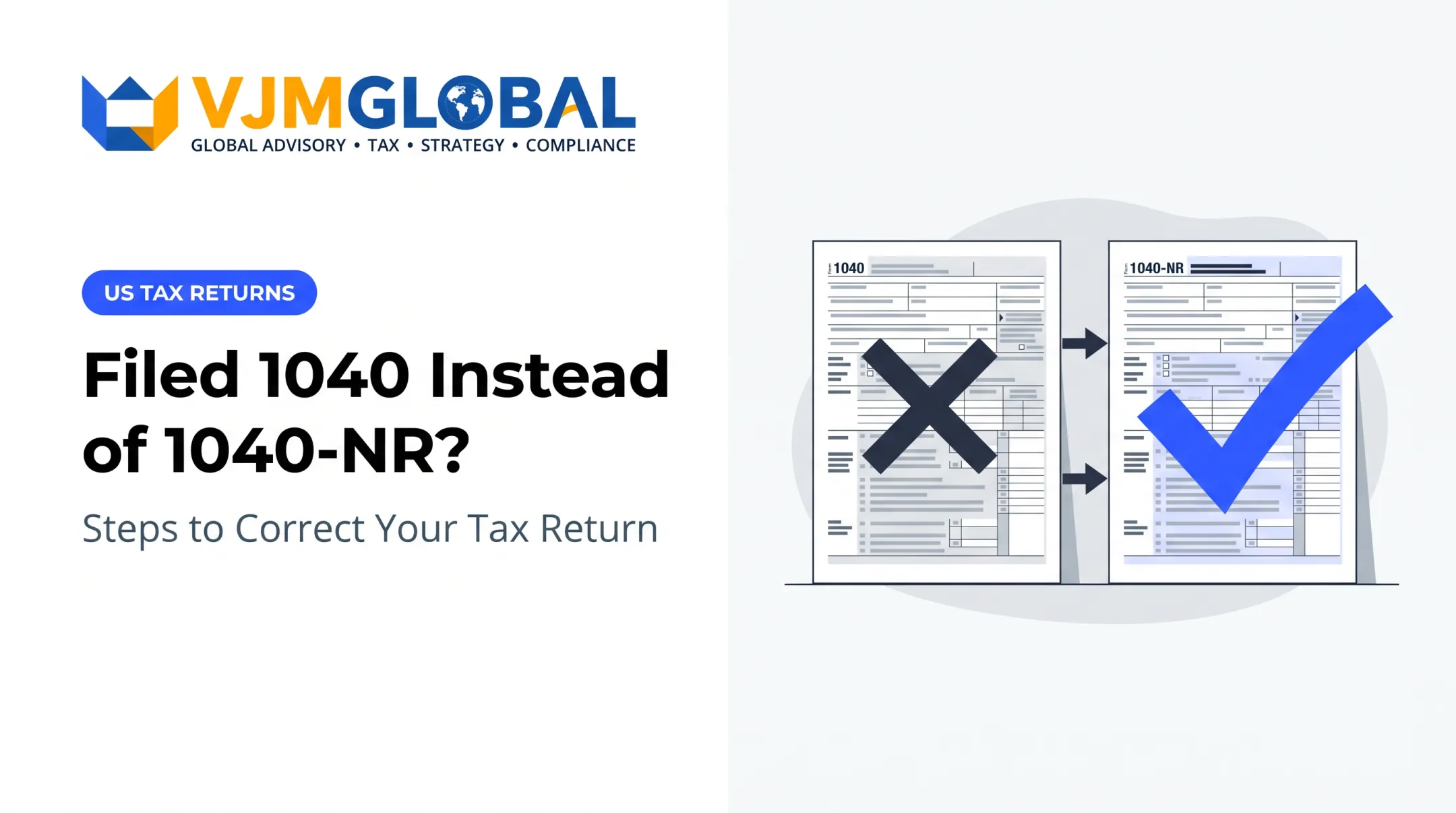
- Choosing Form 1040 instead of 1040-NR
- Picking the wrong tax year
- Assuming your visa decides your residency
- Leaving out Form 8843 when required
- Missing U.S.-source income, or entering withholding from the wrong document
- Claiming resident-only deductions or credits
- Trusting the calculation without reading the generated forms
- Assuming federal e-file covers state or local obligations
If you've already submitted an incorrect return, amend it or seek advice. The IRS allows electronic Form 1040-X amendments of a 1040-NR through tax software, though Sprintax only supports preparation of the amendment, not the e-file itself.
Troubleshooting e-file problems
Not eligible to e-file: Find the cause, such as an unsupported income type, a missing identifier or an amendment. Then choose paper filing or professional help.
Rejected: Sprintax flags mismatches on AGI/PIN, name, date of birth, SSN, and employer name, address or EIN. Compare against your W-2, 1042-S, 1099 and passport, and fix only verified errors.
Status unclear: Check Sprintax and the IRS refund tracker with your SSN or ITIN, filing status and exact whole-dollar refund. Keep proof of payment and do not file a duplicate return.
Alternatives when Sprintax e-filing is unavailable
Paper filing: Download, print and sign the return, attach W-2 and 1042-S copies, mail it and keep proof of delivery.
Professional help: For dual-status years, treaty complications, amendments or residency doubt, use a qualified nonresident tax professional. PTIN holders can prepare federal returns. Enrolled agents, CPAs and attorneys have unlimited IRS representation rights.
VJM Global is one option, with U.S.-compliant professionals who prepare Form 1040-NR returns. It has no IRS affiliation or Sprintax partnership.
Conclusion
E-filing through Sprintax in 2027 works best when you've confirmed the tax year, residency, documents and e-file eligibility before you pay. Check current IRS and Sprintax guidance, keep every acceptance record, and get professional help when your situation is complicated.
Frequently Asked Questions
How much does Sprintax cost?
Sprintax lists federal preparation from US$54.95 and state preparation from US$49.95. Check the live price before you start, since 2027 rates may differ from the published figures.
Does Sprintax allow e-file?
Yes, for eligible federal Form 1040-NR returns, but not every prepared return qualifies. Availability depends on the tax year, your facts, your documents and current rules.
Which form should I file, 1040 or 1040-NR?
U.S. citizens and resident aliens file Form 1040. Eligible nonresident aliens file Form 1040-NR. Dual-status cases need IRS guidance or a professional.
Can I e-file my Form 1040-NR with Sprintax from Australia?
Sprintax allows use after you leave the U.S., but e-file is conditional. It depends on return type, identity verification, documents and your SSN or ITIN status.
What documents do I need to e-file Form 1040-NR in 2027?
Typically a passport, visa documents, U.S. entry and exit dates, SSN or ITIN, W-2, 1042-S and 1099 forms, and bank details. Confirm the exact 2027 checklist with Sprintax.
What should I do if Sprintax says I am not eligible to e-file?
Identify the specific reason and fix any missing information. If it can't be fixed, paper-file or use a professional rather than forcing an unsupported electronic return.