The interest isn't limited to one type of founder. IT professionals, e-commerce operators, consultants and export-oriented businesses all see something different in the Norwegian market. Add in startups scouting Europe, established Indian exporters wanting a EU-adjacent foothold, tech professionals eyeing relocation, and NRIs already living in Norway who want to formalise a venture, and you get a genuinely varied pool of interest.
This guide walks through exactly how an Indian founder can legally register and run a business in Norway, step by step.
Key Takeaways
- Own 100% of a Norwegian company with no residency required to register
- Form an AS (Aksjeselskap) with NOK 30,000 minimum share capital
- Register at the Brønnøysund Register Centre; VAT applies above NOK 50,000 turnover
- Plan for 22% corporate tax, bookkeeping, annual filings, and payroll if you hire
- Get a separate residence permit to live or work in Norway; ownership alone does not grant one
Why Norway Is Attractive for Indian Entrepreneurs
Norway's appeal starts with stability. S&P affirmed the country's sovereign rating at AAA/A-1+ with a stable outlook in March 2025. Few markets offer a clearer signal of economic reliability.
As part of the EEA Internal Market, Norway gives businesses access to the same "four freedoms" framework covering goods, services, capital and people that applies across 30 European states. That's a genuine advantage for any Indian company eyeing European distribution or partnerships.
Sectors where Indian expertise fits well:
- IT services and software consulting
- Fintech and financial services
- Management and technical consulting
- E-commerce and export-oriented trade
- Engineering services
Norway's labour market backs this up. Statistics Norway reported Q1 2026 job vacancies of 4,000 in information and communication and 5,200 in professional, scientific and technical activities. That points to clear demand in fields where Indian professionals often specialise.
On the trade front, the India-EFTA Trade and Economic Partnership Agreement came into force on October 1, 2025, giving Indian businesses a formal framework for deeper commercial ties with Norway and its EFTA partners.
Legal Requirements Indians Must Know Before Starting
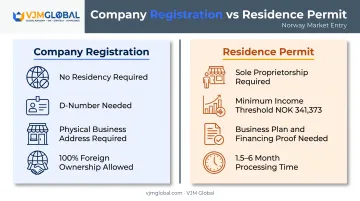
Here's the part most guides get muddled: registering a company and getting permission to live in Norway are two completely separate processes.
An AS can be founded by any natural or legal person, Indian or otherwise. There's no requirement that shareholders reside in Norway. What you do need is a physical Norwegian business address. A PO box won't cut it.
The D-Number Requirement
Foreign nationals without a Norwegian national ID number need a D-number for identification purposes when registering roles in the company or opening a bank account. A few practical points:
- You can't apply for a D-number on your own; the enterprise or authority requesting it initiates the process
- Applications typically go through form BR1015B, submitted by post with a certified colour copy of your identity document
- The Tax Administration may require an identity verification check
If You Plan to Relocate
Founders wanting to live and work in Norway need a residence permit. Under Norway's current skilled-worker/self-employed route, applicants generally need:
- A business operating as a sole proprietorship (not a limited company, per current UDI guidance)
- Likely business income of at least NOK 341,373 before tax
- A solid business plan and proof of financing
Processing isn't instant. Applications through VFS Centres in India go to UDI, which may take up to 1.5 months for initial handling — though complex cases often take 2–6 months.
Indians can be 100% owners and directors of a Norwegian company without ever relocating. Moving there to run it day-to-day is a separate, permit-dependent decision.
Choosing the Right Business Structure
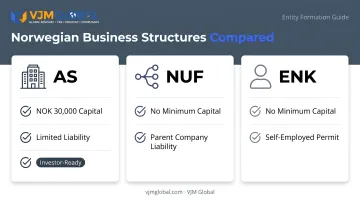
For Indian founders, three Norwegian structures come up most often. Use the comparison below to match the entity to how you plan to operate.
| Structure | Minimum Capital | Best For |
|---|---|---|
| AS (Private Limited) | NOK 30,000 | Scalable, investor-ready businesses |
| NUF (Branch) | None | Indian companies extending existing operations |
| ENK (Sole Proprietorship) | None | Individual founders relocating under self-employed permit |
AS is the strongest fit for Indian entrepreneurs building something long-term. It offers limited liability, a governance structure investors recognise, and does not tie you to residing in Norway.
NUF suits Indian companies that already have an established entity at home and want a Norwegian presence without forming a new legal entity. The catch: your Indian parent company remains legally responsible for the branch’s activities in Norway.
ENK works best for individual operators whose immigration plans align with Norway’s self-employed permit route. That route is built around sole proprietorships, not limited companies.
Quick pick:
- AS — limited liability and room to raise capital
- NUF — Indian parent needs a Norwegian branch, not a new company
- ENK — you are relocating on a self-employed permit
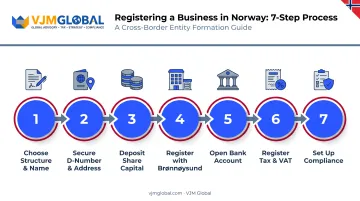
How to Register a Business in Norway – Step by Step
Step 1: Choose Structure and Reserve a Company Name
Decide between AS, NUF or ENK based on your scale and immigration plans. Check name availability through Brønnøysund's online portal — an AS name must include "AS," while a NUF name must include the parent company's name and end in "NUF."
Step 2: Secure a D-Number and Norwegian Business Address
Start the D-number process alongside your registration filing (it can't be submitted alone). Arrange a Norwegian business address; a local service provider can supply one if you are not relocating yet.
Step 3: Deposit Share Capital and Draft Documents
- Deposit the minimum NOK 30,000 into a dedicated share-capital bank account
- Obtain bank confirmation of the deposit
- Prepare your Articles of Association, shareholder details, and business plan
Step 4: Register with the Brønnøysund Register Centre
Submit everything online where possible and pay the registration fee. As of 2026, digital AS registration costs NOK 6,825 (paper filing runs higher, at NOK 7,912). Once approved, you receive an organisation number. That number is your legal go-ahead to operate.
Step 5: Open a Norwegian Business Bank Account
Foreign-owned companies face enhanced KYC checks. Banks like DNB typically ask about business purpose, expected income, foreign transactions and beneficial ownership. There's no officially published turnaround time, but budget several weeks for this stage and have your documentation ready.
Step 6: Register for Tax and VAT
Register with Skatteetaten for corporate tax. VAT registration becomes mandatory once taxable sales exceed NOK 50,000 over a 12-month period. Set up access to Altinn, Norway's digital government portal, for ongoing filings.
Step 7: Set Up Compliance and Ongoing Operations
- Establish bookkeeping under the Norwegian Bookkeeping Act
- Plan for annual financial statements
- If hiring, register as an employer and submit monthly a-melding reports
Registration is only half the work for Indian founders. You still need to keep Norwegian filings in step with Indian FEMA/ODI reporting on the outbound investment.
VJM Global supports entity formation and ongoing compliance across 100+ countries, and can coordinate the Norway paperwork with India-side FEMA/ODI advisory so both tracks stay aligned.
Costs, Timelines, and Common Mistakes Indian Founders Make
Realistic budget breakdown:
- AS registration fee: NOK 6,825 (digital)
- Minimum share capital: NOK 30,000
- Professional and legal service fees: vary by provider—request written quotes, as there is no fixed industry benchmark
Timeline expectations: Brreg's own queue data shows AS registrations processed within 1-2 working days once documents are complete. Registry processing is rarely the hold-up. D-number processing, document translation, and bank KYC checks usually stack up and delay full operations. Bank account setup has no guaranteed timeframe—plan for several weeks.
Common missteps to avoid:
- Underestimating how long enhanced KYC takes for foreign-owned companies at Norwegian banks
- Assuming English works for every official filing — some NUF documents require Norwegian, Swedish or Danish attachments
- Skipping local tax and compliance advice, then discovering VAT or payroll obligations after the fact
- Confusing company registration eligibility with residence permit eligibility — they run on entirely different rules
Frequently Asked Questions
Can I move to Norway without a job?
A job isn't strictly mandatory, but non-EU/EEA nationals like Indians generally need a residence permit tied to entrepreneurship, work, study, or family reunification to stay beyond 90 days.
Is Norway Indian friendly?
Yes, broadly. Norway treats foreign entrepreneurs equally under the law, operates in English for most business contexts, and has a growing Indian professional community, particularly in tech and consulting.
Can Indians buy a home in Norway?
Generally yes: there's no blanket nationality restriction. Some exceptions apply for farmland and certain industry or energy assets, and non-resident buyers may need extra documentation for financing.
How much does it cost to register a company in Norway from India?
Budget the NOK 6,825 digital registration fee plus NOK 30,000 in share capital, on top of professional service fees that vary by provider. Always get a written quote.
Do I need to visit Norway in person to start a business?
Not necessarily. Much of the registration can be handled remotely through a lawyer or service provider, though bank account opening may require identity verification steps.
How long does it take to fully set up a business in Norway as an Indian?
Registration can take 1-2 working days once filed. With D-number processing, document preparation, and bank KYC, expect several weeks to a few months before the business is fully operational.