Introduction
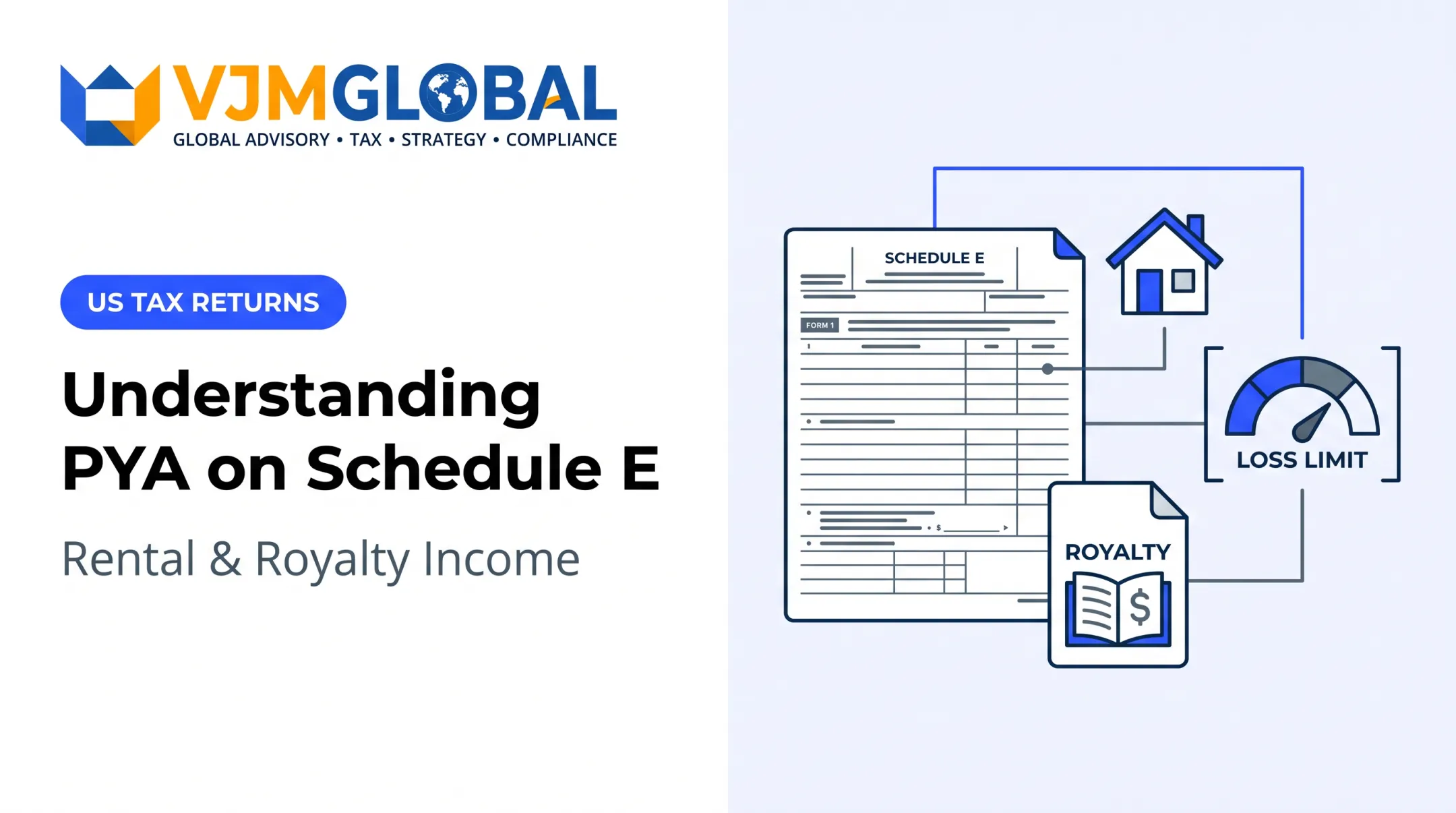
Schedule E is the IRS form used to report rental real estate, royalties and pass-through income. It does not decide whether that income is passive. That call comes from a separate set of rules, and getting it wrong can lock up losses or trigger unexpected tax.
This matters for Australian taxpayers, business owners, investors and NRIs with U.S. rental or pass-through income. You face U.S. filing rules and Australian reporting at the same time.
This guide covers passive activity classification, Schedule E mechanics, suspended losses, special rental rules and the records you need on both sides of the Pacific.
Key Takeaways
- Interest, dividends and most capital gains usually sit outside Schedule E.
- Schedule E shows net income after expenses and depreciation; passive-loss rules decide whether a loss is deductible.
- Material participation, self-rental and short-term rental facts can change classification.
- Review U.S. filing, ATO reporting, treaty relief, foreign tax offsets and currency together.
What Counts as Passive Income on Schedule E?
In everyday speech, passive income means money earned with little effort. The tax code is narrower. Under IRC Section 469, a passive activity is a trade or business in which you do not materially participate. Rental activities are generally passive by default, even if you work hard at them, subject to exceptions.
What Schedule E covers
- Direct rental real estate owned personally or through a disregarded entity
- Royalties, where classification depends on the underlying activity
- Partnership and S corporation income arriving on a Schedule K-1
Royalties deserve a caution. Royalties outside the ordinary course of a business are portfolio income, so they cannot absorb rental losses.
What it does not cover
Taxable interest and ordinary dividends go on Schedule B when filing thresholds apply. Most capital transactions go on Form 8949 and Schedule D. Calling something "passive" does not move it to Schedule E.
Gross receipts are not taxable income
Rent received is only the starting point. Deductible operating expenses, depreciation and loss limitations produce the final number. Classification must also be reviewed activity by activity, using the Schedule E instructions and Publication 925.
How Schedule E Reports and Taxes Passive Income
The parts of Schedule E
| Part | Reports |
|---|---|
| I | Rental real estate and royalties |
| II | Partnerships and S corporations |
| III | Estates and trusts |
| IV | REMIC residual-holder income or loss |
| V | Summary carried to Form 1040 |
Direct rental calculation
- Total your rental receipts.
- Identify eligible expenses.
- Add depreciation. Residential property generally uses a 27.5-year straight-line schedule, and land is not depreciable.
- Calculate net income or loss.
- Keep invoices, statements and receipts supporting each figure.

Pass-through income
K-1 amounts flow to Part II, which has separate passive and nonpassive columns. Check the K-1's indicators, basis information, at-risk amounts and attached statements. You still need to apply your own basis, at-risk and passive-loss limits to those K-1 figures.
Reporting versus tax character
- Net rental income is generally taxed as ordinary income at graduated rates.
- Selling rental property can create capital gain and depreciation recapture. Unrecaptured section 1250 gain has a maximum 25% rate.
- Qualified dividends, interest and capital gains stay off Schedule E.
Related forms
- Form 8582: passive activity losses
- Form 6198: at-risk limits
- Form 4562: depreciation
- Schedule D or Form 4797: certain sales
- Form 1116: U.S. foreign tax credit (not the Australian offset)
Hypothetical example
This is an illustration only, not a tax result. Suppose a rental produces gross rent, and allowable expenses plus depreciation exceed it. Schedule E shows a net loss.
Because rentals are generally passive, that loss goes to Form 8582. Unless a special allowance or passive income applies, it is suspended and carried forward rather than reducing wages.
Passive Losses, Material Participation, and Special Rules
The order of limits
Disallowed passive losses offset passive income first. They then carry forward until you have passive income, a special allowance, or a fully taxable disposition of the entire activity to an unrelated party.
Before a loss gets that far, it faces these limits in order:
- Basis
- At-risk
- Passive activity
- Excess business loss, where applicable

Depreciation therefore does not guarantee a current deduction.
Material participation
There are seven alternative tests. The most common are more than 500 hours, or more than 100 hours when no one else participates more than you.
Investor-style oversight, such as reviewing statements, is not the same as operational work. Reasonable evidence can support your hours, but calendars and logs made at the time are the safest.
Real estate professional status
You need more than 750 hours in real property businesses, and more than half your personal-service time there. You must then materially participate in each rental separately. Status alone is not enough.
The $25,000 allowance
Active participants with at least 10% ownership may deduct up to $25,000 against nonpassive income. It phases out by 50% of MAGI above $100,000 and is generally zero at $150,000.
The IRS's own Publication 925 example shows a $31,000 loss producing a $15,000 deduction and $16,000 carryforward at $120,000 MAGI.

Self-rental
If you rent property to a business in which you materially participate, net rental income is recharacterised as nonpassive. A loss does not get the same treatment and may stay passive. Review the lease, market rent and ownership chain.
Short-term rentals
Average stays of 7 days or less (or 30 days or less with significant personal services) take the activity out of "rental" status. Material participation then matters. Substantial tenant services may push reporting to Schedule C.
Cost segregation and bonus depreciation do not override the loss-limit sequence.
Other taxes
Passive status does not control other regimes:
- Net investment income tax: 3.8% above $200,000 (single) or $250,000 (joint) MAGI; nonresident aliens are generally exempt
- Qualified business income: rentals must qualify as a business
- Self-employment tax: rental income is generally excluded
Cross-Border Filing Checklist for Australian Taxpayers
Confirm the U.S. filing obligation first
Not every Australian resident must file. Consider citizenship, green card status, the substantial presence test (31 days this year and 183 weighted days over three years), entity type and the nature of the U.S. income.
- Nonresident individuals generally face 30% gross-basis tax on non-ECI rent
- An IRC 871(d) election allows net-basis treatment on Schedule E with Form 1040-NR
- Foreign corporations use Form 1120-F instead
- Property sales can trigger FIRPTA withholding, generally 15% of amount realised

Coordinate U.S. and Australian reporting
These are separate analyses. The U.S. year runs January to December; the Australian year runs July to June. Depreciation, income recognition and exchange-rate methods also differ.
Australian residents generally declare foreign income, including U.S. rent. The foreign income tax offset (FITO) is not an exemption. Claims of A$1,000 or less need records of tax paid; larger claims require calculating the offset limit.
The U.S.-Australia treaty preserves U.S. taxation of real property and gives only limited credit relief. Take advice from professionals who know both systems before relying on a treaty position.
Gather records and reconcile
- Leases and rental statements
- Expense invoices and depreciation schedules
- Closing documents
- K-1s and ownership records
- Participation logs
- U.S. tax paid and exchange-rate support
- Prior-year returns
Reconcile Schedule E totals to bank records, property ledgers, pass-through statements and the amounts in your Australian return. The ATO generally expects records kept five years after lodgment, longer for some CGT assets.

VJM Global supports Australian businesses, foreign investors and other cross-border clients with U.S. tax compliance, Form 1040-NR preparation, accounting records and financial reporting coordination.
Bottom Line: What to Review Before Filing
Schedule E is a reporting location. It does not tell you whether income is passive, taxable, deductible or exposed to another tax.
Before filing:
- Identify the income type
- Calculate the net result
- Decide passive or nonpassive status
- Apply basis and at-risk limits
- Check Form 8582 and related forms
- Coordinate U.S. and Australian reporting
This article is general information. Treatment depends on your facts, entity structure, filing status, ownership, participation, income source and tax year.
Frequently Asked Questions
What is capital gains tax?
It is a tax on profit from selling a capital asset. U.S. treatment depends on holding period, basis, depreciation recapture and taxpayer status. Report the gain on Schedule D or Form 4797, not Schedule E. Australian CGT and treaty rules apply separately.
What is the best way to avoid capital gains tax on real estate?
No universal method exists. Legal options include basis planning, qualifying like-kind exchanges of U.S. real property, the home-sale exclusion ($250,000, or $500,000 joint) where eligible, and careful timing. Each depends on your facts.
Is passive income reported on Schedule E?
Rental income, royalties and certain partnership or S corporation amounts are. Interest, dividends and most capital gains are reported elsewhere.
Can passive losses offset active income?
Generally not, unless an exception or reclassification applies. Track suspended losses on Form 8582, and review material participation and the rental allowance.
Are dividends and interest reported on Schedule E?
No. They generally go on Schedule B when required, even though people casually call them passive income.
How does an Australian resident report U.S. rental income?
Depending on status and source, a U.S. return may be required. Australian reporting, treaty provisions, FITO, currency conversion and entity structure need a separate, coordinated review.