The confusion usually comes from mixing up gross receipts and net profit. Federal taxes mostly hit profit. B&O tax hits gross receipts. This guide covers how each tax works, how to calculate and pay it, which Washington obligations to check, and where owners commonly slip. Figures are for tax year 2026 unless noted.
Key Takeaways
- Washington's lack of income tax does not erase federal self-employment and income tax.
- Federal taxes follow net profit. B&O tax follows gross receipts.
- Estimated payments go to the IRS. B&O and sales tax follow Department of Revenue (DOR) schedules.
- Review licensing, taxable services, city rules, and entity choice separately.
What Self-Employment Tax Means for Washington Business Owners
You count as self-employed if you're a freelancer, independent contractor, gig worker, sole proprietor, or partner in a pass-through business, even part-time.
Self-employment tax vs. federal income tax
Self-employment tax is the Social Security and Medicare piece. Federal income tax is separate and depends on taxable income, filing status, deductions, and credits.
Per IRS Topic 554, the basics are:
- Net earnings are business income minus ordinary and necessary expenses.
- Multiply net profit by 92.35% to get earnings subject to the tax.
- The rate is 15.3%: 12.4% Social Security plus 2.9% Medicare.
- The 2026 Social Security earnings cap is $184,500.
- Filing Schedule SE is generally required at $400 in net earnings.
- You can deduct half of the self-employment tax when figuring adjusted gross income.
An Additional Medicare Tax of 0.9% applies above $200,000 (single), $250,000 (joint), or $125,000 (married filing separately) in combined wages and self-employment income.
What Washington's lack of income tax changes
Your state return disappears, and nothing else does. Washington does tax qualifying long-term capital gains through a separate excise tax, but that applies to investment sales, not ordinary business receipts.
A Form 1099 doesn't set your final bill either. A 1099-NEC generally lands on Schedule C, and a 1099-K shows payment volume, not profit. Your full income, expenses, and filing status decide the result.
How to Calculate, Pay, and File Washington Self-Employment Taxes
A worked example
Say a Seattle consultant has $120,000 in gross receipts and $40,000 in business expenses.
- Net profit: $120,000 − $40,000 = $80,000
- SE earnings: $80,000 × 92.35% = $73,880
- Self-employment tax: $73,880 × 15.3% ≈ $11,304
- Half deduction: about $5,652, taken on Schedule 1, not Schedule C
- Adjusted gross income: $80,000 − $5,652 = $74,348
- Taxable income: $74,348 − $16,100 standard deduction (single) = $58,248, before any QBI deduction

Federal income tax then comes from the brackets applied to that taxable income. Washington B&O is calculated separately on the $120,000 gross, not the $80,000 profit.
The half-deduction differs from business expenses. Expenses reduce net profit before self-employment tax is figured. The half-deduction only reduces income tax.
Federal estimated payments
Generally, you must pay quarterly if you expect to owe $1,000 or more after withholding and credits. You're safe if payments reach the smaller of 90% of 2026 tax or 100% of 2025 tax. Use 110% if your 2025 AGI exceeded $150,000.
The 2026 Form 1040-ES due dates:
| Installment | Due |
|---|---|
| First | April 15, 2026 |
| Second | June 15, 2026 |
| Third | September 15, 2026 |
| Fourth | January 15, 2027 |
An extension to file doesn't extend time to pay. Confirm dates and thresholds in the current 1040-ES before each year.
Federal forms
Most sole proprietors file Form 1040 with Schedule C (profit or loss) and Schedule SE, plus 1040-ES vouchers when estimates are due.
Washington reporting
Washington reporting runs separately. Register through the DOR and Business Licensing Service when required, then report B&O tax on the excise tax return in My DOR. DOR assigns your filing frequency:
| Frequency | Annual tax liability | Due |
|---|---|---|
| Annual | $1,050 or less | April 15 after the year |
| Quarterly | $1,051 to $4,800 | End of month after quarter |
| Monthly | $4,801 or more | 25th of next month |
If you had no activity, you can usually file a no-activity return through Express File or My DOR. Some low-revenue businesses qualify for "active non-reporting" (generally under $125,000 in annual gross income with no other DOR liabilities), but retailers who collect sales tax still file.
Washington B&O Tax, Sales Tax, and Local Obligations
B&O tax
The Washington DOR taxes gross income, and ordinary costs like labor, materials, and other taxes generally don't reduce it. You can owe B&O tax in a year when you lose money federally.
Current rates depend on your activity:
| Classification | Rate |
|---|---|
| Service and Other Activities, under $1M prior-year taxable income | 1.5% |
| Service and Other, $1M to $4,999,999.99 | 1.75% |
| Service and Other, $5M or more | 2.1% |
| Retailing | 0.471% |
| Wholesaling | 0.484% |
The small business credit can wipe out much of the bill:
- Service-type income at 50% or more: max credit $1,920, phasing out fully at $3,840 of B&O liability
- All other cases: max credit $660, phasing out at $1,320
These thresholds measure tax liability, not receipts.
A credit that lowers your bill to zero doesn't cancel registration or filing duties.
Sales tax
Sales tax is collected from customers, while B&O is your own cost of doing business. Washington already taxes construction, real-property repair, landscaping, and installing or repairing tangible property.
Since October 1, 2025, ESSB 5814 also covers:
- Advertising and IT services
- Custom website development and custom software
- Live presentations
- Temporary staffing
- Security and investigation services
Exclusions vary, so check DOR guidance for your exact service. Use DOR's rate lookup tool for combined state and local rates based on where the sale is sourced.
City obligations
Cities add their own layers. Examples for 2026:
- Seattle: $2M taxable-revenue threshold, license tax certificate required, and annual revenue reporting even with no tax due.
- Bellevue: $215,000 annual exemption threshold and a 0.1596% gross-receipts rate, roughly $159.60 per $100,000 in receipts.
- Tacoma: its own gross-receipts B&O, generally required for operating or soliciting in the city.
Don't assume a statewide answer. Check DOR, the Business Licensing Service, and your city or county.

Tax Deductions, Recordkeeping, and Tax Planning
Common federal deductions
Eligibility depends on your situation and IRS rules. Common ones include:
- Home office: simplified method at $5 per square foot, up to 300 square feet, for regular, exclusive business use
- Mileage: 72.5 cents/mile January to June 2026, 76 cents/mile July to December
- Self-employed health insurance, except in months you're eligible for employer-subsidized coverage (including a spouse's)
- SEP-IRA: lesser of 25% of compensation or $72,000
- Solo 401(k): $24,500 deferral, within the $72,000 total limit
- QBI deduction: generally up to 20% of qualified business income, with limits
- Software, supplies, professional fees, insurance, and business-use phone and internet
Records to keep
Keep income and expense support for generally 3 years. Longer periods apply to property records, losses, and unfiled or fraudulent returns. Useful documents:
- Invoices and 1099s
- Receipts and mileage logs
- Bank and payment-processor statements
- Asset records
- Notes separating business and personal use
Keep federal and B&O math separate
A deduction that cuts federal profit may do nothing for B&O. Practical habits:
- Use a separate business bank account
- Reconcile books monthly
- Park a percentage of every payment in a tax-reserve account
- Review gross receipts and taxable sales each quarter
VJM Global offers accounting, bookkeeping, and tax-compliance support for US business owners, including ledger cleanup, organized supporting documents, and help responding to IRS notices when federal and Washington filings need to line up.
Do You Need a Washington Business License, Sole Proprietorship, or LLC?
When a sole proprietor needs a license
Per Washington's licensing page, triggers include:
- $12,000 or more in annual gross income
- Taxable sales or services
- Required endorsements
- A business name other than your full legal name
- Hiring employees
A new application costs a $50 processing fee, plus endorsement fees and $5 per trade name. City licenses may apply as well.
Sole proprietor, LLC, or S corporation
- Sole proprietor: Schedule C and Schedule SE. Simple, with no liability separation.
- LLC: A legal structure that separates personal and business liability. A single-member LLC is disregarded for federal income tax by default, so self-employment tax and B&O still apply.
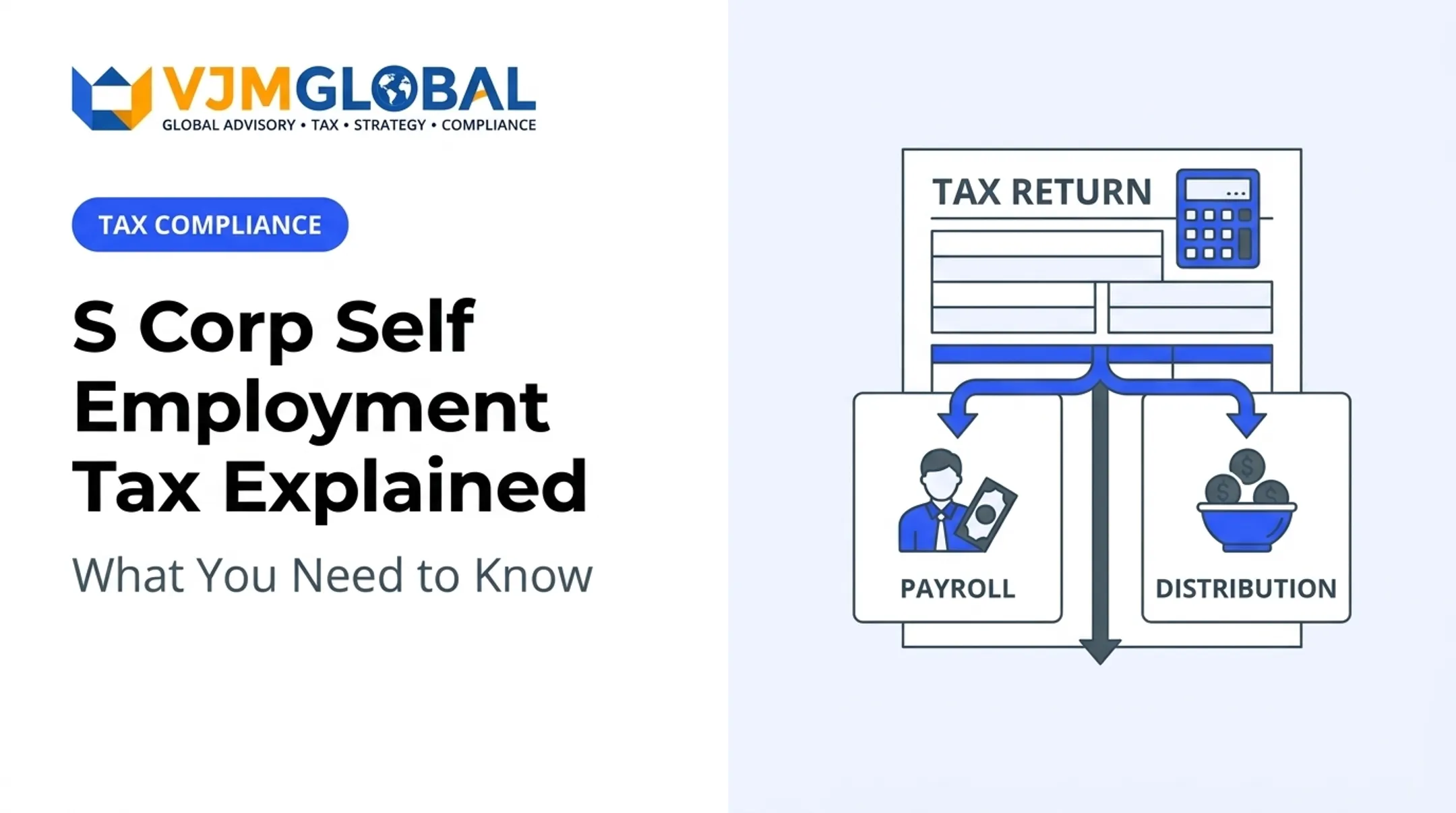
- S corporation election (Form 2553): Income flows through to shareholders. Working owners must take reasonable salary through payroll before non-wage distributions. Savings depend on your numbers, so get a business-specific analysis first.
Washington LLC startup checklist
- Check name availability on the Secretary of State's website
- Appoint a registered agent with a physical Washington street address
- File the certificate of formation ($180, plus an online processing fee)
- Write an operating agreement (internal, not filed with the state)
- Get a free EIN from the IRS
- Apply for a business license and any tax registrations
- File the annual report ($70)
- Set up bookkeeping and a business bank account

Verify fees and processing rules with the Secretary of State and DOR before filing, since they change.
Frequently Asked Questions
Does Washington have a self-employment tax?
Washington has no traditional personal income tax on earned income. Federal self-employment tax and income tax still apply, and B&O tax is a separate state tax on gross receipts.
Is your first $18,000 tax-free?
No blanket Washington rule exempts the first $18,000. The 2026 federal standard deduction is $16,100 (single), $24,150 (head of household), or $32,200 (joint). It doesn't erase self-employment tax, which starts at $400 in net earnings, or B&O tax.
Does a sole proprietor need a business license in Washington state?
Often, yes. It depends on activity, trade name, income ($12,000 trigger), taxable sales, employees, endorsements, and city rules. Confirm through DOR's Business Licensing Service.
What do I need to start an LLC in Washington state?
You need a certificate of formation, registered agent, available name, EIN, operating agreement, and business license. Add tax registrations and annual reports, and budget for state and local fees.
What taxes do self-employed people pay in Washington?
Federal self-employment tax, federal income tax, and state B&O tax. Sales tax applies where you sell taxable goods or services, and city business taxes and license fees may apply.
How do self-employed people pay estimated taxes in Washington?
Federal estimates go to the IRS quarterly when required. B&O and sales tax are paid through DOR excise returns on your assigned schedule.