Introduction
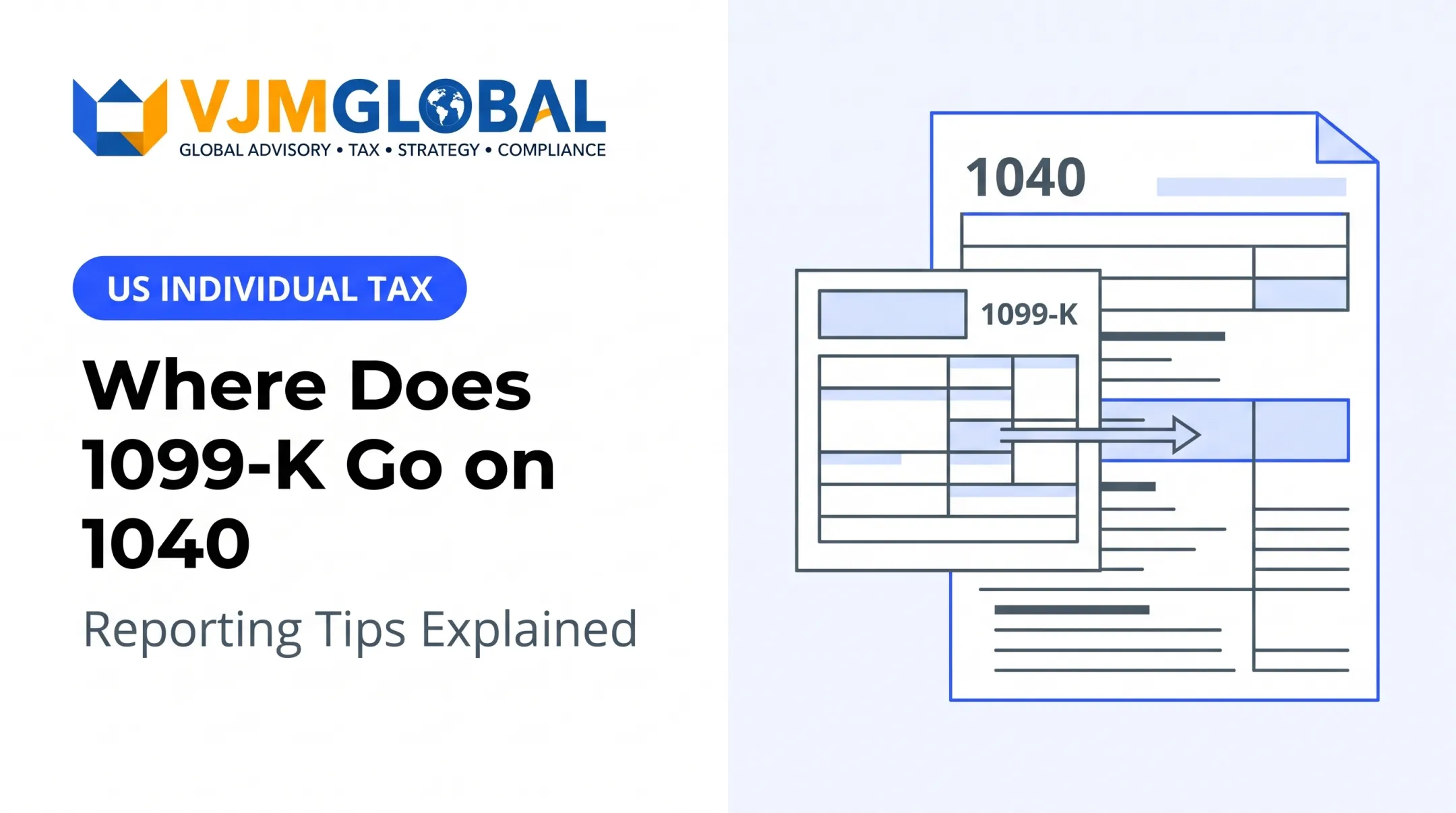
There is no single Form 1040 line for 1099 income. The right destination depends on the 1099 type, the box, and what the payment was actually for.
A Form 1099 tells the IRS and you that someone paid you. It rarely shows taxable income. Schedules often calculate the real figure first, after expenses, basis or exclusions, and only that result reaches Form 1040.
Get it wrong and a mismatch can trigger a CP2000 notice, which proposes changes to your return.
This guide covers 1099-NEC, 1099-MISC, 1099-K, investment and retirement forms, missing or incorrect forms, withholding, and Form 1040 versus 1040-NR. Line references are for tax year 2025, and amounts are in US dollars.
Key Takeaways
- Match each 1099 to the underlying transaction instead of typing every amount onto Form 1040.
- Business income goes through Schedule C, investment sales through Form 8949 and Schedule D.
- Taxable income is reportable even if a 1099 is missing, wrong, or below the payer's threshold.
- Check current-year IRS instructions, because forms and thresholds change.
Understanding Form 1099 and Form 1040
Form 1099 is an information return filed by a payer. Form 1040 is the individual's annual return. Nonresident aliens generally file Form 1040-NR instead.
The form label does not decide tax treatment. A 1099-MISC might report rent, a prize, or business income, and each lands in a different place. The activity behind the payment controls the schedule.
Before entering anything, check these fields:
- Form type and tax year
- Payer and recipient names and TINs
- Box number, label, and amount
- Federal income tax withheld
Payer thresholds are not recipient exemptions. A payer may not have to file a 1099 for a small payment, but you still report the income.
Where to Report Each Type of 1099 Income
Use the same process for every form:
- Identify the form and box so you know which rules apply.
- Confirm what the payment represents (services, interest, sale proceeds, etc.).
- Decide whether it is business or personal activity.
- Apply expenses, basis, or exclusions before you total the income.
- Carry the result to the correct Form 1040 line or schedule.

1099-NEC and 1099-K
Freelance, contractor, and gig receipts go on Schedule C for a sole proprietor or single-member LLC. Net profit flows through Schedule 1 (line 3 for business income, then line 10) to Form 1040 line 8. Schedule SE may apply as well.
A 1099-K shows gross payments, not profit. Reconcile it against:
- Processor fees and refunds
- Shipping, discounts, and credits
- Amounts already on a 1099-NEC or in your books
Business receipts go to Schedule C. A gain on a personal-use item you sold goes to Form 8949 and Schedule D, while a personal-use loss is not deductible.
1099-MISC by box
| Box | Typical destination |
|---|---|
| 1, rents | Schedule E line 3 |
| 2, royalties | Schedule E line 4 |
| 3, other income | Schedule 1 line 8i (prizes, awards) or 8z; business income keeps its character |
| 4, federal withholding | Form 1040 line 25b |
| 9, crop insurance | Schedule F line 6a |
Boxes 5, 6, 8, and 10 have no universal line. Decide based on the payment and the activity.
Investment forms
- 1099-INT: line 2a is tax-exempt interest, line 2b is taxable interest.
- 1099-DIV: line 3a is qualified dividends, line 3b is ordinary dividends.
- Schedule B: required when taxable interest or ordinary dividends exceed $1,500.
- 1099-B: proceeds combine with basis and holding period on Form 8949 and Schedule D, which feeds line 7a.
- 1099-DA: Gross-proceeds reporting starts January 1, 2025; basis reporting for certain transactions starts January 1, 2026. Report digital asset gains even without the form.

Retirement, government, education, debt, and real estate
- 1099-R: IRAs on lines 4a/4b; pensions and annuities on lines 5a/5b. Compare box 1 (gross) with box 2a (taxable) and check box 7 codes. A qualifying rollover may be nontaxable.
- 1099-G: unemployment goes on Schedule 1 line 7. A state refund counts only to the extent it was federally deductible.
- 1099-Q: only earnings not offset by qualified education expenses are taxable (Schedule 1 line 8z).
- 1099-C: cancelled debt goes on Schedule 1 line 8c, subject to exclusions such as insolvency (Form 982).
- 1099-S: report a home sale on Form 8949 even if the gain is fully excluded. A business-use portion may need Form 4797.
How 1099 Income Is Taxed
A 1099 does not make the whole amount taxable. Reimbursements, gifts, returns of capital, and excluded gains may need to be adjusted out or explained on the return.
Gross, net, and taxable amounts
- Business: report gross receipts, then deduct ordinary and necessary expenses.
- Investments: proceeds are not the gain. Basis and transaction costs reduce it.
- Retirement: the taxable portion may depend on plan records or IRS worksheets.
Self-employment tax
Schedule SE applies when net earnings reach $400. It computes net earnings as 92.35% of net profit, then applies 15.3% (12.4% Social Security plus 2.9% Medicare).

The 2025 wage base is $176,100, per the 2025 Schedule SE, and rises to $184,500 for 2026. The tax goes to Schedule 2 line 4, and half is deductible on Schedule 1 line 15. Rental, investment, and most retirement payments follow different rules.
Withholding and estimated tax
Federal tax withheld on a 1099 is a payment, not income. Report it on Form 1040 line 25b.
With little or no withholding, you may owe estimated payments. For 2025, that generally applies when expected tax after withholding is at least $1,000. Withholding must also fall below the smaller of 90% of 2025 tax or 100% of 2024 tax (110% if 2024 AGI exceeded $150,000).
See Form 1040-ES for worksheets and due dates.
Form 1040 or Form 1040-NR?
Residency decides the form, not the payer's location. A green card holder is a resident alien. Others become residents under the substantial presence test: 31 days in 2025 and 183 weighted days across 2025, 2024, and 2023.

A nonresident alien generally files Form 1040-NR when engaged in a US trade or business or when US-source income requires a return. Sourcing differs by income type: services by where performed, interest by payer residence, rent by property location.
Treaties and foreign tax credits can change the result. Australians or other cross-border taxpayers with US payers should have a qualified professional review their position.
Fix Missing, Incorrect, or Duplicate Forms and Avoid Mistakes
When a 1099 never arrives
Don't wait. Rebuild income from invoices, bank statements, platform records, and brokerage statements. Contact the payer, then report taxable income from reliable records.
For a missing 1099-R, call the IRS at 800-829-1040 if it has not arrived by the end of February. The IRS may send Form 4852, which substitutes only for a W-2 or 1099-R. If a corrected form later differs, file Form 1040-X.
When a form is wrong or duplicated
- Compare it against contracts, payment records, and basis statements.
- Ask the payer for a corrected form before filing.
- Never report the same transaction twice, such as a payment on both a 1099-NEC and a 1099-K.
- If the payer won't correct it, follow current IRS procedures and keep your documentation.

Common mistakes
- Putting every 1099 amount straight onto Form 1040
- Confusing 1099-NEC, 1099-MISC, and 1099-K
- Overlooking withholding
- Ignoring business expenses or investment basis
- Using outdated line numbers
Errors multiply fastest with multiple forms, classification questions, or cross-border issues. VJM Global prepares Form 1040 and Form 1040-NR returns and reviews complex 1099 situations, including for nonresidents with US-sourced income.
Frequently Asked Questions
Where does 1099 income go on a 1040?
It depends on the form, box, and activity. Business income goes to Schedule C, investment gains to Schedule D, and interest, dividends, or retirement income to their own Form 1040 lines.
Do I have to report 1099-NEC on my taxes?
Yes. It must be reported even if the form is missing or the amount is below the payer's threshold. Business income commonly flows through Schedule C.
Do I include a 1099 with a tax return?
Generally you enter the details on the right schedules and keep the form. On a paper return, attach forms showing federal tax withheld, such as 1099-R. Check the current instructions.
Is 1099-NEC considered earned income?
It can be. Net self-employment earnings count as earned income, for example for the EITC. The form's gross amount is not that net figure, and self-employment tax may apply after expenses.
What is the minimum income to file 1099-NEC?
That threshold applies to the payer, generally $600 for 2025 payments and $2,000 for certain payments after December 31, 2025. You must report taxable income regardless.
Are a 1040 and a 1099 the same?
No. Form 1040 (or 1040-NR) is your annual individual return. A 1099 is an information return reporting specific payments.