The EIC is not wages, and you don't copy it from your W-2. Your W-2 and other income records feed the calculation. Form 1040 only receives the final credit amount.
This guide covers the exact line, Form 1040 versus Schedule EIC, eligibility, calculation steps, and what U.S. taxpayers filing from Australia need to watch.
Key Takeaways
- For tax year 2025, the EIC goes on line 27a; for 2024, it was line 27.
- The line holds your calculated credit, not your wages or earned income.
- Schedule EIC supplies qualifying-child details and is separate from the 1040 line.
- Living in Australia, or using Form 2555, can block the credit.
Where Is the EIC on Form 1040?
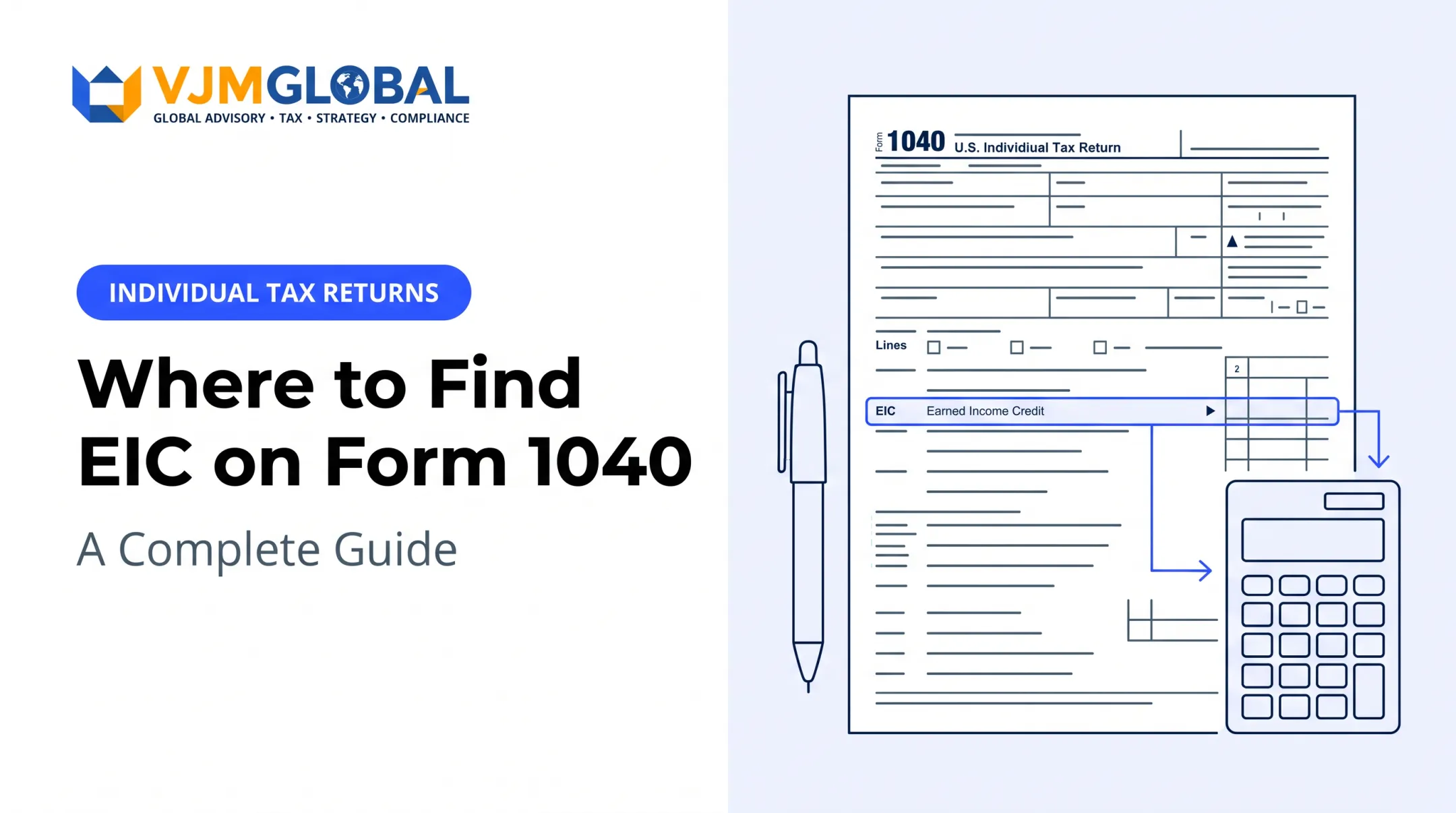
On the 2025 Form 1040 and 1040-SR, "Earned income credit (EIC)" is line 27a. Line 27b concerns clergy filing Schedule SE, and line 27c is a checkbox for taxpayers who don't want to claim the EIC.
It sits in the payments and refundable credits block, which ends with line 32 (total other payments and refundable credits) and line 33 (total payments).
Enter the finished credit after working through the Form 1040 instructions, the EIC worksheet and table, tax software, or another approved method. Wages, tips, and self-employment income are reported elsewhere. They help determine the credit but are never simply copied into line 27a.
Nearby lines readers confuse with the EIC
On the 2025 form, the neighbouring lines are:
- Line 28: Additional Child Tax Credit (ACTC)
- Line 29: American opportunity credit
- Line 30: Refundable adoption credit
- Line 31: Amount from Schedule 3
- Line 32: Total other payments and refundable credits
- Line 33: Total payments
The common slip is entering the EIC on line 28 because both credits often apply to families with children. They are different credits.
Changes between tax years
The 2024 Form 1040 put the EIC on line 27, with ACTC on 28 and the American opportunity credit on 29. For 2025, it became 27a. The 2026 draft also shows 27a, but it is marked "DRAFT—NOT FOR FILING," so don't rely on it yet.

Download the exact Form 1040 or 1040-SR for the year you're filing. Don't work from a screenshot or last year's return.
Asking the IRS to calculate the credit
The 2025 instructions allow you to write "EIC" on the dotted line beside 27a if you want the IRS to figure the credit. With a qualifying child, you must still complete and attach Schedule EIC. This doesn't relax any eligibility rule.
EIC on Form 1040 vs. Schedule EIC
What Form 1040 does
Form 1040 is the main federal individual return. Its EIC line reports the final credit after you've confirmed eligibility and finished the calculation.
What Schedule EIC does
Schedule EIC is attached only when you have a qualifying child. For each child it asks for:
- Name and SSN
- Year of birth (not the full date)
- Relationship to you
- Months the child lived with you in the United States during the year
Schedule EIC doesn't calculate anything
It supplies child information. The amount still comes from the Form 1040 instructions, worksheets, EIC table, or software. Taxpayers with no qualifying child don't attach it, and claim the smaller self-only credit on line 27a if they meet the childless rules.
Who Can Claim the EIC?
Income limits and maximum credits
Figures below are from the IRS EITC tables (limits shown as non-joint / married filing jointly). Use the column matching your tax year.
| Qualifying children | 2025 income limit | 2025 max credit | 2026 income limit | 2026 max credit |
|---|---|---|---|---|
| 0 | $19,104 / $26,214 | $649 | $19,540 / $26,820 | $664 |
| 1 | $50,434 / $57,554 | $4,328 | $51,593 / $58,863 | $4,427 |
| 2 | $57,310 / $64,430 | $7,152 | $58,629 / $65,899 | $7,316 |
| 3 or more | $61,555 / $68,675 | $8,046 | $62,974 / $70,244 | $8,231 |

Both earned income and AGI must fall under the limit. Investment income must also stay under $11,950 for 2025 ($12,200 for 2026). Publication 596 has the full rules.
What counts as earned income
Earned income includes wages, salaries, and tips (W-2 Box 1), plus net self-employment earnings. It doesn't include interest, dividends, pensions, annuities, Social Security, unemployment compensation, or workers' compensation.
Basic taxpayer tests
- Valid SSNs for you, your spouse on a joint return, and any qualifying child. An ITIN doesn't count.
- U.S. citizen or resident alien for the full year
- Nonresident aliens generally can't claim unless filing jointly with a citizen or resident spouse and electing resident treatment
- Married couples generally must file jointly. A separated spouse can qualify only under a narrow IRS special rule.
- You can't be another taxpayer's qualifying child.
- Filing Form 2555 bars the credit.
Qualifying-child tests
The child must pass four tests:
- Relationship: your child or descendant, sibling or descendant of a sibling, or an adopted or foster child
- Age: under 19, under 24 as a full-time student, or any age if permanently and totally disabled
- Residency: lived with you in the United States for more than half the year
- Joint return: generally can't file jointly, except solely to claim a refund
Only one person can claim the same child. When two people both qualify, the IRS tie-breaker rules favour the parent. Between two parents filing separately, the child goes to the parent they lived with longer. If time is equal, the parent with the higher AGI claims the child.
EIC without qualifying children
You can still claim a smaller credit without a qualifying child if you meet all of these:
- Age 25 through 64 at year-end
- Not someone else's qualifying child
- Had a U.S. home for more than half the year
Joint filers have a separate age rule in Publication 596. Check the current-year rules, since thresholds change.
Special considerations for taxpayers filing from Australia
Living in Australia doesn't automatically qualify or disqualify you. A home outside the United States for more than half the year generally fails the U.S.-home test, which blocks the credit for many overseas filers. U.S. military personnel on extended active duty abroad are an exception.
A child must also meet the U.S.-residency test. Foreign wages count as earned income, yet that doesn't override the home test. If you file Form 2555 for the foreign earned income exclusion or housing exclusion, you can't claim the EIC.

How to Find, Enter and Verify the EIC on Your Return
Gather your records
Pull together the documents that support earned income and qualifying children:
- W-2s (Box 1 wages help establish earned income; there is no EIC box on the W-2)
- Relevant 1099s and investment income statements
- Self-employment records and Schedule C details
- SSNs for you, your spouse if filing jointly, and each qualifying child
- Child records that show relationship, age, and residency
Calculate the credit
- Open the current Form 1040 instructions and answer the EIC eligibility steps.
- Use Worksheet A if you answered "No" to Step 5, question 2. Use Worksheet B if "Yes" (self-employment and certain statutory-employee situations).
- Look up the result in the EIC table, using your filing status and number of children.
- Run the IRS EITC Assistant or reliable tax software as a cross-check.

Nontaxable combat pay can be elected into earned income (line 1i). Calculate the credit both ways, since the election can raise or lower it.
Enter the result
Put the amount on line 27a. Attach Schedule EIC if you have a qualifying child. The credit flows into your total payments and can increase a refund even when your income tax is low or zero.
Final verification checklist
- Form year is correct
- Filing status is accurate
- All SSNs are valid
- Income matches source documents
- The amount sits on line 27a, not 28
- Each child's relationship, age, U.S. residency, and joint-return status meet the tests
- Schedule EIC is complete
Refund timing and corrections
Under the PATH Act, the IRS can't issue refunds on returns claiming the EITC or ACTC before mid-February, and the hold covers the entire refund. See the IRS refund timing page for current dates.
If you left out the credit or got it wrong, file Form 1040-X, one per tax year, with any new or changed forms attached. If a prior EIC was reduced or disallowed for a reason other than a math or clerical error, Form 8862 is needed when you claim it again.
Common EIC Filing Mistakes and When to Get Help
Errors that put the credit at risk
- Using the wrong year's form
- Entering the amount on line 28 or another nearby line
- Confusing the EIC with the Child Tax Credit
- Looking for the credit on the W-2
- Omitting Schedule EIC
- Using an invalid SSN or an ineligible filing status
- Exceeding income or investment-income limits
- Claiming a child who fails the residency test
- Overlooking the Form 2555 bar
The IRS also lists mismatched SSNs or last names, multiple people claiming one child, and misreported income as common errors. TIGTA's fiscal 2025 report put the EITC improper-payment rate at 32.7%.
Situations that need extra care
These situations call for close reading of the instructions and solid documentation:
- Split custody or shared claims
- Self-employment or foreign income
- Time abroad
- Inconsistent records
- A prior disallowance
A wrong claim can mean repaying the refund plus interest. Reckless or intentional disregard can bar the EIC for 2 years, and fraud for 10 years.

When professional support helps
Get a review if you:
- File from Australia
- Have foreign or self-employment income
- Are unsure about child rules
- Received an IRS notice about the credit
VJM Global's U.S. tax compliance professionals, who cover international taxation and Form 1040 preparation, can review your reporting, income documentation, and cross-border questions. Eligibility itself is always decided under IRS rules.
Frequently Asked Questions
Who qualifies for the Earned Income Credit?
You need earned income, AGI and investment income under the limits, a valid filing status, valid SSNs, and a U.S. home. Claiming with children also requires a qualifying child. Check current IRS rules.
What is earned income on a 1040?
It generally means wages, salaries, tips, and net self-employment earnings. The EIC amount itself is reported separately, on line 27a for 2025.
How do I figure out my EIC?
Use the current Form 1040 instructions, EIC worksheet and table, the IRS EITC Assistant, or tax software. The result depends on earned income, AGI, filing status, children, and investment income.
Where is Earned Income Credit on W2?
Nowhere. The W-2 has no EIC box. Box 1 wages help determine earned income, and the credit is claimed on Form 1040.
Is the EIC the same as the EITC?
Yes. The IRS treats EIC and EITC as two names for the Earned Income Tax Credit. "EIC" is the label on Form 1040.
Do I need Schedule EIC with Form 1040?
Attach it when you claim the credit with a qualifying child. Childless claims don't need it. Confirm in the current-year instructions.