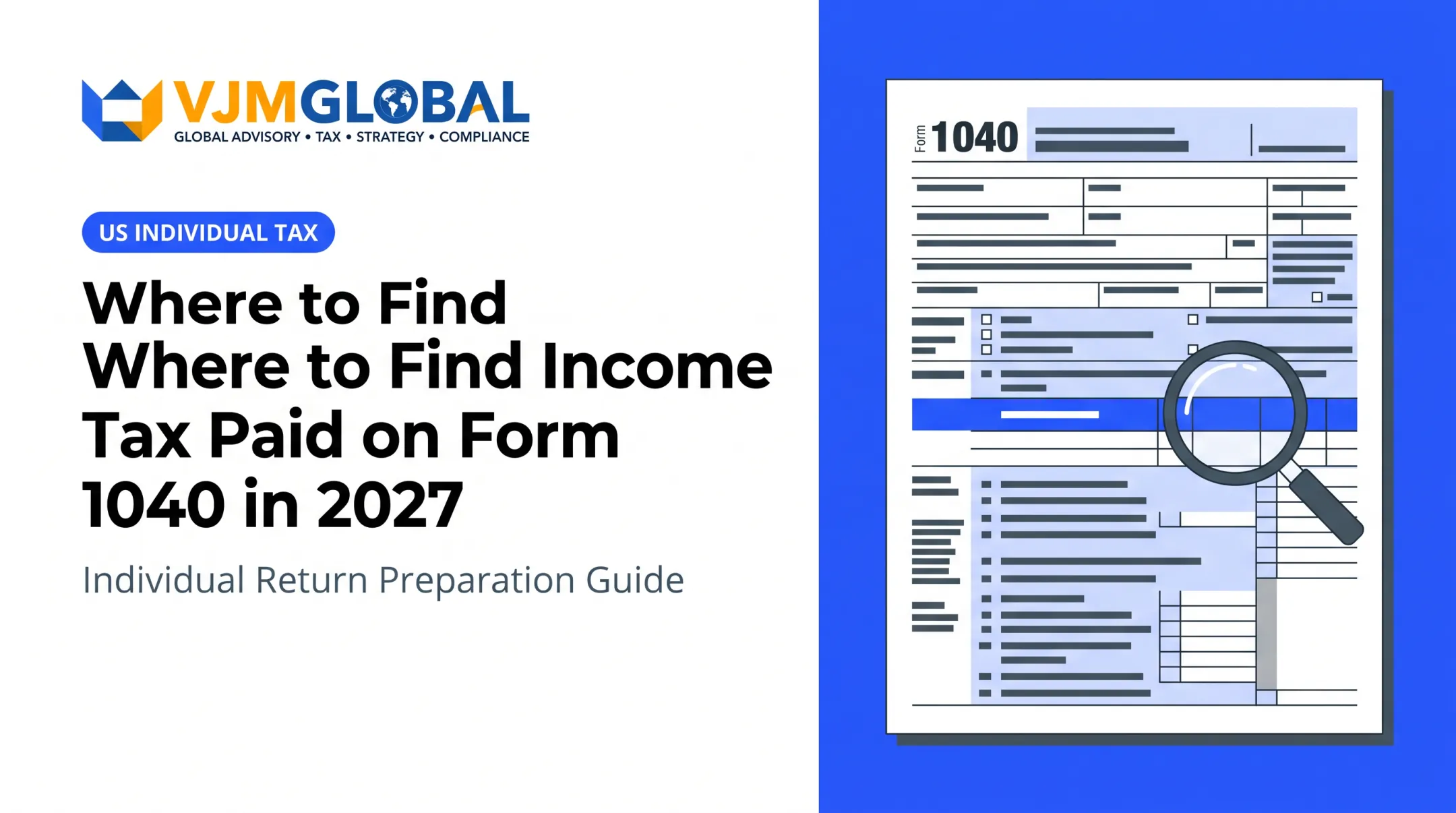
The figure you want depends on what you mean: total income, adjusted gross income (AGI), taxable income, net business profit, or paycheck take-home pay. Each sits in a different place, and one isn't on the form at all.
This guide shows where each figure lives, how they connect, and where Australian-based filers need extra care. It uses the 2025 Form 1040. Always check the form for your own tax year, because line numbers change.
Key Takeaways
- Line 9 is total income, line 11a is AGI, and line 15 is taxable income.
- Self-employed net profit is calculated on Schedule C, line 31.
- Take-home pay appears on a pay stub, not on Form 1040.
- A $70,000 salary alone can't tell you taxable income or take-home pay.
Where Is Net Income on Form 1040?
The short answer
Form 1040 has no single "net income" line. Most people mean one of four figures:
- Total income (line 9)
- Adjusted gross income (line 11a)
- Taxable income (line 15)
- Net business profit (Schedule C, line 31)
The income section on page 1 lists each income type. Some entries only show a total, with the detail sitting on Schedule 1, Schedule C, Schedule D or Schedule E.
What each figure means
| Measure | Location (2025) | What it is |
|---|---|---|
| Total income | Line 9 | Income subtotal before adjustments |
| Adjustments | Line 10 | Pulled from Schedule 1, line 26 |
| AGI | Line 11a (carried to 11b) | Line 9 minus line 10 |
| Taxable income | Line 15 | Line 11b minus deductions on line 14 |
| Business net profit | Schedule C, line 31 | Receipts minus allowable expenses |
Line 9 isn't take-home pay or your final tax base. AGI matters because, per the IRS definition of AGI, it affects free-filing options, credits and other tax benefits. Lenders and benefit programs often ask for it too.
Taxable income (line 15) is the amount your federal income tax is calculated on. It is zero if the result is zero or less.
A sole proprietor's profit follows a set path: Schedule C line 31, then Schedule 1 line 3, Schedule 1 line 10, and finally Form 1040 line 8.

What Form 1040 does not show
Take-home pay isn't a Form 1040 line. Wages and federal income tax withholding appear separately. For 2025, employees pay 6.2% Social Security on wages up to $176,100, plus 1.45% Medicare with no ceiling, according to IRS Publication 15.
Insurance and retirement contributions come out too. Your pay stub shows the result.
Cash movement isn't income either. Loans and transfers between your own accounts may land in your bank account without being taxable.
How Do Total Income, AGI, Taxable Income and Net Income Relate?
Follow the Form 1040 income flow
Income enters through different lines before line 9 adds it up:
- Wages: line 1a (wage categories total on 1z)
- Interest: taxable interest on 2b, tax-exempt on 2a
- Dividends: ordinary on 3b, qualified on 3a
- IRA distributions: gross 4a, taxable 4b
- Pensions and annuities: gross 5a, taxable 5b
- Social Security: benefits 6a, taxable portion 6b
- Capital gain or loss: line 7a, with Schedule D when required
- Additional income: line 8, from Schedule 1
Line 9 adds the taxable entries, not both the gross and taxable columns. Only the taxable part of retirement distributions or Social Security flows through.
From there the path is straightforward:
- Line 9 minus line 10 adjustments = AGI
- Deductions total on line 14 (12e standard or itemised, 13a qualified business income, 13b from Schedule 1-A)
- AGI minus line 14 = taxable income on line 15

Comparing the key figures
- Total income: the broad subtotal
- AGI: total income after eligible adjustments
- Taxable income: the base for the income-tax calculation
- Net income: not a Form 1040 line; often confused with net pay or taxable income
Your refund or balance due isn't net income. It comes from comparing total tax (line 24) with payments on line 33, which include withholding, estimated payments and refundable credits.
A $70,000 example
Suppose you earn $70,000 in wages. That amount appears on line 1a and feeds line 9. Your AGI and taxable income could then be lower, depending on adjustments and deductions.
For scale, the 2025 standard deduction is $15,750 for single filers and $31,500 for married filing jointly. But a real answer also needs your filing status, other income, credits and withholding. Take-home pay depends on payroll deductions and benefit elections, which Form 1040 wages can't reveal.

Business income versus employee income
Employees report W-2 wages. Self-employed filers calculate profit on Schedule C: gross receipts (line 1) and gross income (line 7), less expenses, give net profit on line 31. Gross receipts aren't net income, so don't treat them as such.
What Documents and Schedules Help You Find the Right Figure?
Match source documents to Form 1040 entries
| Document | Reports |
|---|---|
| W-2 | Wages from employers |
| 1099-INT | Interest from banks and brokers |
| 1099-DIV | Dividends and distributions |
| 1099-R | Retirement, pension and annuity distributions |
| 1099-B | Broker and barter transactions |
| Schedule K-1 | A partner's share of partnership income, deductions and credits |
Interest from a 1099-INT goes on line 2b. Schedule B applies when taxable interest or ordinary dividends exceed $1,500, or another trigger applies.
Collect corrected forms and any foreign income statements before relying on your totals. Ask your employer for a replacement if a W-2 is wrong or lost.
Follow the schedule trail
- Schedule C: sole-proprietor profit or loss
- Schedule D: capital gains and losses
- Schedule E: rental, royalty, partnership and S corporation income
- Schedule 1: additional income and adjustments feeding lines 8 and 10
Each schedule handles the calculations. Form 1040 shows the amount carried into the overall return.
Reconcile the figures
Compare your return against W-2s, 1099s, brokerage statements and business records.
The IRS wage and income transcript, available through your Individual Online Account or Form 4506-T, shows what the IRS received for the current year and nine prior years. Early-season data can be incomplete.
Omitted, duplicated or misclassified documents throw off line 9, AGI and taxable income.
Common Mistakes When Looking for Net Income on Form 1040
Confusing the main income figures
Lines 9, 11a and 15 aren't interchangeable with each other or with your net pay. Decide why you need the number first. A loan application, benefits eligibility, budgeting or business reporting each points to a different figure.
Reporting the wrong amount
- Count income without a form as taxable
- Ask the filer to correct a duplicate 1099-K that overstates income
- Review platform gross payments against expenses; gross is not profit
- Separate gross wages from taxable income; only part of retirement or Social Security may be taxable
The IRS gives one example: a sole proprietor runs retail and rental payments through one terminal. The single 1099-K covers both, so retail receipts go on Schedule C and rental receipts on Schedule E.
Using outdated information
The 2026 Form 1040 is a draft marked "DO NOT FILE." Use the 2025 form and instructions for 2025 returns. Complex returns, foreign income, self-employment or disputed IRS figures call for professional advice rather than a general overview.
Form 1040 Considerations for U.S. Taxpayers in Australia
Determine which U.S. return applies
U.S. citizens and resident aliens report worldwide income, and IRS guidance for citizens abroad confirms that living overseas doesn't remove the filing obligation. Qualifying taxpayers abroad get an automatic two-month extension to June 15, though interest on unpaid tax runs from April 15.
Nonresident aliens may need Form 1040-NR instead. Living in Australia doesn't decide it. Status depends on the green card and substantial presence tests, so review your own facts.
Foreign income and documentation
Australian wages, bank interest, dividends, investment gains and business income must generally be converted to U.S. dollars and reported by income type, not as one "net income" figure. The IRS generally uses transaction-date exchange rates, with a yearly average allowed for income received evenly.

Related forms and filings for your year:
- Form 1116 (foreign tax credit)
- Form 2555 (foreign earned income exclusion)
- FBAR, when foreign accounts exceed $10,000 at any time
- Form 8938, with higher thresholds for qualifying individuals abroad
Eligibility varies. Check current IRS guidance.
When professional support may help
Consider help if you have several income sources, self-employment, Australian investment accounts, currency conversions, foreign tax paid, or doubt over 1040 versus 1040-NR.
VJM Global prepares U.S. Form 1040 and 1040-NR returns and supports cross-border accounting and tax compliance. You can request a free tax consultation to talk through your situation. Outcomes depend on your facts, and nothing is guaranteed.
Frequently Asked Questions
How do I find net income on a tax return?
"Net income" usually isn't one Form 1040 line. Use line 9, line 11a, line 15, Schedule C or a pay stub, depending on what you mean.
What line on 1040 is your total income?
Line 9 on the 2025 Form 1040. It adds the relevant income lines above it.
Where do I find my taxable income?
Line 15. It equals AGI (line 11b) minus total deductions on line 14, so it differs from both total income and AGI.
What is my net income if I earn $70,000?
Wages alone can't answer it. The result depends on filing status, other income, adjustments, deductions, withholding and whether you mean taxable income or take-home pay.
What is Form 1099-INT?
It reports interest received from banks and brokers, helping you enter the right amount on line 2b. Australian banks usually issue different statements, so you'll convert those amounts yourself.