%20(4).webp)
Determining the relationship between FASB vs GAAP is essential for ensuring your financial reporting aligns with the highest standards for US business. These concepts directly impact how your company prepares and presents financial statements, which is crucial for maintaining transparency and trust with stakeholders.
But what exactly do these terms mean for your business, and how do they impact your financial statements?
In this blog, we'll break down the key differences and explain how both FASB and GAAP work together to shape your financial reporting.
The Financial Accounting Standards Board (FASB) is an independent, private-sector body that establishes financial accounting and reporting standards in the United States. FASB’s role is crucial in ensuring that businesses follow clear, consistent rules for financial reporting, making it easier for investors, regulators, and other stakeholders to understand and compare financial data.
FASB's standards apply to both public and private companies, as well as not-for-profit organizations in the US. They ensure that financial reporting is consistent, transparent, and accurate, which is essential for the credibility of any business.
Also Read: Company Audit Checklist Guide for Businesses
This framework sets the stage for understanding the broader context of financial reporting, which brings us to the importance of FASB’s role in ensuring accurate financial statements.
FASB plays a critical role in the financial sector of the United States. By creating and maintaining GAAP, it helps to establish a uniform set of standards that all companies in the US must follow. Here’s why FASB is essential:
Understanding how FASB influences financial reporting is essential to grasp the core of the GAAP framework.

The FASB framework is a comprehensive set of accounting standards used by US businesses to ensure clarity, transparency, and consistency in financial reporting. Below are specific FASB standards that guide businesses in preparing their financial statements:
FASB ASC 606 provides a five-step model for recognizing revenue, which includes identifying contracts, performance obligations, and transaction prices. Revenue is recognized when control of goods or services is transferred to the customer. This ensures that companies report revenue in the period it is actually earned, reflecting the completion of obligations under a contract.
ASC 820 establishes a framework for measuring fair value of assets and liabilities based on a three-level hierarchy: Level 1 (quoted prices in active markets), Level 2 (observable inputs), and Level 3 (unobservable inputs). This standard ensures that businesses measure and report assets accurately, especially those without readily available market prices.
Under ASC 360, companies must test long-lived assets for impairment if events indicate their carrying amounts may not be recoverable. If the carrying value exceeds the recoverable amount, an impairment loss is recognized. This standard helps ensure that businesses only report the value of assets that are still likely to provide economic benefit.
ASC 715 governs the accounting for employee benefits, including pensions and retirement plans. It provides guidelines for measuring pension liabilities, recognizing changes in pension obligations, and disclosing pension plan assets and liabilities. This ensures businesses properly account for long-term employee benefits on their balance sheets.
Each of these FASB standards ensures businesses report their financial data with consistency, accuracy, and transparency, allowing stakeholders to make well-informed decisions based on reliable and comparable financial statements.
At VJM Global, we help US businesses overcome the complexities of financial reporting, ensuring compliance with FASB standards and optimizing financial management. Our solutions help maintain accuracy and transparency while cutting operational costs, allowing businesses to focus on growth as we manage financial complexities efficiently.
Now that we understand the foundational role of FASB, let’s explore what GAAP is and how it builds upon these standards to provide detailed accounting rules.
GAAP stands for Generally Accepted Accounting Principles. It is a set of accounting standards and procedures used to prepare financial statements in the US. These principles provide a uniform framework that companies must follow, ensuring consistency and transparency in financial reporting.
In practice, GAAP covers a wide range of accounting activities, including how revenue is recognized, how expenses are matched with revenues, and how assets and liabilities are measured. While FASB sets the standards, GAAP is the comprehensive set of rules that businesses must apply when creating their financial statements.
Also Read: Understanding the Differences Between GAAP and GAAS
Understanding GAAP is critical, but to fully appreciate its importance, let’s explore why adhering to these principles is essential for businesses and stakeholders.
GAAP is crucial for businesses as it provides a standardized framework for financial reporting. GAAP is vital for businesses for several reasons:
For US businesses, complying with GAAP is not just about following rules; it’s about maintaining credibility and trust with stakeholders.
While GAAP ensures consistent reporting, it’s also crucial to understand the specific standards it enforces, so let's examine the standards under the GAAP framework.
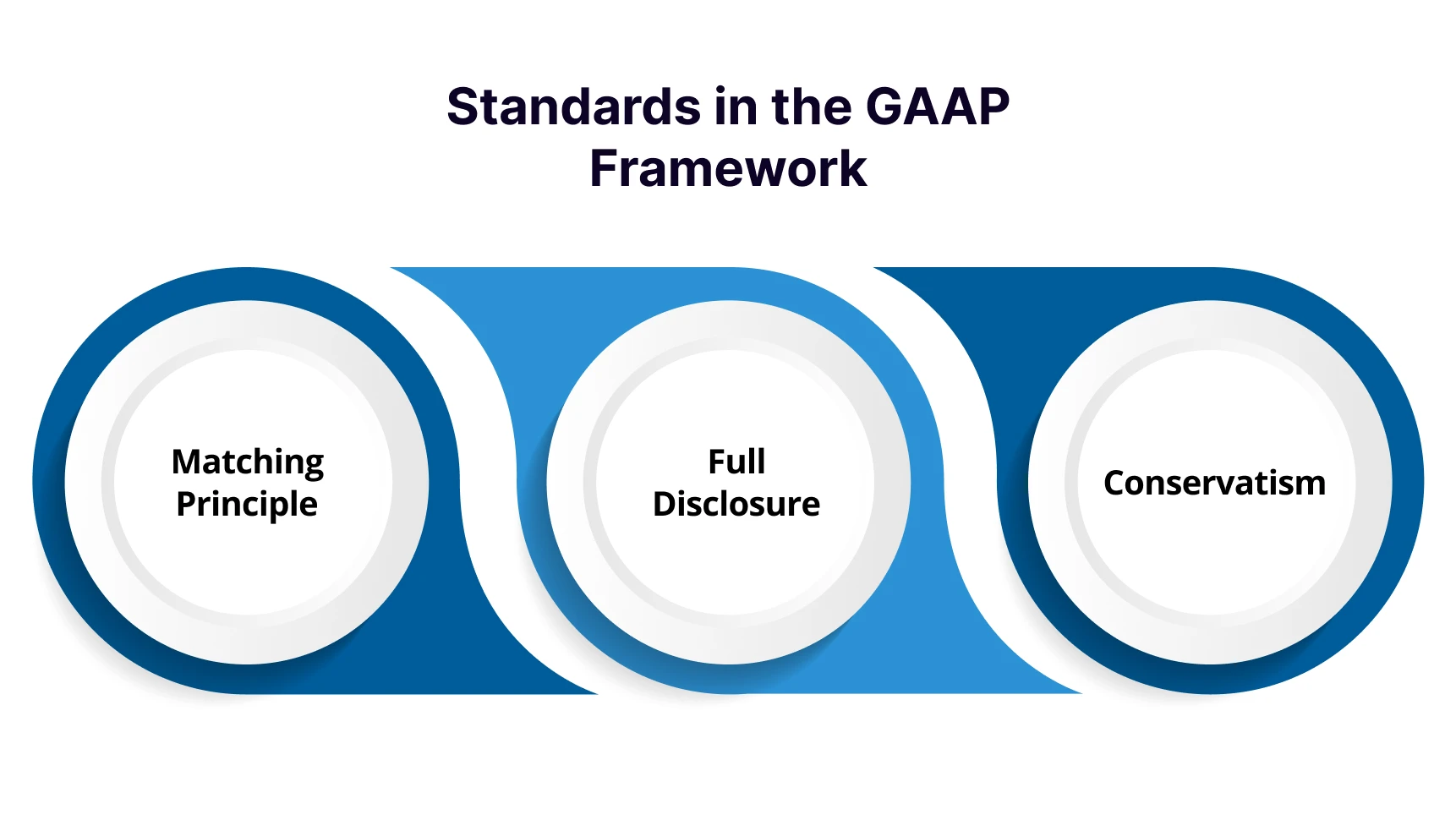
The GAAP framework is structured around specific standards that guide businesses in preparing financial statements. Below are key standards within US GAAP:
Under ASC 720, expenses should be matched with the revenue they help generate in the same period. For example, costs directly related to producing goods or services are recognized alongside the revenue they generate, ensuring that businesses report accurate profit margins for each period.
ASC 275 emphasizes that all relevant financial information, such as contingent liabilities and risks, should be disclosed in the financial statements. This ensures that users of financial reports have a complete picture of the company's financial position, including any off-balance-sheet items.
ASC 450 guides businesses to adopt a conservative approach when recognizing revenue and estimating liabilities. When faced with uncertainty, businesses should report the least optimistic outcome to avoid overstating assets or income. This prevents companies from presenting an overly optimistic view of their financial health.
These GAAP standards ensure that businesses follow a consistent approach to reporting, promoting transparency, reliability, and comparability in financial statements.
At VJM Global, our accounting outsourcing services are designed to help businesses streamline their financial processes while ensuring full compliance with GAAP standards. By outsourcing your accounting needs, you can reduce operational costs and focus on strategic growth.
As we explore how GAAP operates, it’s important to compare its standards with FASB’s, which are the backbone of both frameworks, to understand how they align and differ in practice.
While FASB and GAAP are closely connected, it’s important to understand the distinction between them. Below are key differences in standards that highlight the role and application of each:
In essence, FASB is the body that establishes the GAAP standards, and businesses must follow GAAP to ensure their financial statements meet the required reporting standards.
Also Read: How to Find The Right Accounting Outsourcing Services for USA Business?
Understanding the difference between FASB vs GAAP is critical for US business owners and entrepreneurs. FASB creates and maintains the GAAP standards, which ensure consistency, transparency, and reliability in financial reporting. By adhering to GAAP, businesses can provide accurate financial statements that investors and stakeholders can trust.
For businesses aiming to ensure compliance with financial reporting standards such as FASB and GAAP, VJM Global provides tailored solutions to meet your specific needs. Our expert team helps optimize your financial operations while ensuring full compliance with regulatory bodies.
Schedule a demo with VJM Global to discuss how we can assist in aligning your financial management with FASB and GAAP standards.
FASB stands for the Financial Accounting Standards Board, which is the organization responsible for setting the accounting standards in the United States.
FASB impacts your business by setting the rules for preparing financial statements, ensuring that your company follows consistent and transparent accounting practices.
No, FASB is the organization that establishes and updates GAAP standards, while GAAP refers to the specific set of rules businesses must follow when preparing financial statements.
Following GAAP is essential for ensuring consistency in financial reporting, building trust with investors, and maintaining compliance with regulatory bodies like the SEC.
Generally, US companies are required to use GAAP for financial reporting, as GAAP is based on the standards set by the Financial Accounting Standards Board (FASB). FASB is responsible for creating and maintaining the GAAP standards, which are mandatory for companies operating in the US.