"2026 tax returns" can mean two things. It might mean estimated payments on income you earn during 2026, or the Form 1040 you file in 2026 for tax year 2025. This article covers the first. The 2025 return only matters here as a benchmark for your 2026 estimates.
Below: the due-date schedule, who has to pay, how to calculate, how to pay from Australia, and what happens if you slip.
Key Takeaways
- The four calendar-year deadlines are April 15, June 15 and September 15, 2026, then January 15, 2027.
- Estimated tax covers income without enough withholding, such as self-employment, rental, investment and business income.
- Each payment is judged by its own deadline, so a large late payment does not fix an earlier shortfall.
- Australians with U.S. obligations must track IRS and Australian requirements separately.
2026 Form 1040-ES Payment Due Dates
Use Form 1040-ES to calculate and pay estimated tax for the current year. It is not the annual return. The IRS published the 2026 version on February 12, 2026.
2026 quarterly payment schedule
The "quarters" are uneven. Here is how IRS Publication 505 assigns them:
| Income period | Due date |
|---|---|
| January 1 – March 31, 2026 | April 15, 2026 |
| April 1 – May 31, 2026 | June 15, 2026 |
| June 1 – August 31, 2026 | September 15, 2026 |
| September 1 – December 31, 2026 | January 15, 2027 |

The fourth payment falls in the following calendar year. You can skip it if you file your 2026 return and pay the full balance by February 1, 2027. Note that this is February 1, not January 31, as the IRS prints it in the 2026 form.
Weekends, fiscal years and disasters
- If a due date lands on a Saturday, Sunday or legal holiday, payment is due the next business day.
- Fiscal-year taxpayers pay on the 15th day of the 4th, 6th and 9th months of their fiscal year, then the 15th day of the month after it ends. Confirm your schedule in Publication 505.
- IRS disaster relief can postpone deadlines for eligible taxpayers. Check the IRS disaster relief page rather than assuming the standard calendar applies.
Who Has to Pay Quarterly Estimated Taxes?
You generally need estimated payments when both of these are true for 2026:
- You expect to owe at least $1,000 after withholding and refundable credits.
- Your withholding and credits will be less than the smaller of 90% of your 2026 tax or 100% of your 2025 tax.
If your 2025 adjusted gross income exceeded $150,000 (or $75,000 if married filing separately), use 110% of 2025 tax instead of 100%. The 2025 return must cover a full 12 months.
Common groups
- Sole proprietors, freelancers, contractors and gig workers
- Partners and S corporation shareholders
- Landlords and investors
- People with large interest, dividend, capital-gain or retirement income
- W-2 employees with low withholding (a revised Form W-4 can raise withholding and avoid quarterly payments)
Exceptions
You owe no 2026 estimates if you had no 2025 tax liability, were a U.S. citizen or resident alien for all of 2025, and filed a 12-month return.
Farmers and fishers who earn at least two-thirds of gross income from those activities use 66 2/3% instead of 90%. They generally have one due date, January 15, 2027, or can file and pay in full by March 1, 2027.
Australian-based taxpayers
- U.S. citizens and resident aliens are taxed on worldwide income, subject to exclusions, credits and treaty rules. The U.S.-Australia treaty saving clause keeps citizens U.S.-taxable; Article 22 covers double-tax relief.
- Nonresident aliens use a separate Form 1040-ES (NR) with different payment options. Those rules are not the standard 1040-ES schedule.
- Australian filings do not replace U.S. payments. An Australian tax resident must declare foreign income to the ATO, and the U.S. obligation runs on its own track.
The U.S.-Australia Totalization Agreement means self-employed U.S. citizens living in Australia do not pay U.S. Social Security contributions on that income. It is not a blanket exemption from U.S. income tax.
How to Calculate 2026 Estimated Tax Payments
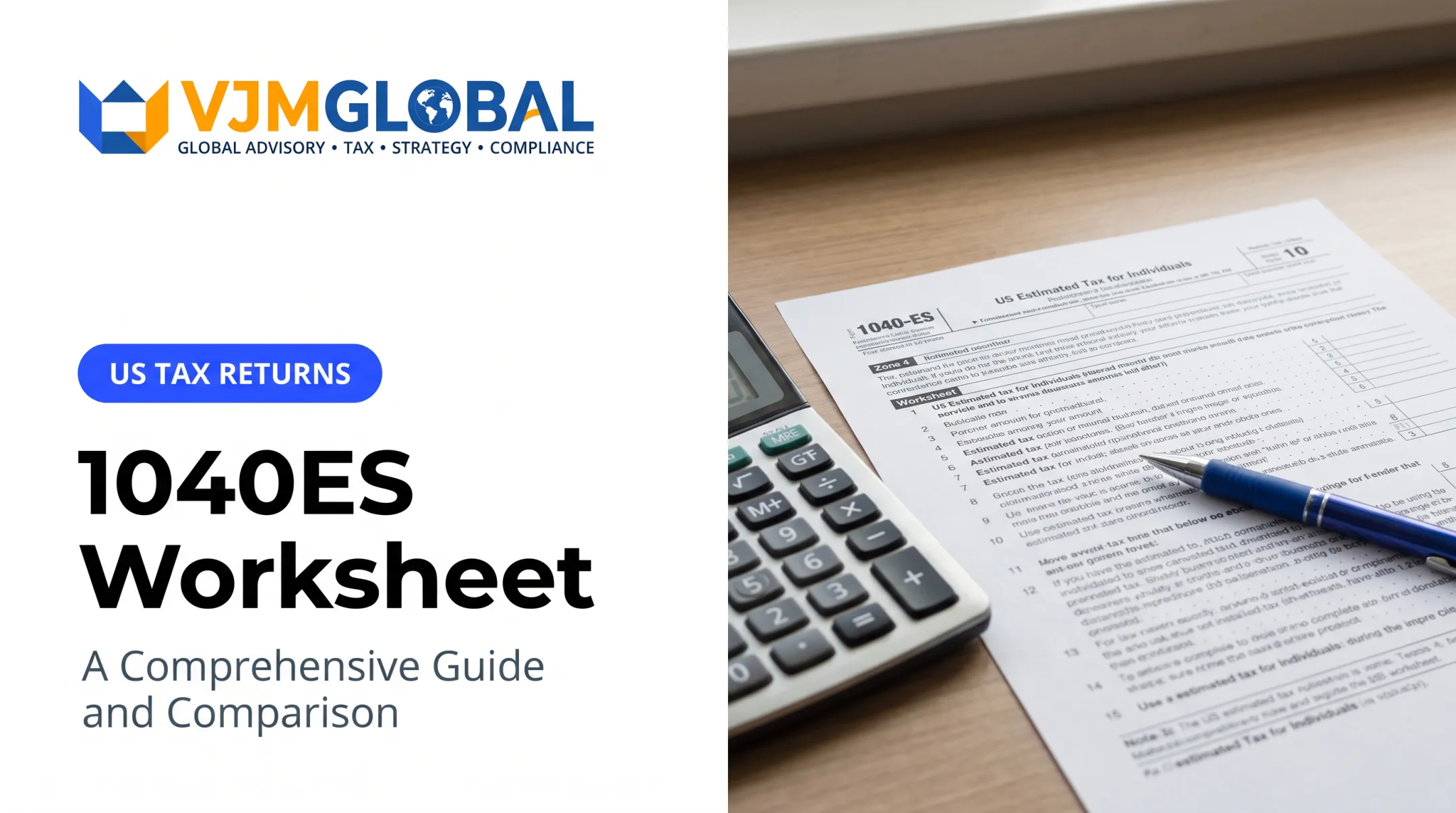
The Form 1040-ES worksheet projects your income, deductions, credits, self-employment tax and total federal tax. Divide the result across your payment dates, or pay it all by April 15.
Start with last year, then adjust
Your 2025 Form 1040 is the easiest baseline. Adjust it for expected changes in income, filing status, deductions, credits, withholding and business activity.
Self-employed? Net earnings for self-employment tax equal 92.35% of net profit. The rate is 15.3%, and for 2026 the Social Security portion applies to the first $184,500 of combined earnings. The Medicare portion has no cap.
Prior-year safe harbour vs annualised income
- Prior-year safe harbour: pay 100% (or 110%) of last year's tax. Simple and predictable.
- Annualised income method: match payments to income actually earned in each period. This suits seasonal or lumpy income. You must file Form 2210 with Schedule AI, even if no penalty is owed.

Cross-border inputs
Australian residents often need to factor in:
- The foreign earned income exclusion, $132,900 for 2026, only if you qualify and claim it
- Foreign tax credits (Form 1116), which reduce U.S. tax on foreign-source income but not U.S.-source income
- Exchange rates: the IRS generally uses the spot rate when income is received or expenses paid, and yearly average rates in some cases
- Self-employment income and the Totalization Agreement
Results vary widely, so verify each input against current IRS guidance.
Recalculate whenever income, deductions or withholding change. Uneven or late payments may call for Form 2210, which the IRS generally computes for you unless you claim an exception or waiver.
When professional support may be useful
Splitting income, credits and payments across two tax systems is where mistakes creep in.
VJM Global, a firm with U.S.-compliant professionals, supports individuals and businesses with cross-border U.S. tax compliance, including Form 1040 and 1040-NR preparation and estimated-payment planning.
It is a U.S. tax compliance resource, not a representative for Australian tax matters.
How to Pay Form 1040-ES Estimated Taxes
You can pay Form 1040-ES estimated tax through these main IRS options:
- IRS Direct Pay: free, no sign-in, pays from a checking or savings account.
- IRS Online Account: free, listed in the 2026 Form 1040-ES.
- EFTPS: free, but individuals can no longer create new accounts. Existing users can continue for now.
- Debit or credit card: via approved processors (fees apply). Pay1040 charges $2.15 debit or 1.75% credit ($2.50 min); ACI Payments charges $2.10 and 1.85%.
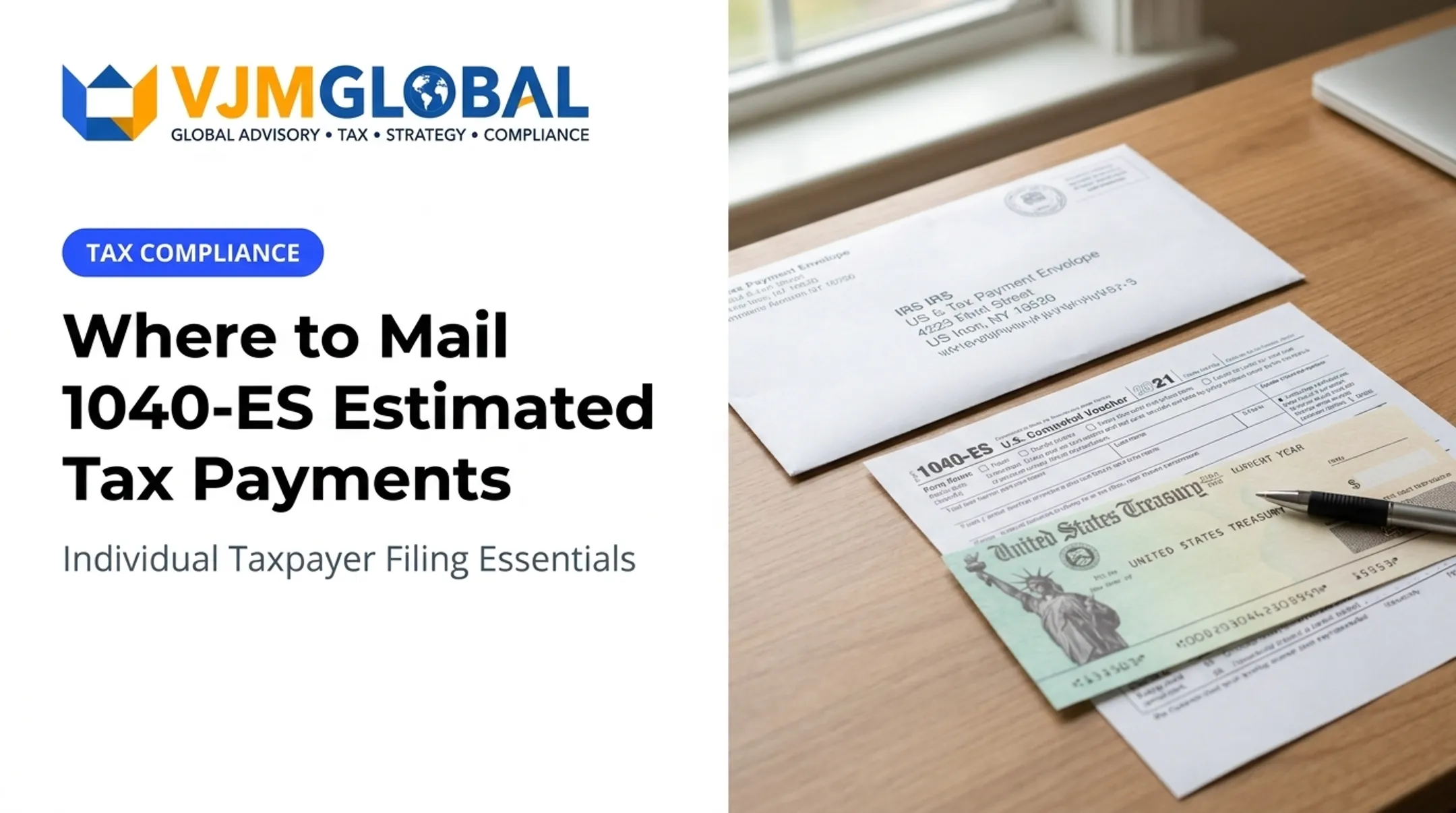
- Mail: a cheque or money order with the Form 1040-ES voucher. A U.S. postmark by the deadline is timely if you mail from within the United States with prepaid postage to the correct address.

Paying from Australia
A few extra steps apply when you pay from Australia:
- If you have no U.S. bank account, the IRS allows an international wire from a foreign bank. It must be in U.S. dollars, and your bank may charge fees.
- Allow extra days for the transfer to arrive.
- IRS yearly average exchange rates do not apply to payments of U.S. tax. You pay actual USD.
- Keep every confirmation, including bank wire receipts and your IRS payment record.
Confirm current foreign-payment instructions on the IRS site before sending money.
What Happens If You Miss or Underpay a 1040-ES Payment?
The penalty is figured separately for each installment, based on the shortfall, the due date and when you paid. The IRS underpayment interest rate is 7% per year, compounded daily for the fourth quarter of 2026. Interest accrues at that rate rather than as a flat fee. Even a refund on your annual return does not stop the penalty.

An extension to file is not an extension to pay. The automatic two-month extension for those abroad (to June 15) moves your filing date only. Interest runs on tax unpaid after the regular due date.
Action plan
- Pay the missed amount as soon as possible.
- Recalculate your remaining installments.
- Keep proof of every payment.
- Check whether Form 2210 or an exception applies, such as a waiver for casualty, disaster or unusual circumstances.
Year-round checklist
- Set calendar reminders for each deadline
- Review income at the end of each period
- Update your bookkeeping monthly
- Recheck withholding after any job or pay change
- File payment confirmations in one place
- Track U.S. and Australian obligations separately
Frequently Asked Questions
What are the 1040-ES estimated tax payment due dates?
For calendar-year taxpayers in 2026: April 15, June 15, September 15, and January 15, 2027. If a date falls on a weekend or legal holiday, the next business day applies.
Who has to pay quarterly estimated taxes?
Anyone whose tax isn't sufficiently covered by withholding, including self-employed people, investors, landlords and some business owners. Check the current IRS test: at least $1,000 owed, and payments below the safe harbor thresholds.
Is the fourth 2026 estimated tax payment due in 2027?
Yes. The payment for September 1 to December 31 income is due January 15, 2027 for calendar-year taxpayers. You can skip it by filing your return and paying in full by February 1, 2027.
Can I pay my 1040-ES estimated taxes monthly or all at once?
Yes. You can pay everything by April 15, or make more than four payments. Either way, required amounts must arrive by each period's deadline, so don't rely on one late lump sum.
What happens if I miss a 1040-ES payment deadline?
You may owe an underpayment penalty on that installment. Pay promptly, recalculate later installments, and check whether Form 2210 or an exception applies.