Form 1040-ES is a US IRS form for estimating and paying individual US federal tax. It is not an ATO form, and it does not replace or reduce PAYG instalments.
This guide covers what the form does, who needs it, how to complete the worksheet, how to pay, which records to keep, and how it compares with Form 1040 and Australian PAYG.
Key Takeaways
- Form 1040-ES estimates current-year US tax and sets instalments when withholding falls short.
- The worksheet, payment vouchers and annual Form 1040 or 1040-NR each do a different job.
- Check every threshold, rate and due date against the latest IRS instructions.
- Convert currency consistently, and treat ATO reporting and foreign tax offsets separately.
What Is Form 1040-ES and Who Uses It?
Form 1040-ES is the IRS package that helps an individual estimate federal tax for the current year and plan estimated payments. The package contains a worksheet and payment vouchers.
Withholding at source usually covers wages. Estimated payments cover income with little or no withholding, such as self-employment, interest, dividends, rent and capital gains.
Who may need to pay
Likely candidates include:
- Self-employed people and independent contractors
- Partners and owners of pass-through businesses
- Investors and landlords
- Anyone with substantial income not covered by withholding
The 2026 tests
For 2026, both of these generally apply, per the IRS 2026 Form 1040-ES:
- You expect to owe at least $1,000 after withholding and refundable credits.
- You expect withholding and credits to be less than the smaller of 90% of 2026 tax or 100% of 2025 tax.
If your 2025 AGI exceeded $150,000 ($75,000 for married filing separately), the prior-year safe harbor is generally 110% instead of 100%. A no-prior-year-tax exception applies for US citizens or residents with no 2025 liability and a full 12-month 2025 return.
Situations needing extra care
- US citizens abroad: The first installment is still due April 15. The automatic extension to June 15 applies to filing, not to this payment.
- Nonresident aliens: The IRS publishes a separate Form 1040-ES (NR), with different installment timing for people without wages subject to withholding.
- Dual-status taxpayers: Year-end status decides whether the annual return is Form 1040 or Form 1040-NR.
Confirm your category before you calculate anything. VJM Global prepares both Form 1040 and Form 1040-NR returns, and that category question is usually where the work starts.
How to Complete the 1040-ES Estimated Tax Worksheet
Start with the official form for the correct tax year. A prior-year copy carries old figures and will mislead you.
The worksheet flows in this order:
- Estimated AGI
- Deductions and taxable income
- Income tax and other taxes
- Credits
- Withholding and other payments
- Required instalments

Estimate income and deductions
List expected taxable sources:
- Wages, self-employment and business income
- Dividends, interest and capital gains
- Rent, royalties and other taxable income
Then subtract adjustments and either the standard or itemised deduction.
The 2026 standard deduction, per the IRS inflation adjustments, is:
| Filing status | Standard deduction |
|---|---|
| Single or married filing separately | $16,100 |
| Head of household | $24,150 |
| Married filing jointly | $32,200 |
Ordinary marginal rates run from 10% to 37%, with bands that vary by filing status.
Add other taxes
- Self-employment tax is generally 15.3% on 92.35% of net earnings; the Social Security portion is capped at a $184,500 wage base for 2026. Half is deductible when working out AGI.
- Additional Medicare Tax of 0.9% applies above $200,000 (single), $250,000 (joint) or $125,000 (married filing separately).
- Net Investment Income Tax of 3.8% applies above the same MAGI thresholds.
Subtract what's already paid
Take off withholding, earlier estimated payments and applicable credits. What remains is your estimated liability.
Equal instalments don't suit everyone. If income is seasonal or lumpy, Form 2210 Schedule AI annualises income by period and can change the required instalment amounts. It isn't an exemption.
Illustrative example
Fictional figures only, not advice. A single freelancer expects $80,000 of net self-employment income and no withholding.
After SE tax, the half-SE deduction and the standard deduction, they work out the total annual tax on the worksheet. Divide the required annual payment by four and pay by each due date. Recalculate if income changes midyear.
How to Calculate and Pay Estimated Taxes
Calculation approaches
- Current-year worksheet: Most accurate when income is predictable.
- Prior-year safe harbor: Use 100% (or 110%) of last year's tax as a planning reference.
- Mid-year recalculation: Refigure when income, deductions or credits change.
Currency conversion
US returns report in US dollars. The IRS accepts a consistent exchange rate that reflects the transaction. You can also use its yearly average table.
For 2025, the table lists Australia at 1.551, so you divide an AUD amount by that rate. Pick one method, apply it consistently and keep the working. See the IRS currency guidance for details.
2026 due dates (calendar-year)
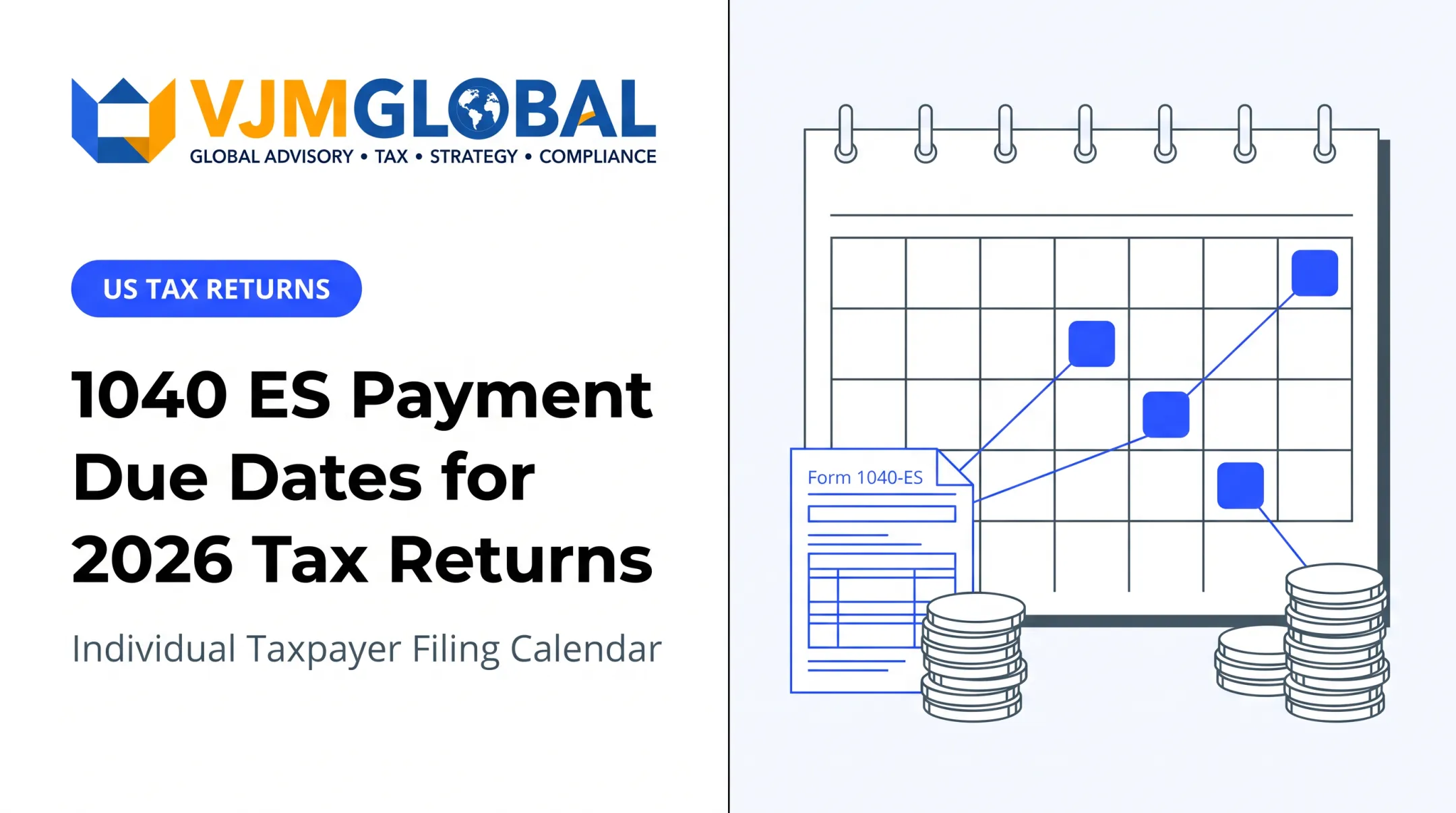
- April 15, 2026
- June 15, 2026
- September 15, 2026
- January 15, 2027, which you may skip if you file and pay in full by February 1, 2027

Weekend and holiday dates move to the next business day. Fiscal-year filers pay on the 15th day of the 4th, 6th and 9th months and the 1st month after year-end. IRS disaster relief can postpone dates for designated areas.
Payment channels
- Direct Pay and Online Account: Free, but generally need a US bank account with an ABA routing number. A SWIFT code won't substitute.
- Card or digital wallet: Processor fees apply (around 1.75% to 2.15%, with a $2.50 minimum), and 1040-ES card payments are limited to two per quarter.
- EFTPS: New individual enrolments stopped in October 2025 and individual access is due to end November 12, 2026. Check the current notice.
- International wire in US dollars: Possible without a US bank account; bank fees may apply.
- Cheque: Payable to "United States Treasury", with the voucher, taxpayer ID and tax year.
The worksheet supports your calculation and stays with your records. The voucher accompanies a mailed payment.
Records and missed payments
Keep payment dates, confirmation numbers, bank records, exchange-rate workings and voucher copies. You'll need them to report payments on the annual return.
Miss or underpay an instalment and a penalty may apply, calculated by period using IRS interest rates (7% for Q1, Q3 and Q4 of 2026, 6% for Q2). A later refund doesn't automatically erase it. Catch up quickly, review Form 2210, and get professional advice before relying on an exception.
Form 1040-ES Compared With Form 1040 and Australian PAYG
Form 1040-ES covers current-year estimates and payments. Form 1040 (or 1040-NR) is the annual return that reports final income and tax. Estimated payments are reported on line 26 of the 2025 forms.
| Feature | US estimated tax | Australian PAYG instalments |
|---|---|---|
| Purpose | Prepays US federal tax | Prepays Australian income tax |
| Administered by | IRS | ATO |
| Entry test | Owe US$1,000+ and withholding below safe harbour | Instalment income of A$4,000+, assessed tax of A$1,000+, estimated tax of A$500+ |
| Frequency | Usually four instalments | Generally quarterly, with some half-yearly or annual options |
| Reconciled on | Form 1040 or 1040-NR | Australian tax return |

The ATO's PAYG guidance confirms PAYG is credited only against Australian tax. A payment to one authority is never a payment to the other, so keep the records separate.
Payment amount and routing both matter:
- Paying too little risks an underpayment penalty
- Paying too much generally becomes a refund or credit on the annual return
- Paying to the wrong tax year or taxpayer ID can post the payment to the wrong account, so check both before you submit
Australia-Specific Considerations and Common Mistakes
Australia-based taxpayers with US-source income, US clients or US investments need to consider residency, income source, treaty and foreign tax credit rules together. A US citizen living in Australia stays within the US system: the 1982 treaty's saving clause generally preserves US taxation of citizens.
For Australian residents, treaty rates still cap US withholding on many payments: 15% on individual dividends, 10% on interest and 5% on royalties, subject to conditions. US-source income without a treaty claim faces 30% gross withholding, and Form W-8BEN goes to the withholding agent, not the IRS.
Common mistakes
- Using a prior-year 1040-ES form
- Confusing US estimated tax with PAYG instalments
- Missing self-employment or investment income
- Switching exchange-rate methods mid-year
- Failing to track quarterly instalments
- Assuming an online payment removes recordkeeping duties
Don't assume a deduction
IRS Publication 334 says federal income tax isn't a deductible business expense.
The ATO treats qualifying foreign tax through the foreign income tax offset (FITO). A$1,000 is a simplified claim threshold, not a universal cap. Confirm treatment under Australian rules before claiming anything.
Australian businesses with US tax or accounting obligations may consider VJM Global's cross-border accounting and tax compliance support, subject to confirming scope and your circumstances.
Always verify current IRS and ATO guidance, and speak to a qualified cross-border tax professional for dual-country situations.
Frequently Asked Questions
How do I calculate estimated tax?
Estimate annual income, deductions, credits, withholding and additional taxes on the current Form 1040-ES worksheet. Then check the instalment amount against current IRS instructions.
What is Form 1040-ES?
It is the IRS Estimated Tax for Individuals package. Its worksheet calculates your estimated tax, and its vouchers accompany mailed payments.
Do I include worksheets with my tax return?
No. The worksheet is for your records, and the annual return is a separate filing. The voucher goes only with a mailed payment. Confirm current IRS recordkeeping rules.
Can I write off estimated tax payments?
Generally no. They are personal tax prepayments, not a business deduction. A foreign tax credit or the ATO's FITO may apply instead, so get advice under both US and Australian rules.
Who needs to pay estimated taxes using Form 1040-ES?
People whose income isn't sufficiently subject to withholding, such as self-employment, investment or rental income. Check the current IRS tests, including the $1,000 threshold.
What is the difference between Form 1040 and Form 1040-ES?
Form 1040 is the annual US income tax return. Form 1040-ES helps you calculate and pay estimated tax during the current year.