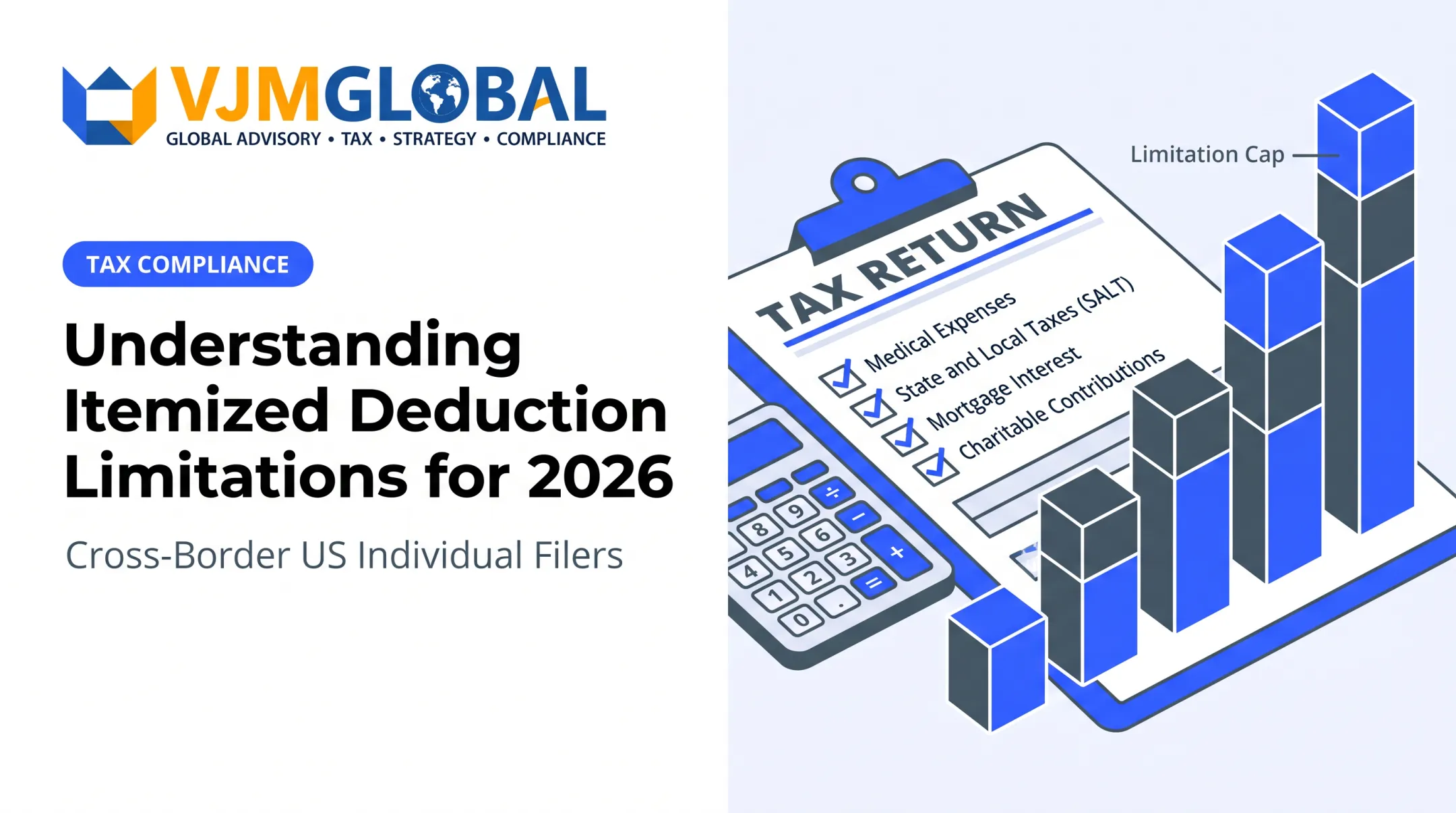
Introduction: 2026 Itemized Deductions in Context
"Itemized deductions" is a U.S. federal tax term. This guide is not about Australian Taxation Office (ATO) rules for claiming work-related deductions. It covers U.S. returns, which matters if you have U.S. citizenship, a green card or U.S.-source income.
For the 2026 tax year, the U.S. standard deduction rises, the SALT cap changes, charitable giving gets a new floor, and a 2/37ths limit now hits some high earners. Several new breaks also sit outside Schedule A entirely.
This guide covers whether itemizing may pay off, which changes apply to whom, and what records to gather.
Key Takeaways
- Most filers compare the standard deduction with itemized deductions; you don't claim both.
- Tips, overtime, vehicle-loan interest and senior deductions work without itemizing.
- The new 2/37ths limit can shrink itemized deductions for top-bracket filers.
- Check final IRS forms and instructions before filing in 2027.
What Are 2026 Itemized Deductions and How Do They Work?
What does "itemized deduction" mean?
Itemized deductions are eligible expenses listed individually, generally on Schedule A of Form 1040. According to the IRS, taxpayers compare their allowable itemized total with the standard deduction and use the larger one.
A deduction reduces the income you're taxed on. A credit reduces the tax bill itself, generally dollar for dollar. So a $1,000 credit cuts tax by $1,000, while a $1,000 deduction cuts taxable income by $1,000, and the saving depends on your bracket.
Standard deduction versus itemized deductions
Itemizing makes sense when your eligible expenses exceed the standard deduction. Standard deduction amounts, per Rev. Proc. 2025-32:
| Filing status | 2025 | 2026 |
|---|---|---|
| Married filing jointly / qualifying surviving spouse | $31,500 | $32,200 |
| Head of household | $23,625 | $24,150 |
| Single | $15,750 | $16,100 |
| Married filing separately | $15,750 | $16,100 |

The extra amount for age 65 or older, or blindness, is $1,650 per condition in 2026 ($2,050 if unmarried and not a surviving spouse).
Above-the-line, below-the-line, and non-itemized deductions
Above-the-line deductions, reported on Schedule 1, reduce adjusted gross income (AGI) whether or not you itemize. Itemized (below-the-line) deductions come after AGI is calculated.
The four new deductions for tips, overtime, vehicle-loan interest and seniors are a separate category. They're claimed on Schedule 1-A, not Schedule A, and are available to non-itemizers. Don't mix them into your Schedule A total.
Tax-year timing and filing-year timing
The 2026 tax year covers income and expenses in 2026. The return is filed in 2027. The IRS's draft calendar lists April 15, 2027, but that date is provisional until final materials appear.
U.S. citizens living abroad usually receive an automatic two-month extension to file, to June 15. Interest on unpaid tax still runs from the regular due date.
Key 2026 Changes to Itemized Deductions and Related Tax Breaks
Standard deduction and the itemizing threshold
The standard deduction rose about 2% for most statuses. A married couple now needs more than $32,200 in allowable itemized deductions to benefit from itemizing. A higher bar means fewer households clear it.
SALT deduction changes
The 2026 state and local tax cap is $40,400 ($20,200 if married filing separately). It phases down by 30% of modified AGI above $505,000 ($252,500 MFS), but not below $10,000 ($5,000 MFS).
- Choose state income tax or general sales tax, not both.
- Eligible real estate and personal property taxes also fall under the cap.
- This cap is separate from the high-income 2/37ths limit covered below.
Charitable contribution changes
Itemizers can deduct only contributions above 0.5% of AGI from 2026. The law coordinates disallowed amounts with existing carryover rules, so don't assume every excluded dollar carries forward.
Non-itemizers get a separate deduction of up to $1,000 ($2,000 joint) for qualifying cash gifts, per the IRS.
Gifts to supporting organizations and donor-advised funds don't count. It doesn't replace the itemized charitable deduction.
Mortgage interest and private mortgage insurance
The $750,000 acquisition-debt limit ($375,000 MFS) for debt taken after December 15, 2017 is now permanent. Qualified mortgage insurance premiums return, reported on Schedule A line 8d.
The draft Publication 936 shows a phase-out starting above AGI of $100,000 ($50,000 MFS), ending at $109,000 ($54,500 MFS). These are draft figures, so confirm them against final IRS guidance.
Educator expenses and other changes
Qualifying educator expenses stay eligible as an exception to the miscellaneous itemized deduction ban. They can go on Schedule A if not already claimed on Schedule 1, where the existing educator deduction continues.
Other changes, mostly outside Schedule A:
- Gambling losses: deductible up to the lesser of 90% of losses or winnings.
- Casualty losses: permanent, and expanded to certain state-declared disasters.
- HSA rules: broader eligibility, but not an itemized deduction.
- QBI: permanent, with higher phase-out ranges and a $400 minimum deduction.
- Student-loan interest: still capped at $2,500, phasing out from $85,000 single or $175,000 joint (a Schedule 1 adjustment).
New 2026 deductions that are not limited to itemizers
| Deduction | Limit | Phase-out begins (MAGI) |
|---|---|---|
| Qualified tips | $25,000 | $150,000 ($300,000 joint) |
| Qualified overtime | $12,500 ($25,000 joint) | $150,000 ($300,000 joint) |
| Vehicle-loan interest | $10,000 | $100,000 ($200,000 joint) |
| Senior deduction (65+) | $6,000 per person | $75,000 ($150,000 joint) |

All four run from 2025 through 2028 on Schedule 1-A. Vehicle loans must originate after December 31, 2024 and finance a new U.S.-assembled vehicle for personal use.
Seniors need a Social Security number, and married seniors must file jointly. Include these when comparing your total deductions, even though they sit outside the Schedule A total.
What Is the 2026 Limitation on Itemized Deductions?
The basic 2/37ths limitation
Public Law 119-21 reduces itemized deductions by 2/37 of the lesser of two amounts: total itemized deductions, or the excess of taxable income plus itemized deductions over the start of the 37% bracket. The IRS expresses this fraction as 5.4%.
The 2026 thresholds:
- $768,700 for joint filers and qualifying surviving spouses
- $640,600 for single and head of household
- $384,350 for married filing separately
It applies after category-specific limits and is not used when calculating Qualified Business Income (QBI).
Who may be affected?
- Below the threshold: no reduction
- Crossing the threshold: a partial reduction
- Already above it: the full 2/37 reduction on allowable itemized deductions
Qualifying to itemize and keeping the full amount are separate questions.
How the limitation interacts with SALT and other caps
The order matters:
- Total eligible expenses.
- Apply category rules, such as the state and local tax (SALT) cap and charitable floor.
- Apply the 2/37ths limit if relevant.

CRS gives an example: a married couple with $1,000,000 taxable income and $100,000 itemized deductions faces a reduction of $5,405.
Practical implications for high-income taxpayers
Affected itemized deductions are effectively worth 35% instead of 37%. That affects charitable giving, state taxes and mortgage interest, and changes the itemize-or-not comparison. It does not impose a 35% ceiling on gifts.
Taxpayers with large incomes, complex investments, business interests or cross-border reporting should plan through the year and get professional review.
Which Expenses Can Be Itemized in 2026?
Each category has its own rules:
| Category | 2026 rule |
|---|---|
| Medical and dental | Only the amount above 7.5% of AGI |
| State and local taxes | Income or sales tax (not both) plus property taxes, within the SALT cap |
| Mortgage interest and PMI | Qualified residence interest within debt limits; PMI per draft Publication 936 |
| Charitable gifts | Cash and non-cash gifts above the 0.5% AGI floor, with substantiation |
| Casualty and theft | Covered disaster losses via Form 4684; check current IRS guidance for 2026 numerical floors |
| Gambling | Lesser of 90% of losses or winnings |
| Educator expenses | Qualifying expenses not claimed on Schedule 1 |
Evaluate the combined allowable amount after every restriction. Don't just add up everything you paid.
How to Decide, Document, and Prepare for 2026 Itemized Deductions
Compare the standard deduction with allowable itemized deductions
- List qualifying expenses.
- Remove nondeductible or reimbursed amounts.
- Apply category limits and floors.
- Add any Schedule 1-A or other non-itemized deductions you can claim.
- Compare the itemized total with the 2026 standard deduction.

Factor in filing status, AGI-based floors, phase-outs and the high-income limitation.
Build a documentation checklist
Gather:
- Income and tax forms, plus property and state tax records
- Mortgage and PMI statements
- Charitable receipts and medical records
- Educator receipts, disaster documentation and gambling logs
Records should show date, amount, purpose, recipient and proof of payment. IRS Publication 17 lists receipts, cancelled checks and account statements as acceptable evidence.
For charity gifts of $250 or more, get a written acknowledgement before filing. Form 8283 is required when non-cash gifts exceed $500, and a qualified appraisal is generally needed above $5,000.
Verify forms, deadlines, and professional support
The 2026 Schedule A, Schedule 1-A and Publication 936 are drafts. Don't file draft forms or rely on draft instructions. Confirm final versions before filing.
Taxpayers with complex business, cross-border or compliance matters may consult VJM Global's tax and advisory professionals to review records and plan filing obligations. This is general information only, not tax representation, and no tax savings are guaranteed.
Frequently Asked Questions
What is the itemized deduction limitation for 2026?
It's a 2/37ths reduction for taxpayers whose taxable income plus itemized deductions exceeds the start of the 37% bracket. Check current IRS or CRS guidance for thresholds and calculations.
What deductions can I take if I do not itemize?
Above-the-line deductions, plus Schedule 1-A deductions for qualified tips, overtime, vehicle-loan interest and eligible seniors. You can also claim a cash charitable deduction up to $1,000 ($2,000 joint).
What are the new tax breaks in 2026?
The key new breaks are the tips, overtime, vehicle-loan interest and senior deductions, claimed on Schedule 1-A. Each has its own eligibility, income limits and documentation, separate from traditional itemized deductions.