Keep tax year and filing year apart. Tax year 2026 covers income and expenses in 2026. A calendar-year return is generally due April 15, 2027. The IRS had only posted draft 2026 forms at the time of writing, so check the final IRS Schedule A, Form 1040, instructions and publications before you file.
This guide covers whether to itemize, what each section allows, how to complete the form, and where Australian-based filers trip up.
Key Takeaways
- Compare your allowable Schedule A total with the 2026 standard deduction, then use the larger.
- Check the limits for medical, SALT, mortgage interest, charity and casualty losses.
- Use Schedule A for itemized deductions; keep Schedule 1 and 1-A for other income and adjustments.
- Australian residents should first confirm a U.S. filing obligation, then handle currency, foreign tax and treaty issues separately.
What Schedule A Is and Whether You Should Itemize
What Schedule A does
Schedule A adds up eligible personal deductions. The allowable total goes to Form 1040 (line 12e on the 2026 draft). A deduction reduces taxable income. A credit reduces tax itself, so the two work differently.
Standard deduction versus itemized deductions
The 2026 standard deduction, per Rev. Proc. 2025-32, is:
| Filing status | 2026 standard deduction |
|---|---|
| Single | $16,100 |
| Married filing separately | $16,100 |
| Head of household | $24,150 |
| Married filing jointly / qualifying surviving spouse | $32,200 |
The decision process is simple:
- Total only the allowable expenses.
- Apply each category's floor, cap or limit.
- Compare the result with your standard deduction.
- Take whichever gives the lower taxable income.
Only about 9.5% of returns itemized for tax year 2023, according to IRS data in Publication 4801. Most people take the standard deduction.
Who should investigate itemizing
Likely candidates include:
- Homeowners with qualifying mortgage interest
- Taxpayers with large state and local taxes
- People with unusually high unreimbursed medical costs
- Those making large charitable gifts
- Those with qualifying casualty losses
Illustrative example only: a married couple filing jointly pays $14,000 in mortgage interest, $9,000 in state taxes and $3,000 in donations. That is $26,000, below the $32,200 standard deduction. Itemizing would cost them money, despite the large mortgage interest.

Some costs belong elsewhere, such as certain adjustments on Schedule 1. Don't add every tax-related expense to Schedule A.
What You Can Claim on Schedule A in 2026
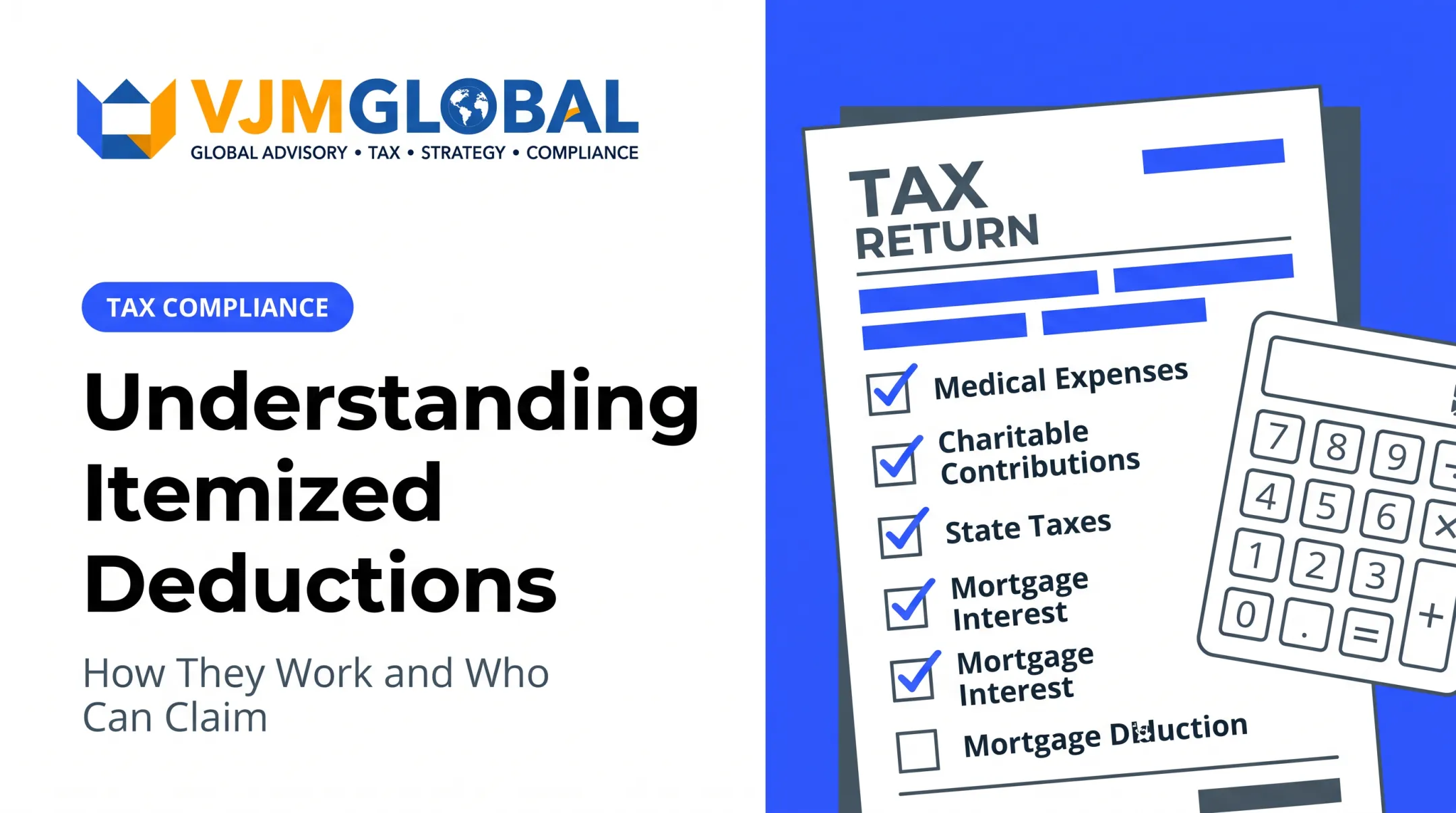
Schedule A groups deductions in this order: medical and dental, taxes paid, interest paid, charitable gifts, casualty and theft losses, other deductions, then the total.
Medical and dental expenses
Only unreimbursed qualifying costs count, and only the amount above 7.5% of AGI. Publication 502 lists eligible expenses, including medical insurance premiums and qualified long-term-care costs. Premiums already used for another credit or deduction can't be counted twice.
Taxes paid, including SALT
You choose state and local income tax or general sales tax on line 5a, not both. Real estate and qualifying personal property taxes also go here.
For 2026, draft figures include:
- SALT cap of $40,400 ($20,200 if married filing separately)
- Phase-down for modified AGI above $505,000 ($252,500 MFS)
- A floor of $10,000 ($5,000 MFS)

Foreign income taxes are a separate itemized tax deduction and sit outside the SALT cap. Foreign real-property taxes aren't deductible as personal taxes.
Interest paid
- Mortgage debt limit: $750,000 ($375,000 MFS) for acquisition debt. The $1,000,000 limit applies to qualifying debt incurred before December 16, 2017.
- Mortgage insurance: premiums are treated as interest, with a phaseout starting above $100,000 AGI and ending at $109,000 (half those amounts for MFS).
- Points: amounts not on Form 1098 go on line 8c.
- Investment interest: line 9, with Form 4952 if required.
- Debt use: funds must buy, build or improve the home.
A foreign home may qualify only if it meets every statutory test. The law doesn't expressly require a U.S. location, but confirm this with a professional.
Gifts to charity
For 2026 itemizers, only contributions above 0.5% of AGI are deductible. Limits of 60%, 50%, 30% or 20% of AGI apply depending on the gift and recipient, and most excess carries forward five years, per IRS Publication 526.
- Gifts of $250 or more need a written acknowledgment.
- Non-cash deductions above $500 need Form 8283.
- Items or groups above $5,000 generally need a qualified appraisal.
- Foreign charities generally don't qualify, and Publication 526 doesn't list Australian charities among the treaty exceptions.
Non-itemizers can claim a separate cash deduction of up to $1,000 ($2,000 joint). It is not on Schedule A.
Casualty, theft, and other itemized deductions
Personal casualty losses can include federally or state-declared disasters. Ordinary losses are reduced by $100 each and only the total above 10% of AGI counts. Attach Form 4684.
Gambling losses are limited to the lesser of 90% of losses or winnings. The "other" list is closed, covering items such as certain bond premiums and claim-of-right repayments above $3,000. General employee expenses and tax-preparation fees don't qualify.
How to Complete Schedule A and File It with Form 1040
Gather documents first
- Form 1098 for mortgage interest
- Property-tax and state or sales-tax records
- Medical receipts and reimbursement statements
- Charity acknowledgements and non-cash gift records
- Investment-interest records
For Australian amounts, note the original currency, transaction date, exchange-rate method and U.S. dollar figure. The IRS says to use the rate when an item is paid or accrued. A posted rate used consistently is generally accepted, and the IRS publishes yearly average rates.

Complete each section and apply limits
Follow the current 2026 line order and enter only amounts paid in the tax year. Apply floors, caps, phaseouts, reimbursement exclusions and debt-use tests as you go. Never count the same cost on Schedule A and another form.
Supporting forms you may need:
- Form 4684
- Form 4952
- Form 8283
- Mortgage statements
High earners also face an overall reduction of itemized deductions, applying to taxable income above $640,600 (single), $768,700 (joint) or $384,350 (MFS).
Transfer the total and check
Move the Schedule A total to the matching line on the 2026 Form 1040. Compare it once more with the standard deduction, confirm filing status, and keep your records.
Illustrative workflow: a U.S. citizen in Melbourne has mortgage interest, charitable gifts and Australian salary. She enters the qualifying items on Schedule A, then handles foreign income reporting and foreign tax credit forms separately. A reviewer who knows both U.S. and Australian rules can catch missed limits and credit interactions.
Common Mistakes and Recordkeeping for Schedule A
Avoid these common Schedule A errors:
- Mixing up tax year 2026 with a return filed in 2026
- Using 2025 limits as if they carry forward
- Deducting reimbursed medical expenses
- Claiming both income tax and sales tax
- Treating mortgage principal as interest
- Counting non-qualifying donations
- Claiming Schedule 1 items on Schedule A
Solid records help you catch these errors early and support every deduction if the IRS asks.
The IRS generally says to keep records for 3 years. Hold them longer for omitted income (6 years) and for bad-debt or worthless-security claims (7 years). Keep property basis records for as long as you own the asset, plus the limitation period after you dispose of it.
Store digital and paper copies of receipts, statements, acknowledgements, appraisals, proof of payment and exchange-rate support.
Schedule A for Australian Residents with U.S. Filing Obligations
Living in Australia doesn't create a right or duty to use Schedule A. It depends on your U.S. status: citizenship, residency, U.S.-source income or another filing trigger.
U.S. citizens and residents abroad report worldwide income. Eligible taxpayers abroad get an automatic two-month extension to June 15, though interest runs from April.
Key points for Australian filers:
- Form 1040-NR: nonresident aliens use a different Schedule A with narrower rules.
- Treaty: the U.S.-Australia treaty's saving clause lets the U.S. tax its citizens and certain immigrants under domestic law, with exceptions.
- Australian income tax: choose a foreign tax credit (usually Form 1116) or an itemized deduction for a given year, not both for the same taxes.
- Other reports: FBAR applies above $10,000 in foreign accounts, and Form 8938 has higher thresholds for those living abroad.

VJM Global provides U.S. individual return preparation (Form 1040 and 1040-NR) and international tax support for Australian and other cross-border clients. Its team of CPAs and Chartered Accountants focuses on coordinated compliance and accurate documentation, without promising any particular filing outcome.
Frequently Asked Questions
What is Schedule 1 used for?
Schedule 1 reports additional income and adjustments to income. It is separate from Schedule A. Schedule 1-A is a separate schedule for certain additional deductions.
Is there a tax table for 2026?
Yes. The IRS sets 2026 brackets in Rev. Proc. 2025-32 and draft Publication 1040. Those tables cover tax rates, not Schedule A deductions. Always use the current IRS versions.
Is Schedule A a U.S. tax form or an Australian tax form?
It is a U.S. form attached to Form 1040. It isn't the normal way to claim personal deductions on an Australian tax return.
Who should use Schedule A in 2026?
Taxpayers with a U.S. filing obligation whose eligible itemized deductions exceed their standard deduction, or who must itemize under another filing rule.
Can I claim mortgage interest and charitable donations without filing Schedule A?
Generally no. Mortgage interest requires itemizing. Non-itemizers may claim the separate cash-gift deduction of up to $1,000 ($2,000 joint).
When will a 2026 Schedule A be filed?
With your 2026 federal return during the 2027 filing season, due April 15, 2027 for most. Form 4868 extends filing by six months to October 15, 2027, but not the time to pay.