Introduction
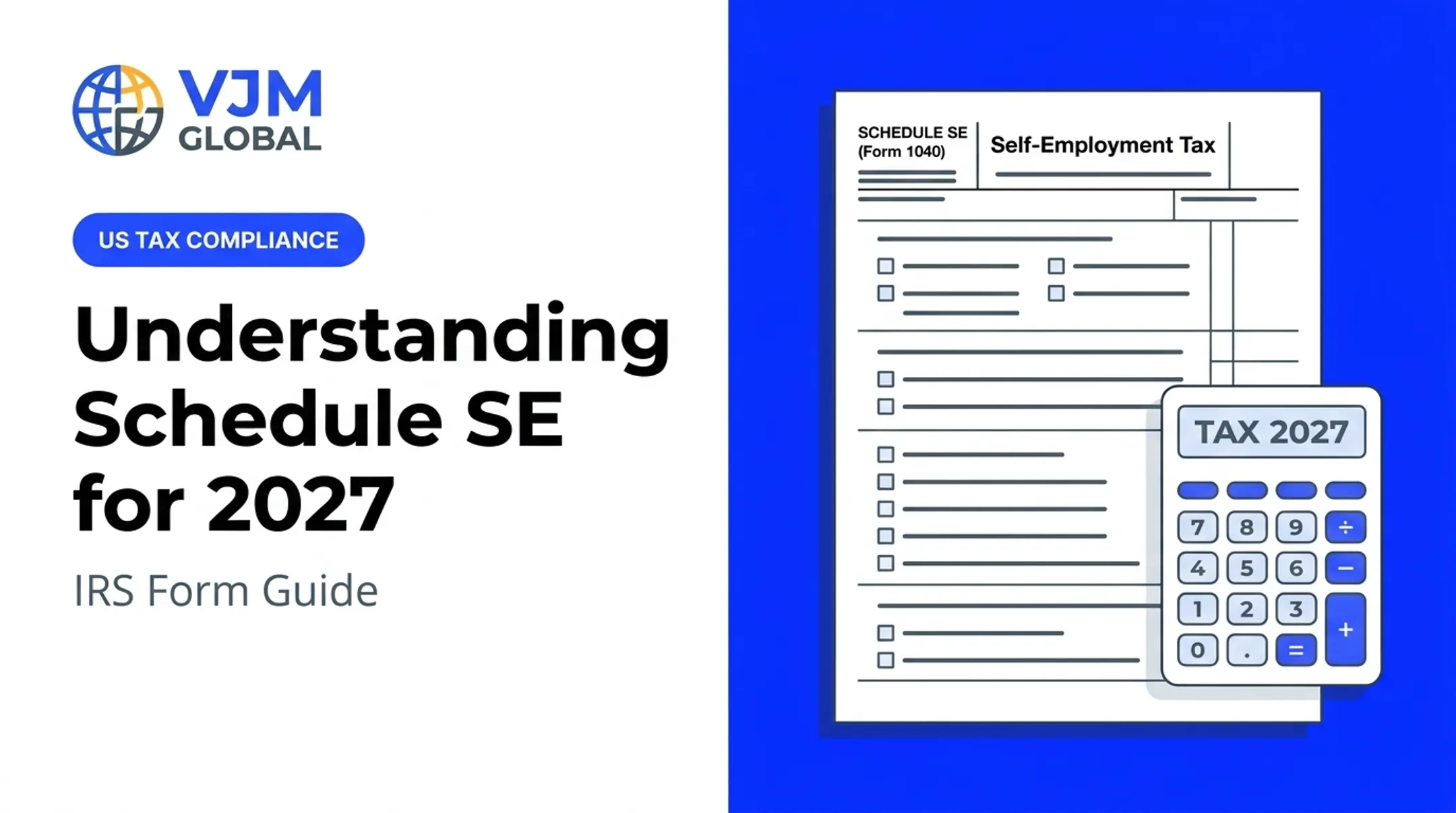
Schedule SE is the IRS schedule that calculates self-employment tax on business, freelance, gig, farming and partnership income reported with Form 1040. Many first-time filers are surprised by it, because the tax is separate from regular income tax and applies even when deductions shrink taxable profit.
"2027 Schedule SE" can mean two things: the form for tax year 2027 (filed in 2028), or a return filed during 2027 (which covers tax year 2026). This guide focuses on tax year 2027.
The IRS has not finalised 2027 figures yet, so treat every rate, threshold and line number below as prior-year reference data from the 2026 form or 2025 schedules.
We cover who files, what to gather, how to complete the form, how the result reaches Form 1040, and what Australian-based taxpayers should check.
Key Takeaways
- File Schedule SE when you have qualifying net earnings from self-employment under the 2027 rules.
- Calculate self-employment tax from net profit, not gross receipts.
- Treat self-employment tax as separate from income tax; half is deductible.
- Australian-based taxpayers should review totalization agreements, exemption letters and foreign tax credits.
What Is 2027 Schedule SE and Who Must File It?
What does Schedule SE calculate?
It calculates the Social Security and Medicare components of self-employment tax on your net earnings, then carries the result to Form 1040. The IRS defines self-employment tax as Social Security and Medicare tax on net earnings from self-employment.
Self-employment tax funds Social Security and Medicare. You calculate income tax on taxable income under separate rules. You can owe both, even after expenses cut your business profit.
Who generally uses Schedule SE?
- Sole proprietors and independent contractors reporting on Schedule C
- Farmers reporting on Schedule F
- Partners with self-employment earnings on Schedule K-1 (a limited partner generally includes only guaranteed payments for services)
- Single-member LLC owners treated as disregarded entities
Corporations, S corporations and partnerships file on different forms depending on their federal classification, and the owner's income arrives through wages or K-1 reporting instead. Form 1040 covers individuals, Form 1120 covers C corporations and Form 1065 covers partnerships.
What is the filing threshold?
Using the 2026 instructions as a guide, you file Schedule SE when line 4c net earnings reach $400 or more, or church-employee income reaches $108.28 or more. Confirm the final 2027 figures in the IRS instructions when they are released. The threshold concerns net earnings, not revenue, and a filing requirement says nothing about how much tax you owe.
What may be excluded or treated differently?
Based on the 2026 instructions:
- Losses reduce or eliminate the calculation
- Ministers are generally subject to SE tax, though Form 4361 can support an exemption
- Statutory-employee income follows special Schedule C rules
- Community-property income is assigned to the spouse carrying on the business
- Personal investment income and most real-estate rentals are generally not SE earnings
How does Schedule SE apply to Australian-based taxpayers?
Schedule SE covers US federal self-employment tax only. It does not replace Australian income tax reporting, residency analysis or ATO obligations.
The US-Australia totalization agreement matters here. SSA guidance says self-employed US citizens residing in Australia are exempt from US Social Security on that self-employment income. The rule names citizens and nationals, so a green-card holder in Australia should not assume it applies without an SSA determination.
Australia issues no certificate of coverage in this situation. You request an SSA letter of exemption and attach a copy to your US return each year. The exemption does not remove the return filing obligation.
What to Gather Before Filling Out Schedule SE
Business income and supporting schedules
- Final Schedule C or Schedule F
- Partnership statements (Schedule K-1)
- Forms 1099 and business ledgers
- Expense records
Wage and self-employment records
W-2 wages count toward the Social Security wage base, so gather wage statements and payroll information. If you run more than one business, collect records for each.
Cross-border and prior-year documents
- Prior-year Schedule SE and Form 1040
- Exchange-rate records for AUD amounts
- Foreign tax documents
- Your SSA letter of exemption, if applicable
Use the final 2027 form and instructions. Never copy line numbers or rates from an earlier year.
How to Complete Schedule SE: Part-by-Part Instructions
Confirm the correct version
Download the final 2027 Schedule SE and instructions from IRS.gov. Avoid outdated forms, and do not mix tax-year and filing-year instructions. If you use tax software, review the underlying business figures rather than trusting entries blindly.
Transfer the correct business income
Carry net profit or loss from Schedule C, Schedule F or your K-1 into Schedule SE. Gross receipts and Form 1099 totals are not interchangeable with net earnings. With multiple businesses, combine results as the instructions direct, without duplicating income or expenses.
Calculate net earnings and apply rates
Line 4a multiplies net profit by 92.35% to produce net earnings. Use these published 2026 rates as your working reference when 2027 amounts are not yet final:
- 12.4% Social Security, up to a $184,500 wage base shared with W-2 wages
- 2.9% Medicare, with no cap
- 0.9% Additional Medicare Tax above $200,000 (single), $250,000 (married filing jointly) or $125,000 (married filing separately)

Farming, clergy, church employees and community income carry special rules in the instructions.
Review the completed form
Check that the result agrees with your source schedule and that supporting forms are attached to Form 1040.
Illustration (hypothetical, 2026 figures):
- Net profit of $50,000 × 0.9235 = $46,175 net earnings
- SE tax at 15.3%: about $7,065
- Deductible half: about $3,532

Your own result will differ with other wages, losses and special rules.
How Schedule SE Tax Reaches Form 1040
Follow the income-to-Form 1040 flow
Net profit moves from Schedule C, Schedule F or a K-1 to Schedule SE, then to Schedule 2 and Form 1040. Verify each line against the final 2027 forms, because numbering changes.

Report the tax and claim the deduction
Line numbers below reflect 2025 and 2026 forms:
- Schedule 2, line 4 carries the self-employment tax as additional tax
- Schedule 1, line 15 carries the deductible part
The deduction lowers income tax. It does not erase the SE tax itself.
Estimate the overall tax burden
A figure like "$20,000 of self-employed income" tells you little. You need to know whether it is gross or net, plus filing status, W-2 wages, deductions, credits and other income. Estimate SE tax and income tax separately.
Estimated payments and Australian issues
For 2026, estimated payments are generally required when you expect to owe at least $1,000. You avoid the penalty by paying the smaller of 90% of current-year tax or 100% of prior-year tax. The prior-year figure rises to 110% if prior-year AGI exceeded $150,000 ($75,000 if married filing separately).
Australian-based taxpayers should also review:
- Foreign income reporting on the US return
- AUD conversion for amounts reported in USD
- Foreign tax credits
- Any SSA totalisation exemption letter
Final Filing Review, Submission, Deadlines, and When to Get Help
Verify 2027 changes and deadlines
Check the final 2027 Schedule SE, Schedule 1, Schedule 2, Form 1040 and instructions for rates, limits and enacted law changes. Under standard calendar rules, the expected deadline for tax year 2027 is Tuesday, April 18, 2028. Confirm the date with the IRS. Qualifying taxpayers living abroad get an automatic two-month extension, generally to June 15.
Final accuracy checklist
- Correct tax year and form version
- Complete, reconciled business-income schedules
- Right calculation method and wage-base coordination
- Forms attached and figures transferred accurately
- Estimated payments recorded
- Return validated before e-filing or mailing
When professional help is appropriate
Consider professional help when your situation involves:
- Australian-US residency questions
- Foreign tax credits or totalization agreements
- Multiple businesses or partnership income
- Clergy or farm income
- Entity classification or large losses
- Amended returns or unclear filing duties
VJM Global prepares Form 1040 returns and supports cross-border clients, including Australian-based taxpayers, through US-compliant tax professionals and a single point of contact. Pricing depends on entity structure and scope.
Frequently Asked Questions
What is the filing threshold for 2027?
Check the final 2027 IRS instructions for the official figure. For 2026 the threshold is $400 of net earnings, not gross revenue, and it is separate from the tax you ultimately owe.
Who is required to file Schedule SE?
Taxpayers with qualifying net earnings from sole proprietorships, independent work, farming or partnership income. Review exceptions and entity classifications separately if your situation is complex.
What is the tax form for self-employed?
Most use Form 1040 with Schedule C (or another income schedule), plus Schedule SE when self-employment tax applies.
How much tax will I pay on $20,000 self-employed?
It depends on whether that figure is gross income or net profit, plus filing status, other wages, deductions, credits and current rates. SE tax and income tax are calculated separately.
What is considered self-employed?
Running your own trade or business, freelancing, contracting, earning gig or farm income, or receiving qualifying partnership income instead of employee wages. Part-time work can qualify.
What are the changes for self-employed individuals in 2026?
Tax year 2026 differs from tax year 2027. Use only enacted legislation and final IRS guidance for changes to rates, thresholds, forms, deductions or estimated-tax rules.