This guide is written for Indian entrepreneurs, SMEs, and exporters weighing Albania's flat 15% corporate tax, open-sector policy, and Balkan location against other entry points into Europe. Albania's incorporation process is often described online as fast and simple. It largely is, for EU nationals.
Indian founders, however, run into friction that generic guides skip: apostille requirements, visa restrictions, and unclear tax-treaty guidance. This article covers what business setup involves, why Indian entrepreneurs are exploring it, the registration steps, structure and tax choices, and the compliance pitfalls specific to Indian passport holders.
Key Takeaways
- Albania allows 100% foreign ownership in most sectors with no local director requirement
- LLCs (Sh.p.k.) register through the National Business Center (QKB), often within days
- Corporate tax is a flat 15%, with 20% VAT above the registration threshold
- Indian founders need a visa to enter and a residence permit to manage operations locally
- India–Albania DTAA has applied since 2013; still plan repatriation with specialist advice
What Is Business Setup in Albania and Why Indian Entrepreneurs Are Choosing It
What Does "Setting Up a Business in Albania" Involve?
Registering a business in Albania means choosing a legal form such as an LLC, joint-stock company, sole proprietorship, or branch, and filing it with the National Business Center (QKB). Registration also generates a NUIS/NIPT number, which doubles as the entity's tax identifier through Albania's e-Albania system.
Depending on the activity, founders may also need a sector-specific licence before trading. Tourism operators, food producers, and pharmaceutical traders all fall under separate QKB licensing categories that require document review and, in many cases, an on-site inspection.
The result is a locally registered, tax-compliant Albanian entity. It can invoice clients directly, hire employees, and benefit from Albania's position between the Adriatic and the wider EU market.
This is a different commitment from exporting to Albania through a local agent. An entity gives full ownership and operational control. It also brings ongoing obligations such as VAT filings, payroll, and annual accounts that exporting alone never creates.
Why Indian Entrepreneurs Are Increasingly Choosing Albania
Albania's appeal for Indian founders rests on three things: cost, tax simplicity, and EU-adjacency. Labour costs remain low by European standards, with average gross monthly wages at ALL 86,984 in Q4 2025. The flat 15% corporate rate applies without the tiered bands common elsewhere in Europe.
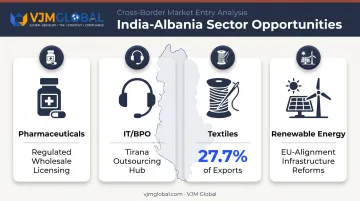
Several sectors show natural overlap with Indian strengths:
- Pharmaceuticals — Albania's regulated wholesale and production licensing creates room for established Indian manufacturers
- IT/BPO — Tirana has become the country's main outsourcing hub, with Durres and Vlore following
- Textiles — Footwear and garments made up 27.7% of Albania's total exports in 2022, according to AIDA's investment data
- Renewable energy — Ongoing EU-alignment reforms are opening infrastructure and energy investment
Bilateral trade, though, remains thin. India's exports to Albania stood at roughly US$1,154 million in FY 2023-24, against imports of just US$7.59 million, according to India's Ministry of External Affairs. That imbalance is precisely why many Indian exporters selling into Albania hit banking and customs friction without a local entity. Incorporation resolves it directly.
Step-by-Step Process to Set Up a Business in Albania from India
The process runs from choosing a structure through banking and tax registration, and it can largely be completed without setting foot in Albania. Before starting, every Indian founder needs:
- Notarised and apostilled passport copies
- Proof of address
- A Power of Attorney if a local representative will file on their behalf
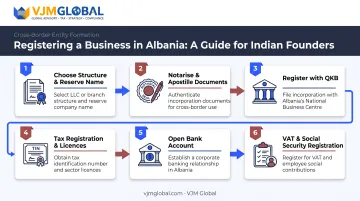
Step 1: Choose Your Business Structure and Reserve a Company Name
Most Indian founders opt for an LLC (Sh.p.k.) because of its 100% foreign ownership allowance and minimal capital requirement. Freelancers often prefer a sole proprietorship, while established Indian exporters extending operations may register a branch office instead.
Step 2: Notarise and Apostille Documents in India
Founding documents, identity proofs, and any Power of Attorney must be notarised and then apostilled in India. India has been a member of the 1961 Hague Apostille Convention since 2005, and India doesn't appear on QKB's list of countries exempt from this requirement. Skipping the apostille is one of the most common causes of delay.
Step 3: Register with the National Business Center (QKB)
Registration happens through the e-Albania portal or via a local representative acting under Power of Attorney. Foreign documents submitted to QKB need certified Albanian translations alongside the apostille. Once approved, the entity receives its NUIS/NIPT number.
Step 4: Obtain Tax Registration and Sector-Specific Licences
The NIPT number serves as the tax ID automatically. Regulated activities such as food processing, pharmaceuticals, and tourism operations require an additional licence application. That process can involve a 30-day review window and a physical inspection before approval.
Step 5: Open a Local Business Bank Account
Indian founders can open accounts as non-residents using incorporation documents, passport copies, and a stated business purpose. Expect Albanian banks to request extra KYC documentation simply because Indian applicants are less common than EU ones.
Step 6: Register for VAT and Social Security, Then Begin Operations
VAT registration becomes mandatory once annual turnover exceeds ALL 5,000,000. Any employee hired locally must be registered for social and health insurance from day one. For a remotely managed entity, setting up compliant bookkeeping and payroll immediately, rather than after the first tax deadline, saves considerable cleanup later.
Business Structures, Capital and Taxation for Indian-Owned Companies
Choosing the right structure depends on how involved the founder plans to be and how much liability protection matters.
| Structure | Best suited for | Liability |
|---|---|---|
| LLC (Sh.p.k.) | Solo founders, SMEs | Limited to capital contributed |
| Joint-Stock Company (Sh.a.) | Larger ventures, multiple investors | Limited, higher capital needed |
| Sole proprietorship | Freelancers, single-owner services | Unlimited personal liability |
| Branch office | Existing Indian companies extending operations | Liability sits with parent company |
An LLC requires only nominal capital, often cited as low as ALL 100. Founders should confirm the current statutory threshold with QKB or an advisor before filing, since this figure can shift with legislative updates. A joint-stock company needs substantially higher capital and fits multi-investor ventures better than a first-time entry.
Corporate tax sits at a flat 15% on profits. Resident companies pay this on worldwide income; branches and non-residents pay it only on Albania-source income. VAT runs at a standard 20%, applicable once turnover crosses the ALL 5,000,000 threshold.
Founders in priority sectors can also apply for incentives through Technological and Economic Development Areas (TEDAs). Benefits can include:
- VAT exemptions on qualifying supplies
- A two-year 20% capital-expense deduction
- A five-year 50% profit-tax exemption in some zones
TEDA Tirana specifically targets automotive, ICT, and electronics investors.
India and Albania have had a Double Taxation Avoidance Agreement in force since 2013, confirmed under Albania's ratification Law No. 167/2013 and listed among agreements currently in force by Albania's tax authority.
Relief is available, but applying it correctly still calls for a cross-border tax specialist before you structure profit repatriation. Withholding rates, permanent establishment definitions, and credit mechanisms all affect the outcome.
Compliance, Visa and Common Mistakes for Indian Entrepreneurs
Registration is fast in Albania, but ongoing compliance is not optional. After setup, plan for VAT filings where thresholds apply, social security and payroll if you hire locally, and annual accounts plus corporate tax returns.
Visa and Residency Requirements for Indian Founders
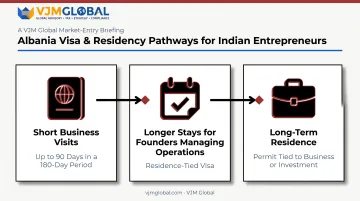
Indian passport holders don't get the 90-day visa-free access that EU, US, and UK citizens enjoy. Arrange an Albanian e-Visa before travel, matched to your purpose and length of stay.
- Short business visits typically fall under a visa allowing stays up to 90 days in any 180-day period
- Longer stays, for founders managing operations locally, require a different visa category tied to residence
- Long-term residence to run the company needs a permit tied to business activity or investment. Confirm criteria with Albania's Ministry of Interior before committing capital
Incorporation itself doesn't require any of this. Since registration can be completed remotely through a Power of Attorney, Indian founders can set up the legal entity without ever travelling to Albania. Travel only becomes necessary for certain bank account openings or licence inspections.
Common Mistakes Indian Entrepreneurs Should Avoid
Registration speed creates a false sense of simplicity. Two mistakes show up repeatedly:
- Under-budgeting for ongoing compliance: VAT filings, social security contributions, and annual accounts continue after registration—many founders budget only for one-time setup costs
- Skipping sector-specific licensing: Open foreign-ownership rules do not cover food, pharma, or import/export; those need ministry approval before trading begins
A proper pre-incorporation review catches both issues. Generic "how to register in Albania" guides often skip Indian-specific document and visa requirements.
Conclusion
Albania gives Indian entrepreneurs a genuinely low-cost, EU-adjacent way into Southeast European trade: flat 15% corporate tax, full foreign ownership, and registration that can move fast once documents are in order. The incorporation step is rarely where things go wrong.
What determines success is everything around it:
- Apostille sequencing
- Visa category choice
- VAT and payroll setup
- Profit repatriation planning under a treaty that exists but still needs careful application
VJM Global has spent over 30 years on entity formation, tax, and compliance across 100+ countries. The team works with Indian companies weighing new markets while staying on top of domestic obligations. If Albania is on your shortlist, a conversation before you file is usually cheaper than fixing avoidable mistakes after.
Frequently Asked Questions
How much does it cost to register a company in Albania?
Statutory LLC capital and government filing fees are low. The real spend is notarisation, apostille processing in India, certified Albanian translation, and professional service fees.
Can an Indian citizen work in Albania?
Indian citizens generally need a visa to enter, and those managing their own business locally need a residence permit tied to business activity or investment. Confirm current criteria with Albania's Ministry of Interior before travelling.
What is the most profitable business in Albania?
Tourism/hospitality, IT/BPO, agro-processing, and textile manufacturing are currently strong sectors based on investment trends. Profitability still depends on execution, local partnerships, and market research.
Is Albania a friendly country to India?
Albania offers equal treatment to foreign investors regardless of origin and maintains open trade relations. Bilateral trade volume remains modest, though, and Indian travellers still need visas, unlike citizens of the EU, US, or UK.
Do I need to travel to Albania to register my company?
Incorporation can typically be completed remotely through a Power of Attorney and a local representative. In-person presence may still be required for opening a bank account or securing certain regulated licences.
Does India have a double taxation avoidance agreement with Albania?
Yes, a DTAA between India and Albania has been in force since 2013 under Albanian ratification Law No. 167/2013. Confirm current application details with a cross-border tax advisor before planning profit repatriation.