Entering it isn't simple, though. Indian founders run into an unfamiliar legal system, strict currency controls, wartime supply chain risk, and a residency process that trips up even experienced operators.
This guide breaks down what actually matters: which entity type fits your business, the step-by-step registration process, visa and work permit rules specific to Indian citizens, tax obligations, and how to manage the risks that come with operating in a country still at war.
Key Takeaways
- Diia enables LLC registration in days; Indian founders usually need a nominee director until a work permit is issued
- LLC fits most Indian SMEs; FOP suits solo consultants; JSC works for large capital raises
- Temporary residence is available via a work permit or a €100,000+ investment route
- Professional due diligence, tax, and compliance support cuts registration delays and regulatory risk
Why Consider Starting a Business in Ukraine from India
Ukraine's economy is rebuilding around sectors where Indian businesses already have real strength.
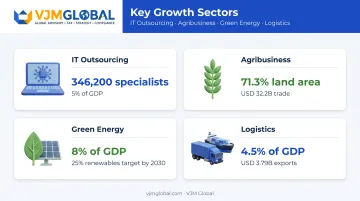
Four sectors stand out for Indian investors:
- IT outsourcing — Ukraine has 346,200 IT specialists, with roughly 70% still working in-country; IT made up 5% of GDP in 2023.
- Agribusiness — farmland covers 71.3% of Ukraine's land area (World Bank); 2024 agrifood trade hit USD 32.2 billion, including USD 24.6 billion in exports.
- Green energy — contributes 8% of GDP, with a national target of at least 25% renewables by 2030.
- Logistics — transport and warehousing add 4.5% of GDP, with USD 3.79 billion in transport-service exports in 2023.
These figures rest on current trade data, not speculative recovery forecasts. Export growth shows flows that are genuinely picking back up.
The diplomatic groundwork helps too. Prime Minister Modi's August 2024 visit to Kyiv, the first by an Indian PM since ties began in 1992, deepened cooperation across trade, agriculture, pharmaceuticals, education, and technology.
That state-level trust filters into easier commercial relationships. India-Ukraine trade turnover reached USD 2.61 billion in 2025, with Ukrainian exports to India alone at USD 857 million.
For Indian founders already exporting IT services or agricultural goods, Ukraine is less a new frontier than an extension of relationships that already exist.
Business Structures Available for Indian Entrepreneurs
The right structure depends on your business scale, how much personal liability you're willing to carry, and whether you plan to relocate. One rule applies across every structure: foreign founders must submit notarized, apostilled, and Ukrainian-translated documents before anything gets filed.
Limited Liability Company (LLC) — The Most Practical Choice
A Ukrainian LLC, known locally as a TOV, has minimal statutory requirements:
- One shareholder and one director are sufficient
- No fixed minimum capital requirement
- Capital contributions are payable within six months of registration
This makes it the default choice for most Indian SMEs entering Ukraine.
There's a catch, often called the chicken-and-egg rule: a foreign founder cannot legally serve as director until they hold a Ukrainian work permit. The work permit application often requires an existing employment relationship with the company, so most founders appoint a temporary Ukrainian nominee director at incorporation, then swap roles once the permit is secured.
Sole Proprietorship (FOP), Joint-Stock Company & Representative Office
Three other structures cover different scenarios:
| Structure | Best for | Key feature |
|---|---|---|
| FOP | Solo consultants, freelancers | Simplified tax and accounting; automated Diia registration may require Ukrainian e-ID |
| JSC | Large-scale capital raising | Minimum capital of 200 monthly minimum wages; heavier governance |
| Representative Office | Market research, liaison only | Cannot conduct independent commercial activity |
A representative office is worth flagging specifically. It lets you establish a presence and study the market, but it can't sign commercial contracts or generate revenue on its own. Founders wanting actual trading activity almost always need an LLC instead.
Step-by-Step Process to Register a Company in Ukraine
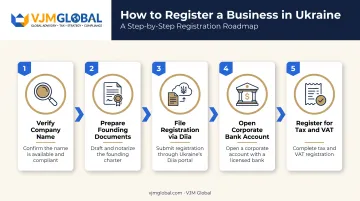
Registering a Ukrainian LLC follows a fairly linear path, though each step has its own paperwork demands.
- Verify your company name through the Unified State Register of Legal Entities. Names identical to an existing registered entity get rejected outright, so check early.
- Prepare founding documents — the charter, UBO disclosure, and notarized, apostilled, translated copies of the founder's Indian passport and corporate documents. Ukraine enforces strict beneficial ownership disclosure, driven by sanctions-related transparency rules.
- File the registration online via Diia or through a notary/state registrar. You can complete this remotely through a power of attorney, so the founder does not need to be physically present in Ukraine.
- Open a corporate bank account in both hryvnia and foreign currency. Banks run their own AML/UBO verification checks before activating the account, so this step often takes longer than registration itself.
- Register for tax purposes and obtain a VAT number if your turnover crosses the threshold. Check separately whether your sector (finance, healthcare, energy, education) needs additional licensing.
Document legalization is usually where self-managed registrations stall. VJM Global's cross-border entity formation team manages the apostille and translation chain, runs due diligence on local partners, and coordinates with Ukrainian registrars. That support helps Indian founders avoid the compliance missteps that commonly delay filings.
Visa, Work Permit and Residency Requirements for Indian Founders
Indian citizens need a Type D long-term visa if they will work or manage the business for more than 90 days. Shorter trips fall under a Type C visa, valid for up to 90 days within any 180-day window.
Regular processing takes up to 10 working days. An expedited option costs roughly double the standard USD 65 fee.
Getting a Work Permit as an Indian Business Owner
Work permits cover Indian founders who serve as directors, other appointed directors, and seconded employees. The employer submits:
- A formal application
- A notarized Ukrainian translation of the passport
- A passport-style photo (3.5 x 4.5 cm)
- A draft employment or gig contract
- Proof of fee payment
Processing officially takes 7 working days. Fees scale with the permit's validity period:
| Validity | Issue Fee | Extension Fee |
|---|---|---|
| Up to 6 months | UAH 9,984 | UAH 6,656 |
| 6 months to 1 year | UAH 16,640 | UAH 13,312 |
| 1 to 2 years | UAH 26,624 | UAH 23,296 |
| 2 to 3 years | UAH 33,280 | UAH 29,952 |
A valid work permit (or a qualifying investment) is the usual next step toward temporary residence.
Temporary Residence Permit: Two Pathways
Pathway 1 (work-permit-based, most common): Register the LLC with a Ukrainian nominee director, secure the work permit for the Indian founder, then formally swap director roles. Duration of the multi-year residence permit depends on the permit category and the underlying employment contract.
Pathway 2 (investment-based): Document a minimum investment of EUR 100,000 in the Ukrainian economy through capital, qualifying property, or securities. This path suits founders making a larger, longer-term commitment and follows its own permit validity terms.
Taxation, Banking and Compliance Essentials
Ukraine's 2025 corporate tax structure is fairly standard by regional comparison:
- Corporate income tax: 18% general rate
- VAT: 20% standard rate; 0% on qualifying goods exports. IT and consulting services supplied to foreign business clients are often outside VAT scope entirely
- Simplified regimes: FOP ceilings for 2025 range from UAH 1.336 million (Group 1) to UAH 9.336 million (Group 3)
Ukraine maintains 70+ double taxation treaties. The India-Ukraine DTAA (signed 1999, later updated with MLI modifications) matters directly for founders repatriating profits. Checking treaty provisions before moving money can prevent paying tax twice on the same income.
Currency control adds another layer:
- Banks require documented proof of source of funds before releasing capital or profits
- AML/KYC checks run before an account is activated, not after
- Dividend remittance limits shift under martial law, so confirm the current cap before each transfer
Firms like VJM Global support Indian businesses with ongoing bookkeeping, statutory filings, and multi-jurisdiction tax compliance once the Ukrainian entity is operational. Founders can stay focused on the business instead of managing filings across two tax systems.
Key Risks and Challenges to Plan For
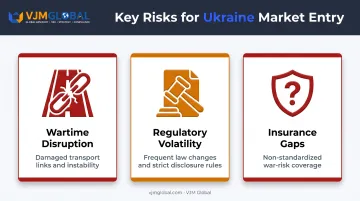
Operating in Ukraine right now means planning around risks that don't show up in a standard market-entry checklist.
- Wartime disruption: Damaged transport links and regional instability require flexible supply chains and backup routes, not single-point dependencies
- Regulatory volatility: Laws change often, beneficiary disclosure is strict, and finance, energy, and healthcare face extra licensing
- Insurance gaps: EBRD-backed cover exists for goods and vehicles in transit, but expatriate war-risk policies aren't standardized across insurers
Before you finalize a partnership or investment, run structured due diligence across financial, legal, tax, and operational dimensions. Surface-level checks miss issues that multi-category screening catches. VJM Global's due diligence framework applies that screening before clients commit capital to a local partner.
Frequently Asked Questions
Can an Indian citizen fully own a company in Ukraine?
Yes. Non-resident foreigners, including Indians, can hold 100% of an LLC's shares. They can't serve as director until they obtain a work permit first.
Do I need to travel to Ukraine to register my business?
Not necessarily. Document preparation, registration, and even work permit applications can often be completed remotely through a power of attorney issued at a Ukrainian consulate.
How long does it take to register an LLC in Ukraine?
Online registration using the model charter can finish within days. Document legalization, translation, and work permit processing usually extend the full timeline to several weeks.
Is it safe for Indian investors to start a business in Ukraine right now?
Wartime risks are real and ongoing. That said, government reforms, simplified procedures, and steady export growth show continued investor activity, provided proper risk management is in place.
What is the minimum capital needed to start an LLC in Ukraine?
There's no fixed minimum authorised capital under Ukrainian law. Founders just need to pay their agreed contribution within six months of incorporation.
Can I hire employees in Ukraine without registering a local entity?
Yes, through an Employer of Record arrangement. Indian companies can hire Ukrainian talent compliantly without a local subsidiary and test the market before full entity setup.