The trade-off is simple to state. S status can remove corporate-level federal income tax and the double taxation of dividends. C status gives you room for foreign owners, preferred stock, outside investors and growth capital.
This article covers U.S. federal tax rules for Australian business owners and investors with U.S. corporations. State, Australian and cross-border consequences change often, so get current professional advice before filing anything.
Key Takeaways
- An S election changes US federal tax treatment, not liability protection or corporate formalities.
- S shareholders can owe tax on profits the company retains.
- Nonresident aliens, corporate shareholders or a second stock class can block or end S status.
- The right choice depends on ownership, financing plans, payroll, US state taxes, Australian tax and exit strategy.
What Does It Mean for a C Corp to Be Taxed as an S Corp?
What changes, and what does not
Legal structure and tax classification are separate things. After an S election, the corporation still has bylaws, shareholders, directors, officers, limited liability and state filing duties. Only the federal tax rules change, as the IRS S corporation guidance explains.
How tax flows under each status
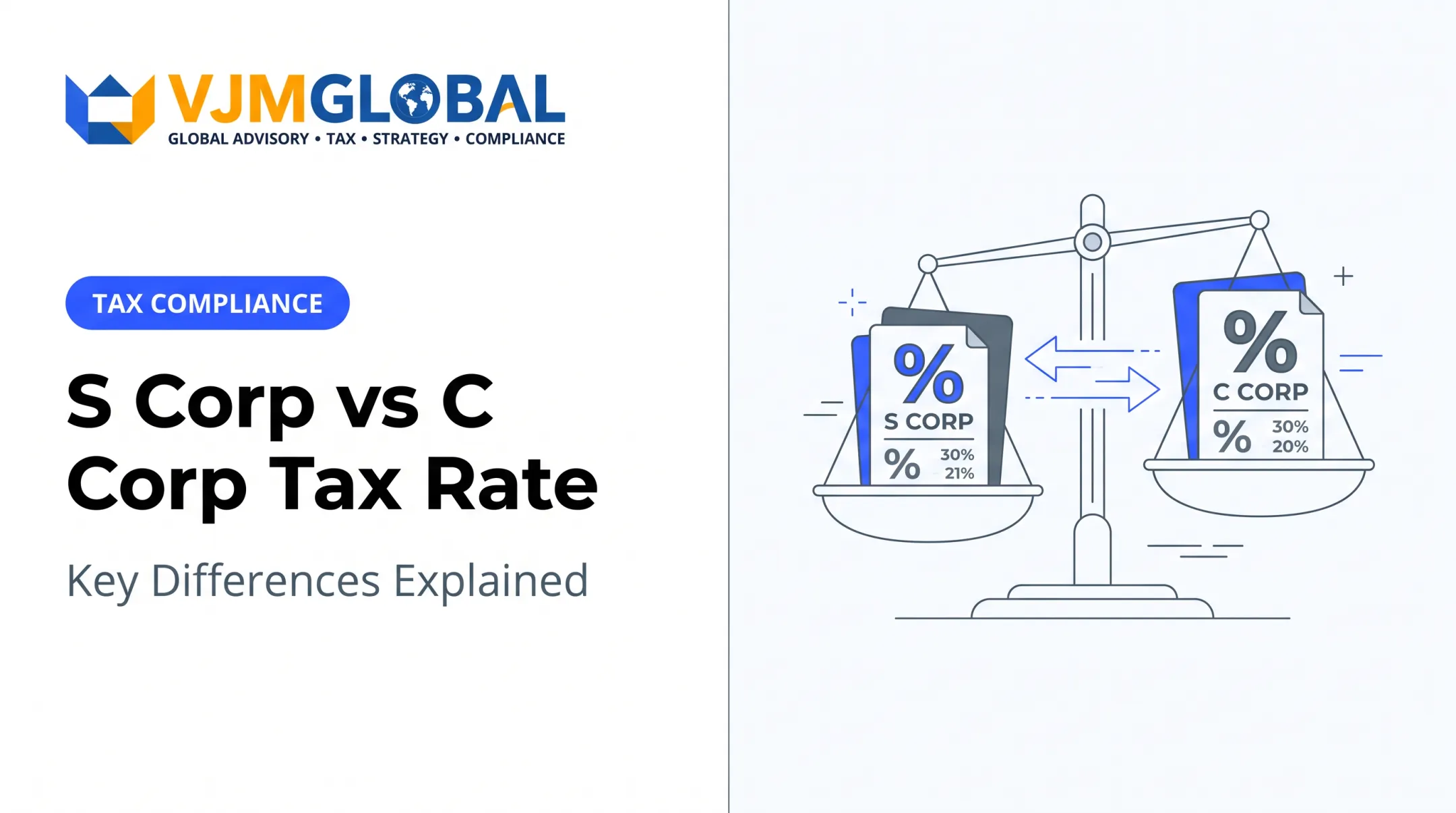
A C corporation reports its income on Form 1120 and pays federal tax at the entity level. The rate is 21% of taxable income.
An S corporation files Form 1120-S. Income, deductions, credits and losses pass through to shareholders on Schedule K-1, and shareholders report their share whether or not cash was distributed.
Here is an illustrative example. Say a business has $100,000 of taxable income:
- C status: about $21,000 of federal corporate tax, before credits and state tax. Any dividend paid afterwards is taxed again in the shareholder's hands.
- S status: no general federal corporate tax. The $100,000 is allocated to shareholders and taxed at their individual rates.
The numbers shift with deductions, shareholder rates, distributions and state taxes. Treat this as a sketch, not a forecast.

What both structures share
Both C and S corporations offer limited liability. Both issue stock, keep corporate records, hold meetings through directors and officers, and file annual reports. VJM Global prepares both Form 1120 and Form 1120-S for U.S. clients.
Why the distinction matters for Australian owners
An S election is a U.S. federal tax election. It does not turn an Australian company into an S corporation. Australian owners should consider these separately:
- U.S. shareholder eligibility
- Australian tax residency and worldwide income reporting
- U.S. withholding and treaty caps
- Currency conversion
The deep end here is Australian classification. Do not assume U.S. pass-through treatment carries over; public ATO rulings on how a U.S. S corporation is characterised are hard to find, so confirm treatment with your adviser. Australian CFC rules may also apply to a foreign company controlled by Australian residents, according to the ATO's residency guidance.
Benefits of Electing S Corporation Status
Potential single-layer taxation
A C corporation's profits are taxed once at the company level and again when paid out as dividends. S status passes income straight to shareholders instead. That can avoid the second layer, but shareholders still pay tax, and the total is not automatically lower.
Pass-through losses and deductions
Eligible shareholders receive their share of losses, deductions and credits. Using them is a different matter. Limits apply in order: stock and debt basis (tracked on Form 7203), then at-risk, passive activity and excess business loss rules. A K-1 loss is not always deductible in full in the year it arises.
Possible payroll tax planning
Shareholder-employees must be paid reasonable compensation for their services before taking non-wage distributions. The IRS can reclassify distributions as wages. For 2026, Social Security tax is 6.2% and Medicare 1.45% for both employee and employer, with a Social Security wage base of $184,500.
Planning the wage and distribution split can matter, but no saving is guaranteed.
Qualified business income considerations
Some shareholders may claim the section 199A deduction of up to 20%, which 2025 legislation made permanent from 2026. Income thresholds, business type, and wage and property limits apply. Confirm the final 2026 IRS Form 8995 figures before you rely on them, since draft versions can change.
Best fit for certain closely held businesses
S status suits businesses with:
- Concentrated ownership among eligible individuals
- Profits that owners expect to take out or use
- No need for venture capital, preferred stock or foreign shareholders
- No plans for a public offering
C Corp vs. S Corp: Key Differences
| Area | C corporation | S corporation |
|---|---|---|
| US federal return | Form 1120 | Form 1120-S with K-1s |
| US federal tax | 21% at entity level | Passed to shareholders |
| Shareholders | Few federal limits | Up to 100, eligible types only |
| Stock | Multiple classes allowed | One economic class |
| Foreign owners | Permitted | Nonresident aliens and companies barred |
Tax return and tax burden
S shareholders owe tax on allocated income even when the company distributes too little cash to cover it. That is a real cash-flow trap for profitable, reinvesting businesses.
Shareholder eligibility and ownership limits
An S corporation must be a US domestic corporation, with no more than 100 shareholders. Shareholders must be individuals, estates, certain trusts or specified exempt organisations. A nonresident alien cannot hold shares, and an Australian company is not an eligible shareholder.
Australian citizenship alone does not decide eligibility. U.S. tax residency and legal form do. Verify any exception against current IRS Form 2553 instructions.
Stock classes and capital raising
Differences in voting rights alone do not create a second class of stock, but every share must carry identical distribution and liquidation rights. Preferred stock therefore conflicts with S status. Venture and private equity deals usually rely on preferred shares, which is why venture-backed startups tend to stay C corporations.
Distributions, share transfers and exit planning
S distributions should follow share rights consistently. Not every unequal payment ends S status, but governing documents and facts matter. Review any share transfer before completing it, because a transfer to an ineligible holder can terminate the election.
C corporations have more room for preferred rights, acquisitions and listings.
Compliance, state taxation and compensation
An S election removes none of the following:
- Payroll filings (Forms W-2, 941)
- Bookkeeping and annual reports
- State income or franchise tax
- Registered agent and beneficial ownership (BOI) requirements
States differ. California charges S corporations 1.5% on California-source net income plus an $800 minimum franchise tax. New York City does not recognise the state S election for its General Corporation Tax. Estimated taxes and coordinated U.S. and Australian reporting also need planning.

Eligibility, Election, and Conversion Considerations
Confirm eligibility before filing
Check the corporation type, every shareholder, the stock classes and the business activity. An Australian resident or Australian entity anywhere in the ownership chain needs specialist review first.
File the election and coordinate timing
Form 2553 is due within 2 months and 15 days of the start of the tax year it takes effect, or at any time in the prior year. All shareholders must consent.
Late-election relief may be available where there was reasonable cause, generally within 3 years and 75 days of the intended effective date. Check the instructions for your tax year, and confirm whether your state requires a separate election.
Plan for legacy issues and ongoing compliance
An existing C corporation faces conversion costs:
- Built-in gains tax on gains recognised during the 5-year period after the election
- LIFO recapture, payable over four instalments
- Tax on excess passive income where accumulated C earnings exist, with possible termination if passive income exceeds 25% of gross receipts for three straight years
VJM Global supports Australian and international businesses with accounting, U.S. tax compliance and cross-border advisory coordination, including entity-specific reporting for S and C corporations.
When Is C Corporation Status Still the Better Choice?
C corporation status often fits better when ownership rules, capital structure or exit plans sit outside S corporation limits.
Situations that may favour C corporation status
- Foreign or entity shareholders, including an Australian parent company
- Venture or private equity funding with multiple stock classes
- Earnings kept for reinvestment
- Planned acquisitions or a public offering
- Qualified small business stock (section 1202) goals on domestic C corporation stock only
For QSBS issued after 4 July 2025, the exclusion is 50% after three years, 75% after four and 100% after five, subject to caps and tests.

Situations that may favour S corporation status
- Closely held ownership by eligible individuals
- Expected shareholder distributions
- Pass-through losses the owners can actually use
- No immediate need for preferred stock, foreign owners or outside investment
Build a side-by-side tax and commercial model
A headline rate comparison is not enough. Model both structures across:
- Corporate and shareholder tax
- Payroll and state taxes
- U.S. withholding and Australian tax treatment, including foreign income tax offsets
- Compliance costs
- Distributions, financing and exit outcomes
Treaty dividend withholding is generally capped at 15%, or 5% for qualifying companies holding at least 10% of voting power. Those are caps, not final Australian rates.
Frequently Asked Questions
Why choose a C corporation instead of an S corporation?
C status allows broader shareholder types, multiple stock classes, foreign ownership and outside investment. It also suits businesses retaining earnings or planning an acquisition or public offering.
What happens when you convert a C corporation to an S corporation?
The corporation stays the same legal entity and files Form 2553. Pass-through rules then apply, subject to eligibility, timing, built-in gains and other legacy C corporation issues.
How much corporate tax would a C corporation pay on $100,000?
At the 21% federal rate, $100,000 of taxable income produces about $21,000 before credits and state tax. If $100,000 is gross revenue, the answer differs. Use a current calculation.
Can a foreign-owned C corporation elect S corporation status?
Not if any shareholder is a nonresident alien or a company. An Australian individual who is a U.S. tax resident may qualify. Review the full ownership chain first.
Does an S corporation still file a corporate tax return?
Yes. It files Form 1120-S and issues each shareholder a Schedule K-1. Shareholders report their share, and payroll, state and annual filings still apply.