This guide is written for foreign entrepreneurs, NRIs, OCIs, and multinational businesses looking to establish a legal presence in India. Getting each stage right matters because a misstep early on can delay your timeline, trigger compliance headaches, or complicate operations for years afterward.
"Company registration" gets used as a catch-all term, but the real process has distinct legal stages that first-time foreign promoters frequently misread. This article breaks down each stage, the documents you'll need, and the factors that determine whether your registration runs smoothly or stalls.
Key Takeaways
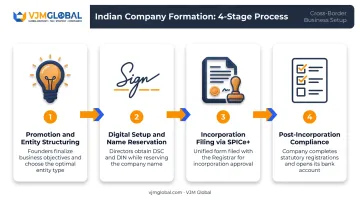
- Company formation in India moves through four practical stages: Promotion, Name Reservation, Incorporation Filing (via SPICe+), and Post-Incorporation Compliance
- Foreign promoters face extra requirements like DIN, DSC, and FDI reporting, plus choosing the right entity structure
- Document authentication abroad, not MCA processing time, is usually the biggest delay factor for foreign promoters
- Incomplete documentation and mismatched entity structures cause most incorporation delays for foreign-owned companies
- Experienced cross-border advisors catch filing errors early, keeping incorporation timelines on track
What Is the Company Formation Process and Why It Matters for Foreign Businesses
Company formation, in the Indian context, is the legal process of converting a business idea into a registered corporate entity recognized under the Companies Act, 2013. Once complete, the entity has a legal identity of its own, distinct from its owners.
That separation matters. Under Section 9 of the Act, the company becomes a body corporate from the date on its Certificate of Incorporation, with the power to own property, sign contracts, and sue or be sued in its own name. Shareholder liability, meanwhile, is capped at unpaid share amounts.
What this legal identity unlocks:
- Opening a company bank account in India
- Hiring staff and entering employment contracts
- Signing commercial agreements with vendors or clients
- Legally receiving foreign investment through recognized channels
What it doesn't include. Incorporation is a distinct legal event from GST registration or trade licensing. Those happen after formation, not during it — though the SPICe+ system lets you apply for some of them (like PAN and TAN) in the same filing bundle.
For foreign businesses, understanding this distinction is critical, since improper structuring or missed compliance at the formation stage can trigger FEMA violations, tax complications, or delays in repatriating profits later. A company set up incorrectly at day one often spends year two fixing it — which is why many foreign investors bring in FEMA and cross-border tax advisors, like VJM Global, before filing incorporation documents rather than after.
Key Stages in the Company Formation Process for Indian Companies
At a high level, the process moves from idea validation and entity selection, through digital documentation, to legal registration, and finally to operational readiness. Each stage builds on the last — skipping ahead usually backfires.
One practical note: private companies can commence business immediately after incorporation. Structures raising funds from the public need additional certificates before they can operate. Most foreign promoters setting up a Wholly Owned Subsidiary or Joint Venture fall into the first category.
Stage 1: Promotion and Entity Structuring
This is the decision-making stage, before any government filing happens.
You're deciding the business opportunity, running a feasibility assessment, and selecting the right legal structure. For foreign promoters, that usually means choosing between:
- Wholly Owned Subsidiary (WOS) — full control, full revenue capability
- Joint Venture (JV) — shared ownership with an Indian partner
- LLP — simpler compliance, but not incorporated under the Companies Act
- Branch Office — permitted activities only, no separate Indian entity
- Liaison Office — representative presence, cannot earn Indian income
This stage also involves identifying your directors, checking FDI sector caps under the automatic or government approval route, and finalizing the shareholding pattern.
Why this matters more than people assume: decisions made here directly affect taxation, liability exposure, and how easily you can repatriate profits later. A Liaison Office set up to test the market can't pivot into revenue generation without restructuring — you'd need to incorporate a fresh entity. Advisors like VJM Global work through this structuring decision with foreign promoters precisely because correcting a wrong entity choice later costs far more than getting it right upfront.
Stage 2: Digital Setup and Name Reservation
Before you can file anything with the Registrar of Companies (ROC), every proposed director — including foreign nationals — needs a Digital Signature Certificate (DSC) and a Director Identification Number (DIN).
There's no nationality exemption here. Section 152(3) of the Companies Act prohibits anyone from being appointed a director without a DIN, and SPICe+ allows you to request DINs for up to three proposed directors who don't already have one.
Next comes reserving your company name, typically through Part A of the SPICe+ form (the RUN service is reserved for renaming an existing company, not registering a new one).
Naming rules to know:
- No names identical or deceptively similar to existing companies
- No restricted or prohibited words without prior government approval
- Trademark conflicts require the trademark owner's consent
- MCA allows limited resubmissions if your first name choice gets rejected
Stage 3: Incorporation Filing via SPICe+
Most Indian companies today are incorporated through the integrated SPICe+ (Simplified Proforma for Incorporating a Company Electronically) form. This single filing covers company incorporation, PAN, TAN, and — through the linked AGILE-PRO-S form — EPFO, ESIC, and bank account setup.
GST registration and Shops and Establishment registration can also be requested through the same linked form, but they're optional, not mandatory parts of incorporation itself.
Core documents filed at this stage include:
- Memorandum of Association (MOA)
- Articles of Association (AOA)
- Director consents and identity/address proof
- Registered office proof
Once the ROC reviews and accepts the filing, it issues a Certificate of Incorporation (COI) along with a Corporate Identification Number (CIN). That certificate date is the legal starting point of your company's existence under Section 9.
MCA describes its Centralised Processing Centre as offering "speedy incorporation services," but doesn't publish a fixed working-day guarantee for private company registration. Treat marketing claims of "3 days" or "7 days" with some skepticism — actual timing depends heavily on document quality and resubmission cycles.
Stage 4: Post-Incorporation Compliance and Operational Readiness
Getting the COI is not the finish line — it's the starting gun for a new set of deadlines. Several obligations kick in immediately after incorporation:
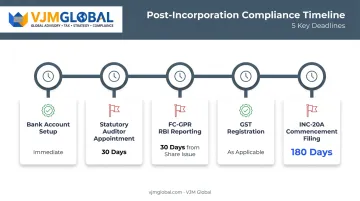
- Open a company bank account and deposit the subscribed capital
- File GST registration if your business activities require it
- Report foreign investment to the RBI via Form FC-GPR if shares were issued to a non-resident — due within 30 days of the share issue
- Appoint a statutory auditor within 30 days of registration (Section 139(6))
- File a declaration of commencement of business (Form INC-20A) within 180 days of incorporation (Section 10A)
Miss the INC-20A deadline, and your company legally cannot commence business or borrow funds. Miss FC-GPR, and you risk falling under RBI's Late Submission Fee framework — an avoidable cost.
Documents and Requirements Foreign Promoters Must Prepare
Foreign-promoted incorporations carry extra documentation weight compared to domestic filings. Here's what typically needs to be ready:
Identity and address proof:
- Notarized and apostilled (or consular-attested) passport copies for foreign directors and shareholders
- Address proof, similarly authenticated
India has been part of the Hague Apostille Convention since 2005, so documents from member countries need apostille rather than full consular legalization. Documents from non-member countries need notarization plus diplomatic or consular authentication instead.
Resident director requirement: At least one director must have stayed in India for 182 days during the financial year — not the calendar year, and not a fixed number tied to when the company was formed. For a newly incorporated company, this is applied proportionately at year-end.
Registered office proof:
- Rental agreement or ownership proof
- A No Objection Certificate (NOC) from the property owner
- Recent utility bill as supporting evidence
FDI-specific documentation:
- No Objection Certificate from the Indian bank handling inward remittance
- Compliance evidence for reporting requirements under FEMA
VJM Global, which has prepared and filed these documents for over 500 American, 250 UK, and 250 Australian businesses, notes that incomplete or improperly attested paperwork causes most ROC filing rejections for foreign-promoted companies.
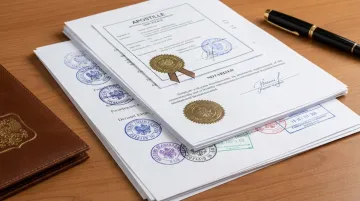
The biggest cause of rejection is rarely the incorporation form itself. It's the supporting documents from abroad: passports, address proof, and NOCs that arrive without proper apostille or attestation.
Factors That Affect Formation Timeline and Complexity
Not every incorporation moves at the same pace. Several variables shift the timeline meaningfully:
Entity Type Chosen
A private limited company follows the SPICe+ route through MCA. An LLP uses a separate FiLLiP framework, not company incorporation at all. Branch and Liaison Offices go through RBI/AD-bank approval instead of ROC filing, a fundamentally different process with its own timeline.
FDI Route and Sector
Whether your investment falls under the automatic route or requires prior government approval changes everything downstream:
| Sector | Cap and Route |
|---|---|
| Manufacturing | 100% automatic |
| Telecom services | 100% automatic |
| Defence | Up to 74% automatic, beyond needs approval |
| Space (components/subsystems) | 100% automatic |
| Insurance | 100% automatic (LIC capped at 20%) |
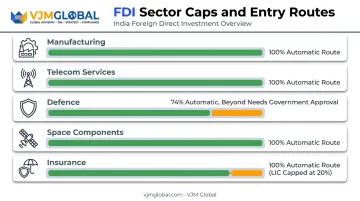
One exception applies regardless of sector: investors from countries sharing a land border with India fall under the government approval route under Press Note 3 of 2020.
Document Readiness
Having a resident director lined up and apostilled documents already in hand from the home country can shave real time off the process. Waiting on apostille from abroad, by contrast, often takes longer than the MCA filing itself.
These variables rarely act in isolation. Entity type, FDI route, and document readiness typically overlap, which is why professional guidance during the planning stage often prevents delays before they start.
Common Mistakes Foreign Investors Make During Formation
A few recurring errors show up again and again with first-time foreign promoters:
- Wrong entity structure: many set up a Liaison Office despite planning revenue-generating activity. An LO cannot earn Indian income under RBI rules. It functions only as a communication channel, not a business vehicle.
- Treating incorporation as the finish line: GST registration, RBI's FC-GPR reporting, and statutory auditor appointment are mandatory next steps, not optional extras.
- Underestimating documentation timelines: apostille or consular attestation abroad often takes longer than the MCA filing itself.
VJM Global's 30+ years advising foreign promoters on Indian entry help clients avoid these missteps and complete formation on the first filing attempt, rather than discovering gaps after a rejection.
Frequently Asked Questions
What are the stages of company formation?
Company formation broadly follows four stages: Promotion (entity structuring), Name Reservation, Incorporation Filing via SPICe+, and Post-Incorporation Compliance. Private companies can begin operations right after incorporation, subject to filing INC-20A within 180 days.
How long does it take to register a company in India as a foreigner?
MCA doesn't publish a fixed working-day guarantee, but describes the process as fast once documents are in order. The bigger time factor is usually apostille or attestation of documents from your home country, not the MCA filing itself.
What is the minimum capital required to start a company in India?
There's no statutory minimum paid-up capital requirement anymore. The Companies (Amendment) Act, 2015 removed the earlier minimum figures for both private and public companies. Your actual capital needs depend on your business plan.
Can a foreign national be a director in an Indian company without a DIN?
No. A Director Identification Number is mandatory for every director under Sections 152(3) and 153 of the Companies Act, with no exemption for foreign nationals. You'll need identity and address proof, properly attested, to obtain one.
What is the difference between a Wholly Owned Subsidiary and a Liaison Office?
A WOS is a full Indian company that can conduct business and generate revenue like any domestic entity. A Liaison Office can only act as a communication channel for its foreign parent and cannot earn income in India.
Do foreign companies need RBI approval to incorporate a company in India?
For most sectors under the automatic route, no prior RBI approval is needed to incorporate. However, once equity is issued to a non-resident, Form FC-GPR reporting to the RBI is mandatory within 30 days of allotment.