It isn't. On the 2025 Form 1120-S, Item J is a checkbox about at-risk and passive activity grouping. The 2025 Schedule K-1 has no Item J at all. Allocation percentage sits in Item G.
This guide identifies the right form and label, then shows where contributions are tracked. It also flags what Australian-based owners should check separately.
Key Takeaways
- Item J on Form 1120-S is not a contribution field, and the 2025 K-1 has no Item J.
- Contributions, loans and distributions are tracked in different places and affect basis differently.
- Schedule L and Form 7203 carry the real contribution trail.
- Direct nonresident alien ownership disqualifies an S corporation.
What "Line J" Means on Form 1120-S and Schedule K-1
The lettering on the 2025 forms looks similar, which is why people misread it. Here is what each label actually is.
Form 1120-S, page 1
Item J asks whether the corporation aggregated activities for section 465 at-risk purposes or grouped activities for section 469 passive activity purposes. Item I, just above it, counts shareholders during the year.
Neither records money put into the company. The IRS 2025 form shows these labels, which match 2024.

Schedule K-1, Part II
Part II of the 2025 K-1 uses these items:
- Item G: current year allocation percentage
- Item H: shareholder's number of shares, beginning and end of year
- Item I: loans from shareholder, beginning and end of year
There is no Item J or Item L. The K-1 also has no capital account analysis and no "capital contributed" field. Older guides that describe one are describing a different form, such as Form 1065.
Item G weights ownership by days held, so it is not necessarily year-end ownership.
What about Box 16?
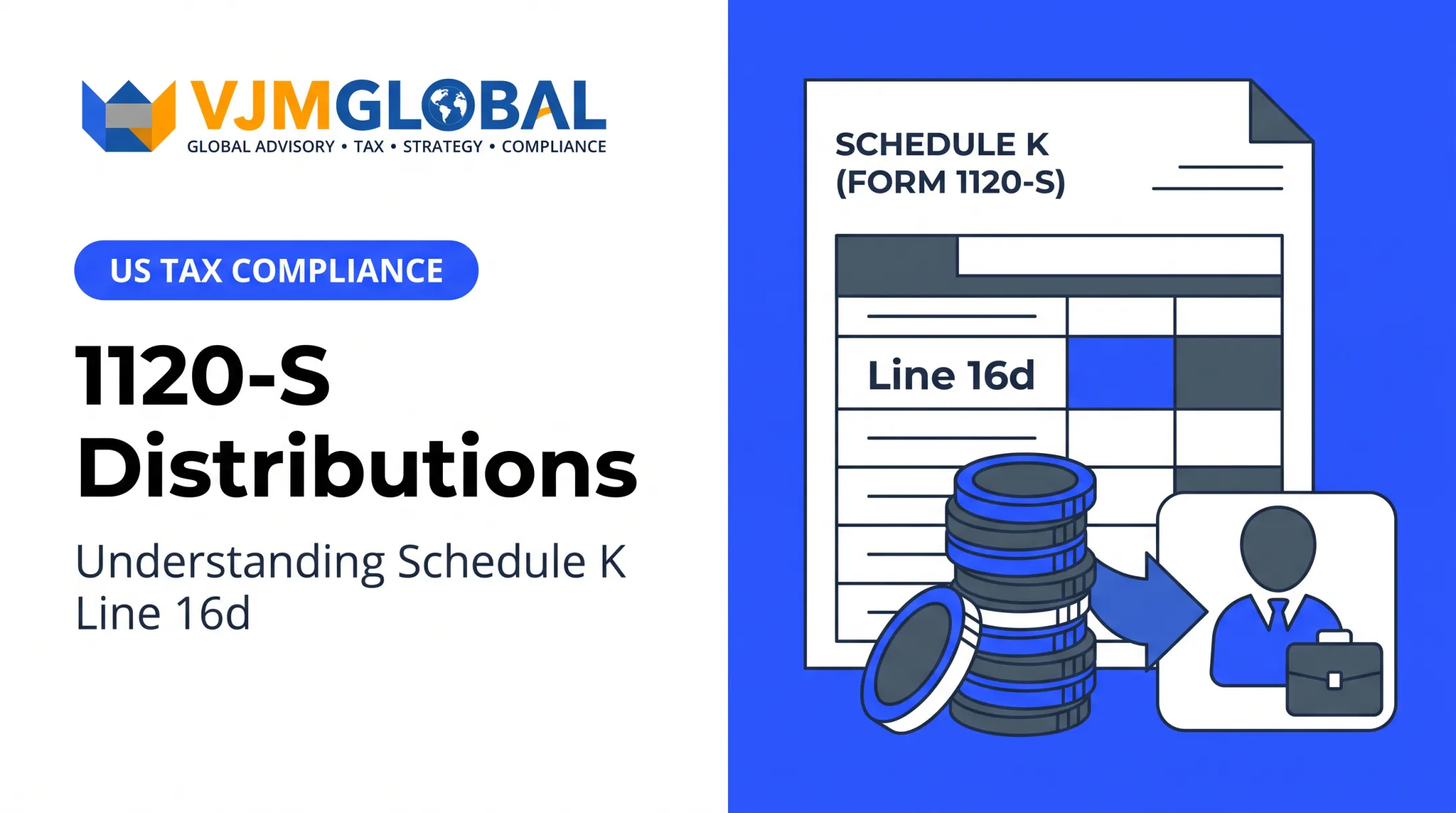
Box 16 is titled "Items affecting shareholder basis". Its codes are:
- A: tax-exempt interest income
- B: other tax-exempt income
- C: nondeductible expenses
- D: distributions
- E: repayment of loans from shareholders
- F: foreign taxes paid or accrued
No code reports contributions. Code D is distributions, which are the opposite flow.
Fact pattern: A shareholder wires $50,000 to the company. The books record either contributed capital or a documented loan. The cash is not income, so nothing goes on an income line. It surfaces in the balance sheet and in the shareholder's basis records.
Where Shareholder Contributions Are Reported
In the company's books
A genuine capital contribution raises an asset, usually cash, and raises equity. Which account depends on the entity's records, so confirm against the general ledger rather than assuming a standard entry.
Section 118 excludes contributions to corporate capital from gross income. Regulation 1.118-1 treats voluntary pro rata shareholder payments as additional amounts paid for stock, even without new shares issued.
On Schedule L
Where Schedule L is required, the 2025 balance sheet shows:
| Line | Label |
|---|---|
| 7 | Loans to shareholders |
| 19 | Loans from shareholders |
| 22 | Capital stock |
| 23 | Additional paid-in capital |
| 24 | Retained earnings |
Contributions without new shares typically land in line 23, and loans in line 19. Schedule L shows combined figures, so it will not say which shareholder paid what.
Exemption: Schedule B, Question 11 lets a corporation skip Schedules L and M-1 if total receipts and year-end total assets are both under $250,000. Question 13 is a different matter (qualified subchapter S subsidiary elections). Schedule M-2 is not part of the exemption.
On the shareholder's basis
Form 7203 instructions include additional capital contributions in the line 2 stock basis calculation and exclude loans. Debt basis is calculated separately.
Schedule M-2's accumulated adjustments account (AAA) is not a contribution total either. It tracks accumulated undistributed income, so keep AAA, contributed equity and basis distinct.
Loan versus contribution
A loan must be bona fide debt running directly to the shareholder. Section 385(b) lists factors such as:
- A written unconditional promise to repay a fixed sum
- A fixed interest rate
- Subordination
- Debt-to-equity ratio
- Convertibility
Guaranteeing a corporate loan creates no debt basis by itself. Misclassifying equity as debt, or the reverse, distorts basis, repayment treatment and loss deductions.
Contributions are also not wages, reimbursements, distributions or ordinary income. Money arriving in the company bank account does not make it revenue.
How to Trace and Reconcile a Contribution
Gather records
- Shareholder's bank statement or transfer confirmation
- Company bank statement
- General ledger
- Opening and closing balance sheets
- Shareholder agreement or resolution
- Loan documents, if any
- Schedule K-1
- Shareholder basis worksheet and Form 7203
Reconcile in order
Schedule K-1 does not report a capital account, so reconcile in layers:
- Start with stock basis at the beginning of the year.
- Add documented contributions and stock purchases.
- Adjust for the shareholder's share of income, losses and Box 16 items.
- Subtract non-dividend distributions.
- Compare against Form 7203 and the preparer's workpapers.
- Separately, tie Schedule L line 19 to the aggregate Item I loan amounts. Guarantees and intercompany debt are excluded from Item I.

Book equity, AAA, stock basis and debt basis are four different measures. Do not expect them to match.
Why a contribution may seem missing
- Booked as a shareholder loan
- Schedule L exempt or incomplete
- Recorded in a different equity account
- Made after year-end
- Return prepared incorrectly
Unresolved items
Confirm whether the transfer was equity or debt. Then request the basis worksheet from the preparer and compare the K-1 with the books.
If a correction is warranted:
- File an amended Form 1120-S with H(4) ticked and an explanatory statement
- Issue an amended K-1 to the affected shareholder
Do this only after professional review.
Cross-border caution
A US federal form does not answer Australian questions. The ATO says Australian tax residents must declare foreign income, and residency rules vary. Controlled foreign company rules and treaty positions need separate review.
Common Compliance Issues and Preparation Checklist
Frequent errors
- Booking a contribution as income
- Treating a contribution as a Box 16 distribution
- Hunting for a dollar contribution in "Item J"
- Treating a shareholder loan as equity, or equity as a loan
- Counting the same transfer twice in books and return
- Assuming K-1 figures equal stock or debt basis
Year-end checklist
- Shareholder names, share counts and allocation percentages
- Contributions, with supporting documents
- Distributions and Box 16 items
- Loans to and from shareholders
- Bank reconciliations
- Schedule L balances, if required
- Form 7203 where a trigger applies
Form 7203 is needed when claiming an aggregate loss deduction, receiving a non-dividend distribution, disposing of stock, or receiving a loan repayment.
Always use the current-year forms and instructions. Seek professional review when any of these apply:
- Multiple shareholders or ownership changes
- Related-party loans
- Large losses or missing basis records
- Any foreign participant
Section 1361 bars direct nonresident alien shareholders, and losing eligibility terminates the S election from that date. Relief under section 1362(f) is conditional, not automatic. Australian investors should not assume they qualify.

Frequently Asked Questions
How do I know if my business is an S corporation and must file Form 1120-S?
S status follows a valid Form 2553 election with all shareholder consents and ongoing eligibility. Confirm the election, entity classification and current IRS instructions.
Where do shareholder contributions go on Form 1120-S?
Not on income lines. They appear in company equity, often Schedule L line 23, and in the shareholder's stock basis on Form 7203. Loans go in line 19 and Item I.
Where do charitable contributions go on Form 1120-S?
They are separately stated and passed through on K-1 Box 12, codes A to G by category. Shareholder-level limits apply, and they are not shareholder capital contributions.
What do the codes on Schedule K-1 (Form 1120-S) mean?
Codes identify specific items, such as Box 16 code D for distributions. The attached statements and the current shareholder instructions explain how to use each one.
Does Line J on Schedule K-1 show shareholder contributions?
No. The 2025 K-1 has no Item J. Allocation percentage is Item G, and no K-1 field reports capital contributed.
Are shareholder contributions taxable?
A bona fide capital contribution is generally excluded from the corporation's income under section 118. It still affects basis and later distributions, so review the facts with a tax professional.
Simplify Your S Corp Tax Returns with Expert Guidance
Tracking contributions, loans and basis across books, Schedule L and Form 7203 requires clean records. VJM Global's US tax-trained professionals support S-corp compliance and Form 1120-S preparation, and serve Australian businesses with bookkeeping, tax compliance and cross-border accounting.
If you want a second look at how your shareholder contributions and loans are recorded, request a review from VJM Global. Cross-border and basis questions depend on your company's actual records, so have them ready.