If you live in Australia and still file with the IRS, the confusing part is this: paying a tax does not mean you can deduct it on Schedule A. Only specific categories qualify, and several come with caps. Foreign income taxes, which many Australia-based filers pay, sit in a separate choice between a deduction and a credit.
This guide covers deductible state and local taxes, property taxes, foreign taxes, the standard-versus-itemised decision, and the records to keep. IRS figures are in US dollars, and line numbers refer to the 2025 form, so check the current instructions before filing.
Key Takeaways
- Schedule A only matters if you itemise instead of taking the standard deduction.
- Four categories qualify: state and local income or sales tax, real estate, personal property, and eligible foreign income tax.
- Foreign income tax can be deducted or credited, but not both.
- Business taxes, federal income tax and payroll taxes do not belong on Schedule A.
What Is Schedule A and Who Uses It?
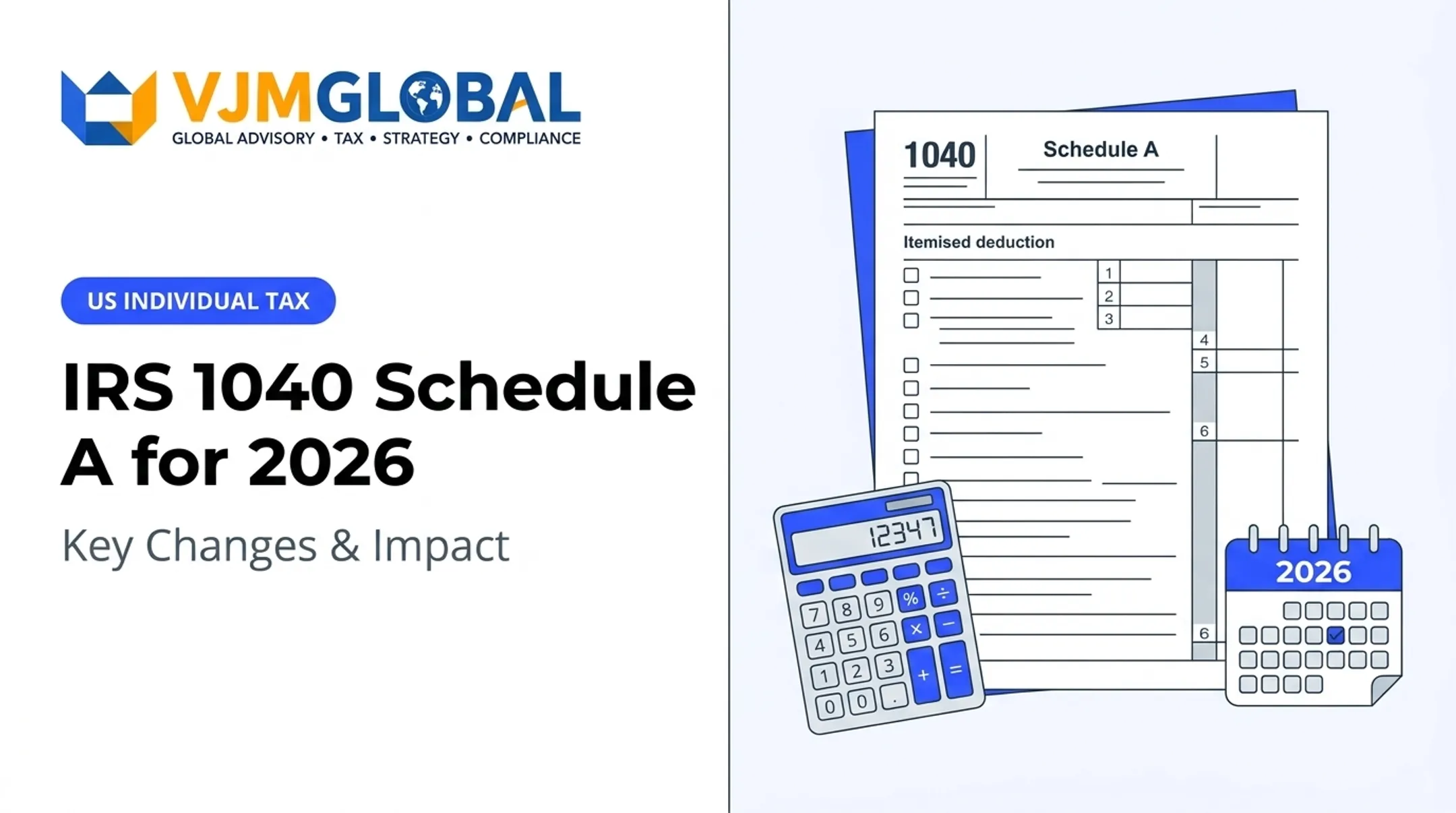
Schedule A calculates your itemised deductions. The total (line 17 on the 2025 form) carries to Form 1040 or 1040-SR, line 12e.
You complete only the sections that apply. Someone with no mortgage and no medical costs may fill in just the taxes section.
Eligibility depends on filing status, income, tax year, residency and the type of expense. Nonresident and dual-status filers generally cannot take the standard deduction, which changes the comparison.
How it differs from other deductions
- Above-the-line adjustments go on Schedule 1 and reduce income before the Schedule A decision is made.
- Credits reduce your tax directly. Deductions only reduce taxable income.
- Business and rental deductions go on Schedule C (sole proprietor) or Schedule E (rental), not Schedule A.
What Taxes Are Deductible on Schedule A?
The taxes section of the form has separate lines, and the IRS Schedule A instructions set out each one. On the 2025 form:
| Line | Tax | Key condition |
|---|---|---|
| 5a | State and local income tax, or general sales tax | One or the other, not both |
| 5b | Real estate tax | Imposed on you and paid in the year |
| 5c | Personal property tax | Value-based and imposed annually |
| 5d/5e | Combined total and allowed amount | Subject to the SALT cap |
| 6 | Other taxes | Includes eligible foreign income taxes |
State and local income or sales taxes
Choose income tax or general sales tax for the year. Sales tax may suit you if your state has no income tax, or if you made a large purchase such as a vehicle. You can use actual receipts or the IRS tables.
Income tax counts what you actually paid in the year: withholding, estimated payments and prior-year balances. Penalties and interest do not count.
The SALT cap
Real estate, personal property and income or sales taxes share one combined cap, not one each.
| Tax year | Cap (most filers) | Cap (married filing separately) | Reduction starts at MAGI of |
|---|---|---|---|
| 2025 | $40,000 | $20,000 | $500,000 / $250,000 |
| 2026 | $40,400 | $20,200 | $505,000 / $252,500 |
Above the threshold, the cap falls by 30% of the excess, down to a floor of $10,000 ($5,000 if married filing separately). The cap is set to rise 1% a year for 2027 to 2029, then revert to $10,000 from 2030.

For this test, MAGI adds back foreign earned income and housing exclusions. Australia-based filers using Form 2555 should not assume their MAGI is low.
Real estate taxes
The tax must be imposed on you, paid to a state or local authority, and used for general public welfare. Some traps:
- Escrow: deduct only what your lender actually paid the authority, not your total deposits.
- Year of purchase: your share starts on the sale date; the seller's ends the day before. The settlement statement shows the split (for example, a 1 September purchase on a $730 annual tax is 122 days, or $244).
- Seller's back taxes: if you pay them, they add to your cost basis rather than being deducted.
- Improvement assessments: street, footpath and sewer assessments generally add to basis. Water, rubbish and similar service charges are not real estate taxes.
Personal property taxes
A personal property tax qualifies only if it is value-based (ad valorem) and imposed annually. Vehicle registration is the usual trap.
If a bill mixes a value-based component with a weight-based or flat fee, only the value-based part counts. Licence fees, inspection charges and flat fees do not.
Taxes that generally do not belong on Schedule A
- Federal income tax
- Social Security and Medicare taxes
- Taxes you paid for someone else
- Marriage, driver's and pet licence fees
- Foreign personal and real property taxes
Taxes tied to a business, rental or other income-producing activity go on the related schedule. Rental property taxes, for example, belong on Schedule E.
Can Foreign Taxes Be Deducted on Schedule A?
Yes, eligible foreign income taxes can go on line 6. That includes Australian income tax, but you must choose between the deduction and the foreign tax credit.
The annual election
Under IRS Publication 514, the choice covers all qualified foreign income taxes paid or accrued in that year. You cannot take the credit for Australian tax and the deduction for another country's tax. You can switch each year.
Other rules to know:
- You must have a legal, actual liability. Amounts reasonably certain to be refunded or forgiven do not qualify.
- Tax on income you exclude under the foreign earned income exclusion generally cannot be deducted or credited.
- The credit is limited by US tax on the relevant foreign-source income, and usually requires Form 1116.
- If a foreign refund arrives later, the credit may need to be recalculated.
- The standard deduction does not stop you claiming the credit.
Credit versus deduction
A credit reduces US tax dollar for dollar. A deduction only reduces taxable income. The credit often gives the stronger result when you owe meaningful US tax on foreign-source income, but not always. Income source, tax rates, the limitation rules and the rest of your return all matter.

Foreign property taxes and other levies
Personal foreign real estate and personal property taxes are not deductible on Schedule A. The type and purpose of the tax decide whether it is deductible, creditable, a business expense or nothing.
A practical example
Take a US citizen living in Sydney who earns a salary from an Australian employer and pays Australian income tax. The Australian income year runs 1 July to 30 June, while the US return covers the calendar year. That mismatch alone means the tax figures rarely line up neatly.
Under the US-Australia treaty, the US still taxes citizens on worldwide income (Article 1(3)). Article 22 gives double-tax relief. For a US citizen resident in Australia, the US credit generally applies after Australia's own credit.
Check how the treaty applies to your situation before relying on it.
Currency and records
Report in US dollars using the rate prevailing when the tax was paid or accrued. Cash-basis taxes generally use the payment-date rate. Keep:
- Foreign tax assessments and payment confirmations
- Refund details
- Exchange-rate calculations
- Notes on whether the tax was claimed as a credit or deduction elsewhere
- Certified translations of any non-English records
The ATO's own foreign income tax offset rules ask for proof of payment too, but those are separate from IRS requirements.
Standard Deduction vs. Itemised Deductions
Compare your total allowable Schedule A deductions with the standard deduction for your filing status and year. Take whichever is larger. The IRS lists these amounts in its 2026 inflation adjustments:
| Filing status | 2025 | 2026 | 2027 |
|---|---|---|---|
| Single | $15,750 | $16,100 | $16,600 |
| Married filing separately | $15,750 | $16,100 | $16,600 |
| Married filing jointly | $31,500 | $32,200 | $33,200 |
| Head of household | $23,625 | $24,150 | $24,925 |
The 2027 figures have been announced but are not yet in force.
A simple comparison
A single filer with $9,000 in eligible state tax, $7,000 in mortgage interest and $3,000 in charitable gifts has $19,000 of itemised deductions. That beats a $16,100 standard deduction. Someone with $8,000 in total itemised deductions would take the standard deduction.

Other limits can change the result:
- Medical: only unreimbursed expenses above 7.5% of AGI count.
- Mortgage interest: acquisition debt limits are $750,000 ($375,000 if separate) for newer debt.
- Charity: foreign charities are generally not deductible, with limited exceptions.
- High earners: an overall itemised-deduction limitation may apply.
What to remember
- Taking the standard deduction means you skip ordinary Schedule A deductions for that return. Above-the-line adjustments and eligible credits still apply.
- If you are married filing separately and your spouse itemises, your standard deduction is zero.
- In the IRS's most recent figures, only 9% of returns itemised (tax year 2023).
- Your US choice does not dictate your Australian return or a US state return. Each system decides separately.
Documents, Common Mistakes, and Filing Checks
Documents to gather
- Property tax bills and payment confirmations
- Mortgage and escrow statements
- Personal property tax records
- Foreign tax assessments and exchange-rate calculations
- Records showing who paid or reimbursed a tax
Escrow deposits are not the same as tax paid to the authority. Use the amount and date on the statement showing the lender's actual payment.
The IRS generally expects records to be kept for 3 years from filing, with longer periods for property and basis records.
Common mistakes to avoid
- Deducting both state income tax and sales tax
- Claiming the same foreign tax as a credit and a deduction
- Putting business or rental taxes on personal Schedule A
- Treating licence or registration fees as value-based personal property taxes
- Deducting total escrow deposits
- Claiming relief for tax on income excluded under the FEIE

Check the current Schedule A instructions each year. Keep records showing the tax type, amount, payer, payment date and exchange-rate method.
When professional review may help
Get qualified advice if you have paid Australian tax, multiple jurisdictions, business ownership or treaty questions. VJM Global supports international individuals and businesses with US tax compliance and cross-border advisory, including Form 1040 preparation. Work is handled by US-compliant professionals with experience across Australia, the US and India.
Frequently Asked Questions
Is it better to get standard deduction or itemised deduction?
Whichever is larger for you. Compare your allowable itemised total, after limits and documentation, with the standard deduction for your filing status and year.
Can I deduct foreign taxes on my taxes?
Eligible foreign income taxes can be a Schedule A deduction or a foreign tax credit. You choose one approach for the year, and the same tax cannot be claimed twice.
What taxes can you deduct on Schedule A?
State and local income tax or general sales tax (not both), real estate tax, personal property tax and eligible foreign income tax. The first three share the SALT cap, and eligibility rules change by year.
Do you have to file Schedule A to claim tax deductions?
You need Schedule A to claim itemised deductions. Some adjustments, such as those on Schedule 1, and some credits can be claimed without itemising.
Are business taxes deductible on Schedule A?
No. Business and rental taxes go on the relevant schedule, such as Schedule C or Schedule E, not your personal Schedule A.