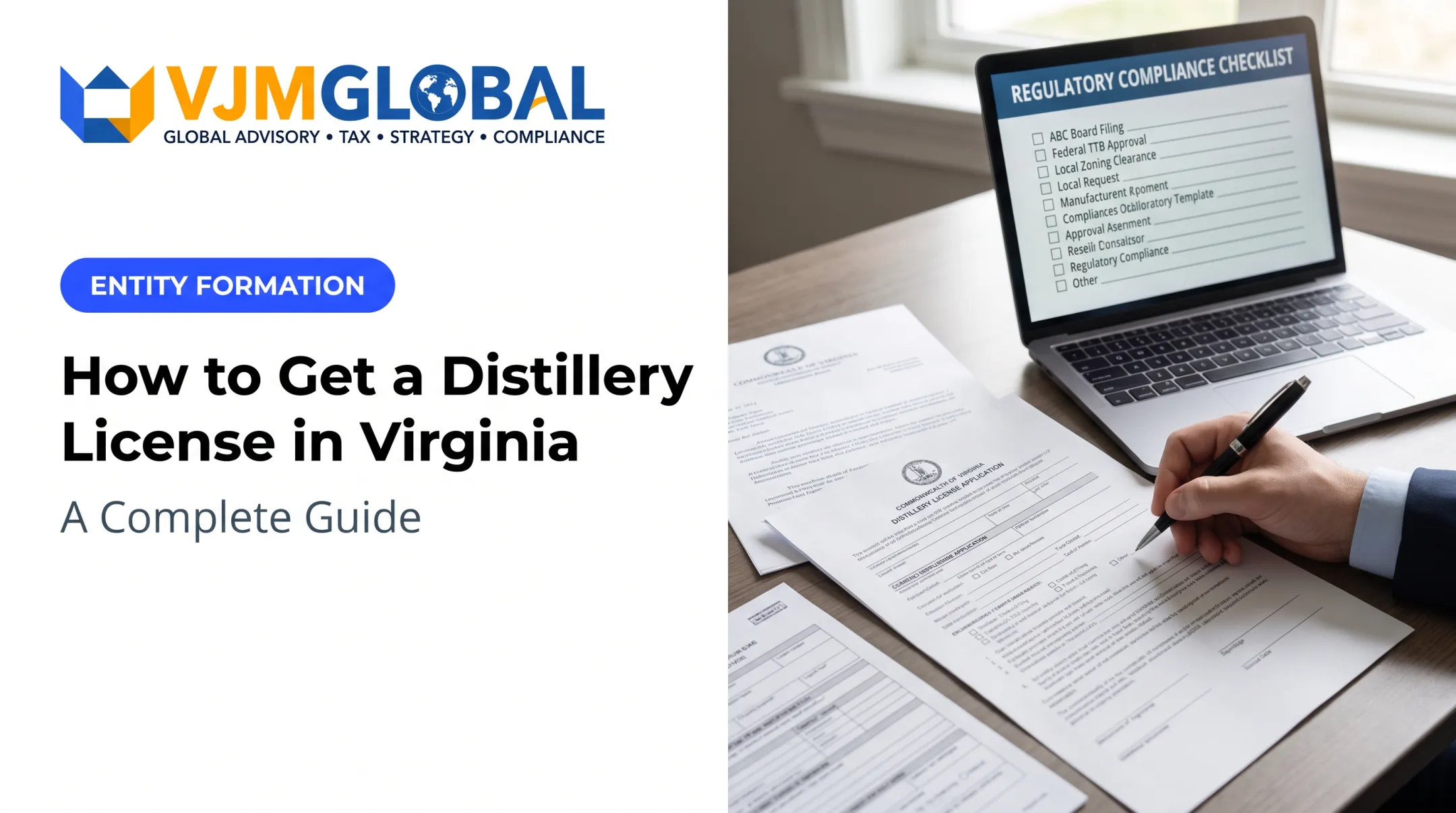
The TTB's Distilled Spirits Plant (DSP) beverage application alone requires registration, a federal basic permit, premises diagrams, and personnel disclosures before production can begin. Add Georgia's state licensing process, county-level alcohol approvals, and activity-specific permits for tastings or food service, and the path gets complicated fast.
This guide is built for craft distillers, foreign investors, and existing beverage businesses planning operations in Georgia. It breaks down what a "distillery license" actually includes, walks through the application sequence step by step, and flags the mistakes that most often stall approval.
Key Takeaways
- Secure federal DSP approval, a Georgia manufacturer license, and local alcohol permits before any production.
- Tastings, bottle sales, food service, and shipping each need separate permissions beyond manufacturing.
- Confirm current fees, bonds, and timelines with the TTB, Georgia Department of Revenue, and your county.
- Do not start production or sales until every approval is issued and premises pass inspection.
What a Georgia Distillery License Covers and Why It Is Needed
A commercial distillery license authorizes an eligible business to manufacture distilled spirits under specific federal, state, and local conditions. That authority arrives as a bundle of overlapping approvals, and each one governs a different slice of your operation.
Georgia's Department of Revenue describes an in-state distillery as a business engaged in distilling, rectifying, and blending spirits, which is distinct from a wholesaler license or a retail package/consumption-on-premises license. Manufacturing authority does not automatically include the right to distribute to retailers or run an unrestricted tasting room.
Here's how the license types typically differ:
| License Type | Primary Activity | Common Limitation |
|---|---|---|
| Manufacturer/Distillery | Producing spirits | Doesn't cover wholesale distribution |
| Wholesaler/Distributor | Selling to retailers | Requires separate licensing from manufacturing |
| Retail Package/On-Premises | Selling directly to consumers | Subject to local zoning and dry/moist restrictions |
| Special Event Permit | Off-site sales at events | Cannot substitute for a standing retail license |
Your intended activities shape your entire approval pathway. Producing spirits for wholesale is a different application than producing spirits, pouring tastings, running a cocktail program, and shipping bottles to customers. Each activity layer typically needs its own sign-off.
Unlicensed distillation is not a legal shortcut. Owning a still for non-alcohol-producing purposes or running educational demonstrations differs from commercial production. Georgia and federal regulators treat unauthorized manufacturing as a serious violation, not an oversight.
How to Obtain a Distillery License in Georgia: Step-by-Step
Step 1: Define Your Business Model and Product Range
Before filing anything, nail down what you're actually building. Identify:
- Spirit categories (whiskey, vodka, gin, rum, and so on) and projected production volume
- Storage and aging requirements, particularly for barrel-aged products
- Sales channels: on-site retail, wholesale, shipping, or a mix
- Whether you'll run a tasting room, offer tours, or serve food
- Whether distribution goes through a licensed partner or stays in-house
This decision set drives every application that follows, so treat it as foundational, not optional paperwork.
Step 2: Establish the Business and Confirm the Premises
Form your legal entity, obtain a federal tax ID, and gather ownership documentation. Then turn to the site itself:
- Secure a lease or ownership documents for the proposed premises
- Confirm zoning permits distillery use at that address
- Review building, fire, utility, and wastewater requirements early
- Assess whether existing equipment or infrastructure meets production needs
Skipping the zoning check at this stage is one of the most common, and costly, mistakes applicants make.
Step 3: Check Local Approvals Before Committing to a Site
Contact your city or county directly. Georgia's alcohol rules vary meaningfully by jurisdiction, and some localities restrict or prohibit certain alcohol activities entirely. Athens-Clarke County, for example, requires both a local and a state alcohol license processed through the Georgia Tax Center, a combined workflow it introduced in January 2022.
Confirm:
- Local business licensing requirements
- Local alcohol licensing procedures and fees
- Occupancy, signage, and fire inspection requirements
- Whether the county or city is dry, moist, or fully wet for your intended activities
Step 4: Apply for Federal TTB Approval
A distillery generally needs federal Distilled Spirits Plant authorization before production starts. TTB's beverage DSP application identifies specific forms:
- Form 5110.41 — DSP registration
- Form 5100.24 — Federal basic permit
- Form 5000.9 — Personnel questionnaire
You'll also need a signed lease or ownership proof, a premises diagram showing bonded areas and equipment layout, and descriptions of your production process.
A federal bond may apply depending on your excise tax liability and production type. The beverage-only bond exemption took effect January 1, 2017, but it isn't automatic for every small producer.
TTB publishes median processing times for original applications, and recent data show a range around 47 to 49 calendar days, against a stated service goal of 75 days. Treat this as a historical benchmark, not a promise.
Step 5: Submit the Georgia State Alcohol Application
In-state distilleries apply through the Georgia Tax Center. Select the correct manufacturer/distillery category and prepare:
- A notarized citizenship-verification affidavit
- Secretary of State annual registration
- A notarized ATT-17 personnel statement
- Federal basic permit, local license, and property deed or lease
- Financial affidavit and manufacturer/distillery bond documentation
- Brand and label registration (submitted through GTC)
Respond quickly to any agency follow-up requests. Incomplete submissions are one of the most frequent causes of delay.
Step 6: Complete Related Approvals and Prepare for Inspection
Beyond DOR, several other agencies may weigh in:
- Georgia Department of Agriculture oversees qualifying packaged-product manufacturing and wholesale distribution
- Local health departments get involved if you prepare or serve food
- Fire, building, and environmental inspectors review construction, wastewater handling, and occupational safety
Before opening, run through a practical checklist:
- Approved labels and formulas where applicable
- Tax registration and inventory recordkeeping
- Responsible-service and age-verification procedures
- Insurance coverage and staff training
- Renewal calendar with current agency deadlines
Always confirm the current forms and portals directly with each agency rather than relying on secondhand summaries. Requirements shift.

Financial and compliance planning matters here too. VJM Global works with foreign investors and business owners to organize financial records, tax-registration documentation, and entity-setup paperwork alongside this process. The actual licensing decisions and legal approvals stay with TTB, Georgia DOR, and local authorities.
Key Requirements, Costs, and Compliance Considerations
What Your Application Package Needs
A complete filing typically includes:
- Entity formation documents and ownership records
- Federal tax identification and federal basic permit
- Premises lease or ownership evidence, plus site plans
- Local business and alcohol licenses
- Citizenship or financial affidavits where required
- Personnel background disclosures
- Bond documentation (state and, potentially, federal)
Understanding the Cost Structure
There's no single "distillery license cost" figure that applies to every applicant. Instead, budget across these categories:
- State application and license fees — published by Georgia DOR but subject to change
- Local license and inspection fees — vary by city and county
- Federal costs, if applicable, tied to your DSP application
- Surety bond premiums — Georgia requires a manufacturer/distillery tax bond; TTB's bond requirement depends on your excise tax liability
- Professional fees for legal, accounting, and licensing support
- Construction, equipment, and insurance costs
- Ongoing renewal charges
Georgia's current spirits excise tax rates, as listed by DOR, sit at $0.50 per liter for spirits under 190 proof and $0.70 per liter at or above that threshold. Confirm these rates and all fee schedules against DOR's current published figures before you file; amounts and effective dates aren't always clear on every page.

Your Business Model Changes the Permit Stack
Don't assume a base distillery license covers everything you plan to do. The following activities typically need separate permits:
- On-site bottle sales and tastings
- Cocktail service
- Prepared food, outside caterers, or food trucks
- Online sales and shipping
- Special events held off your licensed premises
Operational Controls That Affect Approval
Inspectors and regulators commonly review:
- Secure alcohol storage and production-area separation
- Fire protection, ventilation, and boiler/still safety
- Sanitation, water, and wastewater handling
- Recordkeeping and product traceability
- Age-restricted service protocols
Ongoing Compliance Doesn't End at Approval
Once licensed, you remain responsible for:
- Excise and sales tax reporting (Georgia alcohol returns are due the 15th of each month)
- Production and inventory records
- Label and formula compliance
- Prompt reporting of ownership, premises, or activity changes
- Renewal filings and periodic inspections
Common Issues and Misconceptions
A Georgia state license alone doesn't permit every activity you might want to run. Federal TTB approval, local licensing, zoning, health, agriculture, fire, and environmental sign-offs can all apply depending on what you're doing.

Frequent application problems include:
- Choosing the wrong license category for your actual business activities
- Signing a lease before confirming the site meets zoning rules
- Submitting inconsistent ownership details across federal and state filings
- Omitting site plans or affidavits and triggering processing delays
- Overlooking bond requirements until late in the process
- Adding food service without checking with the local health authority first
Approval is only the start—ongoing compliance still applies. These missteps often trigger enforcement issues and put renewal at risk:
- Producing before final approval is in hand
- Selling outside permitted channels
- Failing to keep accurate production and sales records
- Serving underage customers
- Changing premises or the business model without notifying regulators
Conclusion
Securing a Georgia distillery license is a coordinated process, not a single application. It involves the federal government through TTB, Georgia's Department of Revenue and Department of Agriculture, and whichever city or county hosts your premises.
Define your business model and confirm your site before you file anything. Manufacturing, distribution, tastings, retail sales, shipping, and food service each carry different requirements. Retrofitting a plan after signing a lease is far harder than getting it right upfront.
This guide reflects publicly available information as of 2024 and may not capture the most recent regulatory changes. Verify current requirements directly with TTB, Georgia DOR, and your local authority before producing or selling spirits.
Work with qualified legal, licensing, and accounting professionals on your specific plans. VJM Global's insights here are general guidance only and don't substitute for advice from a licensed attorney or your local regulator.
Frequently Asked Questions
How much does a distillery license cost in Georgia?
Total cost depends on state, federal, local, bond, premises, professional, equipment, tax, and renewal expenses. Check Georgia DOR's current fee schedule and your local authority for verified amounts before budgeting.
What are the requirements to get a distillery license in Georgia?
You'll need federal DSP approval, Georgia manufacturer/distillery licensing, local business and alcohol approvals, premises and zoning documentation, required affidavits, inspections, and bonds where applicable. Activity-specific permits apply for tastings, food, or events.
How long does it take to get a distillery license in Georgia?
Timing varies with federal and state review speed, local approval processes, site readiness, and inspections. Recent TTB data shows median federal review times around 47 to 49 days, but always confirm current expectations with each agency.
Is distilling legal in Georgia?
Commercial distilling is lawful when conducted under required federal, state, and local approvals. Unlicensed production or sales can lead to serious penalties, so verify current law and licensing status before beginning operations.