Skip a required registration, and the consequences are real. Fines, cancelled contracts, or getting blocked entirely from bidding on commercial and janitorial contracts. Property managers and facility directors routinely ask for proof of registration, insurance, and bonding before they'll even review your quote.
This guide breaks down exactly which licenses, registrations, and documents you need to legally run a cleaning business anywhere in the US.
Key Takeaways
- There's no single national "cleaning license" — expect a mix of registration, permits, and tax accounts
- Your business structure (LLC, sole proprietorship, corporation) determines your tax ID needs and liability exposure
- Requirements vary by state and city, so verify directly with your Secretary of State and local clerk's office
- Insurance and bonding often win client trust faster than licensing, especially on commercial contracts
Understanding Cleaning Business Licensing Layers in the US
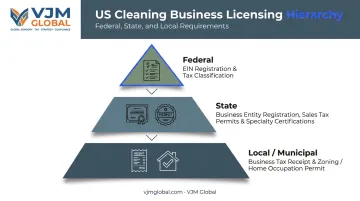
Licensing for cleaning businesses works on three levels, and each one serves a different purpose:
- Federal – EIN registration and tax classification, but no occupational license for general cleaning
- State – business entity registration, sales tax permits (where cleaning is taxable), and specialty certifications
- Local/municipal – general business license or business tax receipt, plus zoning or home occupation permits
Here's the part that surprises a lot of new owners: the US doesn't regulate general residential or commercial cleaning at a national level. The Small Business Administration's list of federally regulated activities covers things like aviation, firearms, and maritime transport — ordinary cleaning isn't on it.
That said, "no license required" doesn't mean "no paperwork required." Most cities still require a general Business Operating License or Business Tax Certificate before you can legally invoice a client, even if there's no cleaning-specific license involved.
When Specialty Services Trigger Extra Requirements
Certain services push you into regulated territory fast:
- Carpet cleaning with certain chemicals – may require OSHA hazard communication compliance
- Biohazard or crime scene cleanup – California requires CDPH registration for commercial trauma-scene waste removal
- Mold remediation – New York licenses mold assessors and remediators under Article 32
- Pest control add-ons – EPA rules govern who can apply restricted-use pesticides
If you hire employees, you'll also trigger separate registration layers, including state unemployment insurance accounts and workers' comp registration. You'll need to maintain these alongside your general business license, not swap one for the other.
The stakes are bigger than most owners realize. The US janitorial services industry is projected to hit $112.4 billion in revenue in 2026, with over 1.26 million businesses now competing in the space, according to IBISWorld's industry analysis. That's a crowded market where clients increasingly use compliance as a filter to weed out unverified operators.
Step-by-Step: How to Register and License Your Cleaning Business
Step 1: Choose Your Business Structure
This decision shapes every document you'll need afterward.
| Structure | Liability | Best For |
|---|---|---|
| Sole proprietorship | Unlimited personal liability | Solo cleaners just starting out |
| Partnership | Often unlimited (varies by type) | Two or more owners splitting duties |
| LLC | Personal assets generally protected | Most growing cleaning businesses |
| Corporation | Strongest liability separation | Larger operations, multiple locations |
Because cleaning work often involves entering someone's home or business, with real risk of property damage or injury claims, many owners skip straight to forming an LLC.
Step 2: Register Your Business Name and Entity
- LLC or Corporation – file Articles of Organization (LLC) or Articles of Incorporation (Corp) with your state's Secretary of State
- Sole proprietor using a trade name – file a DBA ("Doing Business As") if you're not operating under your own legal name
Step 3: Get an EIN from the IRS
Your Employer Identification Number is completely free and comes straight from the IRS. You'll need it to open a business bank account, file taxes, and hire staff.
Approved online applications get an EIN immediately. Fax applications take about four business days; mailed applications run closer to four weeks.
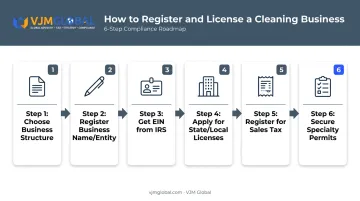
Step 4: Apply for State and Local Business Licenses
Check two places:
- Your state's business licensing portal or Secretary of State site
- Your city or county clerk's office for a general business license or home occupation permit
Requirements differ dramatically here. What Miami-Dade County requires won't match what a small Oregon county expects.
Step 5: Register for State Sales Tax or Service Tax (If Applicable)
Some states tax cleaning services outright:
- Texas taxes cleaning of homes, offices, warehouses, and pools, plus window washing and trash pickup, according to the Texas Comptroller
- Minnesota taxes building cleaning, janitorial work, and carpet/upholstery cleaning
- Ohio taxes building-maintenance and janitorial services under state revenue code
- Wisconsin generally treats routine, repetitive janitorial work as nontaxable, though standalone carpet cleaning can be taxable
Always verify current treatment with your state's Department of Revenue before you start invoicing, since tax guidance changes and old blog posts (including this one) can go stale.
Step 6: Secure Any Specialty Permits
Depending on your service mix, you may need:
- Chemical handling or hazardous waste permits
- Commercial vehicle permits for mobile cleaning vans
- State-required certifications for mold, biohazard, or trauma cleanup
Documents You'll Need to Gather Before You Apply
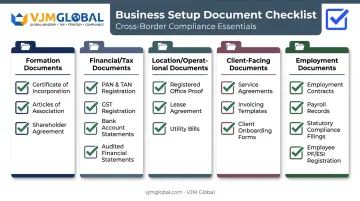
Organizing paperwork upfront saves weeks of back-and-forth later. Here's what to have ready:
Formation documents:
- Articles of Organization/Incorporation or DBA certificate
- EIN confirmation letter (IRS Form CP 575)
- Operating Agreement (for LLCs)
Financial and tax documents:
- State tax ID or sales tax permit
- Business bank account setup paperwork
- A bookkeeping system to track income for tax filing
Location and operational documents:
- Local business license application
- Zoning or home occupation permit
- Lease agreement, if renting commercial space
Client-facing documents:
- Written service agreements/contracts
- Liability waivers
- Pricing and invoice templates
Employment documents (if hiring):
- W-4 and I-9 forms for each employee
- Workers' compensation insurance certificate
- Employment contracts
- State new-hire reporting paperwork
Keep digital and physical copies of every document listed above. Missing paperwork is the top reason license applications get delayed or rejected, so a simple checklist or shared folder can save significant time when deadlines approach.
State-Specific Licensing Considerations
Two states worth spotlighting, since they represent common patterns nationwide:
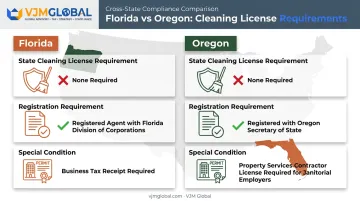
Florida: No statewide cleaning license exists for residential or commercial cleaning. However, local county or city business tax receipts are typically required before you open.
In Orlando, for example, you'd need both a city Certificate of Use and an Orange County business tax receipt. Home occupation processing runs an additional fee, and specialty services may still need separate state registration through the DBPR.
Oregon: Similarly, there's no specific state cleaning license for house cleaning. You do need to register your business with the Oregon Secretary of State, and local business licenses may apply depending on your city.
One wrinkle: commercial janitorial businesses that recruit, supply, or employ workers may need a Property Services Contractor License. Solo operators and residential cleaners are generally excluded.
The pattern repeats across most states: no cleaning-specific license, but registration and local permits are non-negotiable.
Quick reference for these two states:
- Florida — no state cleaning license; city/county business tax receipt required; DBPR registration for specialty services
- Oregon — no state cleaning license; Secretary of State registration required; Property Services Contractor License needed for janitorial employers only
Always cross-check directly with your state's Secretary of State website and local city/county clerk. Rules shift, and even neighboring municipalities can have different requirements.
Insurance and Bonding: The Real Protection Cleaning Businesses Need
Licensing gets you legal. Insurance and bonding get you hired.
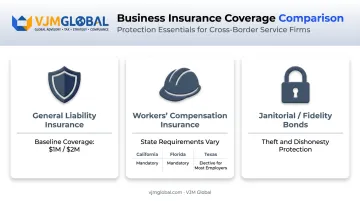
- General liability insurance – the most commonly required coverage, protecting against property damage or injury claims during a job. Most small businesses start around $1 million per occurrence / $2 million aggregate, a common baseline cited by commercial insurers
- Workers' compensation insurance – required once you hire employees in most states, though the trigger point varies by state:
| State | Requirement |
|---|---|
| California | Mandatory with 1 employee |
| Florida | Mandatory at 4 employees (non-construction) |
| Texas | Optional for private employers |
- Janitorial bonds (fidelity bonds) – protect clients against employee theft or dishonesty, and commercial clients frequently require them before signing a contract
For commercial and janitorial contract bids specifically, missing insurance or bonding documentation is often a faster disqualifier than missing a business license.
Frequently Asked Questions
Do cleaners need to be registered?
Individual cleaners typically don't need a personal license, but the cleaning business itself usually needs to be registered as a legal entity and hold any required local business license.
Do I need a license to start a cleaning business in Florida?
Florida doesn't require a state-level cleaning license, but a local business tax receipt from your county or city is generally required. Specialty services may need extra permits.
Do I need a license to clean houses in Oregon?
Oregon doesn't require a specific house-cleaning license, but business registration with the state and a local business license are typically necessary depending on your city.
How much does it cost to get a cleaning business license?
Costs vary by state and city. Expect business registration fees (often $70-$125 for an LLC), a free EIN, and local license fees that differ by jurisdiction. Always check your local government's fee schedule directly.
Do I need an LLC to start a cleaning business?
An LLC isn't mandatory, but it offers liability protection a sole proprietorship doesn't. This is worth considering given cleaning's on-site injury and property damage risks.
What is a janitorial bond and do I need one?
A janitorial bond protects clients against theft or damage caused by your employees. Many commercial clients require or strongly prefer one before signing a contract.