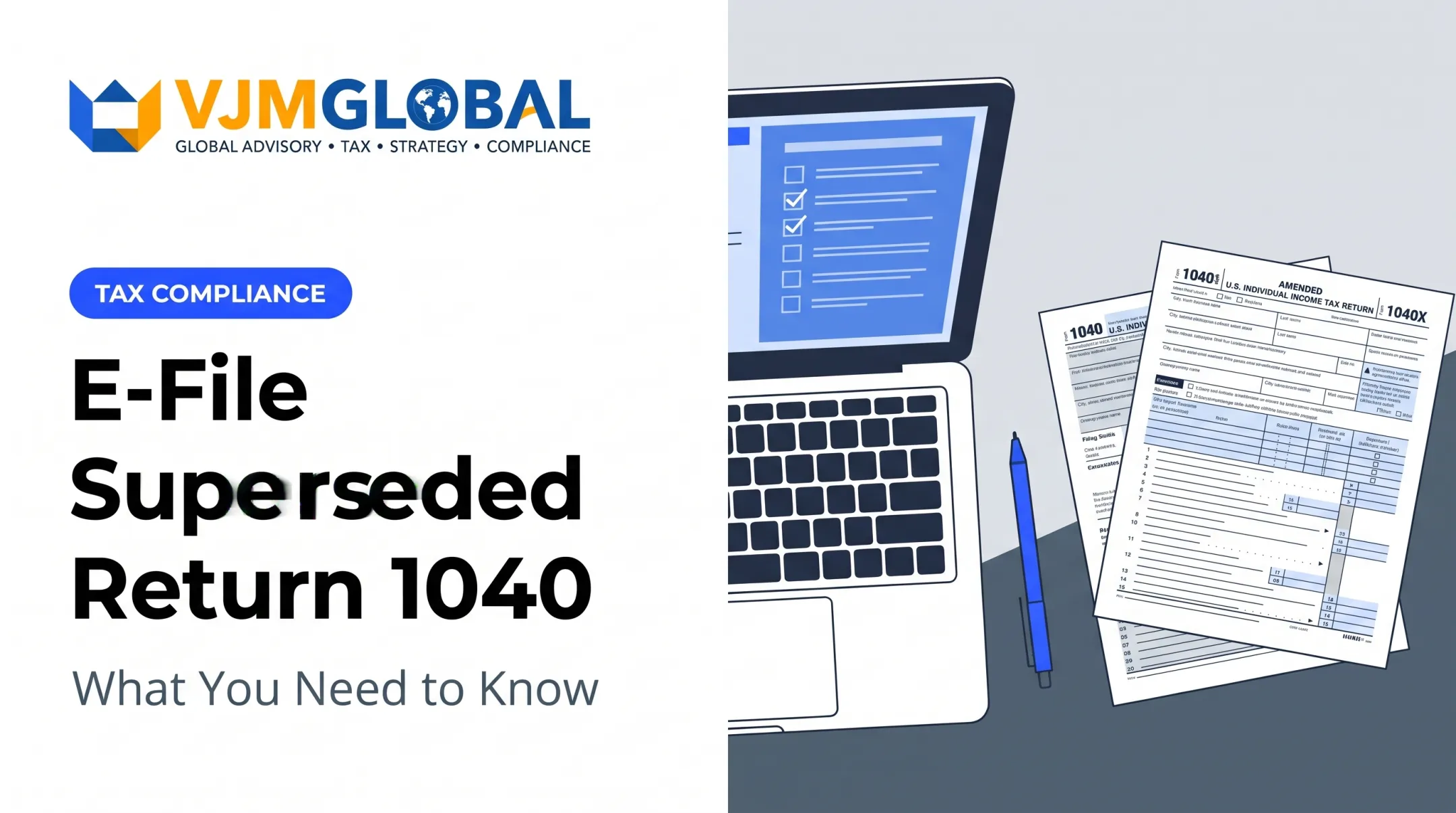
A superseding Form 1040 is a complete replacement return filed before the applicable deadline. It stands in for the original instead of being corrected later through the amended-return process.
Common triggers include late income documents, omitted foreign income, wrong deductions or credits, missing schedules, and filing-status decisions. This guide covers eligibility, the deadline, preparation, e-file and paper procedures, common errors, and when Form 1040-X is the better route. Always check the IRS instructions for your specific tax year.
Key Takeaways
- A superseding return replaces the original only if filed within the original or extended filing window.
- Send the entire Form 1040 package, including unchanged schedules.
- Some elections and filing-status changes have earlier deadlines.
- Federal changes don't update state, FBAR, Form 8938, or Australian filings.
- Keep transmission proof, acceptance records, and a full copy.
How to File a Superseding Form 1040
The Taxpayer Advocate Service describes a superseding return as a timely replacement whose changes relate back to the original. A Form 1040-X filed after the deadline instead modifies the original.
Step 1: Confirm the filing window is open
- Identify the tax year, regular due date, and any valid extension.
- For calendar-year returns, U.S. citizens and resident aliens abroad generally get an automatic extension from April 15 to June 15; Form 4868 can extend filing to October 15.
- Extensions to file don't extend the time to pay. Interest runs on tax unpaid after the regular due date.
- Confirm the original return was accepted. If it was rejected, you likely need to correct and resubmit it, not supersede it.
- Check whether your change involves an election or filing-status action with an earlier deadline.
Step 2: Prepare a complete corrected return
Rebuild the whole Form 1040 for the same year. Don't send only the changed pages.
- Gather the accepted original, corrected W-2s or 1099s, foreign income records, and deduction and credit documents.
- Add payment confirmations and extension evidence.
- Reconcile income, deductions, dependants, filing status, withholding, estimated payments, credits, foreign tax details, and carryovers against the original.
- Confirm the revised refund or balance due matches your corrected figures.
Step 3: Submit using an approved method
Electronic: Confirm your software or preparer supports superseding returns and follow its procedure for flagging the return. Vendors such as Intuit ProConnect and TaxSlayer Pro document support, often limited to the original filing period.
An ordinary second original return can be rejected as a duplicate. IRS materials do not clearly set a universal second e-file rule, so confirm the process with your provider.
Paper: Follow the current-year instructions for signatures, attachments, and any superseding notation.
For foreign-address filers, the IRS directs refund or no-payment returns to Austin, TX 73301-0215. Returns enclosing a payment go to IRS, P.O. Box 1303, Charlotte, NC 28201-1303. Use trackable delivery and keep a full copy.
Step 4: Confirm acceptance and coordinate related filings
- Save the transmission record and acceptance acknowledgement.
- Monitor IRS transcripts and notices. An acknowledgement isn't proof the account is fully updated.
- Review state returns, FBAR, Form 8938, foreign tax credit documentation, and your Australian return with any foreign income tax offset.
- A federal superseding return replaces none of these related filings.

When Should You File a Superseding Form 1040, and What Do You Need?
When it's usually appropriate
- You received a corrected information return.
- You found omitted income or deductions.
- A schedule was missing.
- Withholding or dependants were wrong.
- An election remains legally changeable.
The benefit is greatest when you want the corrected return to stand as the timely filing, not a later modification through Form 1040-X.
When it's unsuitable or higher risk
After the window closes, Form 1040-X or another IRS procedure generally applies. A second return doesn't extend refund-claim, assessment, payment, or penalty periods. According to the TAS, the original return, not a superseding return filed on extension, drives the statute of limitations calculations.
Get professional review for:
- Joint-to-separate or separate-to-joint changes
- Foreign tax credits or treaty positions
- Foreign earned income
- Large refunds
- Complex business income
- Changes affecting several states
Documents to prepare
- The accepted original return
- Revised source documents
- Foreign income and tax records
- Bank or payment confirmations
- Extension records
- Schedules, elections, and prior-year carryovers
Then build a change summary. For each item, record:
- Original amount
- Corrected amount
- Reason for the change
- Supporting document
- Effect on federal, state, and international filings
Software and compliance readiness
Check that your software or preparer supports the tax year, superseding procedures, required attachments, electronic signature authorisations, and foreign-address filing. Cross-border income, foreign accounts, or doubt about how the IRS will treat the filing all justify professional review. VJM Global's Form 1040 preparation follows IRS protocols for federal and state filings.
Key Parameters That Affect a Superseding Form 1040 Filing
Results depend on deadline status, the type of correction, package completeness, and related filings. Labelling a return "superseding" isn't enough.
Filing deadline and extension status
Check the regular due date, any valid extension, the actual acceptance date, and any earlier election deadline separately. Filing inside the window points to a full superseding return. Outside it, Form 1040-X is the likely route.
Nature of the change
Factual corrections are treated differently from filing-status changes and elections. Two examples:
- Joint to separate: Treasury Regulation 1.6013-1 bars a joint-to-separate switch after filing time expires. A return filed after the original due date but within an extension is not treated as superseding for this change.
- Foreign earned income exclusion: Elect on a timely return (including extensions) or on an amended return that amends a timely return. Late elections face narrower conditions.
So a timely superseding return may not be effective for every election.
Completeness and consistency
Recalculate the entire tax result and include every applicable schedule, even if most figures are unchanged. Reconcile income, withholding, payments, credits, carryovers, and the balance due or refund. That lowers duplicate-return and mismatch risk.

Federal, state, and cross-border coordination
State rules differ. They typically address federal changes through their own deadlines:
| State | Federal-change reporting rule |
|---|---|
| California | Notify FTB within six months of a final federal determination |
| New York | Report within 90 days, then file amended return within 90 days |
| Virginia | Amend within one year of final IRS determination |
These cover final federal determinations, not every superseding return. Check your state.
Also keep these separate:
- FBAR: due April 15, automatically extended to October 15.
- Form 8938: for taxpayers abroad, the single-filer threshold is more than $200,000 at year-end.
- Australian returns: the ATO generally allows two years to amend an assessment. The foreign income tax offset isn't the U.S. foreign tax credit.

Common Mistakes, Troubleshooting, and Alternatives
Common mistakes and early warning signs
- Filing after the deadline
- Submitting only changed pages or omitting schedules
- Leaving out foreign income or withholding
- Treating a transmission receipt as IRS acceptance
- Filing both a superseding return and Form 1040-X for the same issue without professional direction
- Assuming a federal correction amends state and Australian filings
Troubleshooting filing problems
If the submission is rejected as a duplicate, check:
- Was the original accepted?
- Did you use the correct superseding indicator and a complete return?
- What do your software's current rejection instructions say?
IRS code IND-452 means the primary SSN is already on an accepted return. That code alone does not mean a properly designated superseding return is invalid.
If the IRS account still shows the original, keep all acknowledgements, monitor transcripts and notices, and avoid unnecessary duplicate filings. Respond through the right IRS or professional channel.
Alternatives to a superseding return
Form 1040-X is the main route once the window closes. Report original amounts, corrected amounts, the difference, an explanation, and support. Use a separate form for each year. The IRS says to allow 8 to 12 weeks, sometimes up to 16, though the National Taxpayer Advocate reported 2025 averages above five months.

For refunds, the general claim period is the later of three years from filing or two years from payment. Foreign tax credit overpayments have a special ten-year period, but that isn't a general extension.
A rejected original needs correcting and resubmitting. State returns and Australian filings each follow their own amendment procedures, separate from the federal superseding process.
Conclusion
A superseding Form 1040 works best when the filing window is still open, the replacement is complete, and every changed figure is reconciled.
- The filing date determines whether the return can replace the original.
- Most problems come from incomplete packages, wrong deadline assumptions, or mixing up federal and international filings.
- The safest approach combines timely submission, solid documentation, acceptance monitoring, and review of state and Australian tax effects.
VJM Global assists Australia-based taxpayers and other cross-border filers with Form 1040 preparation, superseding-return review, and Form 1040-X support when U.S. compliance gets complex.
Frequently Asked Questions
What is a superseding tax return?
It's a complete replacement return filed within the permitted filing period. Unlike a later amended return, its changes relate back to the original.
What is the primary difference between a superseding return and an amended return?
Timing and form. A superseding Form 1040 is filed by the original or extended deadline and replaces the original. A Form 1040-X comes after and modifies it.
Can a superseding Form 1040 be filed electronically?
Sometimes, if your software or provider supports it. Confirm the current procedure and keep the acceptance record.
Can I amend my tax return if I've already received my refund?
Yes. A refund or processed return doesn't by itself bar Form 1040-X, but eligibility, deadlines, and the type of correction still need review.
When should I file a superseding Form 1040?
File the complete corrected return before the applicable original or extended deadline. Elections and filing-status changes may have earlier limits.
What happens if I file a superseding return after the deadline?
It may be treated as an amended-return matter or rejected as a duplicate. Form 1040-X is generally the right route after the window closes.