For Australian-based taxpayers, the answer is usually simple. Form 1040-V travels with a mailed cheque or money order. Pay electronically and you generally skip the voucher altogether.
This guide covers who needs the voucher, how to complete it line by line, payment options from Australia, mailing, deadlines and common mistakes.
Key Takeaways
- Form 1040-V is a payment voucher, not a return and not a payment.
- It goes with a cheque or money order for a balance due on Form 1040, 1040-SR or 1040-NR.
- Pay online and you generally don't complete it.
- Confirm the address, deadlines and currency rules on IRS.gov before paying.
What Is Form 1040-V and When Do You Need It?
What Form 1040-V does
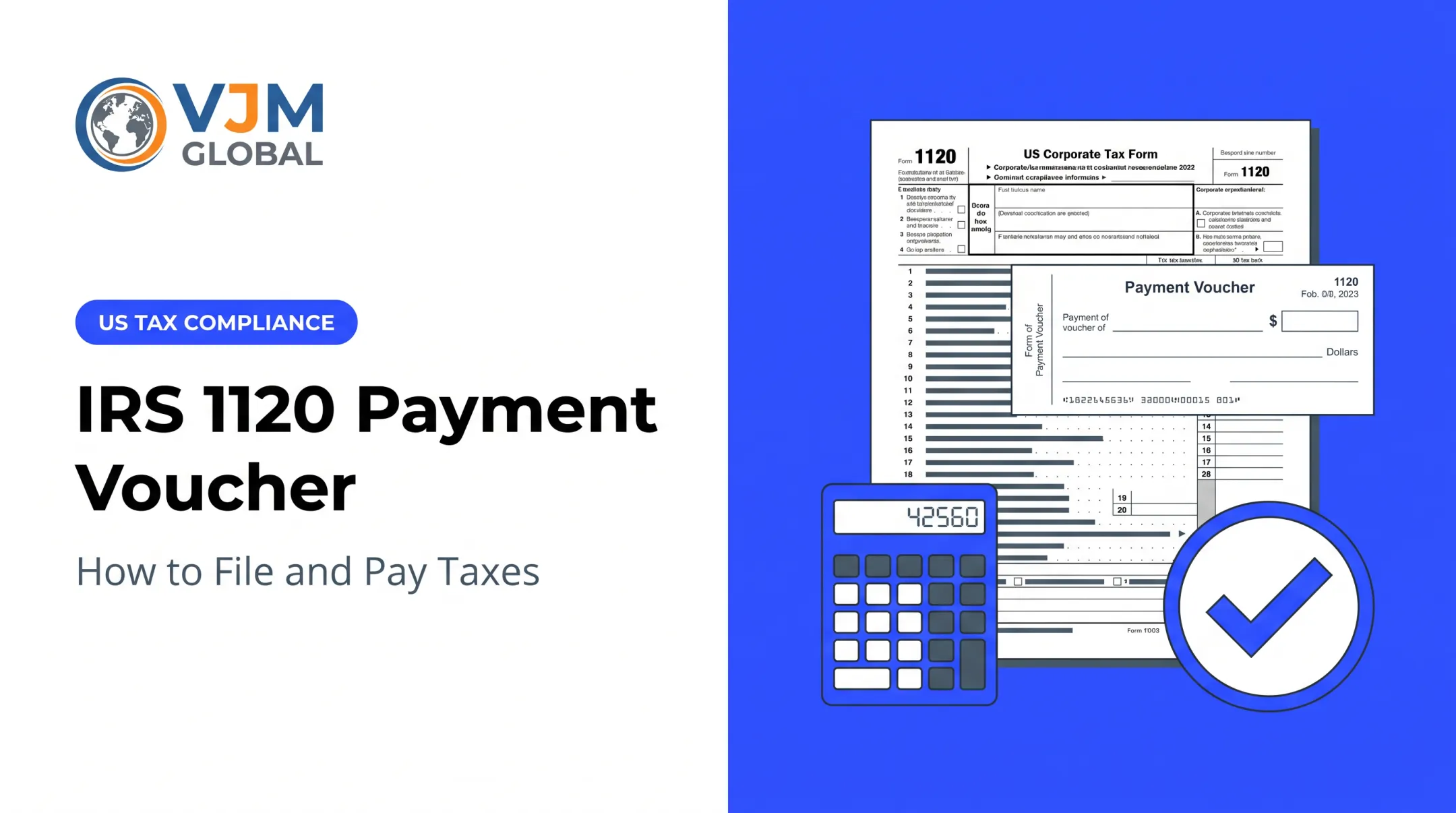
Form 1040-V is a slip that tells the IRS whose mailed payment it is holding. It links the payment to your name, tax identifier and tax year.
It doesn't calculate tax, doesn't replace your return, and can't be submitted without the cheque or money order.
When you need it, and when you don't
You generally need the voucher when your return shows an amount owing and you're paying by cheque or money order. The IRS describes it as a statement you send with your payment for the "Amount you owe" line on Forms 1040, 1040-SR or 1040-NR. The current Form 1040-V download is the 2025 version.
Skip it when:
- You pay through an eligible electronic method (the form itself says not to complete it for online payments)
- Your return shows a refund or zero balance
- No payment accompanies the return
Form 1040 versus related forms
| Form | Purpose |
|---|---|
| Form 1040 | Reports income, deductions, credits, tax and the balance |
| Form 1040-V | Identifies a mailed payment for that balance |
| Form 1040-ES | Figures and pays estimated tax |
| Form 1040-X | Amends a previously filed return |
Form 1040-NR is the return for non-resident aliens with US-sourced income, and it uses the same voucher when paying by cheque.
How to Complete Form 1040-V
Check the return first
Before writing anything, confirm the tax year, return type, amount due and the SSN or ITIN on the return. Confirm you're paying by cheque or money order.
Fill in the four lines
- Line 1: Your SSN, or ITIN where an SSN is requested. On a joint return, use the number that appears first.
- Line 2: The spouse's SSN or ITIN on a joint return, the one appearing second.
- Line 3: The amount you're paying by cheque or money order.
- Line 4: Your name and address exactly as shown on the return, including your spouse's name on a joint return.
The amount on Line 3 must match the enclosed payment. Check the figures against the numerals and words on the cheque. Watch for transposed digits, misplaced decimals, or a balance copied from another year.
Australian addresses
The 2025 Form 1040 instructions ask for the city on its own line, with separate fields for country, state or province, and postal code. Enter "Australia" in full; don't abbreviate the country name.
If you move after filing, don't alter the voucher. Use Form 8822 instead; the IRS generally takes 4-6 weeks to process it.

Final check
- Correct tax year and return type
- SSN or ITIN (and spouse's, if joint)
- Payment amount matches the cheque
- Name and address match the return
- Downloaded fresh from IRS.gov, not an old saved copy
How to Pay Your Balance from Australia
Direct Pay and bank options
IRS Direct Pay requires a domestic bank account and a US ABA routing number. An ordinary Australian account won't work. If you have access through a US account, save the confirmation number so you can look up, change or cancel the payment.
An international wire is available from a foreign bank without a US bank account. The payment must be in US dollars, and fees may apply.
Complete the Same-Day Taxpayer Payment Worksheet with the correct tax-type code and period, then give it to your bank. Your bank also needs a relationship with a US bank.
Card payments
IRS guidance permits a foreign-bank credit card if an IRS processor accepts it. Processor fees (IRS schedule, in US dollars) are:
| Processor | Debit | Consumer credit |
|---|---|---|
| Pay1040 | $2.15 | 1.75% ($2.50 minimum) |
| ACI Payments | $2.10 | 1.85% ($2.50 minimum) |
Your bank may add currency conversion charges. The IRS allows up to two card payments per year for each Form 1040 category.
EFTPS
EFTPS is closed to new individual enrolments, though existing users may continue for now. Don't plan around it.
Practical considerations
- Check your bank's transfer limits and international fees
- Pay in US dollars and expect conversion costs
- Keep the confirmation number, date, amount, tax year and bank or card record

Electronic payment or mail?
| Factor | Electronic | Cheque with 1040-V |
|---|---|---|
| Speed | Bank payments appear in your IRS Online Account immediately | Can take up to three weeks to appear |
| Fees | Processor or bank fees | US-dollar cheque or draft cost, plus postage |
| Proof | Instant confirmation | Postal receipt only |
| Risk | Low | International mail delays |
When the deadline is close, electronic payment is usually safer. If you want a second pair of eyes on a US balance or broader US tax compliance, VJM Global's tax and accounting professionals can review your position.
How to Mail Form 1040-V and Your Payment
Prepare the payment
- Make it payable to "United States Treasury"
- Write your SSN or ITIN, daytime phone number, and "2025 Form 1040" (or 1040-SR / 1040-NR) on it
- Write the amount clearly as $XXX.XX
- Never send cash
- Don't staple or clip the voucher to the payment or return; enclose them loose
Currency matters. Publication 54 states that only US currency is generally acceptable. Treasury rules allow cheques drawn on US-incorporated institutions and collectable at par. An Australian-dollar cheque may be rejected or delayed.
Mailing address
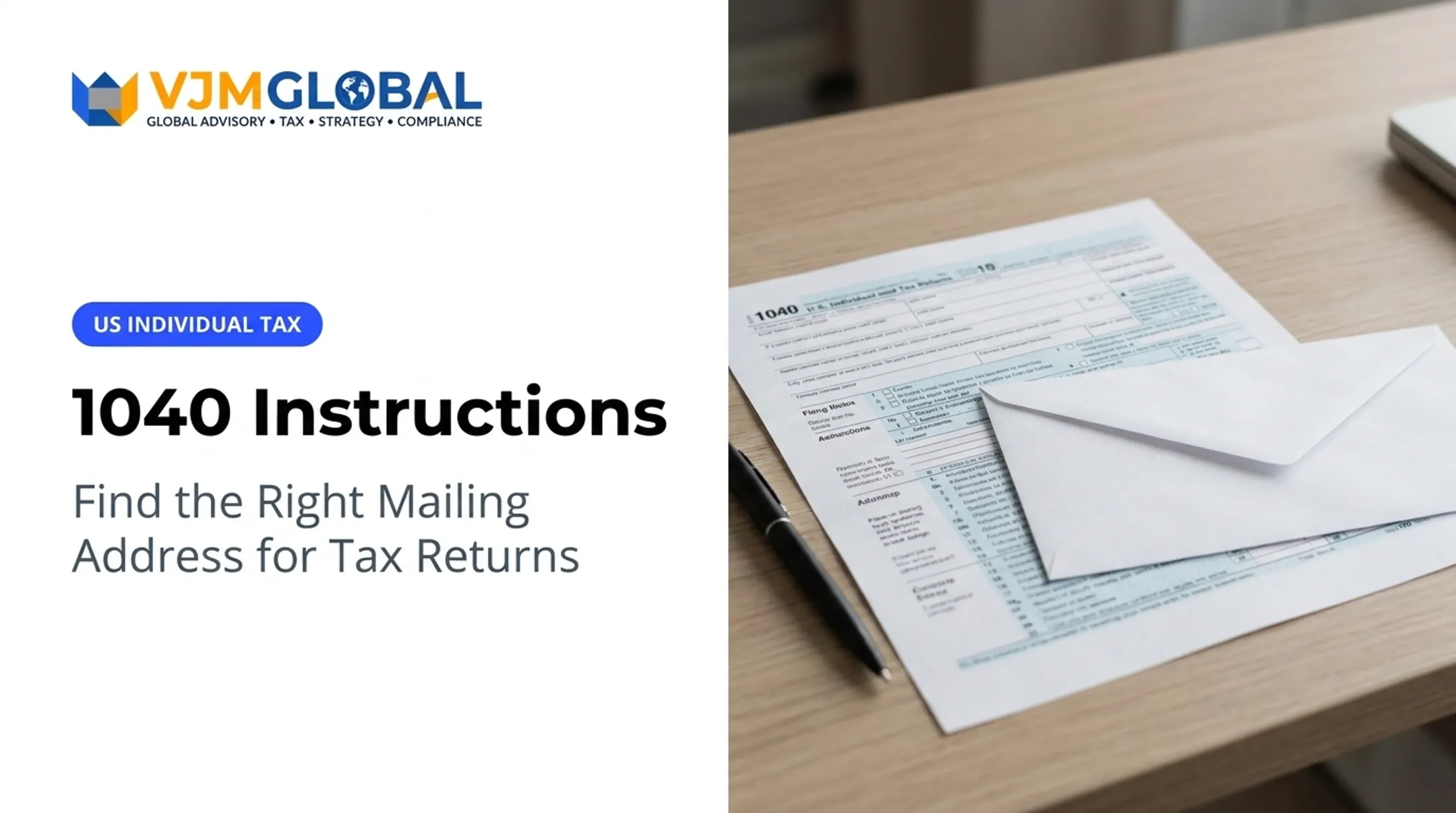
For a payment sent from Australia (or any country outside the US), use:
Internal Revenue Service
P.O. Box 1303
Charlotte, NC 28201-1303
USA
Don't swap in the no-payment return address. Recheck the IRS "Where to File" page right before posting.
Delivery and evidence
Use regular mail when sending Form 1040-V with payment.
Private couriers such as DHL Express Worldwide, FedEx International Priority and UPS Worldwide Express only qualify for timely-mailing treatment if they appear on the IRS list. Those services also deliver to separate street addresses, not the P.O. Box above.
Australia Post lists International Express at 3–6 business days with tracking, and Economy Air at 15+ business days with no tracking. These are general estimates and exclude customs.
Keep copies of:
- The voucher and the cheque
- The envelope and postal receipt
- Any tracking details
Deadlines, Processing and Common Mistakes
Payment deadlines
For 2025 returns, the ordinary deadline was 15 April 2026. Qualifying US citizens and resident aliens living abroad get an automatic extension to 15 June 2026 to file and pay. Interest still runs from the regular due date, per Publication 54.
Form 4868 can extend filing to 15 October 2026, but it does not extend payment further.

Current IRS charges:
- Underpayment interest: 7% a year, compounded daily, for Q4 2026
- Failure to pay: 0.5% per month, up to 25%
- Failure to file: 5% per month, up to 25%
Mistakes that delay crediting
- Wrong tax year
- Incorrect SSN or ITIN
- Voucher and cheque amounts that differ
- Outdated mailing address
- Missing identifying details on the cheque
- Voucher sent without the payment
A cheque can take up to three weeks to show in your online account. If it still can't be located, contact the IRS or a tax professional. The IRS offers overseas help on +1 267-941-1000.
If you can't pay in full
File on time and pay what you can. Don't ignore the balance. According to the IRS payment plans page:
- Short-term: owe under $100,000, pay within 180 days, $0 setup fee
- Long-term, direct debit: owe $50,000 or less, $29 online setup
- Long-term, other methods: $69 online setup
Interest and penalties continue until you pay in full. If you can't apply online, use Form 9465. Confirm with the IRS whether online setup is available when you file from Australia.
Frequently Asked Questions
What is Form 1040?
It is the main US individual income tax return. It reports income, deductions, credits, tax liability and any refund or balance due.
What is a 1040-V form used for?
It's a payment voucher sent with a cheque or money order for a balance due on Form 1040, 1040-SR or 1040-NR.
What's the difference between Form 1040 and Form 1040-V?
Form 1040 calculates your tax. Form 1040-V only helps the IRS identify and process a mailed payment.
Do I need to send my Form 1040 with Form 1040-V?
For an original paper return, mail the return, payment and voucher loose together. If you already e-filed, there's no need to mail the return again.
Can I pay the amount on Form 1040-V online?
You don't pay the voucher itself online. You pay the underlying balance through an eligible IRS electronic method, and then you don't complete the voucher.